
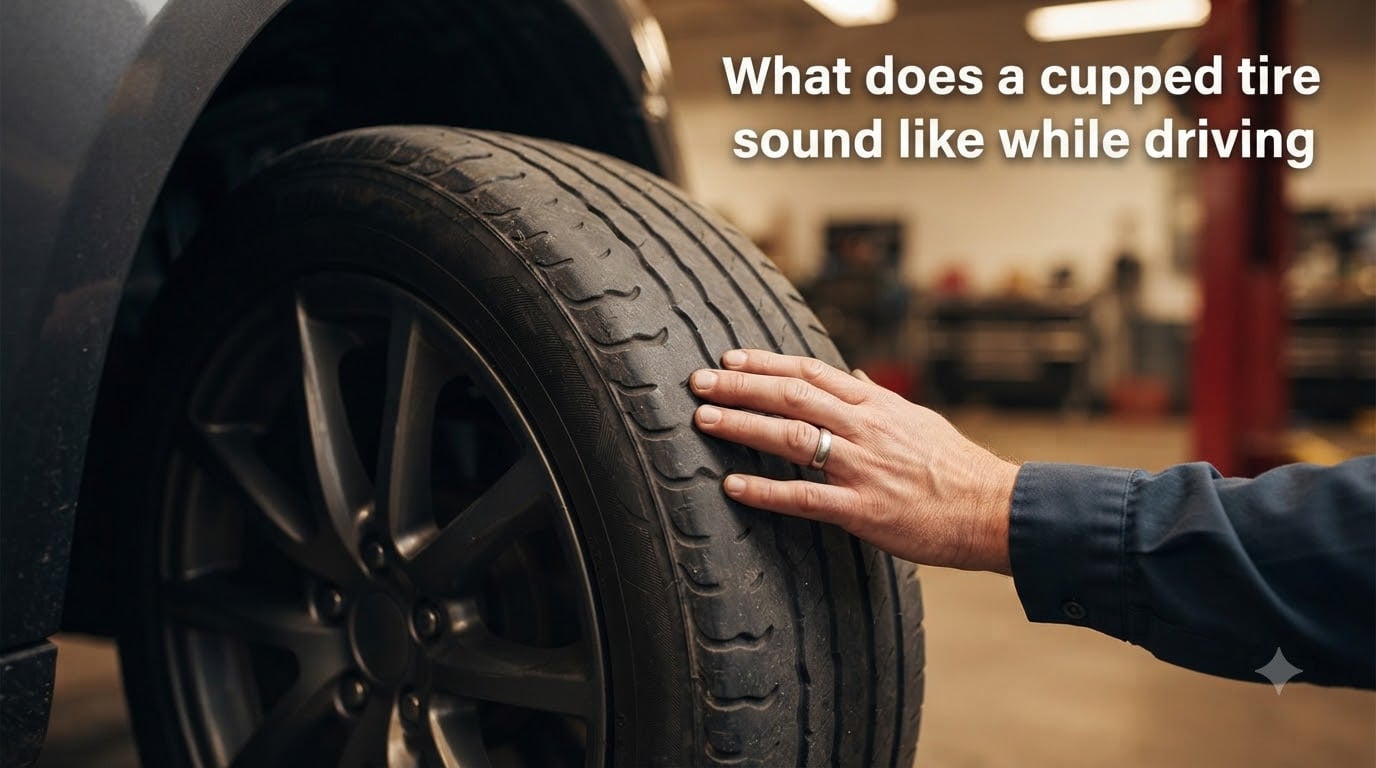
A cupped tire sounds like a rhythmic whop whop or womp womp noise that matches your wheel’s rotation speed. The pitch climbs as you accelerate, the volume gets louder on rougher pavement, and you usually feel vibration through the steering wheel or seat at the same time. The sound is your tire briefly leaving and re-contacting the road on worn or misaligned suspension, so the noise is a symptom — not the problem itself.
If you’ve been searching for what does a cupped tire sound like while driving, that description above is the short answer. Below I’ll walk you through exactly how the noise evolves at different speeds, how to tell it apart from a bad wheel bearing, what’s actually causing it, and when you need to head to a shop.
Table of Contents
What a Cupped Tire Sounds Like While Driving
The signature sound of tire cupping is a repeating low-frequency thump or hum that pulses in step with the wheel. Drivers describe it as whop whop, womp womp, or sometimes a rhythmic growl — and the rhythm is the key clue. It is not a steady hiss from the road surface; it’s a discrete beat per tire revolution.
As speed increases, each beat comes faster and the pitch rises. The volume also climbs, often turning into a roar on the highway. On smooth asphalt the noise can be subtle; on grooved concrete or rough chip-seal it becomes almost impossible to ignore.
Two things make the sound specifically cupping instead of a generic tire noise. First, it survives a tire rotation — if you swap the noisy tire to the rear and the noise follows the tire, the rubber itself is the source. Second, the noise is usually accompanied by vibration through the steering wheel (front) or the floor/seat (rear) at the same pulse rate.
Why a Cupped Tire Makes This Sound
When a tire loses steady contact with the road — usually because a worn shock or strut can’t keep the tire planted — it hops a fraction of an inch with every rotation. Each hop wears a small scooped divot into the tread. As the tire spins, those divots tap the pavement one after another, producing the rhythmic noise.
The repetition rate is directly tied to wheel rotation. At 30 mph, a typical passenger tire makes about 12 revolutions per second, so the whop-whop cycle is roughly that fast. At 60 mph the cycle doubles, which is why the noise turns into a higher-pitched roar.
Speed-by-Speed Sound Guide: 30, 45, and Highway Speeds
No two drivers describe cupped tire noise the same way — partly because the sound actually changes character with speed. Here’s how it typically evolves behind the wheel.
Around 30 mph (City Streets)
This is where cupped tire noise is loudest and most obvious. You’ll hear a distinct rhythmic whop whop — often described as a flat, low-frequency thump. The beat is slow enough that you can clearly count each rotation in your head.
Vibration is usually mild at this speed and may only show up in the steering wheel if the front tires are cupped. On a smooth street the noise can fade into background road rumble; pull onto a rougher patch and it jumps right back out.
Around 45 mph (Suburban Cruising)
The beats merge into a continuous hum or growl. Drivers often describe this as a droning sound that vibrates the seat or floorboard. The rhythmic component is still there, but the pulses are close enough together that your ear hears a tone rather than discrete beats.
This is the speed where most people first decide something is wrong and start Googling. The tire noise is louder than typical road noise but quieter than a bad wheel bearing — which makes cupping the most likely culprit.
Highway Speeds (60 mph and Up)
The hum turns into a full roar. The pitch climbs with speed, and the noise becomes more broadband — less of a clean tone, more of a sustained growl that you feel as much as hear.
At highway speeds, cupped tire noise and bad wheel bearing noise start to sound similar. That’s why the next section on diagnosing the difference matters: at 65 mph they can fool even experienced mechanics.
| Speed | What You Hear | What You Feel |
|---|---|---|
| 30 mph | Rhythmic whop whop, slow thumps | Mild steering vibration on rough pavement |
| 45 mph | Humm or growl, fast pulses blend | Seat or floor vibration |
| 60+ mph | Roaring, higher-pitched growl | Strong steering or cabin vibration |
Other Symptoms You Feel Behind the Wheel
The sound is the loudest symptom, but cupping almost never travels alone. If your tires are cupped, you’re likely to notice one or more of these signs at the same time.
- Steering wheel vibration — most noticeable from 35 to 55 mph, especially if the front tires are cupped.
- Seat or floor vibration — points to cupped rear tires or a tire that’s badly out of balance.
- Pulling to one side — often caused by the camber or toe misalignment that created the cupping in the first place.
- Reduced wet traction — cupped sections don’t channel water like healthy tread, so the tire hydroplanes earlier than it should.
- Tire noise that comes and goes with the road surface — louder on grooved concrete, quieter on freshly laid asphalt.
Drivers on forums often describe the moment they knew it wasn’t normal road noise: the noise was still there at a steady throttle on a smooth road. Steady-state noise on a smooth road is the single most reliable sign that the noise is mechanical, not road-related.
What Causes Cupped Tires
Cupping is almost always a symptom of something else. The tire itself is fine when new — the wear pattern is being carved into it by an underlying issue that prevents even contact with the road.
Worn Shocks or Struts
The most common cause. When a shock or strut can no longer control the spring’s movement, the tire bounces off the road between rotations and the impact chips the tread. Reviewers and forum owners both report that replacing the worn suspension and then installing new tires is the only way to stop the cycle.
Wheel Misalignment (Camber or Toe)
If camber is off, the tire leans into or away from the road and wears more on one edge — producing a cup that runs diagonally across the tread block. Toe misalignment wears the tire feathered across its face. Either condition concentrates load on a small patch and produces cupping within a few thousand miles.
Unbalanced Tires
A tire that hasn’t been balanced will hop slightly at high speed. Over thousands of miles, the hop pattern wears divots into the tread. This kind of cupping is usually evenly spaced and often disappears after a balance and rotation.
Bent or Damaged Rims
Hitting a pothole or curb hard enough to bend a rim leaves a high spot on the tire’s contact patch. Each revolution taps that high spot against the road, producing both vibration and localized cupping.
Worn Suspension Bushings or Control Arms
Loose bushings and worn control arm joints let the wheel wander slightly under load. The wandering wears the tire unevenly, the same way misalignment does.
Cupped Tire Sound vs Bad Wheel Bearing Sound
These two noises get mixed up constantly, and for good reason — at highway speed they sound nearly identical to the untrained ear. The good news is they behave very differently on a road test.
| Clue | Cupped Tire | Bad Wheel Bearing |
|---|---|---|
| Sound type | Rhythmic thump at wheel rotation | Continuous hum or growl |
| Pitch changes with speed? | Yes, climbs with mph | Yes, climbs with mph |
| Changes when turning? | Usually no | Yes — louder or quiets on a turn |
| Changes with road surface? | Yes — louder on rough pavement | No — independent of surface |
| Vibration source | Tire (through steering or seat) | Hubs (felt through floor, follows the bad corner) |
| Follows a tire rotation? | Yes — moves with the tire | No — stays on the same corner |
| Disappears at low speed? | Often still audible below 25 mph | Often quiet below 25 mph |
The single best road test: drive at about 35 mph in a quiet parking lot and gently swerve left and right. If the noise gets louder on one side and quieter on the other, suspect a wheel bearing. If the noise stays the same through both turns, it’s almost always the tire.
Other Sounds That Mimic Cupping
Three other noises show up in the same speed range and can fool a careful listener.
- CV axle click — only happens under hard acceleration or in tight turns, not at steady throttle.
- Brake dust shield rattle — a metallic scraping that comes and goes with braking, not with speed.
- Stuck brake caliper — produces a constant drag and one-sided pull, not a rhythmic thump.
If your noise is a steady rhythmic beat tied to wheel rotation, cupping is by far the most likely cause.
How to Confirm It’s Tire Cupping (3-Step Check)
Sound alone gets you 80 percent of the way there. These three quick checks confirm the diagnosis without pulling the tire off the car.
Step 1: Look at the Tread Pattern
Cupped tires have a scalloped edge — alternating high and low spots running around the circumference. The pattern usually shows up first on the inside shoulder (if camber is off) or evenly across the tread (if the issue is balance or a worn shock). Inspect the tire while it’s still on the car, with the wheel turned to one side so you can see the tread face.
Step 2: Run Your Hand Across the Tread
With the tire off the ground (loosen the lugs first, then jack the car safely), run your palm across the tread in the direction of rotation. A healthy tire feels smooth. A cupped tire feels like a series of small ridges and valleys — almost like a washboard.
Step 3: Do a Lane-Change Test
At about 35 mph, perform a smooth lane change in both directions. A cupped tire noise stays steady through the maneuver because the wear pattern moves with the wheel. A wheel bearing noise changes volume — louder when load shifts onto the bad bearing, quieter when load shifts off.
If all three checks line up, you have tire cupping and an underlying suspension, alignment, or balance problem to chase down.
Is It Safe to Drive on Cupped Tires
Yes, in the short term — but only carefully. Cupped tires are not an immediate roadside emergency. The rubber is still holding air, the structure is intact, and the car still steers and brakes. You can drive to a shop, to work, or to get the tires replaced without drama.
The risk grows the longer you wait. Cupped sections don’t grip the road as well as healthy tread, so wet stopping distances get longer and the tire hydroplanes earlier. The vibration also loads up suspension components and can accelerate wear on the parts that caused the cupping in the first place.
As a rule of thumb: drive gently, avoid highway speeds if the vibration is severe, and book a shop visit within the week. If the tire is also visibly chunking — pieces of rubber missing from the tread — replace it sooner rather than later.
Will Cupped Tires Fix Themselves
No. Once the divots are worn into the tread, the only way to remove them is to wear the rest of the tire down to the same depth — at which point the tire is bald and unsafe. A new set of tires on a car with the original alignment or suspension problem will simply cup again, often within 10,000 to 15,000 miles.
This is the trap that catches a lot of first-time owners: they buy new tires, the noise goes away for a few thousand miles, and then the cupping pattern returns. The pattern came back because the underlying cause never got fixed.
How to Fix and Prevent Cupped Tires
Fixing cupping means fixing the cause, then dealing with the worn tires. A typical sequence looks like this.
Step 1: Diagnose the Root Cause
Start with a four-wheel alignment check. If the alignment is in spec, have the suspension inspected for worn shocks, struts, bushings, and control arm joints. If both come back clean, check the rims for bends and the tires for balance.
Step 2: Repair the Cause
Replace any worn suspension parts and correct any alignment issues before mounting new tires. Putting new rubber on a car with the original problem just resets the clock.
Step 3: Replace or Rotate the Cupped Tires
Light cupping on rear tires sometimes rotates to the front and continues to be usable. Heavy cupping, especially on front tires, calls for replacement. After the new tires are mounted, balance them immediately.
Prevention Checklist
- Rotate tires every 5,000 to 7,500 miles.
- Balance tires every other rotation or at the first sign of vibration.
- Get a four-wheel alignment once a year or after any pothole / curb impact.
- Check tire pressure monthly — under-inflation and over-inflation both wear tires unevenly.
- Inspect suspension components at every other oil change.
None of these steps take long, and together they prevent cupping from coming back on the next set of tires.
Frequently Asked Questions
What does a cupped tire sound like while driving?
A cupped tire produces a rhythmic whop whop or womp womp noise that pulses in step with the wheel. The pitch climbs as speed increases, the volume rises on rougher pavement, and you usually feel matching vibration in the steering wheel or seat.
How do you tell if your tires are cupped?
Look for scalloped edges on the tread, run your hand across the tire to feel for ridges and valleys, and do a lane-change test at 35 mph. A cupped tire produces a rhythmic noise that stays steady through a turn, while a wheel bearing noise changes volume.
Is it okay to drive with cupped tires?
Yes, for short trips and at moderate speeds, but the tires wear faster, lose wet traction, and add stress to suspension parts. Get a shop diagnosis within the week, and replace any tire with visible chunking sooner.
Will cupped tires fix themselves?
No. The divots are permanent wear and will not smooth out. New tires mounted without fixing the underlying cause will cup again in roughly 10,000 to 15,000 miles.
What is the difference between cupped tires and a bad wheel bearing sound?
Cupped tires produce a rhythmic thump tied to wheel rotation that stays steady through turns and louder on rougher pavement. A bad wheel bearing produces a continuous hum that gets louder or quieter when you turn and stays the same regardless of road surface.
Why is my tire making a womp womp sound?
A womp womp sound that matches wheel rotation is almost always tire cupping. The tire is briefly leaving and re-contacting the road because of worn suspension, misalignment, imbalance, or a bent rim, and each re-contact produces the beat.
Why is my car making a whoop-woop noise?
A whoop-woop noise that rises with speed is most often cupped tire noise. Confirm by checking the tread visually, feeling for ridges across the tire, and rotating the suspected tire to the rear — if the noise follows the tire, the rubber is the source.
Bottom Line
If you’ve been wondering what does a cupped tire sound like while driving, listen for a rhythmic whop whop or womp womp tied to wheel rotation that gets louder as speed climbs. That sound, plus a quick visual and tactile check of the tread, almost always points to tire cupping caused by worn suspension, misalignment, imbalance, or a bent rim.
Cupping is not the disease — it’s the messenger. Fix the underlying cause first, then replace the worn tires, and follow a simple rotation, balance, and alignment cadence to keep the next set from cupping the same way.