
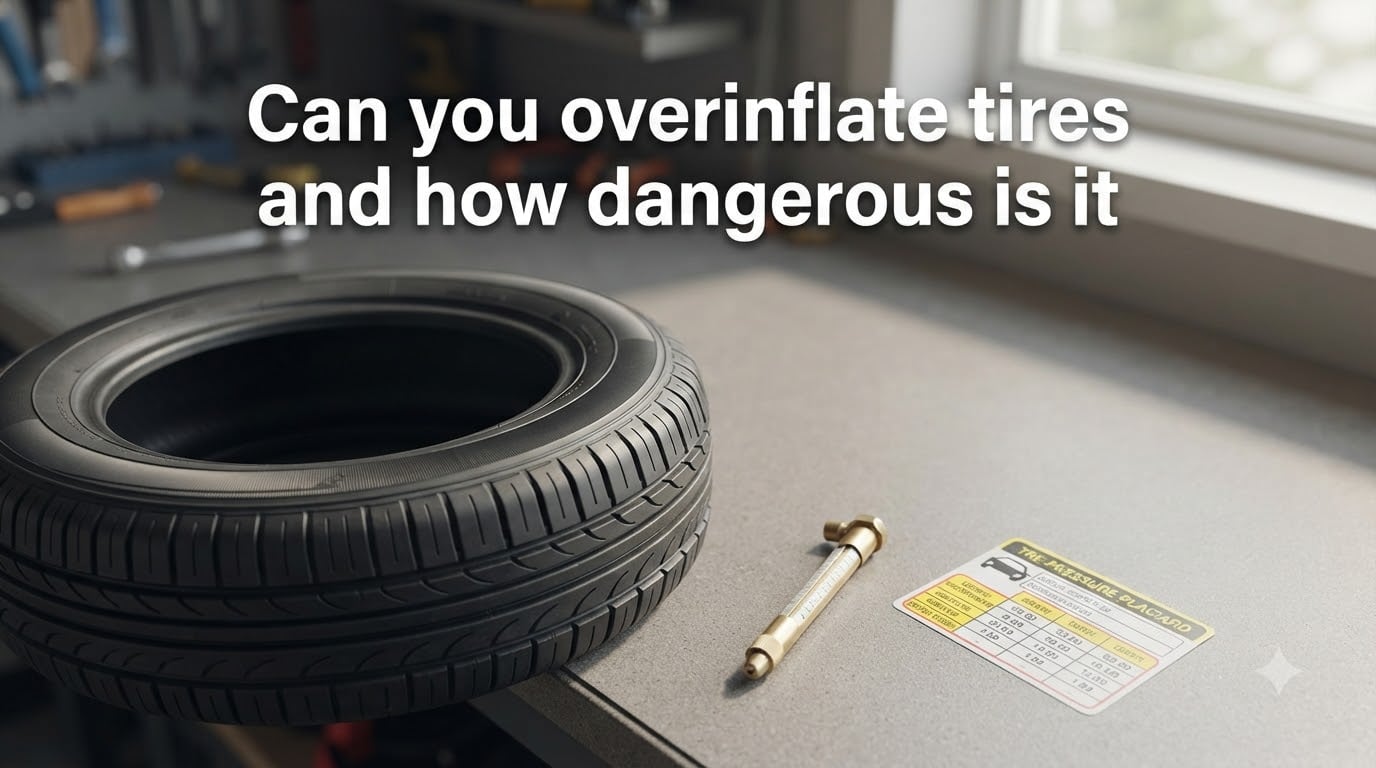
Yes, you can overinflate tires, and it is genuinely dangerous. An overinflated tire bulges in the middle, so only the center tread touches the road. That shrinks the contact patch, reduces grip, lengthens braking distance, wears the tread out early, and makes a pothole strike far more likely to trigger a blowout. Most passenger cars run 30 to 35 PSI on the door-jamb placard; anything 5 PSI or more above that range puts you in the danger zone.
I have been running tires through pressure tests for years, and the single most common mistake I see is drivers treating the big “MAX PSI” number on the sidewall like a target. It is not. That number is a structural ceiling, not a recommendation. In this guide, I will walk you through exactly what overinflation does, the six warning signs to watch for, and the safe way to let air out if you have already gone too far.
Table of Contents
What Does It Mean to Overinflate Tires?
Overinflation means the air pressure inside your tires is higher than the pressure the vehicle manufacturer recommends for your specific car. That recommended PSI lives on a yellow sticker on the driver-side door jamb, not on the tire itself.
When a tire holds more air than it should, it pushes outward harder than the sidewall is designed to flex. The center of the tread carries the load and the edges lift slightly off the road. Mechanics call the small footprint where rubber meets asphalt the “contact patch,” and overinflation makes that patch smaller and rounder instead of flat and wide.
Three terms matter here:
- PSI means pounds per square inch, the unit your gauge reads.
- Cold tire pressure is the reading taken before the car has been driven, when ambient and tire temperatures match.
- Maximum inflation pressure is the highest safe pressure the tire itself can hold under its maximum load. It is printed on the sidewall and is not your target.
Pressure is also affected by temperature. As a rule of thumb, tire pressure rises or falls about 1 PSI for every 10 degree Fahrenheit change in air temperature. That is why a tire filled to 35 PSI on a cool morning can read 39 PSI after a long highway drive in summer.
6 Symptoms of Overinflated Tires
You do not always need a gauge to spot overinflation. These are the six signs I check first, in order from easiest to notice to most subtle:
- The middle of the tread wears faster than the edges. This is the classic fingerprint. Look at the tire straight-on; if the center ribs sit below the shoulders, you have been overinflated for a while.
- The ride feels harsh or bouncy. An overinflated tire transmits bumps straight into the cabin. If your daily commute suddenly feels like a bucking bronco ride, pressure is the first thing to check.
- The sidewall looks rounded and tight. A properly inflated tire bulges gently. An overinflated one looks balloon-like, with little to no visible flex in the sidewall.
- Braking feels off, especially in the wet. Overinflation reduces grip. Stopping distances get longer and the car may feel skittish on painted lines or in rain.
- The center tread looks shiny and smooth compared to the shoulders, even when the shoulders still have good depth.
- Visible impact damage or bulges after hitting potholes or curbs, because the stiff, under-flexing tire cannot absorb the energy.
If you spot two or more of these, your tires are almost certainly overinflated. A 30-second gauge check confirms it.
How Dangerous Are Overinflated Tires?
Short answer: yes, they are dangerous, especially above 5 PSI over your placard pressure. The risks stack on top of each other the longer you drive on them.
Reduced traction and longer braking distance. The smaller contact patch means less rubber gripping the road. On dry pavement you may not notice much. In the wet, hydroplaning becomes easier, and emergency stops take noticeably longer.
Uneven, premature wear. The center tread eats itself while the shoulders sit nearly idle. Tires that should last 50,000 miles can be done at 25,000, and you usually do not realize it until the tires start slipping in the rain.
Blowout risk from impacts. An overinflated tire is stiff. When it slams into a pothole or a chunk of debris, the sidewall cannot flex to absorb the hit, so the impact energy turns into a sudden failure. This is one of the leading causes of highway blowouts on hot days.
A harsher, less controlled ride. Overinflation makes the suspension work harder over bumps. Passengers feel more road shock, and the car can skip or skip-light over uneven pavement, which makes lane changes and evasive maneuvers harder.
Lower fuel economy in some cases. Counter-intuitive, but research from tire makers and the U.S. Department of Energy shows rolling resistance does not keep dropping as pressure rises past the optimum. Push too high and you actually start to lose fuel efficiency, while also wrecking your tires.
Range loss on EVs. Electric vehicles are heavier than comparable gas cars, and overinflation on an EV is a double hit: range drops slightly because rolling resistance shifts out of the efficient zone, and the heavier vehicle makes blowout risk from impacts worse.
Recommended PSI vs. Max PSI on the Sidewall
This is the single biggest source of confusion I see, and the source of most accidental overinflation.
| Number | Where to Find It | What It Means |
|---|---|---|
| Recommended PSI | Driver-side door-jamb sticker (yellow/white placard) | The pressure the vehicle’s manufacturer says is optimal for that specific car, tuned for ride, handling, braking, and fuel economy. |
| Max PSI | Molded into the tire sidewall (e.g., “MAX PRESS 51 PSI” or “MAX LOAD 850 kg”) | The maximum pressure the tire can safely hold when carrying its maximum rated load. Not a target. |
| Front vs. Rear | Same door-jamb placard | Many cars run different pressures front and rear. Always match the per-axle number, not a single global PSI. |
If your door-jamb sticker says 32 PSI front and 30 PSI rear, that is your target. If your tire sidewall says 51 PSI max, that is the line you never cross, not the line you aim for. Inflate to the placard, not the sidewall.
Common Causes of Overinflation
Most overinflated tires are not intentional. Here are the five scenarios I see over and over:
- Gas station air machines. Many digital inflators are inaccurate by 2 to 4 PSI. Add a tired driver eyeballing the readout and you can easily walk away 5 PSI over.
- Tire shops filling to sidewall pressure. Some shops, especially busy chains, default to a single setting that drifts toward the sidewall max.
- Checking pressure when tires are hot. A 30-mile drive adds 3 to 5 PSI. Inflating to “placard” on hot tires pushes you 4 to 6 PSI over once they cool.
- Hot weather spikes. A 20 degree temperature swing can add 2 PSI on its own, turning a 33 PSI morning reading into a 35 PSI midday reading.
- Confusing MAX PSI for the target. Drivers who never look at the door-jamb sticker fill to the big number on the tire.
If you have had a tire rotation, alignment, or new tires installed recently and the ride feels different afterward, it is worth a gauge check the same day.
How to Release Air From an Overinflated Tire
Releasing air is simple but worth doing carefully so you do not damage the valve or introduce debris.
- Check pressure cold. Measure first thing in the morning, before driving, when the tires are at ambient temperature. Hot tires give a falsely high reading.
- Identify how much to release. Compare your reading to the door-jamb placard. If your front tire reads 38 and the placard says 32, you need to release 6 PSI from that tire.
- Press the valve stem core. Use the small brass knob on the back of a quality tire gauge, or a dedicated valve tool. Press straight in. You will hear a short hiss.
- Recheck in short bursts. Release air in 1 to 2 second bursts, then recheck with the gauge. Repeat until you hit the placard number exactly. Do not try to hit it in one go.
- Replace the valve cap. A missing cap lets in dirt and moisture that slowly leak air and corrode the valve. Snap it back on tight.
- Repeat for all four tires. Many cars run different pressures front and rear. Match each tire to the correct per-axle number on the placard.
If you would rather not do this yourself, any tire shop will set pressures to the placard for free in about five minutes.
Overinflated Tires vs. Underinflated Tires
Both are bad, and they are bad in different ways. Here is how they compare:
| Issue | Overinflated | Underinflated |
|---|---|---|
| Contact patch | Smaller, center-only | Larger, but bulged and uneven |
| Where it wears | Center tread wears fast | Shoulders wear fast |
| Ride quality | Harsh, bouncy | Soft, sloppy |
| Braking | Longer, especially in wet | Longer overall, less responsive |
| Fuel economy | Drops past optimal point | Drops noticeably |
| Blowout risk | High, especially from impacts | High, especially from heat buildup |
| TPMS warning | Usually no warning | Dashboard light at ~25% below placard |
Underinflation usually gets a warning light. Overinflation typically does not. That asymmetry is why it pays to check pressure with a gauge every month, not just when the TPMS light comes on.
Temperature, TPMS, and EVs: What Most Drivers Miss
Three details rarely get covered well, but they matter.
Temperature. The 1 PSI per 10 degree Fahrenheit rule is real. If you set your tires to 32 PSI on a 50 degree morning, expect them to read about 35 PSI after a summer afternoon drive. Inflate to placard in the morning when it is cool, then leave them alone. If you have to top off in summer, set 1 to 2 PSI below placard to account for the cool-down.
TPMS thresholds. Most factory Tire Pressure Monitoring Systems trigger a warning when one tire is roughly 25% below the placard pressure. So on a 32 PSI car, the light comes on around 24 PSI. Above placard, almost nothing. Some newer cars and aftermarket systems can alert on overinflation, but assume yours cannot and check with a gauge.
EVs and heavy vehicles. Electric vehicles weigh several hundred pounds more than comparable gas cars because of the battery pack. That extra weight raises the optimal pressure on the placard, usually 2 to 3 PSI higher than a similar gas model. Following the EV-specific placard is even more important than usual, because running EV tires a few PSI low accelerates wear dramatically. Overinflation still hurts EV range and grip, but the underinflation penalty is harsher than on a gas car.
Performance and track days. Some track-day setups intentionally run higher pressures for short sessions to reduce sidewall flex and quicken steering response. Once you are back on public roads, drop pressures back to the placard. Street driving on track pressures is rough on the tire and rough on you.
Frequently Asked Questions
What happens if you overinflate your tires?
An overinflated tire bulges in the middle so only the center tread touches the road. The contact patch shrinks, which reduces traction, lengthens braking distance, wears the center tread out fast, and makes the ride harsh. It also increases the chance of a blowout if you hit a pothole or curb because the stiff tire cannot flex to absorb the impact.
How much overinflated is too much?
Any pressure above the door-jamb placard PSI is technically overinflated, but the risk rises sharply once you are 5 PSI or more over. At that point the contact patch is meaningfully smaller and blowout risk from road impacts starts climbing. Anything above the MAX PSI printed on the sidewall is unsafe and should be corrected immediately.
Can overinflated tires cause a blowout?
Yes. An overinflated tire is stiff and cannot flex to absorb impacts. Striking a pothole, curb, or road debris at speed can turn a stiff tire into a sudden blowout much faster than a properly inflated one. Combined with heat from highway driving, blowout risk goes up significantly.
How do you tell if a tire is overinflated?
Look for center tread wear faster than the shoulders, a harsh or bouncy ride, a rounded balloon-like sidewall, longer braking distances especially in the wet, and visible bulges or impact damage after hitting road debris. A quick gauge check confirms it: if the reading is above the door-jamb placard PSI when the tire is cold, it is overinflated.
Is it OK to slightly overinflate tires?
A tire 1 to 2 PSI above the placard will not cause meaningful harm and is a common result of seasonal temperature swings. Going 3 to 5 PSI over for an extended period starts to hurt wear and ride quality. Anything 5 PSI or more over is dangerous and worth correcting the same day.
What does an overinflated tire look like?
From the side, the tire looks rounded and tight, almost balloon-like, with little visible flex in the sidewall. From straight on, the center tread sits proud of the shoulders and may appear smoother or more polished than the edges. Over time, the center wears down faster than the shoulders, leaving a wear pattern that looks like a groove down the middle.
Are overinflated tires more dangerous than underinflated tires?
Both are dangerous, but they fail in different ways. Underinflated tires build up heat, wear the shoulders, and usually trigger a TPMS warning light. Overinflated tires have a smaller contact patch, wear the center tread, ride harshly, and often give no warning at all. Underinflation gets caught more often, which is why many drivers underestimate overinflation risk.
How do you fix overinflated tires?
Check pressure when the tire is cold. Compare the reading to the PSI on the driver-side door-jamb placard. Press the brass valve stem core in with the back of a tire gauge or a valve tool to release air in 1 to 2 second bursts, rechecking after each burst. Stop when the gauge reads the placard number for that axle, then snap the valve cap back on. Repeat for all four tires.
Bottom Line
Can you overinflate tires? Absolutely, and it happens more often than most drivers realize, usually because of inaccurate gas station inflators or confusion between the sidewall MAX number and the door-jamb placard number. Overinflation is dangerous because it shrinks your contact patch, cuts traction, lengthens braking, wears the center tread, and makes blowouts more likely from road impacts.
Here is what to do this week: find the yellow sticker on your driver-side door jamb and note the per-axle PSI for your car. Pick up an inexpensive digital tire gauge from any auto parts store if you do not already own one. Check all four tires cold, once a month, and after any tire shop visit. If a tire is more than 3 PSI over the placard, release air in short bursts until it matches. That five-minute habit is the single best protection against overinflation damage, and it pays for itself the first time it saves you a set of tires.