
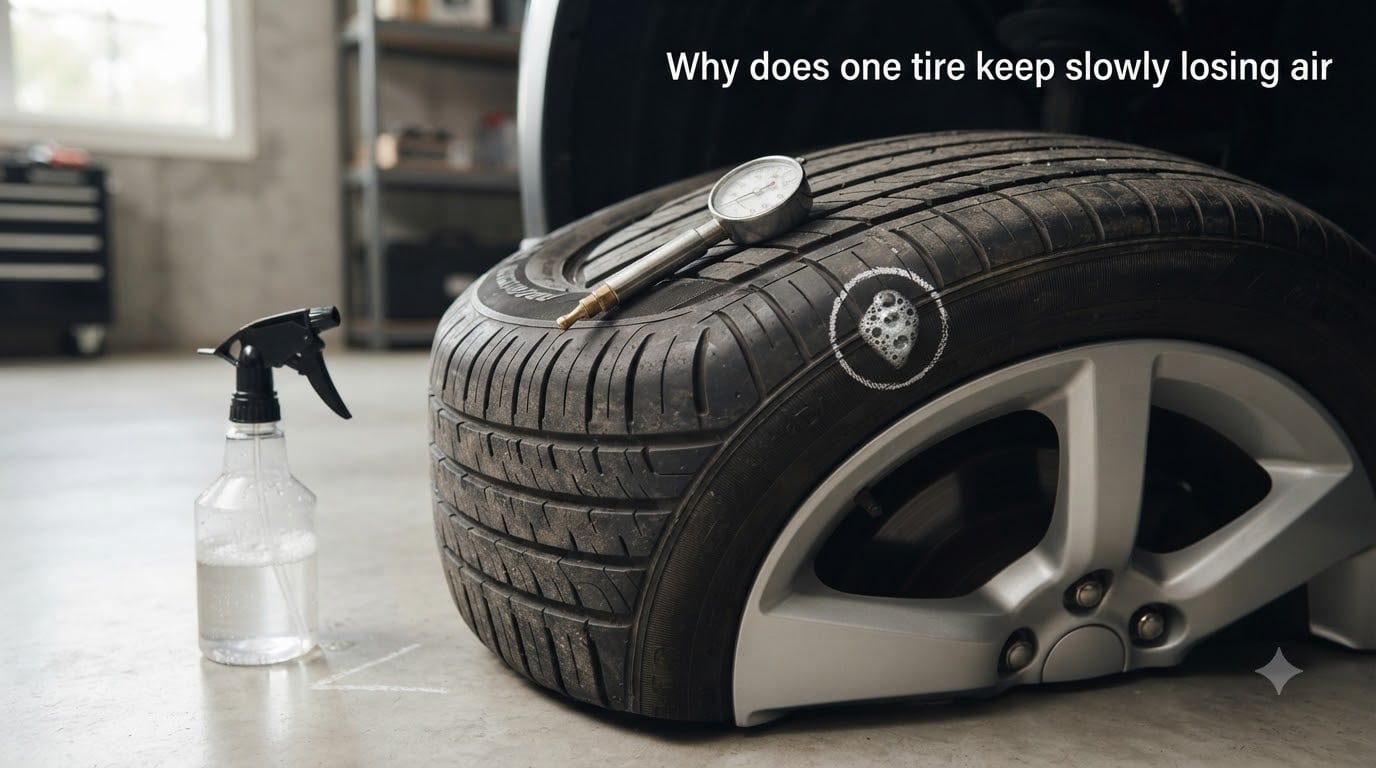
If you keep refilling the same tire every few weeks, you are not imagining things. One tire that keeps losing air almost always points to a specific, diagnosable problem, and the most likely culprits are a small puncture, a leaking valve stem, a failed tire-to-rim seal, or a damaged rim. Add in temperature swings and natural air diffusion, and you have the full list our mechanics see every week.
In this guide, I will walk you through the seven most common reasons a tire keeps going flat, how to test for each one at home with nothing more than soapy water and a gauge, and when it is time to hand the wheel over to a tire professional. Updated for 2026, this is the same diagnostic flow our shop uses at the counter.
Table of Contents
Quick Answer: Why One Tire Keeps Losing Air
The most common reasons a single tire keeps losing air are:
- A small puncture in the tread from a nail, screw, or piece of road debris (the #1 cause)
- A damaged or aged valve stem that no longer seals the Schrader valve
- A tire bead leak where the tire fails to seal against the rim
- A cracked, bent, or corroded rim that breaks the airtight seal
- Cold-weather pressure loss (about 1 PSI for every 10°F drop)
- Natural air diffusion through the rubber (around 1 PSI per month is normal)
If you are losing more than 2 PSI per week on a single tire, you have an active leak somewhere in that system.
Punctures from Nails, Screws, and Road Debris
A puncture is the single most common reason a tire keeps losing air, and nails and screws are the most frequent offenders. These objects usually embed in the central tread area, where they plug the hole just well enough to slow the leak but not stop it. The result is a tire that loses air steadily, sometimes faster in cold weather or after highway driving.
The Tire Industry Association considers a puncture repairable only when it sits in the tread area and is smaller than about 1/4 inch in diameter. Anything in the shoulder or sidewall of the tire cannot be safely repaired and means the tire needs replacement. If you can see the nail still stuck in the tread, leave it in place until you reach a tire shop. Pulling it out turns a slow leak into an immediate flat.
Glass shards and small pieces of metal wire can cause the same symptom without being visible from the outside. That is why so many drivers walk into our shop saying “I cannot find a nail but the tire keeps going flat.” In most cases, the puncturing object fell out on its own, leaving behind a hairline hole that needs a patch-and-plug combination to seal properly.
Damaged or Aged Valve Stems
The valve stem is the small rubber or metal stem that protrudes from the wheel, and it is one of the most overlooked sources of a slow leak. Rubber valve stems typically last five to seven years before the rubber starts to crack, dry rot, or pull away from the rim. Once that happens, air escapes in a thin, steady stream that is easy to miss without a soapy water test.
You can usually spot a bad valve stem by looking for crusty white or greenish residue around the base, which is the residue left behind by escaping air mixing with road grime. If you press the core in with a small tool and notice it does not spring back crisply, the spring inside the Schrader valve has worn out and the core needs to be replaced.
The good news is that valve stem replacement is one of the fastest and least expensive fixes a tire shop performs. Most mechanics swap them as part of any new tire install, and a stand-alone replacement on an existing tire usually takes less than fifteen minutes.
Tire Bead Leaks and Rim Seal Failures
A tire bead leak happens when the airtight seal between the tire and the rim breaks down, and air escapes around the edge of the wheel instead of through the rubber. Bead leaks are common after curb impacts, after a wheel has been removed and reinstalled without proper lubrication, and on alloy wheels that have developed corrosion along the bead seat.
The most reliable way to identify a bead leak is to look at the tire from the side and check for a continuous ring of fine bubbles when soapy water is sprayed around the rim edge. Unlike a puncture, you will not see a single bubble source. Instead, bubbles will appear all the way around the tire-to-rim interface.
Alloy wheels are slightly more prone to bead leaks than steel wheels because aluminum is softer and more easily deformed by potholes and curbs. Steel wheels resist impact better but can rust along the bead seat over time, which also breaks the seal. In both cases, the fix usually involves cleaning the bead seat, applying fresh tire-mount lubricant, and remounting the tire.
Cracked, Bent, or Corroded Rims
A damaged rim is one of the more frustrating causes of a recurring slow leak because the rim itself, not the tire, is the problem. Potholes, curb strikes, and corrosion along the bead seat can all create a path for air to escape. Drivers sometimes blame a “bad tire” for months before realizing the wheel is the actual leak source.
Bent rims often announce themselves through a visible vibration at highway speeds or uneven tire wear on the inner or outer edge. Cracked rims are more dangerous and need immediate replacement, because a crack can spread under inflation pressure and lead to a sudden blowout. Light surface corrosion along the bead seat is the most common rim-related leak cause and is usually fixable with a thorough cleaning and remount.
If you have hit a curb recently, parked near construction, or driven on rough roads, it is worth pulling the wheel and inspecting the bead seat closely. A flashlight and a rag are usually enough to spot the problem area.
Temperature Swings and Natural Air Diffusion
Even a perfectly good tire loses air over time. The rubber itself is slightly porous, so air molecules slowly diffuse through the sidewall and tread. The rule of thumb our team uses is one PSI per month as a baseline. Anything faster than that points to an actual leak rather than natural loss.
Temperature makes this effect dramatic. Air pressure in a tire drops about one PSI for every ten degrees Fahrenheit the ambient temperature falls. That is why drivers in the northern half of the country often see their TPMS light pop on the morning after the first hard frost, even when nothing is mechanically wrong.
To get an accurate reading, always check tire pressure when the tires are cold, meaning the car has been parked for at least three hours or driven less than a mile at low speed. A reading taken after highway driving will be artificially high and can mask an under-inflation problem. Nitrogen-filled tires hold pressure more consistently through temperature swings, but they still diffuse over time.
How to Find a Slow Leak Yourself
You do not need to remove the wheel to track down most slow leaks. The fastest DIY method is the soapy water test, and you only need a spray bottle, dish soap, water, and about ten minutes.
Step 1: Check the pressure in all four tires
Use a reliable tire pressure gauge and record the reading on each tire. Write the numbers down. If one tire is more than two PSI lower than the other three, that is your problem tire.
Step 2: Inflate the problem tire to the recommended pressure
Find the vehicle-recommended PSI on the door-jamb sticker (not the number molded into the sidewall). Bring the problem tire up to that pressure so you start from a known baseline.
Step 3: Spray soapy water around the tire
Mix a few drops of dish soap with water in a spray bottle. Saturate the entire tread, both sidewalls, the valve stem, and the rim edge. Watch for bubbles forming. Even a tiny leak will produce a steady stream of small bubbles you can spot in good light.
Step 4: Listen and feel for escaping air
In a quiet garage, you can often hear a slow leak as a faint hissing sound. Run your bare hand an inch away from the suspected area to feel for moving air, especially around the valve stem and bead.
Step 5: Mark the leak location
Once you find the source, mark it with chalk or a small piece of tape so the shop knows exactly where to repair. If nothing shows up with soapy water but the tire still loses pressure over a day or two, the leak is likely at the bead or rim and the tire will need to be removed for closer inspection.
Repair Cost at a Glance
The cost to fix a slow tire leak varies widely depending on the cause, the tire itself, and whether the tire is still serviceable. Here is a realistic range for each common repair, so you know what to expect at the counter.
- Tire plug: the simplest fix for a small tread puncture. Quick, but a plug alone is considered temporary by most tire manufacturers.
- Patch and plug combination: the industry-preferred permanent repair for tread punctures. Costs more than a plug but lasts the life of the tire.
- Valve stem replacement: a fast, low-cost fix when the stem itself is the leak source. Often added free with a new tire.
- Bead remount and cleaning: needed when corrosion or curb damage breaks the rim seal. Adds labor but usually no new parts.
- New tire: required for sidewall damage, large shoulder punctures, or tires that are too old or worn to safely repair.
For the most current pricing in your area, call your local tire shop with the tire size and the cause you identified. They can usually give a firm quote over the phone.
Is It Safe to Keep Driving With a Slow Leak?
A slow leak is almost always safer to drive on than a sudden flat, but it is not harmless. Driving on an underinflated tire generates excess heat, wears the shoulders of the tread unevenly, hurts fuel economy, and lengthens braking distances. In extreme cases, the sidewall can flex enough to fail and cause a blowout at highway speed.
As a rule of thumb, if the tire is more than five PSI below the recommended pressure, avoid highway driving until it is refilled. If the TPMS light comes on, treat it as a same-day issue rather than a next-week one. Most modern TPMS sensors trigger at around twenty-five percent below the recommended pressure, which is already low enough to cause tire damage over time.
If you must drive to a shop, inflate the tire to the recommended pressure first and drive at moderate speeds. Avoid highways, sharp turns, and heavy loads. The goal is to minimize flex and heat buildup in the sidewall until the leak is fixed.
When to Call a Tire Professional
Some slow leaks are safe and easy to handle at home, but others need a professional eye. Bring the car in if you see any of the following: a bulge or blister on the sidewall, a puncture larger than a quarter inch, damage to the shoulder of the tire, a rim that is visibly cracked or bent, repeated loss of pressure with no visible cause, or a tire that is more than six years old.
A tire professional has the tools to dismount the tire, inspect the inside of the carcass, and check the bead seat and rim up close. They can also test the TPMS sensor, which sometimes fails independently and triggers a false low-pressure warning. If you have already added air twice in a month and the leak keeps coming back, the next stop should be a shop, not the air compressor at the gas station.
Frequently Asked Questions
Is it normal for one tire to lose air slowly?
Losing about 1 PSI per month is normal for any tire. If one tire consistently drops faster than the other three or needs air more than once a month, it has an active leak that needs to be diagnosed.
How do I find a slow leak in my tire?
The fastest method is the soapy water test: inflate the tire to the recommended pressure, spray a mix of dish soap and water across the tread, sidewalls, valve stem, and rim edge, and watch for bubbles. The bubble source marks the leak. You can also listen for hissing or run a bare hand near the tire to feel escaping air.
Can a tire lose air without a hole?
Yes. Air can escape through the valve stem, around the tire bead where it seals against the rim, or through a damaged or corroded rim. Temperature drops also cause the air inside the tire to contract, lowering pressure without any leak at all.
Why does my tire keep going flat overnight?
An overnight loss usually points to a faster leak such as a nail, screw, or failing valve stem. Temperature drops overnight make the loss feel bigger than it is, but if the tire is fully flat in the morning, the leak rate is too high to be normal diffusion.
Can a slow tire leak be fixed?
Yes, in most cases. Tread punctures smaller than about a quarter inch can be repaired with a patch and plug. Damaged valve stems can be replaced. Bead leaks and rim corrosion are usually fixable with cleaning and remounting. Sidewall damage, large shoulder punctures, or age-related failure usually mean the tire needs replacement.
How much does it cost to fix a slow tire leak?
Cost varies by cause and vehicle, but a tire plug or patch-and-plug repair is one of the least expensive tire fixes. A valve stem replacement is also low-cost and is often added free with a new tire. Bead remounts add labor but rarely need new parts. Sidewall damage or an unrepairable puncture means a new tire, which is the priciest option. Call your local shop with your tire size for an exact quote.
Is it safe to drive with a tire slowly losing air?
A slow leak is safer than a sudden flat, but it is not harmless. Underinflation causes uneven wear, hurts braking and fuel economy, and can lead to a sidewall blowout. If the tire is more than five PSI below the recommended pressure, avoid highway driving until it is refilled and inspected.
How do you know if your tire valve stem is bad?
Look for crusty white or greenish residue around the base, cracking or dry rot on the rubber, or a Schrader valve core that does not spring back when pressed. Spray soapy water on the stem and watch for bubbles if you suspect a leak. Valve stems typically last five to seven years before needing replacement.
Can a rim cause a tire to lose air?
Yes. A cracked, bent, or corroded rim can break the airtight seal between the tire and the wheel. Potholes, curb strikes, and long-term corrosion along the bead seat are the usual culprits. The tire often gets replaced before the rim is inspected, which is why the leak keeps coming back after a new tire install.
Why does my tire lose pressure in cold weather?
Cold air contracts, so tire pressure drops about 1 PSI for every 10 degrees Fahrenheit the ambient temperature falls. A 30-degree overnight drop can easily cost 3 PSI, which is enough to trigger the TPMS light. This is not a leak. Check pressure when tires are cold and refill to the door-jamb specification.
How often should you check tire pressure?
Check tire pressure at least once a month and before any long trip. Always check when the tires are cold, meaning the car has been parked for at least three hours or driven less than a mile at low speed. A monthly habit catches slow leaks early, before they cause uneven wear or a TPMS warning.
What does a tire bead leak look like?
A bead leak shows up as a continuous ring of fine bubbles around the tire-to-rim interface when soapy water is sprayed along both sidewall edges. Unlike a single bubble at a puncture, bead leaks bubble all the way around. They are caused by corrosion, curb damage, or an improper remount that broke the airtight seal.
The Bottom Line
One tire that keeps slowly losing air almost always has a diagnosable cause, and in most cases the fix is straightforward. Start with the soapy water test on the tread, sidewalls, valve stem, and rim edge. If you find a puncture in the tread, a patch-and-plug repair handles it. If the valve stem is cracked, replace it. If bubbles appear all the way around the rim, you are looking at a bead or rim issue that a tire shop should clean and remount.
Make tire pressure a monthly habit, especially when the seasons change. Catching a slow leak early keeps your tires wearing evenly, your fuel economy high, and your TPMS light off. If the same tire keeps going flat after a repair, bring it back to the shop. A persistent leak is a signal that something more than a nail is going on.