
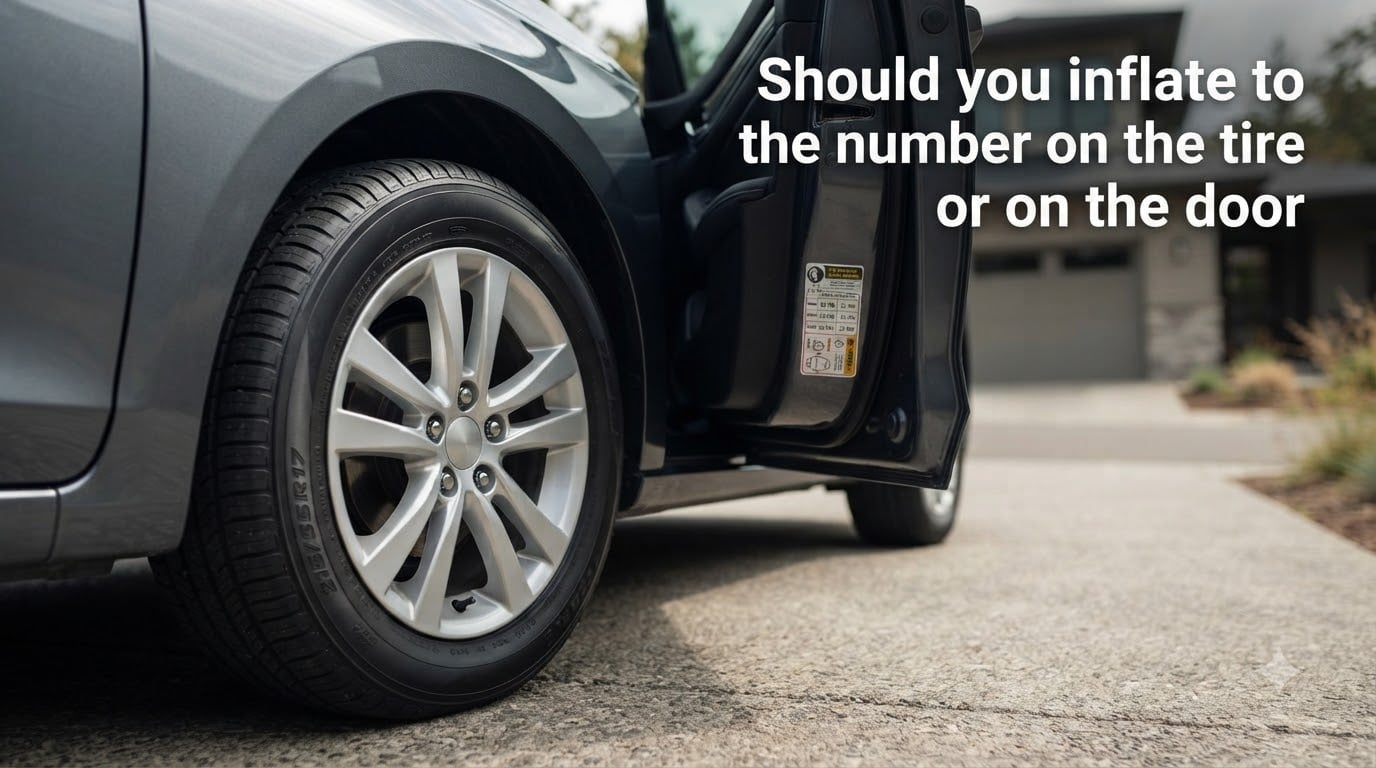
You should always inflate your tires to the number on the door placard (also called the door jamb sticker or tire information label), not the maximum pressure listed on the tire sidewall. This is one of the most common tire maintenance mistakes we see, and it’s easy to understand why there’s confusion — your tire displays one number, your car door shows another, and they rarely match.
The door placard number is set by your vehicle’s engineers specifically for your car’s weight, suspension geometry, and handling characteristics. The tire sidewall number is simply the maximum cold pressure that tire can safely hold across every vehicle it might be installed on. In this guide, we’ll break down what each number means, how to check your tire pressure correctly, and what happens when you get it wrong.
Table of Contents
Should You Inflate to the Number on the Tire or on the Door?
The short answer: always use the number on your driver’s door placard. The tire sidewall shows the maximum pressure the tire can safely handle — it’s a structural limit, not a recommendation. Your vehicle manufacturer calculated a specific pressure that optimizes safety, handling, comfort, and tire longevity for your exact car model. Inflating to the sidewall maximum means you’re consistently over-inflating, which reduces grip, causes premature center tread wear, and makes your ride unnecessarily harsh.
What Does the Number on Your Tire Mean?
When you look at the sidewall of your tire, you’ll find a number followed by “PSI” (pounds per square inch) — typically something like “Max. Load 2,000 lbs at 51 PSI Cold.” This is the tire’s maximum cold inflation pressure, and it tells you the absolute upper limit the tire can safely handle.
That number exists because tires are designed to fit many different vehicles. A tire size like 225/65R17 might go on a Honda CR-V, a Toyota RAV4, or a Ford Escape. Each of those vehicles has different weight distributions and engineering requirements, so the tire manufacturer can only state the maximum pressure the tire can safely hold — not the ideal pressure for every car it fits.
This is an important distinction. The sidewall maximum is a structural limit, not a recommendation. Think of it like a bridge with a 10-ton weight limit — just because it can hold 10 tons doesn’t mean you should drive a 10-ton truck across it every day. Using the maximum pressure regularly leads to a harsh ride, premature center tread wear, and reduced grip on the road.
What Does the Door Placard Number Mean?
The sticker inside your driver’s door jamb lists the recommended tire pressure for your specific vehicle. This number — usually between 30 and 36 PSI for passenger cars and 35 to 45 PSI for trucks and SUVs — was determined by your vehicle’s engineers after extensive testing.
Vehicle manufacturers choose this PSI based on several factors: the car’s total weight, how that weight is distributed between front and rear axles, the suspension design, the tire size the car ships with, and the intended driving conditions. A sedan with a 60/40 front-to-rear weight split will have different recommended pressures for front and rear tires.
You can find this information in two places: on the sticker inside the driver’s side door jamb (visible when you open the door), or in your vehicle’s owner’s manual. The door jamb sticker is the most convenient reference. On some vehicles, the placard also lists different pressures for front and rear tires — follow those distinctions for optimal handling.
Tire Sidewall vs Door Placard: A Side-by-Side Comparison
This table breaks down exactly what each number means and when you should use it:
| Attribute | Tire Sidewall Number | Door Placard Number |
|---|---|---|
| What it is | Maximum cold pressure the tire can safely hold | Recommended operating pressure for your specific vehicle |
| Who sets it | Tire manufacturer | Vehicle manufacturer |
| Typical range | 44–51 PSI for passenger tires | 30–36 PSI for cars, 35–45 PSI for trucks/SUVs |
| Specific to your car? | No — applies to every vehicle that tire fits | Yes — calculated for your exact model and trim |
| Purpose | Structural safety limit | Optimal balance of safety, comfort, handling, and tire life |
| Should you use it? | Never for daily driving — it’s a maximum, not a target | Yes — this is your correct tire pressure |
As the table shows, these two numbers serve completely different purposes. The tire sidewall number protects the tire’s structure. The door placard number protects you, your passengers, and your vehicle’s performance.
How to Find and Check Your Correct Tire Pressure
Checking your tire pressure is a five-minute task that pays off in safety, fuel savings, and longer tire life. Here’s how to do it right:
Step 1: Find your recommended PSI. Open the driver’s door and look for the sticker on the door jamb. It will list the recommended cold tire pressure for front and rear tires. Write these numbers down or take a photo with your phone.
Step 2: Check your tires when they’re cold. “Cold” means the car hasn’t been driven for at least three hours, or has been driven less than one mile at low speed. Driving heats up the tires and increases pressure by 2–5 PSI, giving you an inaccurate reading.
Step 3: Remove the valve cap and press a tire gauge firmly onto the valve stem. A digital gauge is easiest to read, but a quality pencil gauge works fine too. You should hear a brief hiss of air — that’s normal. If air keeps hissing, the gauge isn’t seated properly.
Step 4: Compare the reading to your door placard number. If the reading is below the recommended PSI, add air. If it’s above, press the pin inside the valve stem to release some air, then re-check.
Step 5: Check all four tires plus the spare. Don’t forget the spare — it often requires higher pressure (typically 60 PSI) and needs to be ready if you ever need it. Many people skip the spare for years and find it flat when they need it most.
What Happens When Your Tire Pressure Is Wrong?
Getting tire pressure wrong — whether too high or too low — has real consequences for your safety and your wallet.
Under-Inflation (Too Low)
Under-inflation is the more dangerous condition. When tires run below the recommended PSI, the tire flexes more than designed, generating excess heat. This leads to accelerated tread wear along the outer edges, reduced fuel efficiency (up to 3% worse for every 1 PSI below recommended), poor handling and longer braking distances, and increased risk of a blowout — especially at highway speeds or in hot weather.
The NHTSA estimates that under-inflated tires contribute to roughly 11,000 tire-related crashes per year. A tire that’s 25% under-inflated is three times more likely to fail than one at the correct pressure.
Over-Inflation (Too High)
Inflating to the tire sidewall maximum — which is what happens when people follow the wrong number — pushes the tire into over-inflation territory. Over-inflated tires have a smaller contact patch with the road, which means less grip, especially in wet or cold conditions. The ride becomes harsher because the tire can’t absorb bumps as effectively, and the center of the tread wears faster than the edges.
Over-inflation also makes tires more vulnerable to damage from potholes and road debris. A rock that would bounce off a properly inflated tire can puncture an over-inflated one because there’s less flex to absorb the impact.
Understanding the 4 PSI Rule and 5 PSI Rule
You might have heard about the “4 PSI rule” or “5 PSI rule” in tire pressure discussions. These are guidelines some drivers use to fine-tune their tire pressure, but they’re often misunderstood.
The 4 PSI rule works like this: check your tire pressure when the tires are cold, then drive for about 30 minutes at highway speed and check again. If the pressure rises by more than 4 PSI, your cold pressure was too low — you started with under-inflated tires. If it rises by less than 4 PSI, your cold pressure might be slightly too high. A rise of exactly 4 PSI suggests you’re in the right ballpark.
The 5 PSI rule is a variation used more in performance and off-road driving contexts. It follows the same principle but uses a 5 PSI rise as the target, acknowledging that aggressive driving, heavier loads, or rough terrain generate more heat and pressure buildup.
These rules are not replacements for the door placard recommendation — they’re supplementary tools for enthusiasts who want to dial in their pressure for specific driving conditions. For everyday driving, stick with the number on your door placard.
How Temperature and Seasons Affect Tire Pressure
Tire pressure drops roughly 1 PSI for every 10°F decrease in ambient temperature. This means if you set your tires to 35 PSI on a 75°F summer day, they could read 30 PSI on a 25°F winter morning — a significant drop that affects handling and safety.
Most drivers notice the TPMS (Tire Pressure Monitoring System) light come on during the first cold snap of fall or winter. This is usually because the temperature drop has lowered tire pressure below the system’s alert threshold (typically 25% below recommended). The tires aren’t leaking — they’re just responding to physics.
Check your tire pressure at the start of each season and any time temperatures swing more than 20°F. If you live in an area with extreme seasonal changes, consider topping off your tires in the fall before the cold sets in, and again in spring as temperatures warm up. A small portable tire inflator that plugs into your car’s 12V outlet makes this easy to do at home.
Don’t try to compensate for cold weather by over-inflating in summer. Set the pressure to the door placard number year-round and simply check it more frequently when the weather shifts.
Frequently Asked Questions
Should you put air with the PSI on tires or on doors?
Always use the PSI listed on the door placard (the sticker inside your driver’s door jamb), not the number on the tire sidewall. The door placard number is the vehicle manufacturer’s recommended pressure for your specific car, optimized for safety, handling, and fuel efficiency. The tire sidewall number is only the maximum pressure the tire can safely hold — it is not the recommended operating pressure.
Do you go by the sticker on your driver’s door for tire pressure?
Yes. The sticker on your driver’s door jamb — also called the tire information placard — lists the correct tire pressure for your vehicle. Vehicle engineers determined this number through testing based on your car’s weight, weight distribution, suspension, and tire size. Always follow this number over the tire sidewall maximum, which applies to every vehicle that tire could fit, not just yours.
What is the 4 PSI rule on tires?
The 4 PSI rule is a diagnostic technique: check your tire pressure when cold, drive for about 30 minutes at highway speed, then check again. If the pressure rises by about 4 PSI, your cold pressure is correct. If it rises more than 4 PSI, your tires were under-inflated. If it rises less, they may be slightly over-inflated. This is a fine-tuning tool, not a replacement for the door placard recommendation.
What is the 5 PSI rule?
The 5 PSI rule works the same as the 4 PSI rule but uses a 5 PSI rise as the target. It’s used more in performance driving, off-road driving, or heavy-load situations where tires generate more heat. For normal daily driving, the 4 PSI rule is the standard guideline, and the door placard number remains the primary reference.
Why is the tire sidewall PSI higher than the door placard?
The tire sidewall shows the maximum cold pressure the tire can safely handle — it’s a structural limit, not a recommendation. Because tires are made to fit many different vehicles, the manufacturer can only list the maximum. Your vehicle’s engineers calculated a lower, specific pressure that balances safety, ride comfort, handling, and tire longevity for your exact car model.
Final Thoughts
The answer to whether you should inflate to the number on the tire or on the door is clear: always follow the door placard. Your vehicle’s engineers spent thousands of hours determining the exact tire pressure that gives you the best combination of safety, handling, ride comfort, fuel efficiency, and tire longevity for your specific car.
The tire sidewall number is a maximum limit — a ceiling you should never reach during normal driving. Inflating to that number every time you top off your tires means you’re consistently over-inflating, which shortens tire life, reduces grip, and makes your ride unnecessarily harsh.
Check your tire pressure at least once a month, always when the tires are cold, and keep a reliable gauge in your glovebox. It’s one of the simplest maintenance tasks you can do, and it directly affects every mile you drive.