
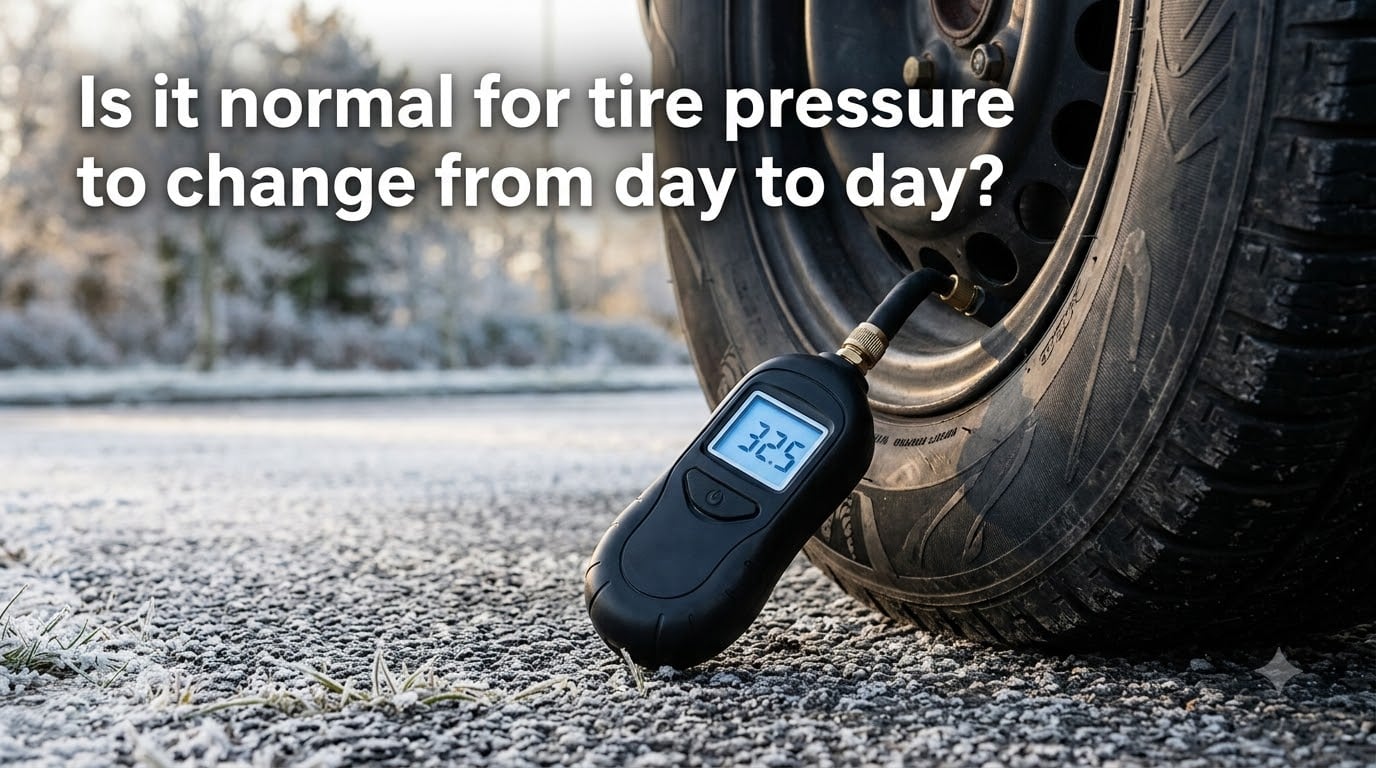
Yes, it is completely normal for tire pressure to change from day to day. Air inside your tires expands when warm and contracts when cool — for every 10°F change in ambient temperature, your tire pressure shifts by about 1 to 2 PSI. That means a 20-degree overnight temperature drop can easily push your tires 2 to 4 PSI lower by morning, which is physics doing its job, not a sign of a problem.
In this guide, I’ll explain exactly why tire pressure fluctuates daily, how much change is normal, and — just as important — when those changes actually signal something that needs attention.
Table of Contents
The Science: Why Tire Pressure Changes With Temperature
Your tires are sealed containers filled with air, and air behaves predictably: it expands when heated and contracts when cooled. This is basic thermal expansion, and it happens inside your tires just as it does in a balloon left in the sun.
The widely cited rule is 1 to 2 PSI per 10°F of temperature change. Here’s what that looks like in a real scenario:
- Morning (60°F): Your tires read 34 PSI after sitting overnight.
- Afternoon (85°F): The same tires now read 37–38 PSI from ambient heat and driving friction.
- Next morning (50°F after a cold front): Those tires drop back to 32–33 PSI.
Nothing leaked. Nothing broke. The air simply expanded and contracted with the temperature. This is why tire manufacturers always specify that pressure should be checked “cold” — meaning before you drive or after the car has sat for at least three hours.
What’s a Normal Day-to-Day Fluctuation?
Day to day, you can expect your tire pressure to fluctuate by 1 to 3 PSI under typical conditions. When a major weather front moves through and swings the temperature 20 or 30 degrees overnight, you might see 4 to 5 PSI of change — and that’s still perfectly normal.
Here’s a practical example of what “normal” looks like over three days:
- Monday morning (70°F): 35 PSI — right at the recommended pressure.
- Tuesday morning (50°F after a cold front): 32–33 PSI — a 2 to 3 PSI drop from the 20-degree temperature swing.
- Wednesday morning (65°F): 34 PSI — back close to where you started as temperatures recover.
If you’re seeing consistent drops of 1 to 3 PSI on cold mornings that rebound during the day or as the season warms up, you’re looking at standard thermal behavior — not a leak.
Day-to-Day vs. Seasonal Changes
It’s worth distinguishing between daily fluctuations and seasonal shifts. Day-to-day changes typically stay within that 1 to 3 PSI range. Seasonal swings — say, a 50°F average difference between a hot August afternoon and a cold January morning — can cause 5 to 10+ PSI of total change over several months.
Many drivers discover this the hard way when their TPMS light turns on during the first cold snap of fall. The tires didn’t leak all summer; they simply lost pressure gradually as the outside air temperature dropped week by week.
Why Your Tire Pressure Drops Overnight or in the Morning
Waking up to a TPMS warning light on a cold morning is one of the most common tire-related concerns we hear about. Here’s what’s happening:
As ambient temperatures drop overnight, the air inside your tires contracts. The tire’s volume stays roughly the same (the rubber doesn’t shrink), so the air molecules take up less space inside that fixed volume — which translates directly to lower pressure.
A few extra factors can make morning readings look even lower:
- Direct sunlight vs. shade: If one side of your car faces the morning sun and the other stays in shade, the sun-facing tires can read 1 to 2 PSI higher than the shaded ones — even on the same axle. This isn’t a leak; it’s uneven solar heating.
- Parking surface: Concrete or asphalt radiates stored heat differently, but this is usually a minor factor.
- Road heat from previous day: If you drove aggressively or on hot pavement the day before, your “cold” reading the next morning may be lower than you expect simply because your baseline was inflated by residual heat.
The practical takeaway: always check tire pressure in the morning before driving, and compare readings to the same conditions each time. A consistent 2 to 3 PSI swing on cold mornings is expected.
Why Tire Pressure Rises While Driving
You’ll also notice that your tire pressure climbs after you start driving — typically 2 to 6 PSI after 20 to 30 minutes on the road. This happens for two reasons:
- Friction heat: As the tire rotates against the road, the contact patch generates heat. That heat transfers to the air inside, causing it to expand.
- Ambient temperature: Driving in hot weather adds environmental heat on top of friction heat, amplifying the effect.
This is why checking pressure at a gas station after a 30-minute highway drive gives you a misleadingly high reading. The tires are hot. If you add air based on that number, you’ll end up overinflated once the tires cool down.
One forum user described this exact scenario — driving to the gas station, checking pressure, seeing it was “high,” and letting air out, only to find the tires underinflated the next morning. The fix is simple: always check pressure when tires are cold, meaning the car hasn’t been driven for at least three hours.
When Tire Pressure Changes Are NOT Normal
Daily fluctuations of 1 to 3 PSI from temperature are normal. But certain patterns point to an actual problem. Here’s a diagnostic checklist for identifying a slow leak:
- One tire consistently reads lower than the others: If you check all four tires and one is always 3 to 5 PSI below the rest, that specific tire likely has a leak — per-tire variation that persists over several days is a strong diagnostic signal.
- Pressure drops regardless of temperature: If your tires lose 5+ PSI in a week even when daytime temperatures are stable, that’s a leak, not thermal contraction.
- Puncture or road debris: Nails, screws, and glass can embed in the tread and cause slow leaks. Sometimes the object stays lodged and the tire only loses air gradually.
- Valve stem failure: The Schrader valve (the small pin inside the valve stem) can corrode or lose its seal over time. A quick test: put a drop of soapy water on the valve cap area and watch for bubbles.
- Bead corrosion or rim damage: Where the tire meets the wheel rim, corrosion or curb damage can break the airtight seal. This is especially common on older alloy wheels.
- Dry rot (tire aging): Rubber degrades with UV exposure and age. Cracked sidewalls or tread edges can allow slow air seepage.
- Wheel porosity: Some alloy wheels, particularly older cast aluminum, develop microscopic pores that slowly leak air. This is more common than most drivers realize.
- TPMS sensor malfunction: If your tire pressure looks fine on a gauge but the TPMS light keeps coming on, the sensor itself might be failing. TPMS sensors have batteries that typically last 5 to 10 years.
The key distinction: normal temperature-driven changes are predictable and affect all tires roughly equally. A slow leak usually affects one tire, persists regardless of weather, and progressively worsens over days or weeks.
How to Check Tire Pressure the Right Way
Getting an accurate reading is straightforward if you follow a few guidelines:
- Check when tires are cold: Before driving or after the car has sat for at least three hours. Driving heats the tires and inflates the reading.
- Use a reliable gauge: Digital gauges are the most accurate and easiest to read. Dial gauges are also solid. Pencil-style gauges work but are harder to read precisely.
- Find your recommended PSI: Look at the sticker inside the driver’s door jamb — not the number on the tire sidewall. The sidewall shows the tire’s maximum pressure, which is almost always higher than the manufacturer’s recommended operating pressure.
- Check monthly at minimum: Most manufacturers recommend a monthly tire pressure check. During seasonal temperature transitions — early fall and early spring — checking every two weeks is smart.
- Don’t forget the spare: If your vehicle has a full-size spare, include it in your monthly check. Compact spares typically run at a much higher PSI (usually 60 PSI) and are easy to overlook.
Understanding Your TPMS Warning Light
Most vehicles made after 2007 are equipped with a Tire Pressure Monitoring System (TPMS). When the dashboard light illuminates — typically a horseshoe-shaped icon with an exclamation mark — it means at least one tire has dropped below the system’s threshold, which is usually around 25% below the recommended PSI.
Here’s what many drivers don’t realize: TPMS is a warning system, not a precision instrument. By the time the light turns on, your tire is already significantly underinflated. That means you can’t rely on TPMS alone to catch a 2 to 3 PSI daily fluctuation — the system is designed to alert you to a genuinely low tire, not minor temperature-driven swings.
If your TPMS light comes on every cold morning and turns off once the car warms up, that’s almost certainly thermal contraction at work. Add air to bring all tires to the door-jamb-recommended PSI when cold, and the light should stay off. If the light stays on persistently, especially on a single tire, you likely have a slow leak worth investigating.
Frequently Asked Questions
How much fluctuation in tire pressure is normal?
A day-to-day fluctuation of 1 to 3 PSI is completely normal and is caused by temperature changes. If a major weather front brings a 20- to 30-degree temperature swing overnight, you might see up to 5 PSI of change. Anything beyond that range, especially if it affects only one tire or persists regardless of temperature, may indicate a slow leak.
Is it normal for tires to lose 2 PSI per month?
Yes, tires naturally lose a small amount of pressure over time — roughly 1 to 3 PSI per month — through the rubber itself via a process called permeation. Temperature changes can make this more noticeable. Monthly pressure checks and top-offs are recommended to account for this gradual loss.
What is the 4 PSI rule on tires?
The 4 PSI rule is a diagnostic technique: measure your tire pressure when the tires are cold, then again after driving for 30 minutes. If the pressure rises more than 4 PSI, the tires were underinflated to start with. If it rises less than 4 PSI, they may have been overinflated. This helps you dial in the correct cold pressure for your driving conditions.
Is 40 PSI tire pressure too high?
It depends on your vehicle. The correct tire pressure is listed on the sticker inside your driver’s door jamb — not on the tire sidewall. While 40 PSI might be appropriate for some trucks and performance vehicles, most passenger cars recommend 30 to 35 PSI. Running significantly above the recommended pressure reduces traction, causes uneven center tread wear, and gives a harsher ride.
Why does my tire pressure light come on in the morning?
Cold overnight temperatures cause the air inside your tires to contract, which lowers the pressure. If it was already close to the TPMS trigger threshold, a cold morning can push it just below — turning the light on. Once you drive and the tires warm up, the pressure rises and the light usually turns off. This is normal behavior in cold weather, not a defect.
How much does tire pressure increase while driving?
Tire pressure typically increases by 2 to 6 PSI after 20 to 30 minutes of driving. Friction between the tire and the road surface generates heat, which causes the air inside the tire to expand. In hot weather or during aggressive driving, the increase can be even higher. This is why tire pressure should always be checked when the tires are cold.
Why is my tire pressure going up and down while driving?
Tire pressure rises as you drive due to friction-generated heat, then drops slightly when you stop and the tires cool. Changes in road surface temperature, speed, and ambient weather during your trip also cause small fluctuations. These on-the-go variations of a few PSI are normal and expected — they’re the air responding to its environment in real time.
Should I add air when it is cold or wait for it to warm up?
Add air when the tires are cold — that is the correct baseline for setting pressure. If you inflate to the recommended PSI on a cold morning, the pressure will rise during the day as temperatures increase and you drive, but it will still be within the safe operating range. Waiting for the tires to warm up before inflating leads to underinflation once they cool back down.
Final Thoughts
If you’ve been wondering whether it’s normal for tire pressure to change from day to day, the answer is a clear yes. Daily swings of 1 to 3 PSI are standard behavior driven by ordinary temperature fluctuations. The key things to remember:
- Check your tires when they’re cold — before driving or after sitting for three hours.
- Use the PSI listed on your door jamb sticker, not the tire sidewall.
- A consistent per-tire difference or pressure loss that ignores temperature trends points to a slow leak worth fixing.
- Your TPMS light is a safety net, not a precision tool — regular manual checks with a gauge give you the full picture.
Understanding the relationship between temperature and tire pressure takes the anxiety out of those morning TPMS lights. It’s not a defect — it’s physics. Keep a gauge in your glove box, check monthly, and you’ll catch real problems long before they become a safety issue.