
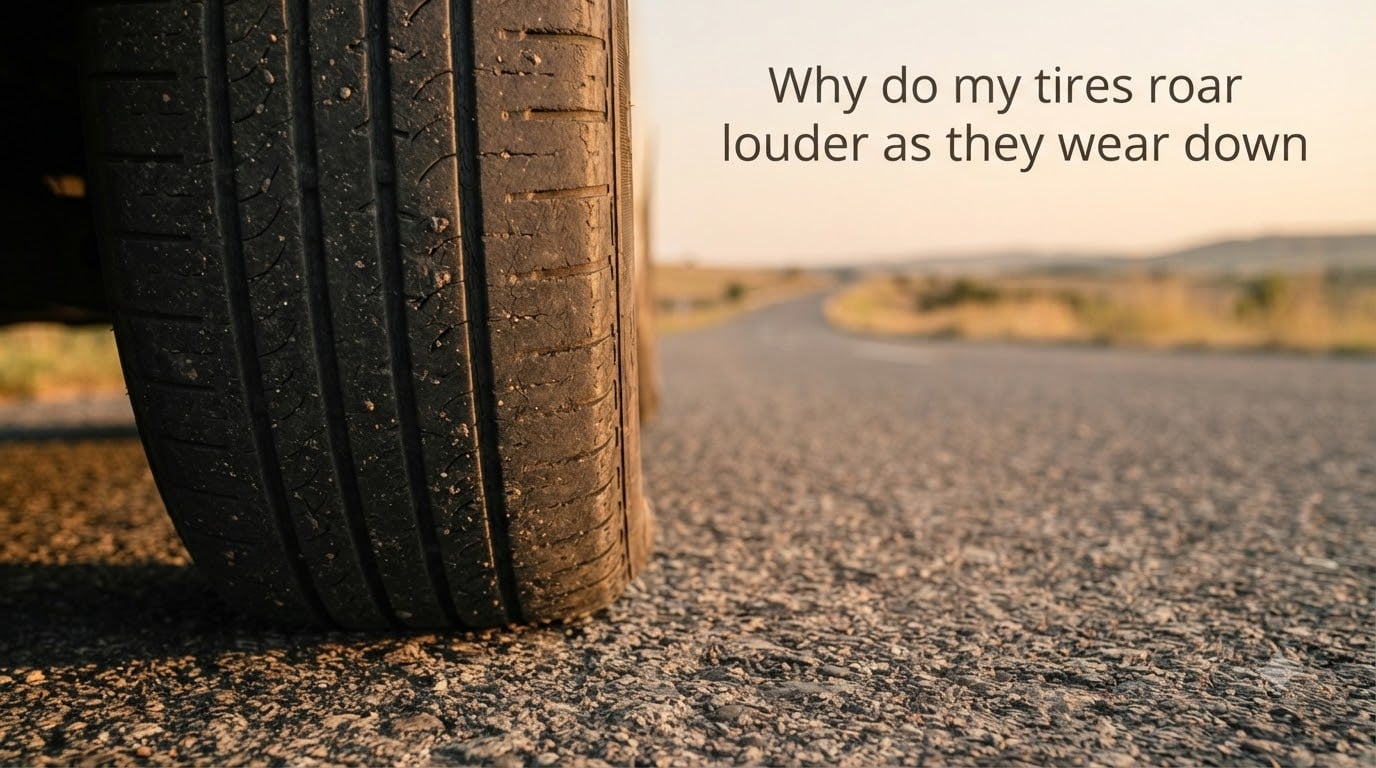
Yes, tires absolutely get louder as they wear down. Two things happen simultaneously: the rubber compound hardens and loses its flexibility to absorb micro-vibrations, while the tread depth decreases and removes the cushioning layer between your cabin and the road. Both changes increase the vibration transmitted through the chassis, which your ears interpret as a louder roar—especially noticeable at highway speeds and on rough pavement.
Table of Contents
Do Tires Get Louder as They Wear?
Tires do get louder as they wear, and it’s not your imagination. As tread depth drops below about 5/32 inch, most drivers notice a measurable increase in cabin noise. The roar becomes especially pronounced on wet pavement, older asphalt, and concrete highways.
The reason is straightforward: fresh tires have deep grooves that channel air and dampen vibration. As those grooves wear shallower, the tread blocks sit closer to the road surface and transfer more energy directly into the wheel, suspension, and cabin. Your tires are working harder to do the same job with less material.
Drivers often report that the noise increase feels sudden rather than gradual. One common scenario on forums involves tires that were quiet for years, then seemed to “wake up” one day—particularly after a rotation or seasonal change. That’s because once you cross certain tread depth thresholds, the noise jump is noticeable even if you didn’t hear it creeping up.
The Science Behind Tire Roar: Why Rubber Hardening Creates Noise
Tire rubber isn’t a static material. It’s a polymer compound designed to flex and absorb road impacts. Over time—typically 4 to 6 years from manufacture—those polymers cross-link and stiffen, a process called polymerization. The rubber loses its ability to deform and absorb micro-vibrations from the road.
When fresh rubber hits a small road imperfection, it compresses and springs back quietly. Hardened rubber doesn’t compress as well. Instead of absorbing the impact, it transmits that energy as vibration through the wheel hub, into the suspension, and up through the chassis to your ears. The result is a low, steady roar that increases with speed.
Tire type plays a role here. Performance tires use stiffer compounds from the start—they’re already louder when new and get noisier faster. Touring tires prioritize comfort with softer compounds, so they stay quieter longer but still harden with age. Off-road and mud-terrain tires have aggressive tread patterns designed for grip, not silence, so they produce more noise at baseline and amplify it as the blocks wear unevenly.
How Tread Depth Loss Increases Road Noise
Tread depth acts as a noise buffer between your cabin and the pavement. New passenger tires typically start with 10/32 to 11/32 inch of tread. That depth provides multiple functions: channeling water, absorbing impacts, and dampening the “air pumping” effect where tread blocks compress air against the road surface.
As tread wears down, each of those functions degrades. At 6/32 inch, you lose meaningful water evacuation capability. At 4/32 inch, most drivers report a noticeable increase in road noise. By 2/32 inch—the legal minimum in most states—you’re running on essentially flat rubber with minimal cushioning, and the roar can be substantial.
The geometric explanation is simple: shallower tread means less rubber between you and the road. Tread blocks that once flexed and absorbed vibration now sit rigidly against the pavement, transmitting every crack and pebble directly into the cabin. Think of it like wearing thin-soled shoes versus thick-soled boots on gravel—the thinner sole lets you feel and hear everything.
What Different Tire Noises Mean
Not all tire noise sounds the same, and the type of noise can tell you what’s happening. Here’s how to identify what you’re hearing:
Roaring or droning is a steady, low-frequency sound that increases with speed. This is classic tread wear noise—your tread blocks are hitting the road at a consistent frequency. It’s most noticeable at highway speeds and may change pitch on different road surfaces.
Humming is a softer, more tonal sound that often starts in one corner of the vehicle. This can indicate uneven wear on one tire, a developing wheel bearing issue, or cupping on the tread surface.
Thumping or womp-womp is a rhythmic, pulsing sound that matches wheel rotation speed. This usually points to a flat spot on the tire, a separated belt, or severe cupping. It’s louder at low speeds and may vibrate through the steering wheel.
Whining or squealing during turns suggests the tread is scrubbing against the pavement. This happens with alignment issues, underinflation, or when performance tires are worn to the point where the contact patch is no longer uniform.
Uneven Wear Patterns That Amplify Roar
Uneven wear is often louder than uniform wear because it creates irregular tread patterns that generate inconsistent vibrations. Three patterns are especially noisy:
Cupping (scalloping) creates shallow, scoop-shaped depressions across the tread surface—usually caused by worn shocks or struts. As the tire rotates, each cupped spot hits the road with extra force, producing a distinctive rhythmic roar that gets faster with speed. You can feel cupping by running your hand across the tread; it will feel bumpy rather than smooth.
Feathering occurs when tread blocks wear at an angle instead of flat—smooth on one edge, sharp on the other. It’s typically caused by misalignment. Feathered tires produce a swishing or hissing noise that changes when you turn the steering wheel, because the angle of the tread blocks shifts relative to the road.
Flat spots develop from hard braking, parking in one position for extended periods, or aggressive driving. A flat spot creates a thumping rhythm that matches wheel rotation speed and can vibrate through the steering wheel and floorboard. Storage-related flat spots often develop over winter if a vehicle sits in one position without being moved.
Other Causes of Loud Tire Noise
Wear isn’t the only reason tires get loud. Several other factors can amplify or create noise independent of tread condition:
Tire pressure affects how the tread contacts the road. Underinflated tires flex more on the sidewalls and create extra friction. Overinflated tires ride on the center of the tread, reducing the contact patch and increasing the impact force of each tread block. Both conditions create noise. Check your pressure monthly and keep it at the manufacturer’s recommended level—not the maximum listed on the sidewall.
Wheel misalignment causes tires to scrub against the pavement at an angle rather than rolling straight. This accelerates uneven wear and creates noise. If your vehicle pulls to one side or the steering wheel is off-center, alignment is likely the issue.
Worn suspension components—shocks, struts, bushings, and ball joints—allow excess wheel movement that translates into tire noise. When the suspension can’t dampen road impacts, the tire absorbs more vibration and transmits it to the cabin.
Wheel bearings can produce a humming or grinding noise that mimics tire roar. A failing bearing typically gets louder when you turn and load one side of the vehicle, which is a key diagnostic clue.
How to Tell if It’s Your Tires or a Wheel Bearing
This is one of the most common questions drivers ask, and for good reason—both problems can sound nearly identical at highway speeds. Here’s how to tell them apart:
Speed sensitivity: Tire noise increases steadily with speed and is consistent. Wheel bearing noise may change pitch or volume at certain speeds, sometimes fading in and out.
Turning test: When you turn left, weight shifts to the right side. If the noise gets louder turning left, it’s likely the right wheel bearing. If the noise stays the same regardless of turn direction, it’s more likely tire-related.
Road surface test: Tire noise changes dramatically between smooth asphalt, rough pavement, and concrete. Wheel bearing noise remains relatively constant regardless of surface.
Rhythm: Tire noise often has a rhythmic quality that matches rotation speed—especially with cupping or flat spots. Wheel bearing noise is usually a constant hum or grind without a distinct rhythm.
If you’re still unsure, a mechanic can diagnose this in minutes by lifting the vehicle and spinning each wheel by hand. A bad bearing will often have play (side-to-side movement) or make noise when spun freely.
How to Fix Loud Tires: A Maintenance Checklist
You can’t reverse rubber hardening or restore worn tread, but you can slow the progression and address the mechanical issues that amplify noise:
Rotate your tires every 5,000 to 7,000 miles. This ensures even wear across all four positions and prevents one tire from becoming significantly louder than the others.
Check tire pressure monthly and before long trips. Use a quality gauge and set pressure to the manufacturer’s recommendation on the door jamb sticker.
Get an alignment check annually or whenever you notice uneven wear, pulling, or an off-center steering wheel.
Inspect your suspension if you notice cupping or if the ride feels bouncy. Worn shocks and struts are a leading cause of cupping and the roaring noise it creates.
Replace tires when tread reaches 4/32 inch if you want to maintain reasonable noise levels. Waiting until the legal minimum of 2/32 inch means driving on significantly louder tires for thousands of miles.
Consider tire type when replacing. If road noise bothers you, choose touring or grand touring tires designed for low noise rather than performance or all-terrain options. Check the tire’s noise rating on the sidewall label if available in your region.
Frequently Asked Questions
Why do my tires sound like they are roaring?
Tire roaring is caused by tread blocks hitting the road surface at a consistent frequency. As tires wear, the rubber hardens and tread depth decreases, both of which increase the vibration transmitted to your cabin. The sound is most noticeable at highway speeds and on rough or wet pavement.
Do tires get louder as they wear?
Yes, tires get noticeably louder as they wear down. The rubber compound hardens with age and mileage, losing its ability to absorb micro-vibrations. Simultaneously, tread depth decreases, removing the cushioning layer between your vehicle and the road. Most drivers notice a significant noise increase below 5/32 inch of tread depth.
How to tell the difference between tire noise and wheel bearing noise?
Tire noise changes with road surface and increases steadily with speed. Wheel bearing noise stays constant regardless of surface and gets louder when you turn and load one side of the vehicle. Tire noise often has a rhythmic quality matching rotation speed, while bearing noise is typically a steady hum or grind.
Why are my tires so loud all of a sudden?
Sudden loud tire noise usually indicates you’ve crossed a tread depth threshold where noise becomes noticeable, or you’ve developed uneven wear patterns like cupping or feathering. Other causes include a significant pressure change, new road surface you’re driving on, or a developing mechanical issue like a failing wheel bearing.
Loud tire noise after rotation—why does this happen?
Tires that were previously on the rear move to the front after rotation, placing them closer to the cabin where you hear more noise. Additionally, if tires developed uneven wear in their previous position, that wear pattern can create noise in the new position. The noise typically normalizes after 500 to 1,000 miles as the wear pattern evens out.
If you’re dealing with why your tires roar louder as they wear down, the answer almost always comes back to two factors: hardened rubber and reduced tread depth. You can slow the noise progression with regular rotation, proper inflation, and timely alignment checks—but once the rubber compound has aged past its flexible years, replacement is the only real fix. Catching uneven wear early through visual inspection and addressing mechanical issues like worn shocks or misalignment can save you from driving on tires that roar louder with every mile.