
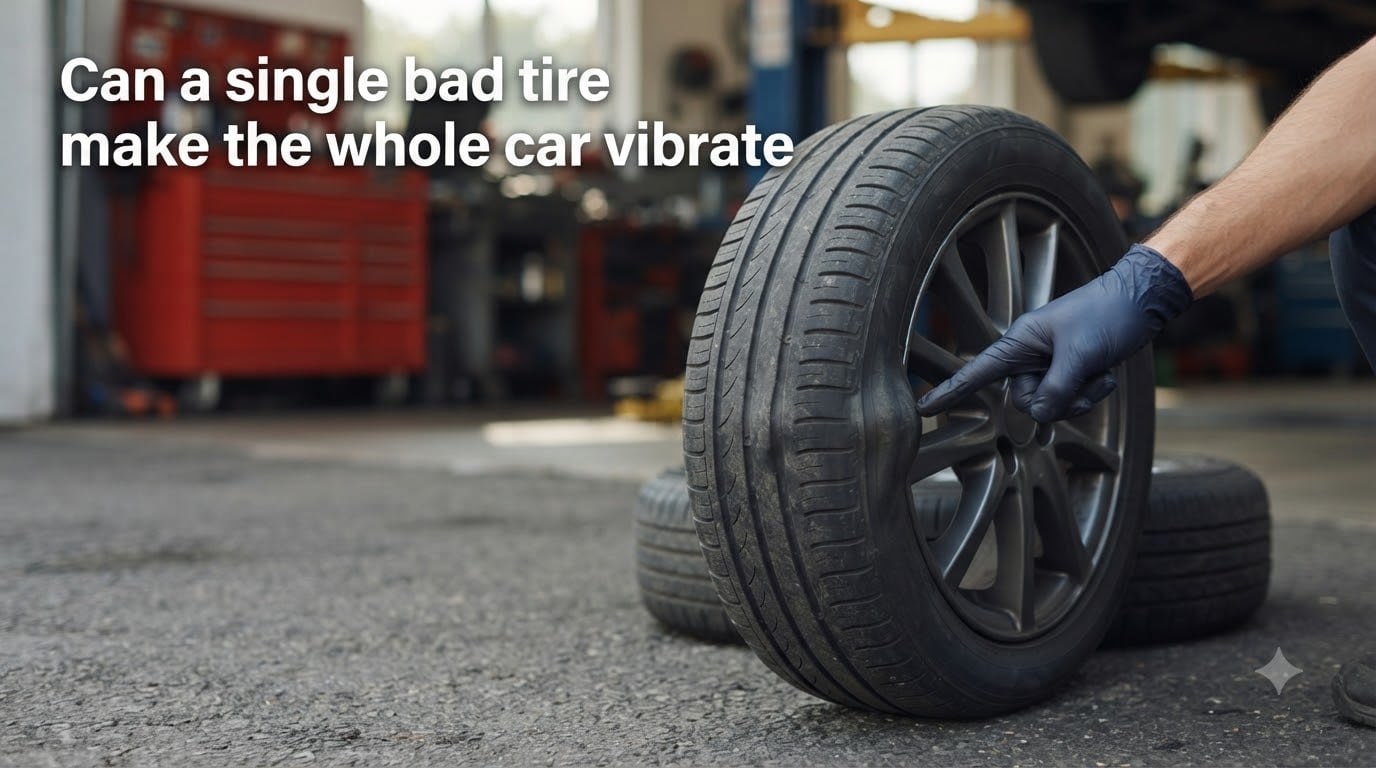
Yes – a single bad tire can absolutely make your whole car vibrate. One tire that is out of balance, out of round, has a shifted internal belt, a sidewall bulge, or separated tread creates a tiny rhythmic force every revolution, and that force travels up through your suspension into the steering wheel, seat, and floorpan.
I have worked on customer vehicles where the entire cabin shakes at highway speed, and a single $40 wheel balance on one corner fixed the problem. In this guide, our team walks you through the five defects that cause this, the exact swap test to find the bad tire in your own driveway, and the safety warning signs that mean you need to pull over right now.
Whether the vibration just started, has been creeping in for weeks, or appeared right after a shop installed a new tire, the answer is almost always one tire doing something wrong.
Table of Contents
Key Takeaways
- A single bad tire is enough to make your whole car shake – you do not need to replace all four.
- Imbalance, out-of-round, shifted belt, bulge, and uneven tread wear are the five defects to check for.
- Steering-wheel shake points to a front tire; seat or floorpan shake points to a rear tire.
- The swap test (rotate front-to-rear and re-drive) is the easiest DIY way to isolate the bad tire.
- Stop driving immediately if you see a bulge, exposed wire, or hear a rhythmic thud.
How a Single Bad Tire Causes Whole-Car Vibration
The mechanism is simple once you see it. Every tire has a tiny weight distribution that should be perfectly even around its circumference. When one tire is unbalanced, has a flat spot, or has a separated internal belt, that even distribution breaks.
At every single revolution of the wheel, the bad spot creates a small rhythmic force. Multiply that by 800 revolutions per minute at 60 mph, and the small force becomes a steady shake you feel through the steering wheel, the seat, and even the pedals.
The physics: tiny forces become big vibrations
A brand-new tire can be off by as little as a quarter-ounce in one spot. That sounds tiny, but at 60 mph a quarter-ounce imbalance is hit roughly 13 times every second. Suspension components amplify that hit, and the cabin of the car resonates with it.
This is why the vibration often feels bigger than the defect actually is. The tire itself may look perfectly fine. The damage is happening once per revolution, and the rest of the car is broadcasting it.
Why the vibration feels like the whole car is shaking
Your suspension, steering rack, and floorpan are all physically connected to each wheel. When one corner pulses, that pulse travels through metal arms, rubber bushings, and the chassis itself. The steering column picks it up. The seat tracks pick it up. Even the mirror vibrates.
So when you feel the whole car shake, you are not imagining it. One tire really is shaking the whole vehicle.
Why the vibration seems to come and go
You may have noticed the shake is worst at one speed and almost disappears at another. That is normal and is actually a useful clue. Tire vibrations are tied directly to wheel speed, so each defect has a signature speed range where it shows up loudest.
Road surface also matters. A smooth highway amplifies a balance problem; a rough back road masks it. Headwinds, crosswinds, and even the temperature of the tire (cold morning rubber is stiffer) can change how strongly you feel the shake.
5 Common Single-Tire Defects That Make Your Whole Car Vibrate
Here are the five physical defects that turn one tire into the source of a whole-car shake. Any one of them is enough on its own.
1. Tire imbalance
The most common cause of single-tire vibration. Even a small clump of extra rubber, a missing balance weight, or a slightly bent rim can put a tire out of balance. Imbalance almost always shows up between 50 and 70 mph.
2. Out-of-round tire
A tire that is not perfectly round pulses once per revolution. Factory defects, curb damage, or a pothole impact can flatten one section. An out-of-round tire often pulses at lower speeds than imbalance and may feel like a rhythmic thump.
3. Shifted belt or tread separation
This is the dangerous one. The steel and fabric belts inside a tire can shift during manufacturing or after a hard impact. When they shift, the tire is no longer uniform. Mechanics call this a “shifted belt” or “separated tire.” Reddit users on r/MechanicAdvice have reported shops saying they literally cannot balance the tire because the belt has moved inside it.
4. Sidewall bulge
A bulge means the internal cords have broken and air is pushing the sidewall out. Even a small bulge makes the tire hop slightly every revolution. A bulge is a blowout waiting to happen – more on that in the safety section below.
5. Uneven tread wear (cupping or feathering)
Cupping looks like scallops scooped out of the tread. Feathering means each tread block is sharper on one side than the other. Both create a rhythmic pulse once per revolution. Uneven wear usually points to a suspension or alignment problem that has damaged one specific tire.
Tire Imbalance: The #1 Cause of Whole-Car Vibration From a Single Tire
If you only read one section, read this one. Tire imbalance causes more single-tire vibration cases than any other defect.
What “tire balance” really means
A perfectly balanced tire has its weight distributed evenly around its center. In the factory, a technician mounts the tire and wheel on a spinning balancer. Tiny weights (clip-on or stick-on) are added to the rim to counter any heavy spots in the tire itself.
If a weight falls off, the tire was never balanced correctly, or the rim got bent, the balance is gone. Now one spot on the tire is heavier than the rest, and that heavy spot pulls the wheel down at every revolution.
How imbalance creates shake you feel in the seat and steering
When the heavy spot pulls down, the suspension compresses slightly. When the heavy spot rotates to the top, the suspension extends slightly. That up-and-down motion happens 10 to 15 times every second at highway speed.
Your body reads those tiny suspension movements as vibration. The steering wheel shakes because the tie rods and steering rack move with the wheel. The seat shakes because the floorpan moves with the suspension.
A simple wheel balance – usually 15 minutes and a small fee – fixes the vast majority of single-tire vibration cases.
Steering Wheel Vibration vs Seat Vibration: Which Tire Is to Blame
Where you feel the shake tells you which tire is the problem. Use this quick rule:
- Steering wheel shake – the bad tire is almost always on the front axle.
- Seat, floorpan, or pedal shake – the bad tire is almost always on the rear axle.
- Whole-body shake at any speed – severe imbalance or a serious defect on any corner.
Front tires are mechanically connected to the steering wheel through the tie rods and steering rack. Any pulse from a front tire shows up immediately in the wheel.
Rear tires are not connected to the steering, but they are connected to the chassis through the trailing arms and floorpan. Their pulses show up in the seat and pedals.
If the shake moves from the steering wheel to the seat after a front-to-rear rotation, the bad tire is now on the rear and you have just confirmed your swap test (more on that in a minute).
Why the Vibration Often Shows Up at Highway Speeds (60-70 mph)
Vibration that only shows up between 60 and 70 mph is the classic signature of a single tire problem.
Speed matters because of revolutions per minute
A tire that is even slightly out of round or unbalanced pulses once per revolution. At 30 mph, that pulse is slow and gentle – you barely feel it. At 60 mph, the pulse is happening 800 times a minute, right in the resonance range of most car suspensions. That is why 60 to 70 mph feels the worst.
At 75 mph and above, the pulses are happening so fast that they blur together into a hum rather than a shake. The vibration often feels like it goes away at very high speed, but it has just changed character.
Why low-speed vibration usually means something else
If you feel a strong shake at 20 to 30 mph, the cause is more likely a bent rim, a badly out-of-round tire, or a brake issue like a warped rotor. A simple balance problem usually stays quiet until 50 mph and up.
The Swap Test: How to Find the Bad Tire in Your Driveway
This is the single most useful piece of advice in this guide. Reddit users on r/MechanicAdvice have been recommending this test for years, and it works without paying a shop a dime.
You need a jack, a lug wrench, and a safe flat surface. Give yourself about 30 minutes.
- Mark each tire’s position. Use a piece of tape or chalk to mark “LF” (left front), “RF” (right front), “LR” (left rear), “RR” (right rear) on each tire before you remove it.
- Move the front tires to the rear. Swap the left front to the left rear position, and the right front to the right rear position. Keep them on the same side of the car.
- Move the rear tires to the front. Swap the left rear to the left front, and the right rear to the right front. Again, keep them on the same side.
- Torque the lug nuts to spec. Hand-tighten in a star pattern, then torque to your vehicle’s spec (usually 80 to 100 lb-ft for passenger cars).
- Drive at the vibration speed. Take the car on the same highway stretch where you felt the shake, ideally at the same speed (60 to 70 mph).
- Notice what changed. If the vibration moved from the steering wheel to the seat, the bad tire is now at the rear and was originally at the front. If the vibration is gone, one of the rear tires was the culprit. If nothing changed, the problem is not one specific tire – it is alignment, balance, or something else.
Several Reddit mechanics confirm this is the standard DIY diagnostic before you ever pay for a service. One user summed it up: “Swap your tires from front to back. If problem goes away, then the original position was the problem.”
Visual Tire Inspection Checklist: 8 Things to Look For Right Now
Before you even think about going to a shop, walk around your car and run through this list. You can do it in five minutes with no tools.
- Sidewall bulges or blisters. These look like round bubbles pushing out from the rubber. Stop driving immediately if you see one.
- Cracks in the sidewall. Small cracks mean dry rot. Deep cracks mean the tire is at the end of its life.
- Exposed wire or fabric. If you can see the cords, the tire needs to be replaced today.
- Nails, screws, or embedded objects. Check the tread carefully. A slow leak can mimic a balance issue.
- Uneven tread depth. Look across the tread. If one side is noticeably more worn than the other, you have an alignment or suspension issue that damaged one tire.
- Cupping or scalloping. Run your hand across the tread. If it feels like a washboard, you have cupped tires.
- Bald spots. A smooth patch anywhere on the tread is a sign of a balance or suspension problem.
- DOT date code. Look on the sidewall for “DOT” followed by a 4-digit code. The last 4 digits are the week and year of manufacture (for example, “1522” means week 15 of 2022). Most tire makers recommend replacement at 6 to 10 years regardless of tread depth.
Check Tire Pressure First: The Easiest Fix Most Drivers Skip
Before you blame a tire for being defective, check the pressure in all four. Low pressure changes the shape of the tire and can create the same rhythmic pulse as an out-of-balance tire.
You will find the correct pressure on a sticker inside the driver’s door jamb, not on the tire itself. The number on the tire sidewall is the maximum, not the recommended pressure.
Check pressure when the tires are cold (driven less than a mile or sat for 3 hours). A tire that is 5 psi low in one corner will cause a measurable vibration at highway speed. Filling all four to spec takes two minutes and a $10 gauge.
Why Your Car Vibrates After Replacing Only ONE Tire
This is one of the most common real-world scenarios we see, and almost no competitor article covers it. A driver gets a flat, replaces just one tire, and now the whole car vibrates at highway speed. Here is why.
The three remaining tires have worn-down tread. The new tire has full tread. When one corner of the car has a noticeably different tread depth, the rolling radius is different. That difference shows up as a rhythmic pulse, especially between 50 and 70 mph.
Tread pattern matters too. A user on Reddit’s r/MechanicAdvice replaced one Michelin Defender T+H with a Defender 2 and felt seat vibration within a day. The two tires looked similar but had different tread block designs, and the difference was enough to create vibration.
What to do: ideally, replace tires in pairs (both fronts or both rears). If you can only replace one, ask the shop to mount the new tire on the rear axle for safety, and accept that you may feel some vibration until the other three wear down to match.
When the Vibration Is Not the Tires at All
Sometimes one bad tire is the wrong answer. Before you replace a tire, rule out these other common causes.
Bent rim
Hit a pothole recently? A bent rim creates the exact same symptom as an out-of-balance tire. Visually inspect the rim for a wobble, and watch the tire while the car is on a lift – if the rim is bent, the tire will wobble visibly.
Wheel bearing failure
A worn wheel bearing usually makes a humming or growling noise that changes with speed, and the noise gets louder when you turn. If you hear noise plus feel vibration, suspect the bearing.
Warped brake rotor
If the vibration only happens when you press the brake pedal, the rotor is warped. Rotors can be resurfaced or replaced; this is unrelated to the tires.
Loose lug nuts
A loose lug nut lets the wheel wobble on the hub. Check torque after any tire service. If a lug nut is missing entirely, do not drive the car.
Worn suspension or alignment
Worn bushings, ball joints, or struts can let the wheel move in ways that create vibration. If your tires are wearing unevenly (cupping, feathering, inner-edge wear), the suspension is usually the root cause and the tire is just the messenger.
How Much Will the Fix Cost? Balance vs Rotation vs Alignment vs New Tire
Cost transparency matters when you are trying to decide whether to go to a shop. Here are typical ranges for the four most common fixes.
- Wheel balance (per tire): the cheapest fix and the most common solution for single-tire vibration.
- Tire rotation: moving tires front-to-rear to even out wear; inexpensive and quick.
- Wheel alignment (2-wheel or 4-wheel): more involved; corrects toe, camber, and caster angles.
- New single tire: the most expensive option; necessary for bulges, separated tread, or worn-out rubber. Always replace in pairs when possible.
- New set of four tires: required when the existing tires are worn, when you need matching tread depth across all corners, or when the vehicle is AWD.
Ask the shop for an itemized estimate. A reputable shop will tell you whether you need a balance, a rotation, an alignment, or a replacement – not just sell you the most expensive option.
Is It Safe to Drive With One Bad Tire? When to Stop Immediately
This is the most important question in this guide, and the answer depends on what kind of “bad” the tire is.
Safe to drive short term: minor imbalance, slight uneven wear, or low pressure. Get to a shop within a few days but you are not in immediate danger.
Stop driving as soon as possible: exposed wire or fabric, deep sidewall cracks, or a tire older than 10 years. These are failure warnings, not cosmetic issues.
Stop driving immediately and call a tow truck: sidewall bulge, fast leak, rhythmic thumping that gets louder every minute, or visible tread separation. A bulge means the internal cords have broken, and the tire can blow out without warning, especially at highway speed. A blowout at 65 mph can cause loss of control.
When in doubt, slow down, pull over, and call for help. The cost of a tow is always less than the cost of an accident.
Frequently Asked Questions
Will one bad tire cause vibration?
Yes. A single tire that is out of balance, out of round, has a shifted belt, a bulge, or separated tread creates a rhythmic pulse at every revolution. That pulse travels through the suspension into the steering wheel, seat, and floorpan, making the whole car feel like it is shaking.
What causes the whole car to vibrate?
The most common causes are tire imbalance, an out-of-round tire, a shifted or separated internal belt, a sidewall bulge, and uneven tread wear like cupping or feathering. Non-tire causes include a bent rim, worn wheel bearing, warped brake rotor, loose lug nuts, and worn suspension components.
Should I drive my car if it is vibrating?
It depends on the cause. Minor imbalance or low pressure is safe for short trips to a shop. Stop driving immediately if you see a bulge, exposed wire, fast leak, or hear a rhythmic thump that grows louder. These are blowout warnings and the tire can fail without notice, especially at highway speed.
Why is my car vibrating at 70 mph while I am driving?
Vibration that peaks between 60 and 70 mph is the classic signature of a tire defect. A tire that is off by even a quarter ounce pulses once per revolution, and at 70 mph the wheel is rotating roughly 13 times per second. That pulse falls right in the resonance range of most car suspensions, which is why the shake feels so strong at highway speed.
Why does my tire vibration come and go?
Tire vibration is tied to wheel speed, so each defect has a signature speed where it shows up loudest. Road surface, wind, and tire temperature also change how strongly you feel the shake. A smooth highway amplifies a balance problem, while a rough back road can mask it entirely.
Can unbalanced tires cause serious shaking?
Yes. Even a small imbalance of a quarter ounce creates a measurable pulse at highway speed. After hundreds of revolutions per minute, those pulses add up to a serious shake you feel in the steering wheel, seat, and pedals. A simple wheel balance fixes the vast majority of these cases.
So, can a single bad tire make the whole car vibrate? Yes – one tire is all it takes. Start with the cheap fixes first: check pressure in all four tires, run through the 8-point visual inspection, and do the swap test to isolate the bad corner. If the shake is still there after a balance, the tire likely has a defect that means replacement. For anyone in the situation we described, a quick trip to a trusted shop with the swap-test result in hand will save diagnostic time and money.