
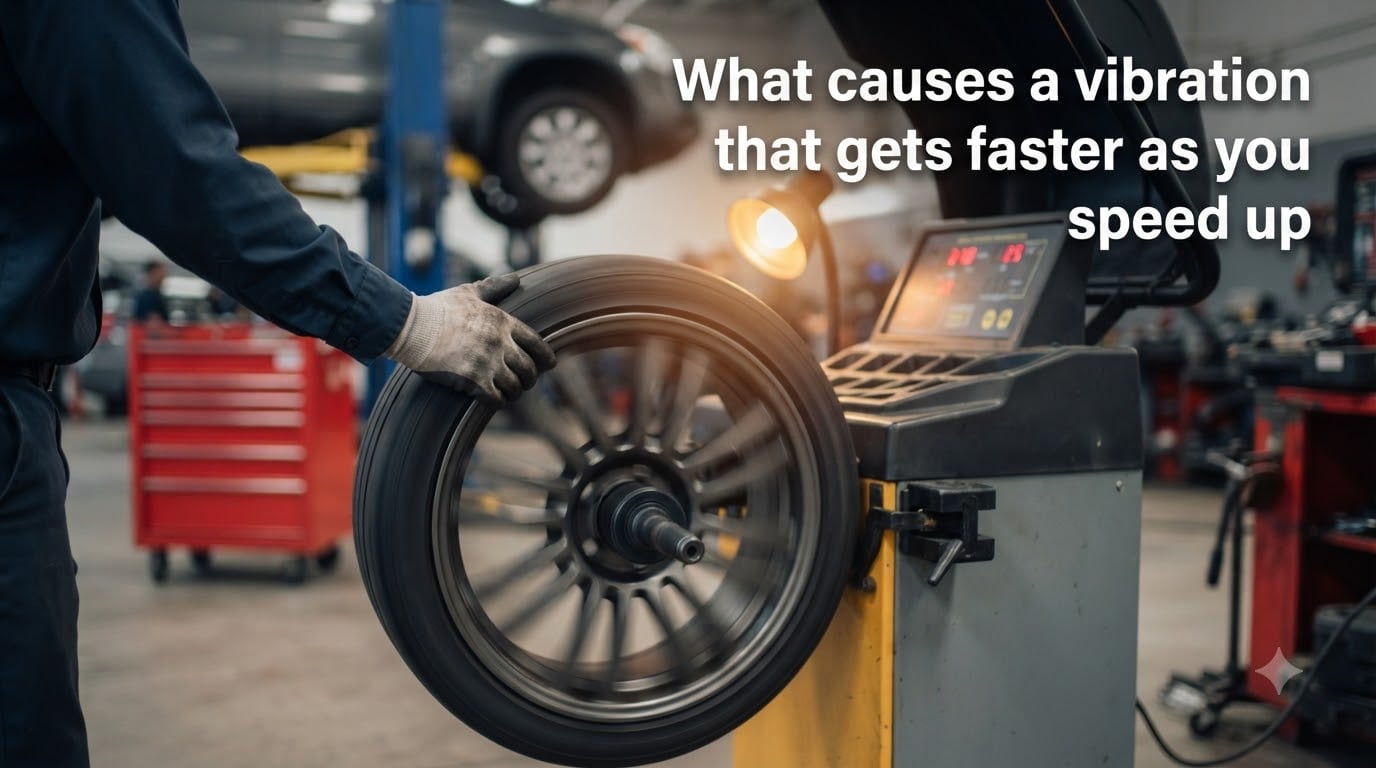
A vibration that gets faster as you speed up is almost always caused by something rotating unevenly. The most common culprits are unbalanced tires, bent rims, uneven tire wear, or worn wheel bearings. As the wheel spins faster, the imbalance creates more pulses per second, so the shake gets quicker and stronger with speed.
That physics matters because it narrows the search. Speed-proportional vibration is mechanical and rotational, while vibration that appears only under acceleration tends to be drivetrain-related. Knowing which one you have can save you a trip to the wrong specialist and a lot of diagnostic time.
In our shop we see this complaint every week. Drivers describe it as "shimmy at 60," "the steering wheel buzzes above 50 mph," or "the floor shakes when I push the gas." The good news: most causes are inexpensive. The bad news: a few are safety issues that need attention now, not later. This guide walks through all of them, in plain English.
Table of Contents
Common Causes at a Glance
Scan this table first. Match your symptom to the most likely cause, then read the matching section below for the fix.
| Symptom | Most Likely Cause | Typical Fix |
|---|---|---|
| Steering wheel shakes above 50 mph, smooth below 30 | Unbalanced tire or bent rim | Tire balance, road-force balance, wheel replacement |
| Vibration at highway speed in seat and floor, not steering wheel | Out-of-balance rear tire or worn tire | Balance all four corners, replace tire |
| Shake starts under acceleration, mostly stops when coasting | CV joint, driveshaft, or motor mount | Replace CV axle, U-joint, or engine mount |
| Rough idle with flashing check-engine light and a shake | Engine misfire (spark plug, coil, fuel injector) | Diagnose code, replace plugs/coils/injector |
| Steering wheel shimmy plus grinding or humming that grows with speed | Worn wheel bearing | Replace bearing (per wheel) |
| Steering wheel pulse only when braking | Warped brake rotor | Resurface or replace rotor and pad |
| Vibration appears only after new tires installed | Lug-centric mounting issue or improper balance | Re-torque lugs, road-force balance |
| Car pulls plus vibration, worse on crowned roads | Wheel alignment or bent suspension component | Four-wheel alignment, replace worn part |
Speed-Dependent vs Load-Dependent Vibration: How to Tell the Difference
Here is the single most useful question to ask yourself: does the shake change when you let off the gas?
Speed-dependent vibration stays roughly the same whether you are on the gas, coasting, or braking. The intensity rises with road speed because the rotating part (tire, wheel, brake rotor, bearing) is spinning faster. Tires, wheels, wheel bearings, and brake rotors live in this category.
Load-dependent vibration shows up or gets worse when you press the gas, and it fades or disappears when you coast. Engine torque is twisting a worn or loose component, so it only acts up under power. CV joints, driveshafts, U-joints, motor mounts, and transmission mounts fall here.
The exception is engine misfire, which behaves a bit differently. A misfire is tied to engine RPM, not vehicle speed. If the shake tracks the tachometer, not the speedometer, suspect spark plugs, ignition coils, or fuel delivery. We will come back to that distinction in the engine section.
A quick mental test: drive at a steady 45 mph and note the vibration. Then drive at 45 mph in a lower gear so the engine spins faster but the wheels stay the same speed. If the shake is the same, it is speed-dependent. If it gets worse with the higher RPM, it is engine or load-related. That one test rules out half the parts list.
Tire and Wheel Problems (The Most Common Cause)
Tire and wheel issues are responsible for the majority of speed-proportional vibration we see at American Tire. They are also the cheapest to fix, which is why we start here.
An unbalanced tire has a heavy spot. As it rotates, that heavy spot pulls outward once per revolution, creating a small rhythmic shake. At 30 mph the shake is gentle because the wheel turns about 11 times per second. At 60 mph it turns about 22 times per second, doubling the pulses and quadrupling the energy the imbalance throws at the suspension. That is why the same tire can feel fine around town and awful on the highway.
Tire Balance
A standard spin balance measures static and dynamic imbalance and adds weights to compensate. For most tires, this is enough. For modern stiff-sidewall tires, low-profile performance tires, and run-flats, it is often not enough. Those tires can have a heavy spot in the carcass that a regular balance cannot fix. That is where road-force balancing comes in, and we cover it in its own section below.
Uneven Tire Wear
Cupping, feathering, or scalloped wear patterns create their own out-of-round geometry. A tire with worn patches acts like a slightly egg-shaped wheel, throwing a vibration once per revolution. Cupping usually points at a suspension or balance problem that has already been ignored. Feathering often traces back to an alignment issue.
Bent Wheel or Damaged Tire
Hitting a pothole or curb can bend a rim slightly without you noticing visually. A small lateral run-out in the rim makes the tire hop as it rotates. Sidewall bulges, impact damage, or a separated belt do the same thing more dramatically. The classic field test is to swap the suspect and right wheel with the spare and see if the vibration moves to the other corner.
Tire Pressure and Tire Age
Low pressure changes the tire shape and can amplify vibration. Old tires (six years or more) harden as the rubber outgases its oils, and a hardened tire transmits more road noise and vibration through the chassis. There is no cheap fix for an aged tire besides replacement.
Why Balanced Tires Still Shake: Road-Force Balancing and Lug-Centric Mounting
This is the most frustrating scenario in our shop. A customer brings the car back two days after a balance and says it still shakes. Nine times out of ten, the balance was technically correct but the tire still has a hidden problem.
Road-Force Balancing
A road-force balancer is a different machine. It presses a loaded roller against the spinning tire to measure how the tire and wheel assembly deflects under real-world load. It finds heavy spots the regular balance cannot see and pairs the tire to the wheel so the stiffest spot of the tire aligns with the lightest spot of the wheel. For high-performance, run-flat, and low-profile tires, road-force balancing routinely solves vibrations that two or three regular balances could not.
Lug-Centric Mounting and Torque
Most modern cars are hub-centric: the wheel is centered by the hub, not by the lugs. If the wheel is mounted on the balancer cone but then installed on the car off-center, it will wobble even though the wheel-tire assembly itself is in balance. Likewise, lug nuts torqued unevenly (some too tight, some too loose) distort the wheel slightly. The fix is to torque lugs to spec in a star pattern, not in a circle, and to use a torque wrench rather than an impact gun for the final pass. Tire Review and several forum threads confirm this is a leading cause of vibration that appears right after a fresh tire install.
Drivetrain: CV Joints, Driveshaft, and Motor Mounts
Drivetrain vibration is the load-dependent cousin of tire vibration. It tends to show up under acceleration and quiet down when you coast.
CV Joints and Axles
Worn CV joints are the textbook cause of acceleration-only vibration, especially in front-wheel-drive cars. The inner or outer joint is filled with grease and held together by a boot. When the boot cracks, grease leaks out, and the joint starts to wear. A failing outer CV joint produces a clicking on turns, while a failing inner joint produces a shudder under load. A torn boot caught early is an inexpensive repair. A worn joint that is ignored will leave you stranded.
Driveshaft and U-Joints
Rear-wheel-drive and all-wheel-drive vehicles use a driveshaft with universal joints. Worn U-joints cause vibration that comes and goes with throttle. A bent driveshaft or a missing balance weight on the shaft itself produces the same symptom at a specific speed. Driveshaft work is a specialty job, but it is well within a competent shop’s reach.
Motor Mounts and Transmission Mounts
Motor mounts are rubber-and-metal cushions that hold the engine to the frame. Over time the rubber cracks and the mount deflects. Under hard acceleration, the engine twists and the worn mount lets it move enough to shake the whole car. The vibration often goes away the instant you lift off the gas, which is the clearest signal that mounts are the problem. Replacing mounts is a moderate job and well worth it for a smooth idle and crisp shifts.
Engine Misfires, Wheel Bearings, and Brake Rotors
Three more causes that fit the speed-proportional pattern but live in different systems.
Engine Misfires
A misfiring cylinder skips combustion. The engine momentarily loses power, the crankshaft slows slightly, and you feel a shake that pulses with engine RPM rather than wheel speed. Spark plugs, ignition coils, bad fuel injectors, vacuum leaks, and low fuel pressure all cause misfires. The check-engine light will usually flash. Read the code first; it points directly at the cylinder or system to check. Misfires damage the catalytic converter if ignored, so do not sit on this one.
Wheel Bearings
A wheel bearing lets the wheel spin smoothly on the hub. As it wears, it gets rough. You will hear a hum or growl that increases with speed and changes when you swerve (the loaded bearing changes tone). Once it gets bad enough, the bearing loosens and the wheel develops a slight wobble, which is the speed-proportional shake. Wheel bearing replacement is a per-wheel job, not a four-wheel job, and one bad bearing does not mean replacing all four.
Brake Rotors
Brake rotors can warp from heat or develop thickness variation from uneven pad wear. The symptom is unique: the steering wheel pulses only when you press the brake pedal. Releasing the brake makes the shake go away instantly. Resurfacing the rotors (or replacing them) along with a fresh set of pads is the standard fix. Cheap pads can also transmit a vibration if the pad material is uneven; quality pads and properly seated rotors fix it.
Suspension and Alignment
Alignment issues typically cause the car to pull, drift, or wander, not to shake. But a badly misaligned car can develop uneven tire wear fast, and the worn tires then create the vibration. So alignment is often part of the chain, even if it is not the first link.
Worn suspension parts also contribute. A worn ball joint, a cracked control arm bushing, a sagging strut, or a loose tie rod end lets the wheel move slightly under load. At highway speed, that small extra movement becomes a vibration. The classic sign is a shake that appears at a specific speed range and stays there until you slow down significantly.
Four-wheel alignment after any suspension repair or new-tire install is cheap insurance. It extends tire life, prevents the kind of uneven wear that causes vibration in the first place, and makes the car drive the way it was designed to.
5 DIY Checks Before You Go to a Shop
These five checks take about 20 minutes, cost nothing, and often identify the cause before you pay for a diagnostic.
- Check tire pressure on all four corners plus the spare. A single low tire changes the wheel’s effective diameter and can create a noticeable shake above 50 mph. Inflate to the door-sticker spec, not the number on the tire sidewall.
- Look at each tire visually. Walk around the car and look for bulges, cracks, foreign objects, or uneven tread wear. Run your hand across the tread to feel for cupping or feathering.
- Watch the wheels spin on the balancer. If your shop has a road-force balancer, ask them to run each tire. The chalk marks show where the tire and wheel meet the roller. Visual confirmation builds trust.
- Try a wheel swap test. Move the front tires to the rear (a standard rotation pattern). If the vibration moves to the rear, the front tires were the problem. If it stays in the steering wheel, the issue is rear-end or suspension.
- Torque your lug nuts correctly. After any tire work, re-torque the lugs to the spec in your owner’s manual using a star pattern and a calibrated torque wrench. This single step eliminates a surprisingly large share of post-installation vibration complaints.
When It Is Unsafe to Keep Driving
Most vibration is annoying, not dangerous. A few patterns are not.
Pull over and arrange a tow if the steering wheel suddenly develops a violent side-to-side shake at highway speed. That can be a separated tire, a broken belt, or a failing wheel bearing that is about to lock up.
Stop driving if you hear loud clunking from a wheel along with the vibration. That is often a broken ball joint or control arm, and the wheel can fold back under braking.
Get a same-day diagnostic if the brake pedal pulsates hard and the car pulls to one side under braking. That points at a severely warped rotor or a stuck caliper, both of which can lengthen stopping distance.
For everything else, the car is usually safe to drive at reduced speed until you can get it looked at. Avoid highway speeds until you know what is going on. The repair is almost always cheaper than the secondary damage caused by ignoring the symptom.
Frequently Asked Questions
Can unbalanced tires cause vibration when accelerating?
Yes. An unbalanced tire creates a small shake every revolution. Under acceleration the engine torque loads the suspension and amplifies the vibration, so the shake feels worse when you press the gas. Balance the tires first; if the shake stays, check the CV joints and motor mounts.
Why does my car vibrate after wheel balancing?
A standard balance fixes weight distribution but does not measure tire stiffness under load. On stiff-sidewall, low-profile, or run-flat tires a road-force balance is needed. Lug-centric mounting and uneven lug torque can also re-introduce vibration right after a fresh balance.
Why does my car feel like it is vibrating when I accelerate?
Acceleration loads the drivetrain. Vibration that appears under acceleration and fades when you coast is almost always load-dependent: CV joints, driveshaft U-joints, or motor mounts. Vibration tied to engine RPM rather than speed points at a misfire instead.
Why does my car shake when I accelerate but not when I coast?
That is the textbook load-dependent pattern. The engine torque is twisting a worn or loose component. The most common causes are CV axles on front-wheel-drive cars, U-joints on rear-wheel-drive cars, and cracked motor mounts. The vibration going away when you lift off the gas is the strongest single clue.
Why does my car vibration increase with speed?
Every wheel revolution creates one pulse. At 30 mph the wheel turns about 11 times per second. At 60 mph it turns about 22 times per second, so you feel twice as many pulses per second and four times as much energy. The vibration gets both faster and stronger with speed for that reason.
Does tire balancing help with vibration?
Yes, in most cases. A proper balance eliminates the heavy-spot pulse that creates highway-speed shake. If a regular balance does not fix it, ask for a road-force balance, which measures tire stiffness under load and pairs the tire to the wheel for a smoother result.
Can wheel alignment cause vibration at high speed?
Alignment itself rarely causes vibration directly, but it causes the uneven tire wear that causes vibration. A car with bad alignment can scrub the front tires into a cupped or feathered pattern within a few thousand miles, and the worn tires then shake at highway speed.
Why is my car vibrating at high speeds after I changed the tires?
The three most common reasons are loose lug nuts that need re-torquing in a star pattern, a wheel not centered on the hub during mounting, and a balance that did not account for tire stiffness. A road-force balance and a re-torque to spec fix most post-installation vibration complaints.
Bottom Line: What a Vibration That Gets Faster With Speed Is Telling You
A vibration that gets faster as you speed up is your car telling you that something is rotating out of spec. The faster you go, the louder that signal becomes.
Start with the tires and wheels. They cause the majority of speed-proportional vibration, and they are the cheapest to fix. If a regular balance does not solve it, ask for a road-force balance and check the lug torque. From there, move to wheel bearings, brake rotors, and suspension components.
If the shake only shows up under acceleration, look down the drivetrain: CV joints, driveshaft U-joints, and motor mounts. If the shake tracks the tachometer instead of the speedometer, suspect a misfire and pull the engine codes before changing parts.
When in doubt, bring it to a shop that will road-test the car with you, watch the wheels spin on the balancer, and walk you through what they find. A good diagnostic beats guessing every time, and your car will tell you everything you need to know if you give it the chance.