
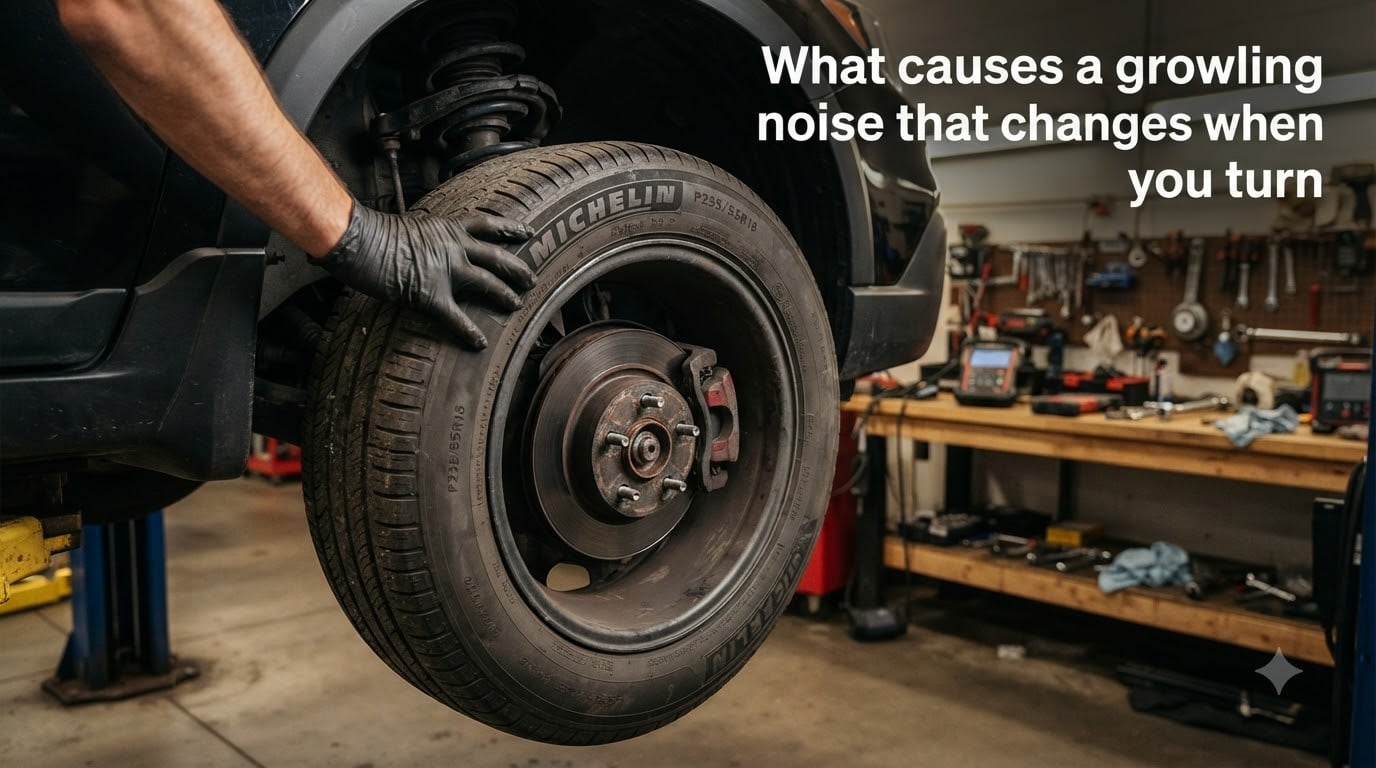
A growling noise that changes when you turn is almost always caused by a worn wheel bearing, a failing CV joint, or a power steering problem. Turning shifts load and angle onto the suspect part, which is why the sound gets louder or quiets down depending on direction.
I have spent years chasing these noises on customer cars and on my own vehicles, and the same rule keeps holding up: the noise that gets louder in one direction points to that side’s wheel, axle, or steering component. In this guide, I will walk you through the five most common causes, the diagnostic shortcuts that actually work, and a clear safety answer for each scenario.
By the end, you will know exactly what is going on under your car and whether you can keep driving it.
Table of Contents
Start With When It Happens: The Quick Diagnostic
The fastest way to narrow down a growling noise when turning is to ask one question: does it change with vehicle speed, with engine RPM, or only when the steering wheel moves? Each answer points to a different system.
If the noise is speed-dependent (louder the faster you drive, regardless of RPM), the problem lives in the wheels, hub bearings, or tires. If it only shows up when the steering wheel turns and quiets when you drive straight, you are looking at the steering system or CV axles. If it tracks the engine RPM and gets louder as you accelerate, the source is in the engine bay.
Quick Lookup: Noise Condition vs Likely Cause
- Loud growling in one direction only, quieter in the other: wheel bearing on the loud side, or CV joint on the opposite side.
- Clicking or popping in tight turns at low speed: bad CV joint (classic symptom on FWD cars).
- Whining or groaning when turning the wheel while parked: low power steering fluid or a failing pump.
- Scraping or rattling that comes and goes: bent brake dust shield (the cheap fix everyone forgets).
- Grinding that gets louder with engine RPM, not speed: water pump, alternator, or AC compressor bearing.
Forum regulars at Bob Is The Oil Guy have a saying: if the noise changes with vehicle speed and not engine RPM, it is in the wheel or hub area, not the engine bay. One Reddit user on r/Cartalk confirmed this by driving in neutral with the engine off and still hearing the growl.
CV Joint and CV Boot Failure: The Most Common Cause on Front-Wheel Drive
A worn CV joint is the number one cause of growling, clicking, or popping when turning on front-wheel-drive cars. CV (constant velocity) joints transfer power from the transmission to the wheels, and they work at sharp angles every time you turn the steering wheel.
When the rubber CV boot tears, grease leaks out and dirt works in. Within a few thousand miles, the joint wears and starts making noise. Cold weather and road salt accelerate this dramatically, which is why Northern cars fail CV boots faster than Southern ones.
How to Tell a CV Joint From a Wheel Bearing
The classic CV joint symptom is a clicking or popping sound that happens only in tight, low-speed turns, especially when you pull out of a parking spot. A wheel bearing usually produces a steady hum or growl that changes with vehicle speed, not steering angle.
If the noise gets louder when you turn left, the failing CV joint is most likely on the right side, because turning left loads the right axle. The reverse is also true. This rule surprises people, but it is one of the most reliable diagnostic shortcuts in the trade.
One Reddit user replaced both a wheel bearing and a hub assembly and the growl got quieter but did not go away. The leftover noise turned out to be the drive axle itself. If a wheel bearing replacement does not solve the problem, do not assume the parts are bad; look at the axle next.
Wheel Bearing Diagnosis: Load-Dependent Growling That Gets Louder
A worn wheel bearing produces a steady, low-pitched growl or roar that gets louder as speed increases. The defining feature is that turning changes the volume: the growl is loudest when the failing bearing is loaded, which happens on the outside wheel during a turn.
If the noise gets louder turning right, the bad bearing is on the right side. If it gets louder turning left, the bad bearing is on the left. Load-dependent noise is the giveaway.
The DIY Wheel Play Test
You can confirm a bad bearing at home in five minutes with the wheel play test.
- Jack up the suspect corner of the car and support it on a jack stand.
- Grasp the tire at the 12 and 6 o’clock positions and try to rock it in and out.
- Then grasp at 9 and 3 o’clock and rock it side to side.
- If you feel any clunk, click, or play, the wheel bearing or a ball joint is worn.
- Spin the wheel by hand; a healthy bearing spins silently, a failing one grumbles or feels rough.
If both tests point to the same wheel, you have your answer. If only the side-to-side test shows play, suspect a ball joint or tie rod end instead of the bearing.
Power Steering System Issues: Low Fluid, Failing Pump, or Electric Steering
Power steering problems usually show up as a whining, groaning, or creaking noise when you turn the steering wheel, especially at low speeds or while the car is parked. The sound gets louder as you turn the wheel all the way to one side because that is when hydraulic pressure peaks.
The most common cause is simply low power steering fluid. Check the reservoir under the hood; if the level is below the MIN line, top it up and see if the noise goes away. Leaks often show up as wet spots on the ground overnight, so look for that too.
If the fluid is full and the noise persists, the pump itself is wearing out. Pumps use internal vanes that wear down over time and start making a louder whine as they age. A failing pump typically gets worse gradually over months, not overnight.
Hydraulic vs Electric Power Steering
Older cars and most trucks use hydraulic power steering with a pump and fluid. Newer cars, especially hybrids and small sedans, use electric power steering (EPS), which has no pump, no fluid, and no hoses. If you have EPS and hear a groan when turning, the electric motor in the steering column is the likely culprit, not a fluid issue.
A failing steering rack usually makes a clunk or thud when you turn, not a steady growl. If you feel play in the steering wheel or the car wanders on the highway, the rack itself may be worn, which is a bigger repair.
Brake Dust Shield, Strut Mount, and Suspension Components
Not every growling noise is expensive. The cheapest and most overlooked cause is a bent brake dust shield. This thin metal disc sits behind the rotor and protects it from debris. It is easy to bend by hitting a curb or even a steep driveway, after which it rubs the rotor with every rotation and sounds like a bearing.
You can fix a bent dust shield with a pair of pliers in about ten minutes. Reach behind the rotor and bend the shield back so it no longer contacts the rotor surface. If the noise disappears, you just saved yourself a large repair bill.
Strut Mount Bearing Wear
The strut mount sits at the top of the front suspension strut, right under the spring. It contains a bearing that lets the strut rotate as you turn the steering wheel. When that bearing wears out, you hear a creaking, popping, or growling noise that is loudest during low-speed turns, especially over bumps.
Strut mounts typically last 80,000 to 150,000 miles, so age matters. If your car has higher mileage and the noise correlates with steering input, this is a strong candidate.
Ball Joints and Tie Rod Ends
Worn ball joints usually clunk over bumps rather than growl, but they can produce a faint grinding sound on rough roads. A failing tie rod end makes the steering feel loose and causes uneven tire wear; the noise alone is rarely the main symptom. If your steering feels vague or your tires are wearing oddly, have these checked.
Engine-Bay Causes: Water Pump, Alternator, and AC Compressor
If the noise tracks the engine RPM instead of vehicle speed, the source is in the engine bay. The three usual suspects are the water pump, alternator, and AC compressor, all of which use bearings that wear out and growl as engine speed rises.
The fastest way to isolate which one is failing is to remove the serpentine belt briefly and run the engine for a few seconds. With the belt off, the water pump, alternator, and AC compressor are no longer spinning. If the noise is gone, one of those three is the culprit. If it remains, look elsewhere.
Water pump failures often come with a coolant leak or an overflowing reservoir. Alternator whine usually changes when you turn on electrical loads like the headlights or rear defroster. AC compressor noise typically only happens when the AC is engaged.
Why the Noise Changes Between Left and Right Turns
When you turn left, your car’s weight transfers to the right side of the vehicle, loading the right wheel bearing and right CV joint. The reverse happens when you turn right. This weight transfer is why a growling noise often sounds louder in one direction than the other.
This rule works for both FWD and RWD cars, but it matters more on FWD cars because both the CV joints and the wheel bearings are involved. On RWD cars, the rear axle and differential can also produce noise under load, which adds another variable.
Front-Wheel Drive vs Rear-Wheel Drive
On FWD cars, the CV joints are the most common source of growling during turns because they work at the steepest angles. On RWD cars, the differential and rear axle bearings are more often the cause, especially when accelerating through a turn. If you drive an AWD or 4WD vehicle, all of these systems are in play, and the diagnosis gets more involved.
Is It Safe to Drive With a Growling Noise When Turning?
That depends entirely on what is causing it. Here is the urgency tier system I use with my own customers.
Tow It: Stop Driving Immediately
If you hear loud grinding, feel vibration in the steering wheel, smell burning, or see any fluid leaking under the car, stop driving and have it towed. A seizing wheel bearing can lock up a wheel at highway speed, and a sudden loss of power steering at low speed can cause a crash in traffic.
A torn CV boot with grease flung around the inside of the wheel is also a stop-driving condition if the boot is flapping. A boot left open will destroy the joint within a few hundred miles.
Get It In Soon: Within a Week or Two
A steady growl that is consistent but does not change quickly is usually a wheel bearing in the early stages of failure. You can drive it to work and to the shop, but do not take a long highway trip or carry heavy loads until it is fixed. Bearings fail progressively, and the timeline is usually weeks to a few months, not days.
A whining power steering pump falls in this category as long as you have fluid in the reservoir. Top it up and book an appointment.
OK for Now: Schedule at Your Convenience
A bent brake dust shield, a worn strut mount that only creaks over speed bumps, or a faint hum that disappears above 30 mph are all in the green zone. You are not in danger, but you should still get them addressed within a few months to avoid secondary damage.
DIY Diagnostic: Engine-Off in Neutral Test
If you are still not sure whether the noise is from the engine bay or the wheels, try the engine-off test.
- Find a flat, empty parking lot or quiet street.
- With the engine running, coast at about 25 mph in neutral and listen for the noise.
- Shift into neutral and turn off the engine (only if safe and on a flat surface).
- Coast down from 25 mph and keep listening.
- If the noise is still there with the engine off, it is in the wheels, hubs, or brakes.
- If the noise disappears when the engine is off, it is in the engine bay accessories.
This is the exact test forum members on r/Cartalk and Bob Is The Oil Guy use to isolate the source, and it works on cars from the 1990s to the latest models.
Repair Cost Ranges by Cause
Costs vary widely by vehicle, but here are typical ranges for common causes based on what I have seen across hundreds of repairs. Use these as a sanity check, not a quote.
- Wheel bearing replacement: parts and labor for a single front wheel bearing usually runs in the low to mid hundreds of dollars; rear bearings are similar. Hub assemblies that combine the bearing and sensor cost more but install faster.
- CV joint replacement: a new CV axle (the most common repair) typically runs in the same range as a wheel bearing. Replacing just the boot is cheaper but only works if the joint itself is still clean.
- Power steering pump: parts alone are often under two hundred dollars, but labor brings the total higher because the pump sits in a tight spot on many engines.
- Strut mount: parts are usually modest, but because the strut has to come out and be reassembled, labor adds up. Many shops press in the new mount on the existing strut.
- Brake dust shield repair: effectively free if you do it yourself; a shop might charge a small diagnostic fee if you ask them to bend it back.
- Water pump, alternator, AC compressor: these are bigger jobs, often running higher than the others, but they also last longer once replaced.
Frequently Asked Questions
Why does my car growl when I turn it on?
A growl that starts the moment you turn the key usually points to the starter motor, the alternator, or the serpentine belt tensioner. If the growl continues while idling and goes away with the belt removed, the alternator or one of the belt-driven accessories is the cause. If it goes away once the engine is running, the starter is worn.
What does a failing steering rack sound like?
A failing steering rack usually makes a clunk or thud when you turn the wheel, especially over bumps or at low speed. A steady whine or groan usually points to the power steering system rather than the rack itself. If you feel play in the steering wheel or the car wanders, the rack is more likely the cause than a pump.
Is it safe to drive when the steering wheel makes noise when turning?
It depends on the noise. A faint creak or groan from a worn strut mount or low power steering fluid is safe to drive on for now. A loud grind, a clunk with steering play, vibration in the wheel, or a burning smell means stop driving and tow it. A seizing wheel bearing or failed power steering can cause loss of control.
What noise does a bad ball joint make when turning?
A bad ball joint typically makes a clunk or pop when you turn the steering wheel, especially at low speed over bumps. It rarely produces a steady growl; that is more often the wheel bearing. If you hear a clunk that gets louder in turns and the front tires are wearing unevenly, have the ball joints inspected.
Final Thoughts on Diagnosing a Growling Noise When Turning
A growling noise that changes when you turn almost always comes down to one of five things: a wheel bearing, a CV joint, the power steering system, a brake dust shield, or an engine accessory. Start with the speed test: if the noise tracks vehicle speed, look at the wheels and axles; if it tracks engine RPM, look at the belt-driven accessories.
If turning left makes it louder, focus on the right side. If turning right makes it louder, focus on the left side. That one rule, plus the wheel play check and the engine-off test, will get you to the right answer in almost every case. When in doubt, get the car up on a lift and have a trusted shop confirm before you commit to a repair.