
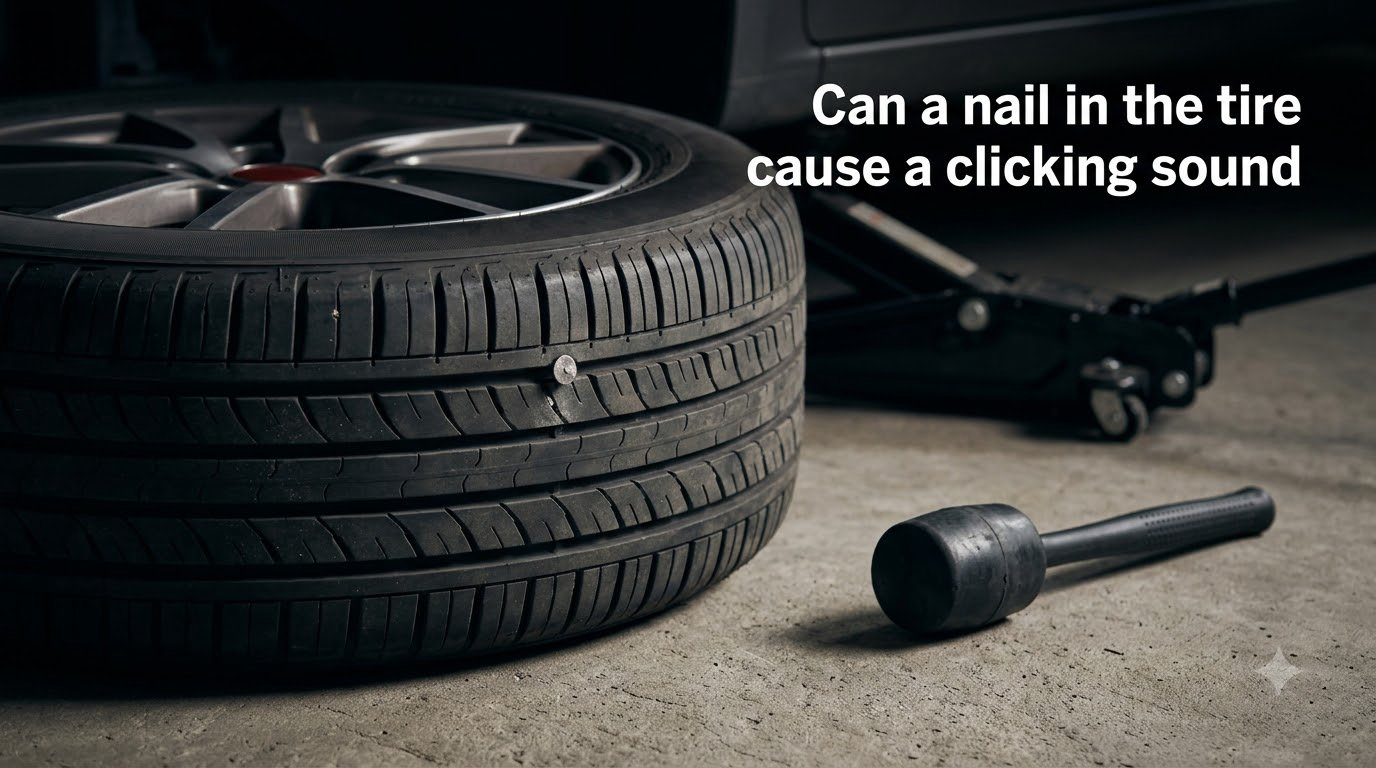
Yes, a nail in your tire can absolutely cause a clicking sound. When a nail, screw, or piece of metal becomes embedded in your tire tread, the exposed head strikes the pavement with every rotation, producing a rhythmic tapping or clicking noise that typically speeds up as you drive faster. This is one of the most common reasons drivers report a new clicking noise from a wheel, and it’s a problem our team sees every week in the shop.
If you just heard a clicking sound start up while driving, you’re in the right place. In this guide, we’ll explain exactly why a nail makes that sound, what other problems can sound almost identical, and how to figure out what’s going on with your car. We’ve pulled together advice from professional technicians, real driver experiences from forums like TacomaWorld and Car Talk Community, and decades of tire repair know-how so you can diagnose the issue quickly and safely.
By the end, you’ll know whether to pull over right away, drive carefully to a tire shop, or keep going and monitor the sound. Let’s start with a quick answer and then dig into the details.
Table of Contents
Quick Answer: Can a Nail in the Tire Cause a Clicking Sound?
Yes, a nail embedded in your tire is one of the most common causes of a rhythmic clicking or tapping sound while driving. The exposed metal head extends beyond the rubber tread and strikes the road surface once per tire revolution, creating a metallic click that often sounds louder at lower speeds and on smooth pavement.
The clicking from a nail is usually:
- Rhythmic and tied to tire rotation (not engine RPM)
- Louder at slow speeds on smooth asphalt
- Coming from one specific wheel, not all four
- Sometimes accompanied by a slow air leak
- Fades or disappears once the nail head wears down or falls out
If the sound gets faster as you accelerate and slower as you slow down, and it stays consistent in tone regardless of whether you’re braking or turning, there’s a good chance you’re dealing with something stuck in your tire. That something is often a nail, screw, lag bolt, or piece of construction debris.
But a clicking sound from your wheel area isn’t always a nail. Other issues like a worn CV joint, a failing wheel bearing, loose lug nuts, or even a pebble stuck in the tread can produce similar noises. The rest of this guide will help you tell the difference.
Why Does a Nail in a Tire Make a Clicking Sound?
The mechanism behind a nail clicking in your tire is simple physics. Your tire is made of rubber, fabric, and steel belts, but the tread that contacts the road is mostly rubber. When a sharp object punctures the tread, the rubber seals around the shaft of the nail and holds it in place, often well enough to keep the tire inflated.
The clicking sound happens because the head of the nail sticks out beyond the surface of the tread. Every time the tire completes one full rotation, that protruding metal head slaps the pavement once. One rotation equals one click. Drive faster, and the tire spins more times per minute, so the clicks come faster too. Slow down, and the clicks slow down with you.
The Role of Tire Speed and Road Surface
You’ll often notice the clicking most clearly at low speeds on smooth pavement. That’s because the road is quiet enough that the small tapping sound stands out, and there’s no engine or wind noise to mask it. On rough roads or at highway speeds, the click can blend into the general rumble of driving and become hard to hear.
One TacomaWorld forum member put it well: “A nail or screw in a tire WILL make a clicking noise when driving on a smooth road at slow speed, at least until the head is worn off.” That’s exactly what we see in the shop. The head eventually wears down from contact with pavement, and the clicking fades, but the nail itself is still lodged in the rubber and still slowly leaking air.
Why You Might Not Lose Air Right Away
A nail in your tire doesn’t always cause an immediate flat. The rubber around the puncture squeezes tightly against the metal shaft, and the nail itself can partially plug the hole. Many drivers drive for days or even weeks with a nail in their tire before the pressure drops low enough to notice.
This is also why the clicking can persist for a long time without any other obvious symptoms. The tire holds air, the car drives normally, but that little metallic tap keeps going every revolution until you deal with it.
What Does a Nail in Your Tire Sound Like?
The sound a nail makes in a tire is distinctive once you know what to listen for. Most drivers describe it as a sharp, metallic click or tap that happens at a steady rhythm matching the tire’s rotation speed. Some people compare it to a turn signal that won’t cancel. Others say it sounds like a small rock or pebble flicking up off the tread continuously.
The volume and character of the sound depend on three factors:
- The size and shape of the nail head (a lag bolt sounds louder than a finish nail)
- The speed of the tire (slower equals louder, clearer clicks)
- The road surface (smooth asphalt amplifies the sound; gravel muffles it)
Common Sound Descriptions From Real Drivers
On forums and Q&A sites, drivers describe the sound in different ways:
- “A rhythmic clicking from the front right tire that gets faster as I speed up”
- “Like a turn signal ticking but coming from the wheel”
- “Metallic tapping noise at low speed, gone above 45 mph”
- “A little click-click-click on smooth roads, barely noticeable on the highway”
If your description matches these, you’re very likely hearing something embedded in your tire, and a nail is the most common culprit.
How the Clicking Changes With Speed
The single most useful clue is how the sound responds to speed changes. If the clicking rate increases proportionally with your vehicle speed, it’s almost certainly coming from a rotating component like a tire, wheel, or brake. If the sound stays the same speed regardless of how fast you’re going, it’s more likely coming from the engine bay or under the hood.
For a nail specifically, expect the click to:
- Start clearly at low speeds (under 30 mph)
- Speed up smoothly as you accelerate
- Stay steady in tone through turns and braking
- Often fade or disappear above 50 to 60 mph as road and wind noise take over
Other Causes of Clicking Sounds From Wheels
A nail is the most common reason for a clicking noise tied to tire rotation, but it’s far from the only one. If you can’t find a nail in your tire, or if the noise continues after a tire repair, one of these other issues is likely the cause. Each one has its own signature sound and driving pattern.
CV Joint Clicking
A worn CV (constant velocity) joint is one of the most expensive causes of clicking sounds, and one of the most commonly confused with a nail in the tire. CV joints connect your transmission to your wheels and allow them to keep spinning as the suspension moves. When the protective rubber boot cracks and grease leaks out, the joint wears down and starts clicking.
The big difference from a nail: a CV joint clicking usually gets louder when you turn, especially during slow, sharp turns. A nail click stays consistent in tone through turns. If the clicking is worse turning left, the right CV joint is suspect. If it’s worse turning right, check the left side.
Wheel Bearing Noise
A failing wheel bearing produces a humming, grinding, or rumbling noise that gets louder with speed, but it usually sounds more like a drone than a click. However, early-stage wheel bearing wear can produce an intermittent clicking, especially at low speeds or when turning slightly.
Wheel bearing noise tends to change with vehicle speed rather than tire rotation, and it often gets louder on one side when you swerve gently at highway speed. If the noise you’re hearing sounds more like a low hum than a sharp tap, suspect the bearing.
Brake Pad Clicking
Worn brake pads often produce a high-pitched squeal, but they can also click when the pad hardware is loose or when a wear indicator tab is touching the rotor. Some brake pad designs include a small metal tab that deliberately clicks when the pad needs replacing.
Brake-related clicking typically:
- Stops when you apply the brakes firmly
- Returns when you let off the brakes
- May only happen at very low speeds
- Is often accompanied by a squeal or grind
Loose Lug Nuts
A loose lug nut produces a rhythmic metallic click that sounds almost identical to a nail, which is why it’s one of the trickiest diagnoses. After a tire rotation or repair, if a wheel wasn’t torqued properly, one or more lug nuts can be slightly loose. As the wheel rotates, the loose nut shifts and taps the studs.
One JustAnswer mechanic shared a case where a customer thought they had a nail in their tire after a patch job, but it was actually a loose lug nut from improper torque after the repair. A torque wrench check confirmed it.
Hubcap or Wheel Cover Clicking
If your wheels have plastic hubcaps or center caps, a loose or cracked cap can rattle and click as the wheel spins. This is especially common in cold weather when plastic becomes brittle. The sound is usually lighter and more plastic-sounding than a metal nail click.
Press firmly on the hubcap while parked. If the clicking stops when you push on it, you’ve found your culprit.
Pebbles or Rocks Stuck in the Tread
Small stones frequently lodge themselves in the grooves of your tire tread. While they usually don’t make noise, larger pebbles can tap the road with each rotation, producing a sound identical to a nail click. A Car Talk Community member wrote: “Look closer for something like a pebble or piece of gravel stuck between the treads.”
Good news: a stuck pebble is harmless and will eventually fling out on its own. Just inspect the tread and pull them out when you find them.
Suspension Components
Worn sway bar links, control arm bushings, or ball joints can produce clicking noises that drivers sometimes attribute to the wheel area. These noises often change with road texture and are more pronounced over bumps. A bouncy or loose feeling in the steering is another clue that the suspension is the source.
How to Tell If the Clicking Is From a Nail vs Something Else
Telling a nail apart from other causes mostly comes down to paying attention to when and how the noise happens. Use the comparison table below as a starting point, then walk through the speed-based diagnosis steps.
Clicking Noise Comparison Table
| Cause | Sound Type | Speed Pattern | Turn Behavior | Brake Behavior | Visual Clue |
|---|---|---|---|---|---|
| Nail or screw in tire | Sharp metallic click, rhythmic | Faster with speed, louder at low speed | No change | No change | Nail visible in tread |
| CV joint wear | Clicking that intensifies on turns | Worse at low speed | Much louder turning | Variable | Cracked CV boot, grease |
| Wheel bearing | Hum, drone, or low grind | Grows with speed | Slight change | No change | Looseness when rocking tire |
| Loose lug nut | Metallic tap, same rhythm as nail | Tied to wheel rotation | No change | No change | Recent tire work |
| Brake pad wear | Click or squeal | Often low speed | Variable | Stops or changes when braking | Visible pad wear |
| Hubcap rattle | Plastic tapping | Tied to rotation | No change | No change | Loose or cracked cap |
| Pebble in tread | Light tap, similar to nail | Tied to rotation | No change | No change | Stone visible in groove |
Speed-Based Diagnostic Steps
Try this simple test on a quiet road:
- At 10 to 15 mph, note the click rate and volume. Pull over and note which wheel the sound seems to come from.
- Accelerate gently to 30 mph. Does the click rate speed up smoothly? If yes, it’s tied to rotation.
- Slow back down to 15 mph while lightly turning the steering wheel left, then right. If the click gets much louder in one direction, suspect a CV joint.
- Lightly apply the brakes while clicking is happening. If the sound changes or stops, look at the brakes.
- Drive to a smooth section of road at 25 mph with windows up and radio off. Listen carefully. A nail click is usually very clear here.
Location-Based Diagnosis
Where you think the sound is coming from can also help narrow it down. Front wheel clicking is more likely to involve brake pads, wheel bearings, CV joints, or a nail in a front tire. Rear wheel clicking is more often a nail, lug nut issue, or rear wheel bearing.
If you have a passenger, ask them to roll down their window on the side you suspect while you drive slowly. Outside noise is much easier to localize than cabin noise.
How to Inspect Your Tire for a Nail or Embedded Object
Once you suspect a nail or other debris, a quick visual inspection will usually confirm it. Here’s the safe way to do it.
Step 1: Find a Safe, Level Spot
Pull into a parking lot or level driveway. Make sure you’re off the road and out of traffic. Engage the parking brake and turn off the engine.
Step 2: Check Each Tire One at a Time
Walk around the vehicle and look at each tire individually. Start with the wheel where you think the noise is coming from. Look at the tread pattern, the sidewall, and the area where the rubber meets the wheel.
Step 3: Look Closely at the Tread Grooves
Most embedded nails sit in the main tread grooves, the deep channels that run around the tire. Run your hand (carefully) along the tread or use a flashlight to inspect each groove. A nail head, screw head, or piece of wire will be visible sticking out of the rubber.
Step 4: Don’t Pull It Out Yet
This is critical: if you find a nail, leave it in place. The nail is acting as a plug, and removing it will usually cause the tire to lose air faster. Drive to a tire shop with the nail still in place so a technician can assess whether the tire can be repaired.
Step 5: Check Tire Pressure
Use a tire pressure gauge to check the pressure of the suspect tire. Compare it to the pressure listed on your driver’s side door jamb sticker. If the pressure is significantly lower than the others, the nail has likely caused a slow leak. Add air if needed and drive to a repair shop.
One CarsAustralia subreddit user warned: “If you hear a tapping noise when you drive, it might be a bolt in your tire. Don’t pull it out!” That advice applies to nails, screws, bolts, and anything else embedded in the tread.
Is It Safe to Drive With a Nail in Your Tire?
The short answer: it depends on the situation, but treat it as urgent rather than casual. A tire with a nail in it can fail suddenly, especially at highway speeds, and the failure often happens without much warning.
The Risk of Driving With a Nail
As the tire rotates and flexes with each mile, the nail can shift slightly, breaking the seal between the rubber and the metal shaft. Once that seal breaks, air escapes faster and the tire pressure drops quickly. If pressure drops low enough while you’re driving, you can experience:
- A sudden blowout at highway speed
- Loss of vehicle control, especially in a front tire failure
- Damage to the wheel rim from running on a flat
- Costly damage to other components like the brake caliper or fender
A Nissan service article on driving with a nail in your tire notes that while you may be able to drive short distances, the risk of a sudden pressure loss is real and grows the longer you wait.
When to Stop Driving Immediately
Pull over and arrange a tow if:
- The tire is visibly flat or sagging
- You can hear hissing air escaping
- The tire pressure is more than 5 psi below the recommendation
- The nail is in the sidewall, not the tread
- The vehicle pulls to one side while driving
When It’s OK to Drive to a Shop
If the tire still holds air, the vehicle drives straight, and the tire isn’t visibly damaged, you can usually drive to a tire shop at moderate speed. Keep the speed under 50 mph, avoid highways if possible, and recheck the pressure every 10 to 15 minutes. Most tire shops can repair a nail-in-tread situation in under an hour.
Why Sidewall Nails Are More Serious
A nail in the sidewall is much more dangerous than one in the tread. The sidewall flexes constantly with every rotation, and patches or plugs cannot safely seal a sidewall puncture. If the nail is in the sidewall, the tire will need to be replaced, not repaired. Don’t drive on a sidewall-punctured tire any longer than absolutely necessary.
Tire Repair vs Replacement: What Happens Next
Once you get the tire to a shop, a technician will pull the nail, assess the damage, and recommend either a repair or a replacement. Here’s how that decision typically gets made.
When a Repair Works
Most nail punctures in the tread can be repaired, especially if:
- The puncture is in the center three-quarters of the tread
- The hole is smaller than about a quarter inch across
- The tire hasn’t been driven on while flat or very low
- The tire has enough tread depth left to be useful
A standard repair uses a combination of a plug (inserted from outside) and a patch (applied to the inside of the tire). This combination repair is the industry standard and considered permanent.
When Replacement Is Necessary
The tire usually needs replacement when:
- The puncture is in the sidewall or shoulder
- The hole is too large to safely patch
- The tire has been driven on while flat, damaging the sidewall from flexing
- The tread is already worn down to 2/32 inch or less
- There are multiple punctures close together
Some drivers try to save money with a DIY plug kit. Plug-only repairs (without an internal patch) are considered temporary fixes by most tire manufacturers and are not recommended for long-term use.
What to Expect at the Shop
A typical nail repair takes 30 to 60 minutes and includes removing the object, preparing the puncture, installing a patch-plug combination, and remounting and balancing the tire. The cost is usually modest compared to a new tire, which is why most technicians will recommend a repair whenever the damage allows it.
After the repair, the clicking should be gone immediately. If the noise continues, bring the vehicle back, since the original cause may have been misdiagnosed.
Frequently Asked Questions
Why is there a clicking sound in my tire?
The most common reason for a clicking sound in a tire is a nail, screw, or other small object embedded in the tread. The protruding head strikes the road once per tire rotation, creating a rhythmic click that speeds up as you drive faster. Other common causes include loose lug nuts, worn CV joints, brake pad wear indicators, hubcap rattle, or a pebble stuck in the tread. The speed pattern and behavior of the sound help identify the actual source.
What does a nail in your tire sound like?
A nail in your tire typically sounds like a sharp, metallic click or tap that happens at a steady rhythm matching the tire’s rotation. Many drivers compare it to a turn signal that won’t cancel. The clicking is loudest at low speeds on smooth pavement and often fades above 50 mph as road and wind noise take over. The sound does not change when you brake or turn, which helps distinguish it from CV joint or brake noise.
Will a tire pop with a nail in it?
A tire does not usually pop immediately when a nail punctures it. In many cases, the nail stays embedded for days or weeks while the rubber holds a partial seal around the shaft. However, the seal can break suddenly, causing rapid air loss and a blowout, especially at highway speed. The longer you drive with the nail in place, the higher the risk of sudden failure. Have the tire inspected and repaired as soon as you notice the issue.
What could be causing a clicking noise when I drive slowly?
A clicking noise at low speed is often caused by something embedded in the tire tread, such as a nail, screw, bolt, or pebble. Other common low-speed causes include a worn CV joint (worse when turning), loose lug nuts after recent tire work, worn brake pad hardware, or a loose hubcap or wheel cover. If the clicking rate increases proportionally with your vehicle speed, it is tied to a rotating component, most likely the tire itself.
Final Thoughts
Yes, a nail in the tire can cause a clicking sound, and it’s one of the most common reasons drivers hear a rhythmic tap while driving. The fix is usually straightforward and inexpensive when caught early, but ignoring it risks a sudden flat or blowout at the worst possible time.
If you’ve heard clicking from your wheels, start with a careful inspection of each tire for embedded objects, check your tire pressures, and pay attention to how the noise behaves under braking and turning. If you don’t find a nail but the clicking continues, bring the vehicle to a trusted tire shop for a closer look. Our technicians can usually diagnose and repair the cause within the same day.
Drive safe, check your tires regularly, and don’t ignore new sounds. They’re usually trying to tell you something specific, and a quick response can save you from a much more expensive repair down the road.