
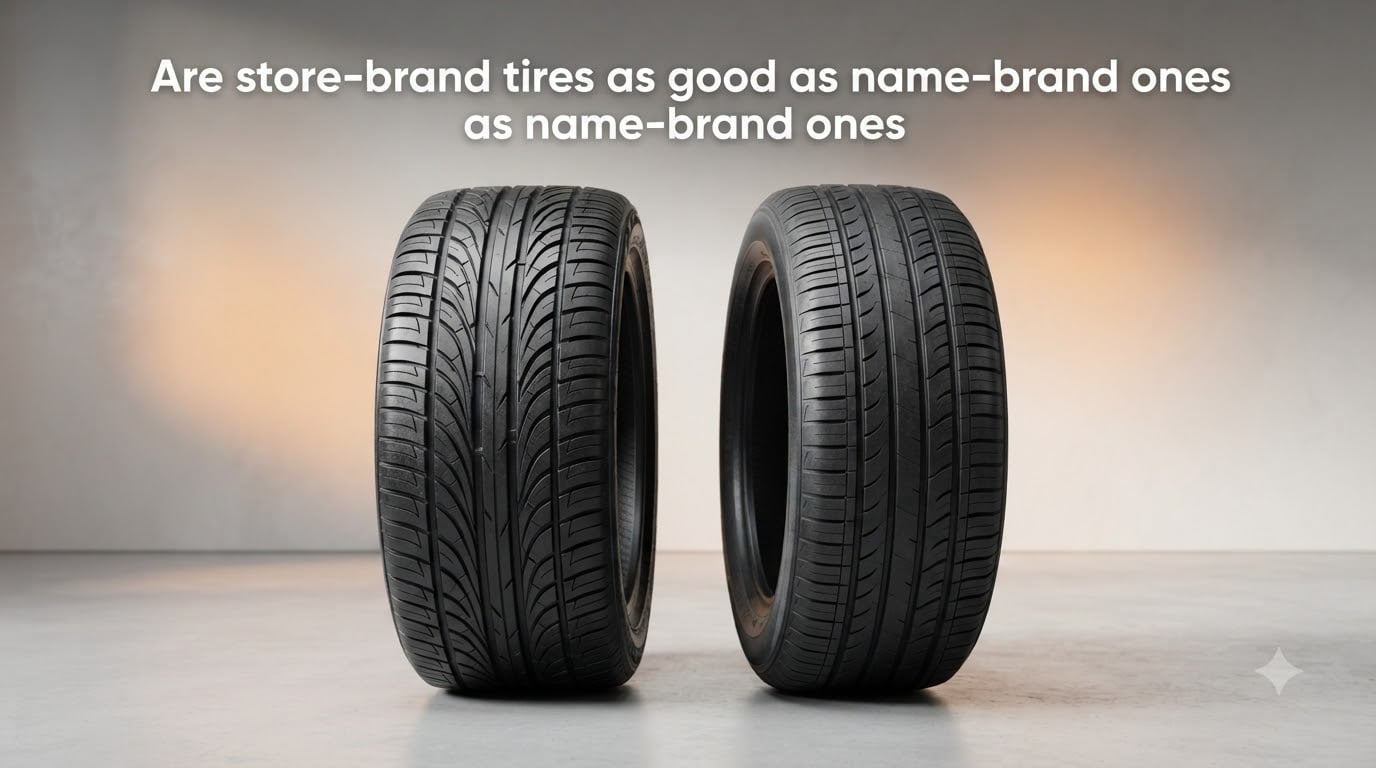
Are store-brand tires as good as name-brand ones? In short, no, not usually. Independent tests show the worst-performing tires can take up to 47 feet longer to stop on wet pavement than the best-performing tires, and that gap is exactly where store-brand tires most often fall short. Name-brand tires also tend to last longer, ride quieter, and come with stronger warranties. There are situations where a store-brand tire makes sense, but for daily-driven family transport, the premium option is almost always the better buy.
I have been writing about tires and wheels for more than a decade, and I still hear the same question every week from readers: why pay more for the same black rubber circle? It is a fair question, and the answer has gotten more interesting as the tire market has consolidated. Most “store-brand” tires you see on shelves today come from the same factories that build premium tires, but they use different rubber compounds, simpler tread designs, and less rigorous quality control. The black rubber may look the same, but the engineering behind it is not.
In this guide, I will walk you through what I have learned from years of tire testing data, Consumer Reports surveys, and conversations with tire-shop owners. You will see exactly where the gap shows up, where it does not, and how to decide which tire is right for your vehicle and your budget in 2026.
Table of Contents
What Counts as a Store-Brand Tire vs a Name-Brand Tire
A store-brand tire is a tire sold under a retailer’s house label rather than a recognized manufacturer brand. The best-known examples include Walmart’s Douglas and Yokohama Geolandar lines, Costco’s Kumho and Bridgestone-sourced private labels, and Discount Tire’s Lexani and various private-label offerings. Some auto dealers also sell “dealer-branded” tires that are essentially relabeled budget or mid-tier models.
A name-brand tire is one sold under the manufacturer’s own label, like Michelin, Goodyear, Continental, Bridgestone, Pirelli, Yokohama, Hankook, or Cooper. These companies invest heavily in research and development, run their own testing programs, and stand out behind the product with full warranties.
Where Store-Brand Tires Actually Come From
This is the part that surprises most people. Many store-brand tires are made in the same factories as name-brand tires. Continental, for example, has historically manufactured private-label tires for several major retailers. The same plant, the same production lines, and sometimes even the same engineers work on both products.
The difference is the specification. When a retailer orders a private-label run, they typically specify a lower-cost rubber compound, a simpler tread pattern, and fewer quality-control checkpoints. The factory builds to that spec because the retailer wants a lower price point. The tire that comes off the same line under the manufacturer’s own label usually has a more sophisticated compound, more sipes, and tighter uniformity tolerances.
Where Name-Brand Tires Are Made
Premium tire manufacturers operate their own plants in the United States, France, Germany, Japan, South Korea, and a handful of other countries. They keep their flagship product lines in tightly controlled facilities and use contract manufacturing or older lines for budget-tier products. That is not a bad thing; it is just how the industry balances cost and quality across tiers.
The country of origin matters less than the brand and tier. A Michelin tire made in South Carolina will perform like a Michelin tire made in France because the spec and quality control are the same. A no-name tire made in an unknown Chinese factory with no brand accountability is a different story entirely.
How Rubber Compounds Differ Between Cheap and Premium Tires
The biggest single difference between a store-brand tire and a premium tire is the rubber compound. Modern tire compounds are sophisticated blends of natural rubber, synthetic rubber, carbon black, silica, oils, and antioxidants. The exact recipe determines grip, wear rate, rolling resistance, and noise.
Premium manufacturers spend millions of dollars on compound development. Michelin’s silica-based compounds, for example, are tuned to stay flexible in cold weather while resisting heat buildup at highway speeds. Continental’s Black Chili compound uses specialized polymers that grip better on wet pavement. These compounds cost more to produce, and that cost shows up in the price.
Store-brand tires use simpler, cheaper compounds that meet basic safety standards but are optimized for low cost rather than peak performance. The result is a tire that grips okay in normal conditions but falls behind in the extremes, especially wet braking and cold-weather flexibility.
Carbon black and silica ratios also affect tread life. Cheaper compounds tend to wear faster, which is why you see budget tires needing replacement at 30,000 miles while premium tires often run to 60,000 or more.
Wet Braking: Where the Gap Is Biggest
Wet braking is where the difference between store-brand and name-brand tires is most dramatic and most dangerous. Independent tests by organizations like TyreReviews.com, Auto Bild, and Consumer Reports consistently show wide gaps in wet stopping distance across tire tiers.
In one widely cited TyreReviews.com test, a premium Continental tire stopped from 60 mph in significantly shorter distance than eight cheaper alternatives, including budget brands sold at Walmart and other major retailers. The total spread between the best and worst tire was roughly 47 feet, which is more than two car lengths. At highway speeds, that is the difference between stopping safely and rear-ending the car in front of you.
Why Wet Grip Matters More Than Dry
Dry braking is mostly about tread contact patch and rubber hardness. Wet braking adds water evacuation, hydroplaning resistance, and chemical grip on a water film. That is where premium compounds with high silica content shine. They bite through the water film and maintain contact with the asphalt.
Budget compounds get slippery faster on wet roads. Their tread patterns often have fewer sipes, which are the small slits that cut through water and give the tire biting edges. Without those sipes, the tire relies on grooves to push water out, and grooves are less effective at maintaining grip at the contact patch.
Specific Wet Braking Test Results
Consumer Reports’ member surveys consistently show that wet grip is the number-one priority for tire buyers, with 74% of respondents rating it as very important. Yet it is also the area where tire performance varies most by tier.
In their testing, premium all-season tires like the Michelin CrossClimate 2 and Continental PureContact LS routinely post wet-braking distances 15 to 20 feet shorter than mid-tier competitors, and 30 to 47 feet shorter than the worst performers. That is a meaningful safety gap, especially for drivers in rainy climates or anyone who drives on highways at any speed.
Dry Braking, Handling, and Cornering Performance
Dry performance differences between store-brand and name-brand tires are smaller but still real. In dry braking tests, premium tires typically stop about 10 to 30 feet shorter from 60 mph than the worst performers. That is roughly one to two car lengths.
Dry handling and cornering follow the same pattern. Premium tires have stiffer sidewalls, more sophisticated tread blocks, and better balance between grip and wear. The car feels more planted in corners, steering response is sharper, and the tire gives more feedback through the steering wheel.
Budget tires feel vague by comparison. Steering response is slower, cornering grip runs out earlier, and you can feel the tire sliding before it actually breaks loose. For most everyday driving, that is not a safety problem. For spirited driving or mountain roads, it is noticeable.
The dry performance gap is also smaller because dry conditions are easier on tires. There is no water to evacuate, no cold to fight, no hydroplaning risk. Even a basic tire can generate decent dry grip if the compound and tread design are sound.
Tread Life and Durability Differences
Tread life is where the cost argument flips. Store-brand tires are cheaper upfront, but they often wear out faster, which means you buy more tires over the life of the vehicle. Premium tires cost more upfront but last longer.
Consumer Reports data shows that premium tires typically deliver 60,000 to 80,000 miles of useful tread life. Mid-tier tires run 50,000 to 70,000 miles. Budget tires often last 30,000 to 50,000 miles. The exact numbers depend heavily on driving style, climate, rotation, and alignment, but the trend is consistent.
Cost Per Mile Calculation
Let me walk through a quick cost-per-mile example. Suppose a premium tire costs more but lasts 70,000 miles, and a budget tire costs less but lasts 40,000 miles. You would need to buy roughly 1.75 sets of budget tires to cover the same mileage as one set of premium tires.
When you divide the total cost by miles, the budget tire often ends up costing the same or even more per mile than the premium option. And that does not include the hassle of two extra tire purchases, two extra installation appointments, and two extra disposal fees.
Why Some Budget Tires Wear Out Faster
Budget tires wear out faster for a few reasons. The rubber compound is softer or less wear-resistant. The tread depth at the start may be lower. The internal construction may use fewer ply layers or thinner steel belts, which allows the tire to flex more under load and generate more heat, which accelerates wear.
None of that means a budget tire cannot last. Plenty of drivers get 50,000 miles out of budget tires with careful rotation and proper inflation. But the upper limit is lower, and the spread of real-world results is wider.
Ride Comfort, Road Noise, and Rolling Resistance
Premium tires tend to ride more comfortably and quietly than budget tires. The differences come from sidewall construction, tread block design, and the use of noise-dampening foam in some premium products.
Sidewall flex matters a lot for ride comfort. Premium tires use sidewall profiles tuned to absorb small bumps without transmitting them into the cabin. Budget sidewalls are stiffer or less precisely engineered, which means more impact harshness over rough pavement.
Road noise is another differentiator. Premium tires use variable-pitch tread blocks and sound-dampening technology to break up the noise frequencies that humans notice most. Budget tires have simpler tread designs that produce more consistent and more noticeable noise.
Rolling resistance affects fuel economy. Lower rolling resistance means the engine works less to keep the car moving, which translates to better MPG. Premium tires typically have 10% to 20% lower rolling resistance than budget tires, which adds up to real savings at the pump over the life of the tire.
Warranty Coverage: Where Cheap Tires Cost You More
Warranty is one of the most overlooked differences between store-brand and name-brand tires. Premium manufacturers back their tires with comprehensive tread life warranties, road hazard coverage, and 30-day or 60-day satisfaction guarantees. Store-brand tires often carry only a basic materials and workmanship warranty with no tread life coverage.
A tread life warranty means the manufacturer will replace the tire or prorate a credit if it wears out before the warranted mileage. A 60,000-mile warranty is common on premium all-season tires. If your tire wears out at 30,000 miles due to a manufacturing defect, you get a substantial credit toward a replacement.
Store-brand warranties rarely include tread life coverage. If the tire wears out early, you are on your own. That risk is built into the upfront savings, and it is one of the hidden ways cheap tires end up costing more over the life of the vehicle.
Road hazard warranties are different. Those are usually sold by the retailer, not the manufacturer, and they cover damage from potholes, nails, and curbs. Premium tire shops often bundle road hazard coverage into the install price. Big-box retailers sell it as an add-on. Either way, the warranty is on the retailer side, not the tire side.
The Brand Tier Guide: Premium, Mid-Tier, Budget, and Avoid
One of the biggest gaps in most tire-buying guides is a clear visual breakdown of which brands sit in which tier. Here is how I think about it after years of reviewing tires and talking to tire-shop owners.
Premium tier: Michelin, Continental, Bridgestone, Pirelli, Goodyear. These companies invest heavily in compound development and have the deepest engineering resources. Their flagship all-season and performance tires consistently top independent tests.
Strong mid-tier: Yokohama, Hankook, Cooper, Toyo, Firestone. Often owned by or affiliated with premium manufacturers, these brands offer 80% to 90% of premium performance at 60% to 75% of the price. They are the sweet spot for many drivers.
Budget tier: Kumho, Nexen, General, Falken, Atturo, Achilles. Independent testing in recent years showed several of these brands performing surprisingly well against premium options, especially in all-season categories. Reddit users frequently cite Kumho and Nexen as the “safe middle ground” between budget and premium.
Store-brand tier: Douglas (Walmart), Lexani (Discount Tire), various Costco private labels. Performance varies widely. Some are made in premium factories to lower specs. Others come from less established manufacturers.
Unknown or avoid tier: Off-brand tires from manufacturers with no track record, no published test results, and no warranty support. These are often the cheapest tires on the shelf and the most inconsistent in real-world performance.
Premium Tier Brands
Michelin and Continental consistently rank at the top of independent tire tests. Their all-season tires, the CrossClimate 2 and PureContact LS, are widely considered benchmark products. Bridgestone and Pirelli are also top-tier, with strong showings in both all-season and performance categories.
Mid-Tier Brands Worth Considering
If you want premium-like performance without the premium price, Yokohama (Geolandar series), Hankook (Kinergy AS), Cooper (CS5 Grand Touring), and Toyo (Extensa A/S II) are all worth serious consideration. These brands frequently appear in independent tests and routinely outperform older premium models.
The Tomket Sport, a budget tire, has been cited by TyreReviews.com as the best of the budget category in head-to-head testing against premium tires, which shows that the tier lines are blurrier than they used to be.
Tire Brands to Avoid
The brands to avoid are usually the ones with no published test data, no manufacturer transparency, and prices that seem too good to be true. Some Chinese brands fall into this category, though not all. The key red flags are no warranty support, no published UTQG ratings, and no track record in independent reviews.
Specific brands that have drawn consistent criticism from tire reviewers include Westlake, Achilles (some models), and various ultra-cheap private-label tires sold at gas stations and online marketplaces. None of these are necessarily dangerous, but they offer less performance and less support than the alternatives.
When Store-Brand Tires Make Sense (and When They Don’t)
Not every driver needs premium tires. Here is the framework I use when readers ask whether they should save or splurge.
Choose premium tires if: you drive a family vehicle, you commute in heavy rain or snow, you drive at highway speeds regularly, you keep your cars for more than three years, or you care about ride comfort and quiet.
Choose mid-tier tires if: you want most of the premium benefit at a lower price, you drive moderate miles (under 15,000 per year), or you live in a mild climate.
Choose store-brand tires if: you are selling the car soon, you drive an older second vehicle, you have a tight budget and cannot afford premium, or you only need tires to last until your next paycheck and plan to upgrade later.
Avoid unknown tier tires if: you drive at highway speeds, you transport family members regularly, or you live in a region with heavy rain or snow. The risk is not worth the small savings.
How to Decide Between Store-Brand and Name-Brand Tires
If you have read this far and still feel unsure, here is a simple five-step decision process I walk readers through.
Step 1: Identify your driving reality. Most of your miles are highway or city? In heavy rain or dry climate? With passengers or usually solo? Your answer determines how much performance gap actually matters to you.
Step 2: Set a real budget. Look at the total cost of four tires plus installation, balancing, and disposal. Add any road hazard warranty cost. That is your true all-in number.
Step 3: Calculate cost per mile. Take the all-in cost and divide by expected tread life in miles. A premium tire at 70,000 miles may actually be cheaper per mile than a budget tire at 35,000 miles, even though the sticker price is higher.
Step 4: Check independent test results. Look at Consumer Reports, TyreReviews.com, or Auto Bild test results for the specific tire models you are considering. Pay special attention to wet braking and tread life scores.
Step 5: Buy from a reputable retailer. Whether you choose store-brand or name-brand, buy from a shop that will stand behind the install. Tire installation quality affects performance and safety as much as the tire itself.
A few extra tips. Rotate your tires every 5,000 to 7,500 miles to extend life. Keep them inflated to the pressure on the door jamb sticker, not the number on the tire sidewall. Get an alignment when you install new tires. These habits alone can add 10,000 miles of useful tread life to any tire.
If you want a single piece of advice after reading this whole article, here it is. Spend the extra money on premium tires for any vehicle where you carry family, drive in rain, or keep the car for more than three years. The safety margin, the tread life, and the warranty support are all worth the higher upfront cost. For a beater commuter or a car you are about to sell, a mid-tier tire is the best balance of cost and performance. For a temporary stopgap on a tight budget, a reputable store-brand tire will get you down the road safely until you can afford an upgrade.
Frequently Asked Questions
What brand of tires should I stay away from?
Avoid tire brands with no published test results, no manufacturer transparency, and no warranty support. Ultra-cheap private-label tires sold at gas stations and some online marketplaces often fall into this category. Specific names that have drawn consistent criticism include some Westlake and Achilles models, plus generic off-brand tires from unknown manufacturers. Stick with brands that publish UTQG ratings, appear in independent tire tests, and offer real warranty support.
What are some cheap tire brands to avoid?
The cheapest tire brands on the market are often the most inconsistent. Avoid tires with no published UTQG (Uniform Tire Quality Grading) ratings, no independent test data, and no manufacturer warranty. The risk is not that these tires will fail immediately, but that wet grip, tread life, and quality control vary widely from tire to one. Reputable budget options like Kumho, Nexen, General, and Falken offer much better consistency at similar prices.
Why are tires so much cheaper at Walmart?
Walmart sells tires cheaper because of volume, private-label sourcing, and lower overhead costs compared to specialty tire shops. Walmart’s Douglas brand tires are private-label products sourced from major manufacturers, often built to a lower specification than the manufacturer’s own-branded equivalent. You get a working tire at a lower price, but typically with less performance margin, shorter tread life, and a thinner warranty than premium options.
Is it better to get cheap or expensive tires?
It depends on your vehicle, your driving, and how long you plan to keep the car. For family vehicles, highway commuters, and drivers in wet climates, more expensive tires are almost always worth it because of better wet braking, longer tread life, and stronger warranties. For a beater car you plan to sell soon, cheap tires may be the practical choice. The middle ground is mid-tier tires like Kumho, Nexen, or Hankook, which deliver most of the premium benefit at lower cost.
Which tire brand is considered the best quality?
Michelin and Continental consistently rank at the top of independent tire tests for all-season and performance categories. Bridgestone and Pirelli are also widely considered premium-tier brands with strong engineering and quality control. Within each premium brand, the flagship models (like the Michelin CrossClimate 2 or Continental PureContact LS) outperform the budget models, so the specific tire line matters as much as the brand name.
Which tires have the best wet traction?
Premium all-season tires with high silica content in the tread compound tend to have the best wet traction. The Michelin CrossClimate 2, Continental PureContact LS, and Bridgestone Turanza QuietTrack routinely top wet-braking tests. Independent testing shows the best wet tires can stop up to 47 feet shorter from highway speeds than the worst performers, which is a meaningful safety gap in heavy rain.
What is the 3% rule for tires?
The 3% rule for tires refers to a guideline that you should replace tires when tread depth drops to about 3% of the original tread depth, or roughly 2/32 inch. Most safety experts recommend replacing tires when tread reaches 4/32 inch for wet conditions, but 2/32 inch is the legal minimum in most U.S. states. The rule of thumb is to start shopping for replacements when your tread is at 4/32 inch so you have time to choose and install before hitting the legal minimum.
Are store-brand tires as good as name-brand ones? After looking at the test data, the warranty differences, and the real-world owner reports, the answer is clear. For most drivers, especially anyone carrying family or driving in rain, premium or strong mid-tier tires are the better buy. Store-brand tires are not dangerous, and they can be a sensible choice for older vehicles or short-term use, but the gap in wet braking, tread life, and warranty support is real and measurable. If you take only one thing from this guide, take the cost-per-mile number. A cheaper tire that wears out twice as fast is not actually cheaper. Spend the money where the road meets the rubber, and your car, your wallet, and your passengers will all thank you.