
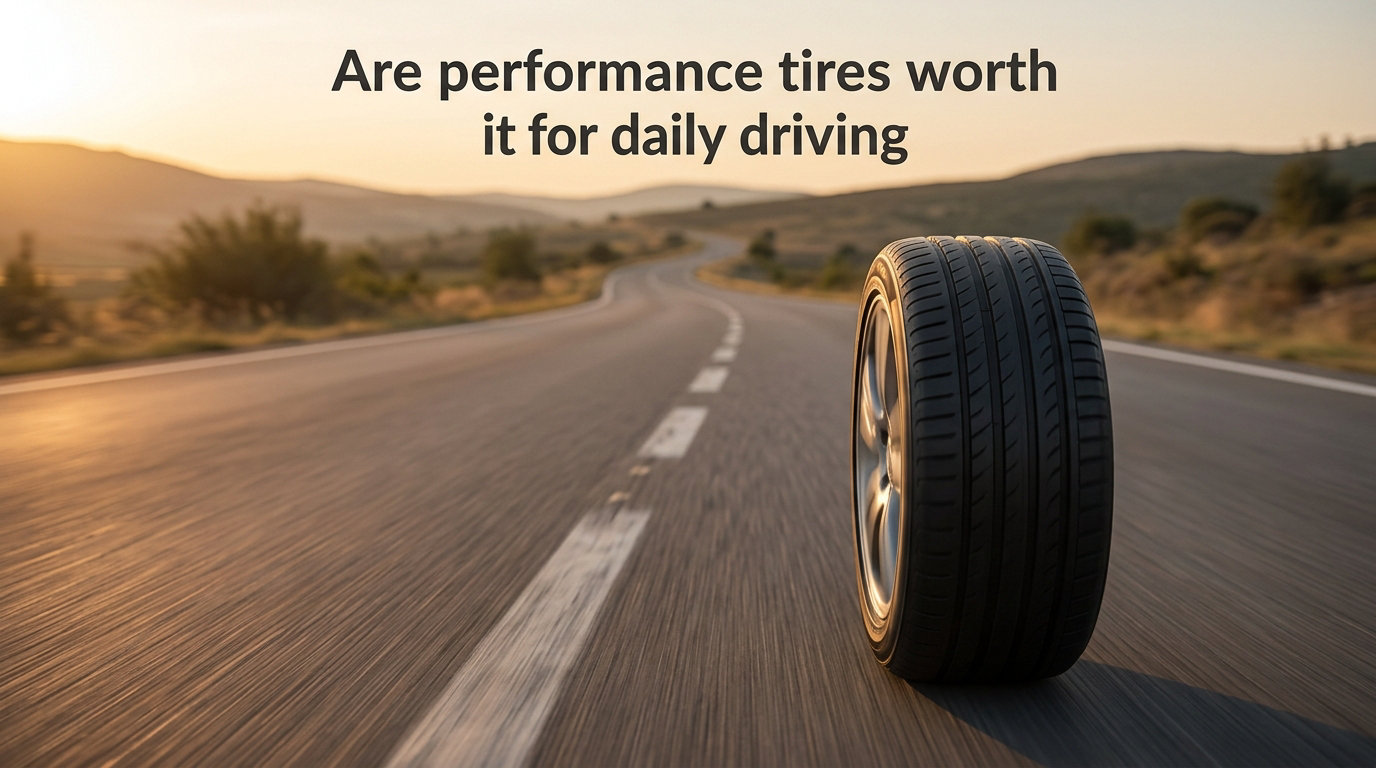
When I switched from a standard all-season tire to a summer performance tire on my daily-driven coupe, the steering feel changed overnight – sharper turn-in, a planted cornering stance, and noticeably shorter dry stops. I was hooked, then I got caught in an unexpected cold snap and learned why the question “are performance tires worth it for daily driving?” has a much more nuanced answer than the tire shop aisle might suggest. Performance tires are absolutely worth it – but only when you pick the right category for your climate, your mileage, and how you actually drive.
Table of Contents
Are Performance Tires Worth It for Daily Driving?
Yes, performance tires can be worth it for daily driving, but only if you match the tire category to your climate and driving style. Drivers in warm or mild regions who value sharper steering, shorter braking, and predictable cornering grip will feel a real difference every day. Drivers in cold, snowy climates will be safer, more comfortable, and better off running an ultra-high-performance all-season or a dedicated winter tire. The right answer depends entirely on where you live, how you drive, and how much tread life you’re willing to trade for grip.
The Short Verdict
If you live where temperatures routinely drop below 7°C / 45°F, performance tires are not worth it for daily driving – go with an ultra-high-performance all-season instead. If you live where it’s warm year-round and you enjoy driving, summer performance tires deliver real, measurable benefits every single day.
What Are Performance Tires?
Performance tires are tires engineered with softer rubber compounds, stiffer sidewalls, and tread patterns tuned for maximum grip and responsive handling in dry and wet conditions above about 7°C / 45°F. Compared to standard all-season or touring tires, they typically have a lower profile, a wider footprint, larger tread blocks, and higher speed ratings (V, W, or Y – meaning they are rated for sustained speeds of 149 mph and up).
Inside the category, there are three distinct sub-types that drivers often confuse with one another. Knowing the difference is the single biggest factor in deciding whether they’re worth it for your daily drive.
The Three Main Performance Tire Categories
- Summer performance tires – Maximum dry and wet grip in warm weather. Sticky compound, large tread blocks, minimal sipes. Do not perform below 7°C. Expected mileage around 20,000-30,000 miles.
- Ultra-high-performance (UHP) tires – The aggressive end of summer performance. Built for sports cars and track-day driving. Heat-cycle dependent – they need to warm up to deliver advertised grip. Often the worst choice for a slow daily driver because the rubber never fully heats on a street commute.
- Ultra-high-performance all-season tires – The daily-driver compromise. Grip approaching summer performance with cold-weather usability and much longer tread life (often 50,000+ miles). Includes options like the Michelin Pilot Sport All-Season, Continental ExtremeContact DWS06, and Pirelli P Zero All-Season.
Performance Tires vs Touring Tires vs Standard All-Season
The fastest way to decide is to compare categories side by side. Here is how the three options stack up across the criteria that matter most on a daily commute.
| Attribute | Summer Performance | UHP All-Season | Touring / Standard All-Season |
|---|---|---|---|
| Dry grip | Excellent | Very good | Good |
| Wet grip | Very good | Very good | Good to very good |
| Snow / cold-weather | Unsafe below 7°C | Acceptable in light winter | Capable in mild winter |
| Typical tread life | 20k-30k miles | 40k-60k miles | 50k-85k miles |
| Road noise | Moderate to high | Moderate | Low to moderate |
| Ride firmness | Firm | Moderately firm | Soft / compliant |
| Cost per set (typical) | Premium tier | Mid to premium tier | Budget to mid tier |
| Fuel economy impact | Small decrease | Marginal | Baseline |
The Real Benefits of Performance Tires for Daily Driving
When people ask if performance tires are worth it, they’re usually chasing one of these specific gains. I’ve felt each of them on real cars, and so have the thousands of daily drivers in forum threads debating the same question.
Sharper Steering and Better Road Feedback
The stiffer sidewall on a performance tire flexes less during a turn, so the steering wheel translates your inputs more directly. On a twisty backroad you’ll feel the front tires loading up before the rear steps out, which makes the car easier to place precisely. This is the single change most drivers notice first when they make the switch.
Confident, Shorter Braking in the Dry
Sticky compounds and a wider contact patch shorten braking distances. Owners in r/cars routinely report summer performance tires cut dry stopping distances by 10-15% versus cheap all-seasons. The gap narrows against premium all-seasons, but it never closes completely – especially from highway speeds.
More Grip During Emergency Avoidance
Beyond straight-line braking, the extra grip pays off during sudden lane changes or swerve-and-brake maneuvers. A higher grip budget means more headroom before the tires break loose, which is the kind of margin you really only appreciate when you need it.
Wet-Weather Confidence
Performance tires use tread patterns with wide circumferential grooves and aggressive lateral blocks to evacuate water. On a quality summer performance tire, standing water is far less stressful than it is on a budget tire, and stopping distances in the wet are meaningfully shorter.
Better Cornering Stability
Larger tread blocks and stiffer construction keep the tire’s footprint flatter through a corner. The car settles quicker and holds a more consistent line, which is hugely noticeable on highways where crowned pavement and gusty crosswinds unsettle soft-sidewall tires.
The Real Drawbacks of Performance Tires
For every benefit there is an honest drawback, and the more honest the tire shop, the more willing they are to talk about them. Here is what drivers consistently flag in forum threads and owner reviews.
Faster Tread Wear
Performance tires do wear out faster than standard all-seasons. Summer performance tires typically deliver 20,000 to 30,000 miles, UHP all-seasons run 40,000 to 60,000 miles, and standard all-seasons push 50,000 to 85,000 miles. If you drive 15,000 miles a year, a summer performance set may need replacement every 18 months, which adds up quickly.
More Road Noise
Aggressive tread patterns and stiffer construction transmit more road noise into the cabin. Highway commuters who log 25,000+ miles a year consistently rank noise as the dealbreaker. If your daily route is mostly highway at 70 mph, the extra drone adds up.
Firmer Ride
Stiff sidewalls transmit more of the road surface – expansion joints, potholes, and broken asphalt – directly to the cabin. On smooth pavement it feels precise; on rough pavement it can feel punishing over a long commute.
Higher Cost (Two Sets in Cold Climates)
In any region where temperatures drop below 7°C, you’ll need a separate set of winter tires plus storage, mount-and-balance fees each season, and the hassle of twice-yearly swaps. Over five years of ownership that easily doubles your tire budget.
Marginal Fuel Economy Hit
Sticky compounds and aggressive tread patterns add rolling resistance. Most drivers see a 1-3 mpg drop, which over 15,000 annual miles adds up. The few competitors that quantify this: a serious gap worth filling.
Cold Weather and the 7°C Rule
This is the single most important rule about performance tires and the one most often overlooked when the question “are performance tires worth it for daily driving?” comes up.
The 7°C / 45°F rule is simple: summer performance tires are engineered for grip above approximately 7°C (45°F). Below that temperature, the soft rubber compound hardens dramatically, the tire loses a large share of its grip, and braking distances can stretch by 30% or more – sometimes on a clear, dry day. Drivers across r/cars, r/tires, and enthusiast forums consistently describe being caught out by an early cold snap and sliding through a corner that would have been routine in October.
Real driver experience: Multiple owners on enthusiast forums warn that the cold-weather failure can happen on a single morning commute – the tire doesn’t warn you, it just doesn’t bite. If you live anywhere with a real winter, plan for a second set.
What about all-weather and UHP all-season options? Modern ultra-high-performance all-season tires handle cold mornings and light snow far better than summer compounds. They will not match a true winter tire in deep snow, but for many daily drivers they eliminate the need for a seasonal swap.
Who Should Buy Performance Tires for Daily Driving
Skip this section if you’ve already decided. If you’re still on the fence, these are the criteria that make performance tires a clear win.
- You drive a sporty sedan, coupe, or sports car – The handling benefit shows up most when the suspension and chassis are tuned for it.
- You live where winters are mild or you can swing two sets – Anything south of Nashville, equivalent latitudes, or any climate where you can store winter tires is fair game.
- You actually enjoy driving – If you notice and appreciate sharper turn-in, you will feel the difference every single day.
- You do most of your driving on winding roads or highways – Long, sweeping on-ramps and mountain curves are where the benefits compound.
- You commute fewer than 50 miles a day round trip – Above that, ride firmness and noise start to feel like a quality-of-life tax.
- Your budget comfortably handles replacement every 2 years – Faster wear means budgeting in advance, not scrambling when the tread is gone.
When Performance Tires Are NOT the Right Choice
Honestly, there are situations where performance tires are simply the wrong call for a daily driver. Here are the clearest disqualifiers, drawn from owner regrets and shop-floor experience.
- You live in the snow belt – If you see real snow every winter, a UHP all-season plus a real winter tire is a safer and cheaper long-term move than summer performance tires plus winter tires plus storage.
- You’re turning the car back to a lease – Lease wear-and-tear limits (often 4/32 inch tread depth) make fast-wearing tires a costly gamble.
- You prioritize comfort over feel – Long-distance cruisers, family SUVs, and luxury shoppers should look at touring tires instead.
- You drive fewer than 5,000 miles a year – Tread life matters less when the odometer barely moves, but you’ll still pay the noise and ride penalty every drive.
- The car is slow and underpowered – You will not feel the benefit on a 130-hp commuter; the cost vs reward math doesn’t work out.
The Practical Compromise: Ultra-High-Performance All-Season Tires
If you’ve been weighing performance tires against standard all-seasons, the answer for most daily drivers in 2026 is neither – it’s an ultra-high-performance all-season.
Three options dominate the conversation. The Michelin Pilot Sport All-Season is the handling benchmark, with steering response close to a summer tire and acceptable light-snow behavior. The Continental ExtremeContact DWS06 is the all-weather specialist, with a documented 3PMSF severe-snow rating and predictable behavior through cold mornings. The Pirelli P Zero All-Season Plus 3 rounds out the trio with strong wet braking and long tread life for daily-driven sports cars.
Owners on r/tires comparing the Pirelli P Zero AS Plus 3 against the Scorpion AS Plus 3 confirm the practical sweet spot: nearly all the grip of summer performance, none of the cold-weather panic, and tread life that doesn’t force a replacement every other year. For most daily drivers this is the answer to “are performance tires worth it for daily driving?” – just a specific kind of performance tire, the all-season kind.
If you live where winter is severe, the same approach extends to a real winter tire swap. A summer UHP on the car March through November, then a dedicated winter set December through February, gives you the best of both worlds. Yes, it costs more. Most enthusiasts who try it once tell me they would never go back to a single compromise set.
Tire Maintenance Tips That Extend Performance Tire Life
Faster-wearing tires demand faster rotation cadence. A few minutes of attention every few thousand miles can stretch performance tire life by 20-30%, which quickly offsets the higher upfront cost.
- Rotate every 5,000 to 7,500 miles – Performance tires often wear faster on the rear axle; matching front-to-rear rotation patterns evens out the wear pattern.
- Check pressure monthly – Stiff sidewalls are less forgiving of underinflation. Use the door-jamb placard, not the number on the sidewall.
- Alignment after any curb impact – Performance tires live or die by even contact patches, and a bent toe setting will chew through them in months.
- Store off-season tires properly – Clean, dry, in opaque bags, stacked horizontally if possible. Heat and direct sunlight dry out the compound.
- Replace in pairs on the same axle at minimum – Mismatched grip levels on a performance car can upset handling balance more than the marketing suggests.
Tread Depth: The 3% Rule and the 4/32 Inch Threshold
The 3% rule (sometimes called the 3% rule of thumb for tires, also referred to as the 4/32 inch tread depth threshold) is a maintenance heuristic: once tread depth drops below roughly 3% of a new tire’s original depth – or about 4/32 of an inch – wet performance drops sharply. On summer performance tires with shallower initial tread, this arrives sooner than drivers expect. Plan replacement well before the legal 2/32 inch minimum if you regularly drive in the wet.
Frequently Asked Questions
Are performance tires good for everyday driving?
Yes, performance tires can be good for everyday driving, especially on sporty sedans, coupes, and sports cars in warm climates. Drivers typically notice sharper steering, shorter braking distances, and more confident cornering. Trade-offs include faster tread wear, more road noise, and a firmer ride.
Do performance tires wear out faster?
Yes. Summer performance tires typically last 20,000-30,000 miles, ultra-high-performance all-seasons run 40,000-60,000 miles, and standard all-seasons push 50,000-85,000 miles. The softer compound is what gives you grip, but it also sacrifices tread life.
Should I get all-season or performance tires?
If you live where winters are mild and prioritize handling and braking, summer performance tires are a strong pick. If you see real winter weather or want one set year-round, an ultra-high-performance all-season tire – like the Michelin Pilot Sport AS, Continental DWS06, or Pirelli P Zero AS – is the practical compromise most daily drivers end up choosing.
Are performance tires good in the snow?
No, dedicated summer performance tires are not safe in the snow. Their soft compound hardens below 7°C / 45°F and loses a large share of grip, and their minimal siping cannot evacuate snow. For snowy climates, run a true winter tire (3PMSF rated) or an ultra-high-performance all-season with a severe-snow rating for light winter duty.
What is the 7 7 rule for tires?
The 7°C / 45°F rule is the temperature below which summer performance tires lose grip dramatically. Below that threshold the soft rubber compound hardens, dry and wet braking distances can lengthen by 30% or more, and the tire offers little warning before breaking loose. If your area sees temperatures under 7°C, switch to an all-season or winter tire.
What is the 3% rule for tires?
The 3% rule (4/32 inch threshold) is the point at which wet-traction performance starts to drop off sharply. At about 3% of original tread depth – roughly 4/32 inch – the tire can no longer evacuate standing water effectively. Replace performance tires well before the legal 2/32 inch minimum if you regularly drive in the wet.
What tires are best for everyday driving?
For most daily drivers, an ultra-high-performance all-season tire is the strongest overall pick. The Michelin Pilot Sport All-Season, Continental ExtremeContact DWS06, and Pirelli P Zero All-Season Plus 3 deliver close-to-summer grip with cold-weather usability and long tread life. Drivers in warm climates who value maximum handling should consider summer performance tires and pair them with winter tires in cold months.
Final Verdict on Performance Tires for Daily Driving
Performance tires are absolutely worth it for daily driving – when you pick the right category for your conditions. Warm-climate drivers who enjoy handling feel will notice the difference on every single commute, especially on summer performance tires paired with a winter set in cold months. Drivers in milder climates or anyone who wants one set year-round will get 90% of the benefit from an ultra-high-performance all-season tire. Match the tire to your climate, your mileage, and how you actually drive, and the answer is yes.