
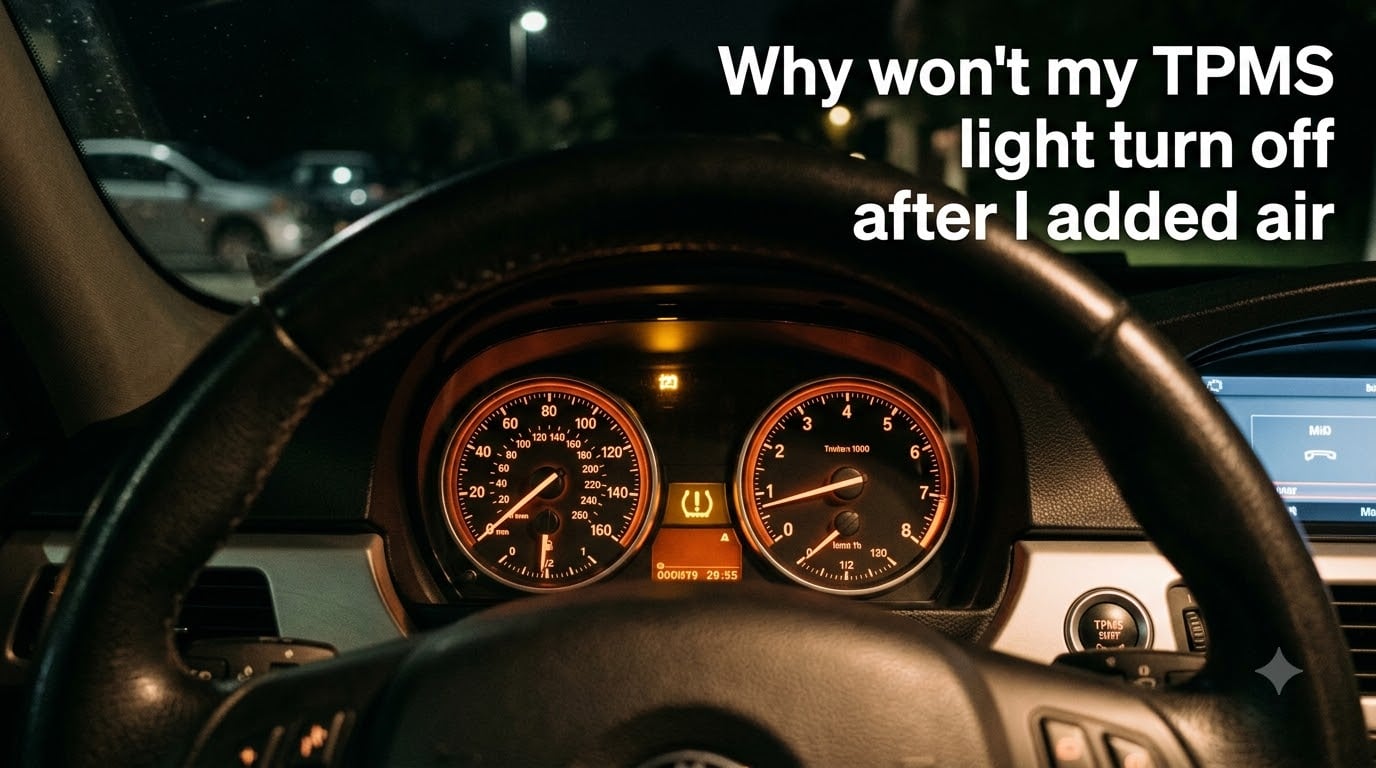
Your TPMS light stays on after adding air for one of three reasons: a tire is still below the recommended PSI, the system has not recalibrated yet, or a sensor is faulty or dead. TPMS stands for Tire Pressure Monitoring System, and it uses sensors inside each wheel to track pressure in real time. We have helped hundreds of drivers troubleshoot this exact issue, and in most cases the fix is simpler than you would expect.
Before you assume the worst, understand that the TPMS light does not reset instantly. Many systems need 10 to 30 minutes of driving at highway speeds before they register new pressure readings. If you just topped off your tires at the gas station and the light is still glowing on your dash, that does not automatically mean something is broken.
In this guide, we walk through every reason the tire pressure light stays on after filling tires, show you how to tell if the problem is pressure or a sensor, and give you five proven reset methods. We also cover when it is time to stop troubleshooting and visit a mechanic.
Table of Contents
5 Reasons Your TPMS Light Stays On After Adding Air
There are five common causes for a tire pressure warning light that will not turn off even after you have added air. Understanding which one applies to your situation saves you time and money.
1. One or More Tires Is Still Underinflated
The most common reason the TPMS light stays on is that at least one tire is still below the manufacturer’s recommended pressure. Gas station air pumps are not always accurate, and a tire that was significantly low may need more air than you think. Check every tire including the spare with a reliable gauge.
2. The System Has Not Had Time to Recalibrate
TPMS sensors do not update in real time after you add air. Most direct TPMS systems need to be driven for at least 10 minutes at 50 mph or faster before the car’s computer recognizes the new pressure values. Some vehicles require up to 30 minutes of driving. If you just filled your tires and the light is still on, take the car for a highway drive before panicking.
3. A TPMS Sensor Is Faulty or Dead
Each TPMS sensor runs on a sealed battery that typically lasts between 5 and 10 years. When the battery dies, the sensor stops transmitting and the system triggers a warning. On older vehicles, one or more dead sensors is a very common explanation for a persistent tire pressure light. A sensor can also fail from physical damage caused by potholes or curb strikes.
4. Cold Weather Dropped Your Pressure Again
Tire pressure drops about 1 PSI for every 10 degrees Fahrenheit decrease in temperature. If you filled your tires in a warm garage and then parked outside overnight in freezing weather, the pressure may have fallen below the threshold again. This is one of the most common reasons drivers see the TPMS light return each morning during winter.
5. Recent Tire Rotation or Replacement
When you rotate or replace tires, the TPMS sensors may lose their position registration. The system no longer knows which sensor belongs to which wheel. This typically requires a TPMS relearn procedure to match each sensor to its correct location. Many tire shops perform this automatically, but some do not.
How to Tell if It Is a Pressure Problem or a Sensor Problem
The pattern of your TPMS light tells you exactly what is going on. A solid yellow light usually indicates low tire pressure, while a flashing light that turns solid after 60 to 90 seconds typically signals a sensor malfunction. Knowing this distinction saves you from adding air to tires that are already full when the real issue is a dead sensor.
Solid Yellow TPMS Light
A steady TPMS light means the system detected pressure below the recommended level in one or more tires. Use a tire pressure gauge to check each tire against the PSI listed on your driver’s door jamb sticker. If all four tires read correctly and the light remains on after driving for 15 to 20 minutes, the issue may be a slow recalibration or a sensor problem.
Flashing Then Solid TPMS Light
If the TPMS light blinks for about 60 to 90 seconds every time you start the car and then stays on, that is the universal indicator of a TPMS sensor failure. This flashing-then-solid pattern means one or more sensors is not sending a signal. The community consensus among mechanics is clear: this almost always requires sensor replacement, not just more air.
Service Tire Monitor System Message
If your dashboard displays a “Service Tire Monitor System” or “TPMS Fault” message instead of just the low-pressure icon, your vehicle’s computer has detected a communication failure with the sensors. This typically requires a diagnostic scan with an OBD-II tool to pinpoint which sensor has failed. A dealer or tire shop can run this scan quickly.
How to Reset Your TPMS Light After Adding Air
Once you are confident the pressure is correct, try one of these five reset methods. Start with Method 1 since it works for the majority of vehicles without any tools.
Method 1: Drive to Trigger Auto-Recalibration
This is the simplest reset and works on most modern vehicles. Drive at 50 mph or faster for 10 to 15 minutes. The car’s computer will re-read the sensor signals during the drive and update the pressure values. After you park and restart the engine, the light should be off. Some Toyota and Honda models need up to 30 minutes of driving.
Method 2: Use the TPMS Reset Button
Many vehicles have a dedicated TPMS reset button, usually located under the steering wheel or in the glove box. With the ignition on but the engine off, press and hold the button until the TPMS light blinks three times. Then start the engine and drive for about 20 minutes to let the system recalibrate. Check your owner’s manual for the exact location on your model.
Method 3: Inflate, Deflate, and Reinflate
For some vehicles, particularly older models, this trick works: deflate each tire about 3 PSI below the recommended level, then reinflate to exactly the recommended pressure. Drive for a few minutes. The pressure change forces the sensors to transmit fresh data, which can trigger a reset. This method is mentioned frequently in mechanic forums as a workaround when other methods fail.
Method 4: Disconnect the Battery
Disconnect the negative battery terminal for about 10 minutes, then reconnect it. Start the car and drive normally. This resets the vehicle’s computer and clears stored fault codes including TPMS warnings. Note that this also resets your radio presets and clock. This method works on some Ford and Chevrolet models but not all.
Method 5: Use a TPMS Relearn Tool
A TPMS relearn tool or OBD-II scanner with TPMS capability can force a system reset and re-register each sensor. Basic tools start at a reasonable price and are useful if you change your own tires. You activate each sensor in sequence (usually starting with the front left), and the tool programs the car’s computer to recognize them. Some vehicles require this tool after every tire rotation.
How to Verify Your Tire Pressure Is Actually Correct
Before trying any reset method, make absolutely sure your tires are at the right pressure. This step alone solves the problem for a surprising number of drivers who think they added enough air but did not.
Check When Cold
Always check tire pressure when the tires are cold, meaning the car has been parked for at least three hours or has been driven less than one mile. Driving heats the tires and raises pressure by 2 to 4 PSI, giving you an artificially high reading. If you check right after driving to the gas station, the numbers will not be accurate.
Use the Door Jamb Sticker, Not the Tire Sidewall
The correct tire pressure for your vehicle is printed on a sticker inside the driver’s door jamb, not on the tire’s sidewall. The number on the tire is the maximum pressure the tire can handle, not the recommended operating pressure. For most passenger cars, the recommended PSI falls between 30 and 35.
Use a Quality Tire Pressure Gauge
Gas station air pump gauges are often inaccurate by several PSI. Keep a reliable digital or dial gauge in your glove box. Check each tire including the spare. If one tire is reading 3 to 5 PSI lower than the others, that is likely your culprit.
Direct TPMS vs Indirect TPMS: What You Need to Know
Your vehicle uses either a direct or indirect TPMS system, and the reset process differs between them. Direct TPMS has a physical pressure sensor mounted on each wheel’s valve stem that wirelessly reports pressure to the car’s computer. This is the system in most vehicles made after 2007.
Indirect TPMS does not use pressure sensors at all. Instead, it relies on the ABS wheel speed sensors to detect differences in tire rotation. An underinflated tire spins at a slightly different rate than a properly inflated one. Indirect systems are common in some Honda, Toyota, and Volkswagen models. These systems require a manual recalibration through the dashboard menu after any pressure adjustment.
Your Spare Tire Might Be the Culprit
Most drivers forget that many vehicles include the spare tire in the TPMS system. If your spare has a sensor and its battery has died or its pressure is low, the warning light will stay on no matter how many times you fill the other four tires. Full-size spares are more likely to have TPMS sensors than compact temporary spares.
Check your spare tire’s pressure and confirm whether your vehicle includes it in the TPMS monitoring loop. Your owner’s manual will specify this. If the spare has a sensor and is more than 7 years old, its battery may be dead.
When to See a Mechanic
Most TPMS issues can be resolved at home, but some situations call for professional help. If you have verified correct pressure on all tires, driven for 30 minutes, and tried multiple reset methods without success, the sensor or the system needs diagnosis. A mechanic with an OBD-II scanner can read the specific fault code and identify exactly which sensor is the problem.
Signs of a Faulty TPMS Sensor
The strongest sign of a bad sensor is the flashing-then-solid light pattern at every startup. Other indicators include intermittent warnings that come and go regardless of actual pressure, the TPMS light staying on after a fresh tire installation, or a “Service Tire Monitor” message on the dashboard. Sensors older than 7 years are prime candidates for failure due to battery depletion.
TPMS Sensor Replacement Cost
Replacing a single TPMS sensor typically costs between 50 and 150 dollars for the part, plus 20 to 50 dollars per sensor for installation and programming. If you need all four sensors replaced, expect the total to range from 200 to 600 dollars or more depending on the vehicle. Some shops offer a discount when replacing all four at once. Luxury and performance vehicles tend to have more expensive sensors.
You do not always need to replace all four sensors at once. If only one has failed, replacing just that one is perfectly fine. However, if the sensors are all the same age, the others may fail soon too. Many mechanics recommend replacing them in pairs at minimum.
Frequently Asked Questions
Why is my TPMS light on after I put air in my tires?
Your TPMS light stays on after adding air because either a tire is still below the recommended PSI, the system has not had time to recalibrate (typically needs 10 to 30 minutes of driving at 50 mph or more), or a TPMS sensor is faulty or dead. Check each tire with a gauge when cold, then drive for 15 minutes before assuming something is wrong.
How long does it take for the TPMS light to turn off after filling tires?
On most vehicles, the TPMS light turns off within 10 to 15 minutes of driving at highway speeds after correcting the tire pressure. Some systems may need up to 30 minutes. If the light does not go off after 30 minutes of driving, the issue is likely a sensor problem rather than a pressure problem.
Is it safe to drive with the TPMS light on?
You can drive short distances with the TPMS light on, but you should check your tire pressure immediately. Driving on underinflated tires reduces fuel economy, causes uneven wear, and increases the risk of a blowout. The NHTSA reports that tire-related crashes cause hundreds of deaths each year. Check your tires as soon as possible and do not ignore the warning for extended periods.
How do I reset my tire pressure sensor after adding air?
The easiest reset method is to drive at 50 mph or faster for 10 to 15 minutes after inflating your tires to the correct pressure. If that does not work, try pressing and holding your vehicle’s TPMS reset button (usually under the steering wheel) until the light blinks three times, then drive for 20 minutes. Some vehicles also respond to disconnecting the battery for 10 minutes.
Does cold weather cause the TPMS light to come on?
Yes. Tire pressure drops about 1 PSI for every 10-degree Fahrenheit decrease in temperature. If you filled your tires on a warm day and a cold front moved in overnight, the pressure in one or more tires may have fallen below the TPMS threshold. This is extremely common in fall and winter and usually resolves once you top off the tires and drive for a few minutes.
How much does it cost to replace a TPMS sensor?
A single TPMS sensor costs between 50 and 150 dollars for the part, with installation and programming adding another 20 to 50 dollars per sensor. Replacing all four sensors typically runs 200 to 600 dollars total depending on your vehicle. Luxury and performance cars tend to have more expensive sensors. You can replace just the failed sensor if only one is bad.
Is it normal for the TPMS light to come on after new tires?
It can be normal if the TPMS sensors were not re-registered after the tire change. When tires are rotated or replaced, the sensors may lose their wheel position mapping and need a TPMS relearn procedure. Most reputable tire shops perform this automatically, but if the light comes on within a day or two of new tires, bring it back and ask them to relearn the sensors.
What does a blinking TPMS light mean?
A TPMS light that blinks for 60 to 90 seconds at startup and then stays solid indicates a TPMS sensor malfunction, not low tire pressure. This pattern means one or more sensors is not communicating with the vehicle’s computer. The most common cause is a dead sensor battery. You will need to have the faulty sensor replaced to resolve this issue.
Conclusion
A TPMS light that will not turn off after adding air is frustrating but rarely a serious emergency. The fix is usually one of three things: verifying that all tires are truly at the correct pressure (including the spare), giving the system enough driving time to recalibrate, or replacing a dead sensor. Now that you understand how your tire pressure monitoring system works, why won’t my TPMS light turn off after I added air becomes a question you can answer yourself with a tire gauge, 15 minutes on the highway, and a little patience.