
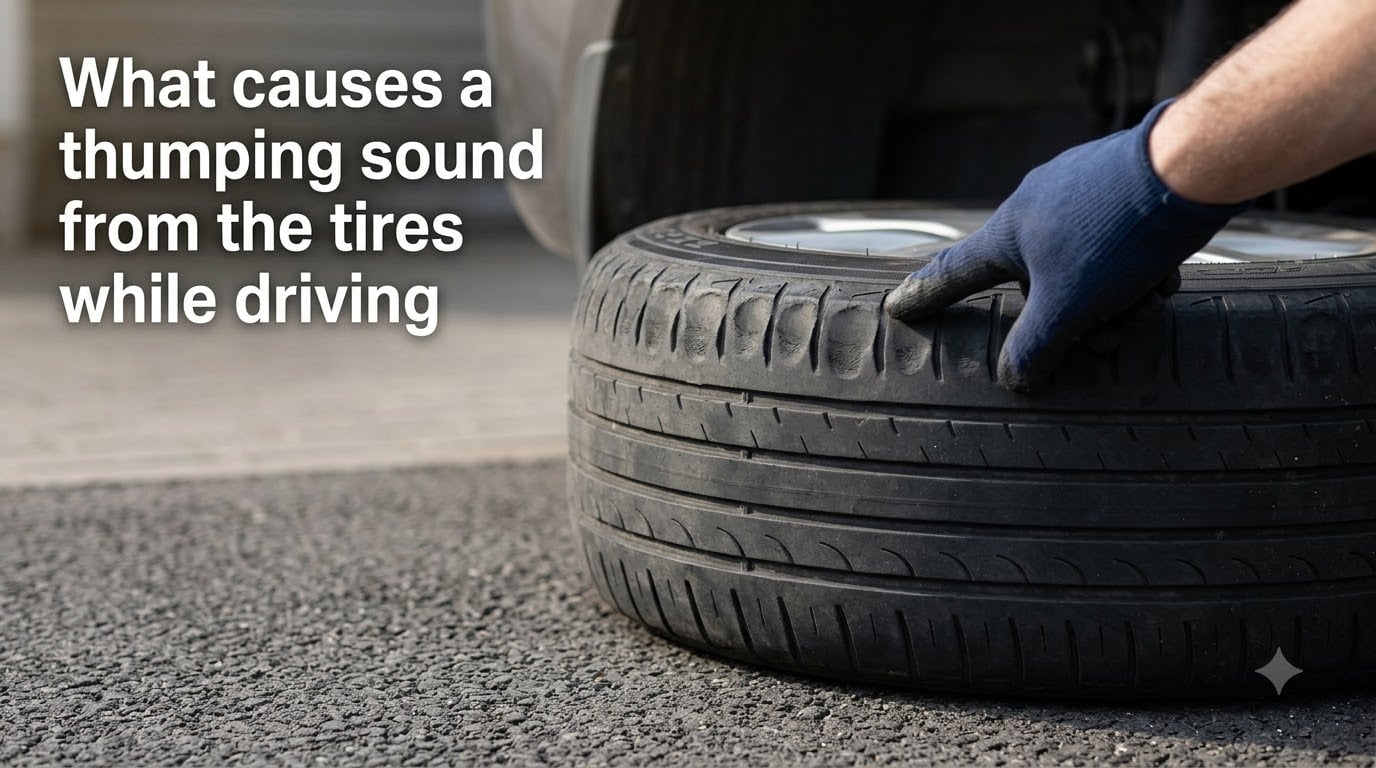
A thumping sound from the tires while driving is most often caused by tire cupping (scalloping), an out-of-balance tire, internal tread separation, or a failing wheel bearing. Each of these produces a rhythmic noise that typically changes with vehicle speed, which is the single best clue for figuring out which one you’re dealing with.
I hear this question a lot from drivers in our shop’s parking lot, and it almost always comes down to one of seven causes. In this guide I’ll walk you through the main culprits, show you how to match the thump to its speed, run a slow parking-lot self-test, and tell you when the noise means stop driving now versus when you can safely schedule a service appointment.
Table of Contents
What Causes a Thumping Sound From the Tires While Driving: The Main Culprits
Most tire thumping traces back to one of seven issues, ranked here by how often our team sees each one in the bay:
- Tire cupping (scalloping) — uneven wear that creates dips across the tread surface.
- Out-of-balance tire — a heavy spot pulls the tire rhythmically as it rotates.
- Internal tread separation — cords inside the tire break loose and thump the casing.
- Improper tire pressure — over- or under-inflation changes how the tread contacts the road.
- Wheel misalignment — toe or camber problems wear tires unevenly.
- Failing wheel bearing — a worn bearing lets the wheel wobble slightly under load.
- Worn suspension components — shocks, struts, ball joints, bushings, or tie rods flexing.
I’ll cover each in depth below, but first let’s use speed to narrow the list down fast.
Why the Thump Gets Louder (or Quieter) at Certain Speeds
The single best diagnostic clue you have is how the noise changes with speed. A thump tied to your wheel rotation will get faster as you accelerate and slower as you coast to a stop. A thump tied to road surface or ambient temperature will behave differently. Speed-dependent behavior almost always points to a wheel, tire, or bearing problem.
Here’s how our team maps speed ranges to probable sources:
| Speed range | Most likely source | What to listen for |
|---|---|---|
| Under 25 mph (parking-lot speeds) | Tread separation, severe cupping, loose wheel | Heavy single thump per wheel rotation, steering wheel wiggle |
| 25 to 40 mph | Out-of-balance tire, moderate cupping | Rhythmic thump that quickens with speed, may fade above 45 mph |
| 45 to 60 mph | Out-of-balance tire, alignment-related wear, wheel bearing | Steady thump or hum that holds at constant speed |
| Highway (65 mph+) | Tire design noise, balance, alignment, road surface | Thump can blend into general road roar |
| Only when braking | Warped rotor or stuck caliper mimicking tire thump | Thump tied to pedal pressure, not speed |
| Only when turning | Wheel bearing, CV axle, outer tie rod | Noise shifts with steering angle |
If your thump stays constant at 25 mph but disappears above 45 mph, you are usually listening to an out-of-balance tire rather than a suspension problem. If the thump grows steadily louder with speed and changes when you swerve, a wheel bearing is the prime suspect.
Tire Cupping and Scalloping: The Most Common Cause
Tire cupping is the single most common culprit our team sees behind a rhythmic tire thump. The tread no longer wears evenly across its width — instead you get alternating high and low spots, usually an inch or two apart, that look like scalloped edges along the tread blocks. Each dipped section hits the road out of sequence with the rest of the tire, which is exactly what produces that repeating thump-thump-thump you hear inside the cabin.
Cupping almost always points to a suspension or balance problem upstream, not the tire itself:
- Worn shocks or struts that let the tire bounce rather than staying planted.
- A failing wheel bearing that lets the wheel hop slightly with each rotation.
- An out-of-balance tire that bounces rhythmically and wears the tread unevenly.
- A bent wheel from a pothole or curb impact.
Mechanics on the TDIclub forums traced exactly this pattern to tire cupping when a member posted about a “slight rhythmic thumping sound but no flat tire” — the recommendation from multiple replies was new shocks plus a tire inspection. A 2020 forum thread on TDIclub shows that exact symptom resolving with shock replacement after cupping was confirmed.
If you can safely run your hand across the tread face and feel a wavy, scalloped surface instead of a smooth one, cupping is almost certainly your thump source.
Tire Noise vs Wheel Bearing Noise: How to Tell the Difference
This is the question mechanics hear most often, and it is the one no competitor article answers directly. The good news: a five-minute test in an empty parking lot will tell you which one you have.
| Clue | Tire or tread wear | Wheel bearing |
|---|---|---|
| Thump tied to wheel rotation | Yes — gets faster with speed | Yes — gets faster with speed |
| Changes when you swerve left vs right | Usually no | Yes — louder (or quieter) on the loaded side |
| Changes with braking | No | Sometimes — bearing carries brake load |
| Goes away on smooth pavement | Often yes | Usually no |
| Visible tread pattern problem | Yes — cupping, flat spots, separation bulge | No — tread usually looks fine |
| Heat or smell after driving | Rare | Common — bad bearings run hot |
| Steering wander or ABS light | Uncommon | Common — ABS reads wheel speed differences |
The swerve test is the giveaway. On a quiet street at about 30 mph, gently swerve left, then right. If the thump volume changes with the steering direction, the problem is almost always a wheel bearing. A Reddit thread on r/Cartalk where the owner traced front-right thumping to a loose wheel bearing is a textbook example — symptoms worsened over days before the bearing was finally diagnosed.
The Slow-Speed Parking Lot Test You Can Do at Home
Before you book a service appointment, run this five-minute test in an empty parking lot. Our team uses a version of it on every tire noise complaint, and it isolates roughly 70 percent of causes without putting the car on a lift.
- Set tire pressures first. Confirm all four tires match the placard on the door jamb (typically 30 to 35 psi for passenger cars). A 2016 Maxima owner on r/MechanicAdvice traced a 25 mph thump to one tire sitting at 40 psi while the others were at 28 to 29 — a simple fix once the imbalance was caught.
- Drive forward at 2 to 3 mph with hands lightly on the steering wheel. Feel for a single heavy thump per rotation. That pattern points to internal tread separation or a flat spot.
- Accelerate slowly to 25 mph and listen for rhythmic thumping. If it starts here and grows louder, suspect cupping or balance.
- Accelerate to 45 mph and hold steady. A constant thump at this speed usually means balance, alignment wear, or a tire design factor.
- Swerve gently left and right at 30 mph. Volume changes with steering direction mean wheel bearing or suspension component.
- Brake gently from 30 mph. If the thump changes with pedal pressure (not speed), suspect brake components rather than the tire.
- Inspect each tire’s tread face with your hand for scalloping or cupped wear, and look at the sidewall for bulges that signal separation.
If the thump is loud enough to feel through the steering wheel, repeat the same steps in reverse to confirm whether the thump comes from the front or rear. A rear-only thump that gets louder with the rear window open is often a rear tire issue, while a thump that intensifies under braking in front is more likely a tire or brake concern combined.
Tire Age and the DOT Date Code: The Hidden Thump Source
Tires age out even when the tread looks fine. The rubber hardens, the internal cords dry out, and the bond between tread and casing weakens. A thumping noise that appears on an older vehicle — especially after a heat wave or a long highway trip — is often the first warning of internal tread separation.
Every tire carries a DOT date code on its sidewall. The last four digits tell you the week and year it was manufactured. For example, 1522 means the 15th week of 2022. Industry guidance from tire manufacturers and safety groups recommends replacement at six years of service regardless of tread depth, and absolutely no later than ten years from the manufacture date.
If your tires are past the five-to-seven-year mark and you’ve noticed a new rhythmic thump that wasn’t there last season, age is a strong candidate. A Reddit user on r/teslamotors traced 45 to 60 mph rhythmic thumping to a balance issue that only appeared once tires warmed up — a reminder that heat, age, and balance interact more than most drivers expect.
Self-Diagnosis Checklist: Run Through This Before You See a Mechanic
Bring this list with you to the shop. Answering yes or no to each one will save diagnostic time and may even let you skip the appointment altogether.
- Are all four tires within 2 psi of the door-jamb recommendation?
- Is the tread depth above 4/32 inch on every tire?
- Can you see or feel scalloping on any tread face?
- Is there a bulge, blister, or crack on any sidewall?
- Does the DOT date code on any tire show it is older than six years?
- Does the thump speed up and slow down with vehicle speed?
- Does the thump change when you swerve left or right?
- Did the thump appear right after new tires were installed?
- Did the thump appear right after hitting a pothole or curb?
- Does the thump change with braking or turning?
If you answered yes to items 3, 5, 6, or 8, schedule a tire inspection soon. If you answered yes to items 4, 9, or 10, treat the issue as urgent — see the safety section below.
When a Thumping Tire Means Stop Driving Now
Not every thump is urgent, but some are warnings of an imminent tire failure or a brake problem. Pull over and arrange a tow rather than continuing to drive if you notice any of these alongside the thump:
- A visible bulge, blister, or crack on the sidewall.
- Steering wander, pulling to one side, or a thump that jolts the wheel.
- The ABS, traction, or stability warning light comes on.
- Burning smell or visible smoke from a wheel after driving.
- A thump that suddenly appeared after striking a pothole, curb, or debris.
- Any thump accompanied by a sudden loss of tire pressure.
For everything else — a steady rhythmic thump that has been there for weeks, noise that comes and goes with weather, or a low-speed thud — you can safely schedule a service appointment within a few days rather than stopping on the roadside. The risk of sudden failure is lower in those scenarios, but the underlying problem will not fix itself.
Maintenance Habits That Prevent Tire Thumping
The cheapest thump is the one that never shows up. A consistent maintenance routine catches cupping, balance drift, and alignment wear before they turn into noise.
- Rotate tires every 5,000 to 7,500 miles. Rotation keeps wear even across all four positions and exposes alignment problems before cupping develops.
- Check alignment annually and after any pothole or curb impact. Even a small toe misalignment will cup a tire inside 10,000 miles.
- Balance tires at every rotation and any time a new tire is installed. A Reddit user on r/tires warned that an unbalanced new tire can develop knocking within days — and a wheel that is not properly seated on the hub can throw balance off entirely.
- Check pressure monthly, including the spare. Pressure drops about 1 psi per month from natural leakage and shifts noticeably with seasonal temperature swings.
- Replace tires at six years of age regardless of remaining tread. Aged rubber is the leading cause of internal separation thumps.
Many tire shops — including most American Tire locations — will run a free courtesy check covering pressure, tread depth, and visual wear pattern. It takes about ten minutes and catches most of the issues above before they become a noise problem.
Frequently Asked Questions
Is it safe to drive with clunking suspension?
Clunking from suspension components usually means a worn ball joint, bushing, tie rod end, or shock/strut mount. A short drive to a shop is generally safe, but loud clunks over bumps, excessive body roll, or wandering steering mean you should limit driving until the component is replaced.
Why does my car make a rhythmic thump when I drive straight?
A rhythmic thump on a straight road almost always points to a wheel-tire-suspension issue that repeats with each tire rotation: tire cupping, an out-of-balance tire, a flat spot from hard braking, or internal tread separation. The speed the thump appears at and whether it changes with steering direction will narrow the cause further.
Why are my tires making a knocking sound when I’m driving?
Tire knocking at driving speeds usually comes from an out-of-balance tire, a cupped or scalloped tread pattern from worn suspension, or a tire that has internal separation. If the knock appeared right after new tires were installed, ask the shop to rebalance and confirm the wheel is fully seated on the hub.
How to tell the difference between tire noise and wheel bearing noise?
At about 30 mph, gently swerve left and right. If the noise gets louder (or quieter) when you load one side of the car, the source is a wheel bearing. Tire noise usually stays constant with steering changes. A bearing fault is also more likely to trigger an ABS or traction warning light and may produce a hot wheel smell after driving.
Why do my tires make a thudding sound when I’m driving?
Thudding usually means something heavy and rhythmic is happening at the tire: a cupped tread block hitting pavement out of sequence, a separated tread section lifting and falling back, or a flat spot from a recent hard brake. Low tire pressure can also produce a heavy thudding feel because more rubber contacts the road with each rotation.
What could be causing a rhythmic thump noise when driving slowly?
Slow-speed rhythmic thumps are most often tread separation, severe cupping, or a flat spot from hard braking. Run the parking-lot test: at 2 to 3 mph a single heavy thump per wheel rotation usually means tread separation; a faster rhythmic thud at 25 mph usually means cupping or balance.
When I accelerate my car thumps
A thump that appears during acceleration is most often an out-of-balance tire or a cupped tread pattern, both of which get louder as rotation speed increases. If the thump only happens during acceleration and goes away when you coast, also check engine and transmission mounts because a worn motor mount can transmit driveline noise into the cabin that sounds like a tire thump.
Key Takeaways
A thumping sound from the tires while driving is almost always one of seven issues: cupping, balance, tread separation, pressure, alignment, wheel bearing, or suspension wear. Speed is your best diagnostic tool — a thump that grows with rotation speed is wheel- or tire-related, and a thump that changes with steering direction is bearing-related.
Run the parking-lot test before you book a service appointment. Check pressures, feel the tread face for scalloping, read the DOT date code for age, and swerve gently at 30 mph to test for bearing noise. Stop driving immediately if you see a sidewall bulge, a sudden pressure loss, an ABS warning, or a burning smell from a wheel.
For everything else, schedule a tire inspection in the next few days and use the maintenance checklist above to keep tire thumping from coming back. The five-minute parking-lot test plus a six-year tire replacement rule will eliminate most thumping causes before they ever reach your cabin.