
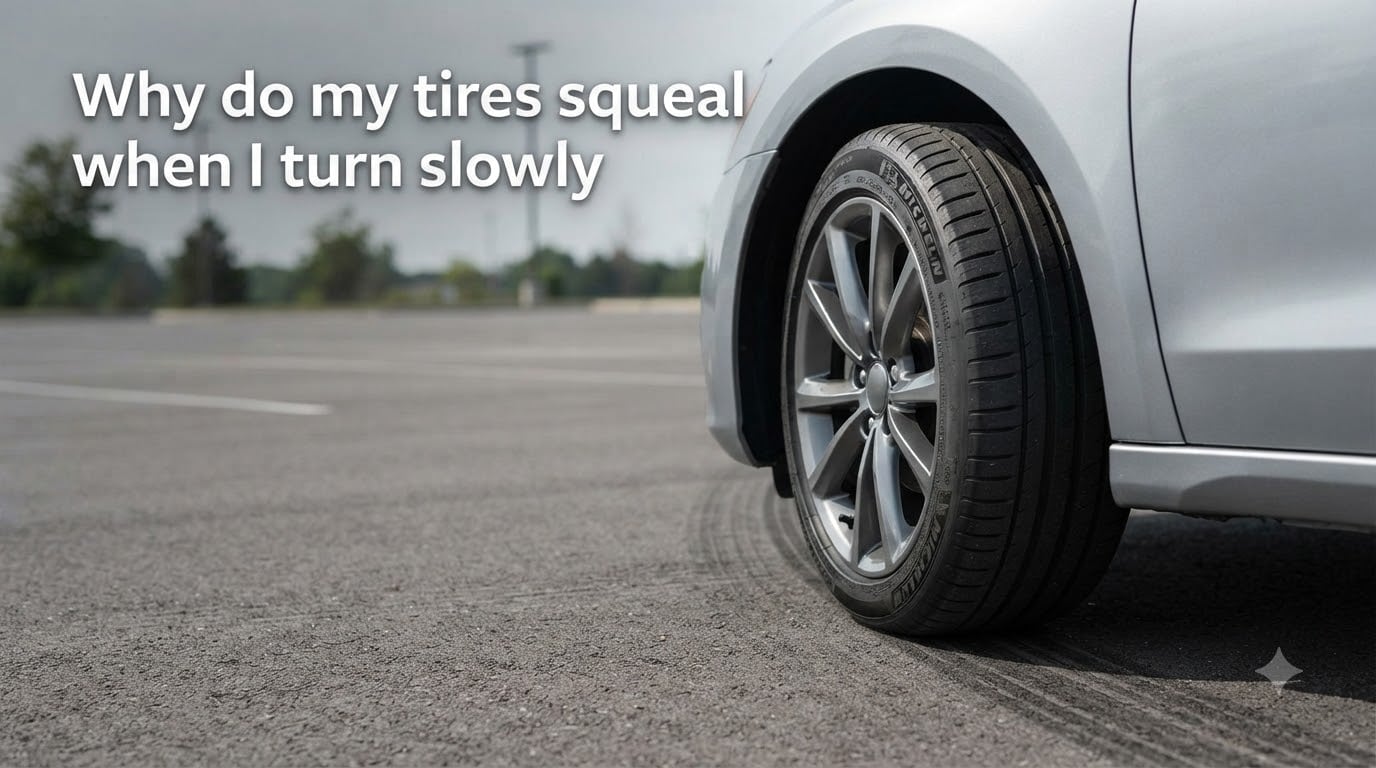
Tires squeal when you turn slowly because the tire rubber is slipping or scrubbing against the pavement instead of gripping it. The most common causes are low air pressure, misaligned wheels, uneven tread wear, and worn or dry suspension components like bushings or ball joints. At slow speeds there is not enough momentum to push the tire through the slip, so any loss of grip turns into an audible squeal.
I have spent the past few months digging through mechanic forums, owner threads on the 4Runner and Cherokee boards, and Stack Exchange answers to put this guide together. If your tires chirp in parking lots, screeches on slow U-turns, or squeaks every time you swing into a driveway, the answer below will help you narrow down the cause.
Table of Contents
The Physics of Why Slow Turns Make Tires Squeal
When you turn a corner, the outside edge of every tire needs to travel a slightly longer path than the inside edge. That difference in path length forces the tire to slip a small amount – this is called the slip angle. Modern tire compounds handle this slip quietly under normal conditions, but anything that reduces grip lets the rubber scrub audibly against the pavement.
At highway speed, road and wind noise mask the squeal. At slow speeds, that masking is gone and your ears pick up every slip. This is exactly why tires squeal when you turn slowly but stay quiet on the highway – the underlying physics is the same, only the volume changes.
What makes the slip worse
- Low tire pressure softens the sidewall and increases the contact patch distortion
- Misalignment changes the angle at which the tire meets the road
- Uneven wear means parts of the tread have less grip than others
- Dry rubber bushings in the suspension cannot absorb small movements
Reddit’s explainlikeimfive subreddit explains it well – the outside edge moves faster than the inside edge, so any loss of traction shows up as rubber scrubbing against asphalt. Now let’s walk through every cause and how to spot it.
Why Your Tires Squeal When Turning: The 8 Most Common Causes
After reading hundreds of owner posts and mechanic write-ups, I narrowed the field to eight causes that show up over and over. Each one has a different signature sound or trigger condition, and the list below mirrors what professional techs walk through during a diagnostic.
1. Low Tire Pressure
Underinflated tires are the number one reason for slow-speed tire squeal. When pressure drops below the recommended PSI (usually printed on the door-jamb sticker), the sidewall flexes more than it should and the contact patch deforms. That deformation causes the rubber to scrub instead of roll, and you hear a high-pitched squeal on every turn.
Check your tire pressure with a reliable gauge once a month. Most passenger cars run between 32 and 35 PSI cold. If your TPMS light is on, that is already a confirmation of low pressure on at least one tire.
2. Uneven Tread Wear
Worn or uneven tread changes how the tire meets the road. Edge wear, cupping (scalloped dips across the tread), and feathering (one side of each tread block sharper than the other) all produce squeal because different parts of the tire grip differently through a turn.
Run your hand across the tread. If you feel sharp edges on one side or feel scalloping, you have uneven wear. A simple penny test (Lincoln’s head should be partly covered by the tread) tells you if the tires are due for replacement – if you can see all of Lincoln’s head, the tread is below 2/32 inch and the tires need to go.
3. Wheel Misalignment
Wheel alignment covers three angles – camber, caster, and toe. If any of them are off, the tire rolls slightly sideways instead of straight ahead. During a turn, that misalignment amplifies slip and produces squeal. Owners often report squealing returns shortly after an alignment, which usually means a suspension component (worn bushing, bent steering part) is knocking the alignment out.
The classic symptom: the car pulls to one side, the steering wheel sits off-center when driving straight, and the tire squeal appears on slow turns. A four-wheel alignment typically runs in the moderate range cost-wise and is well worth it if you cannot remember your last service.
4. Worn Suspension Components
Dry or worn bushings, ball joints, and strut mounts are the suspension’s shock absorbers for small movements. When they dry out or wear, metal contacts metal or rubber contacts metal where it should not, producing squeaks that are easy to mistake for tire noise.
The sound from a worn bushing often changes with speed and temperature – quieter when warm, louder when cold or after the car has been sitting. Mechanics on Stack Exchange note that worn control arm bushings and ball joints are a leading cause of slow-speed squeaks that owners wrongly blame on tires.
5. Dry Steering Rack and Tie Rod Ends
The steering rack and tie rod ends connect your steering wheel to the wheels. When their internal grease dries out or the rubber boots crack, the components bind slightly under load and produce a creak or squeak that gets louder at full lock during slow maneuvers.
If you hear the noise mostly at full lock – the moment when steering effort peaks – the steering rack is a strong suspect. Power steering systems can mask this with hydraulic assistance, but the noise still bleeds through.
6. Power Steering Belt or Low Fluid
A worn serpentine belt or low power steering fluid can produce a high-pitched squeal that pulses with steering input. The sound usually appears at low speed because hydraulic pressure is highest when the pump is working hardest (engine idling, full lock).
Check the fluid reservoir on the driver’s side of the engine bay (most cars). Top up to the indicated line with the recommended fluid type. If the squeal persists, have the belt and tensioner checked – a glazed belt will squeal until replaced.
7. Brake Components Mimicking Tire Noise
Worn brake pads, missing anti-rattle clips, or a sticking caliper can squeal during slow turns. The trick is that brake noise and tire noise sound almost identical to the untrained ear, but brake noise usually correlates with braking – the sound appears when you press the pedal, not just when you turn.
Try this test: drive at low speed and turn without braking. If the squeal disappears, the issue is brake-related, not tire-related. If the squeal stays during the turn alone, your tires or suspension are the source.
8. Tire Size, Fitment, and Rubbing
Oversized tires – a common upgrade on lifted trucks and SUVs – can rub against the inner fender liner or suspension components during full-lock turns. The rubbing produces a squeal that varies with steering angle and disappears the moment you straighten the wheel.
Reddit’s r/4Runner forum and the Wrangler TJ forum both have long threads on this. Lifted vehicles with larger tires than stock often need additional clearance work – trimming the plastic liner, adjusting the steering stops, or installing aftermarket control arms to prevent rubbing during slow full-lock turns.
Quick Diagnostic: When Does the Squeal Happen?
The fastest way to find your culprit is to pay attention to when the noise appears. Below is a symptom-to-cause map I built from forum reports and mechanic write-ups – it is the same chart a tire shop tech uses mentally during a road test.
| Symptom | Most Likely Cause |
|---|---|
| Squeal only at full lock in parking lots | Normal slip – or tire rubbing (lifted vehicles) |
| Squeal on every slow turn, even gentle ones | Low tire pressure, uneven tread wear, or dry bushings |
| Squeal only when cold, disappears after 10 minutes | Rubber compound or cold-weather tire behavior |
| Squeal on turns but not straight driving | Alignment, suspension component, or tire fitment |
| Squeal when turning AND when braking | Brake pads, caliper, or worn brake hardware |
| Squeal pulses with engine RPM, not steering | Power steering belt or fluid level |
| Noise on one side only | Wheel bearing, CV joint, or single-side suspension wear |
| Squeal started right after new tires installed | New tire break-in period (see below) |
Save this chart for your next drive. Most owners can solve the puzzle within a single trip around the block once they know what to listen for.
Front vs Rear Tire Squeal
Front tires squeal more often than rear tires because front tires handle both steering and (on most cars) the majority of braking. Rear tires squeal usually points to a different set of issues – worn rear suspension bushings, a sticking rear brake caliper, or in rear-wheel-drive vehicles, a differential or driveshaft issue.
If only the rear tires squeal during a slow turn, jack up the rear of the car (safely, with jack stands) and try to rock each rear tire. Any play or grinding suggests a wheel bearing – a fix that should not be delayed.
Special Cases That Fool Most Drivers
Three scenarios show up constantly on forums because they do not match the standard cause list. Here is what is really going on.
Why new tires squeal more
New tires come with a thin layer of release agent from the factory and have never been broken in. The first 200 to 500 miles release that residue and rough up the surface, after which grip improves dramatically. During this break-in, even a normal turn can squeal, especially on smooth painted parking lot surfaces.
Give new tires at least 500 miles of mixed driving before you judge them. Aggressive cornering during break-in can also leave flat spots that worsen the squeal.
Cold weather tire squeal
Cold rubber is stiffer and grips less well than warm rubber. On the first cold morning of the season, even properly inflated tires with good tread can squeal during slow turns until they warm up. The same tires stay quiet in summer. This is normal rubber behavior, not a defect.
If cold-weather squeal is severe, switching to a winter tire compound helps – winter tires use softer rubber that stays grippy below 45 F.
When squealing is genuinely normal
Owners on the Jeep Cherokee forum and Toyota 4Runner forum repeatedly confirm: a slow full-lock squeal in a dry parking lot on smooth asphalt is often just the tire operating at the edge of its slip angle. If the noise only appears during tight parking maneuvers and disappears once you straighten up, you are likely hearing normal tire slip – not a defect.
The diagnostic question is: does the squeal appear during normal driving too? If yes, something needs attention. If no, your tires are probably fine.
How Long Can You Drive With Squealing Tires?
It depends on the cause. A parking-lot squeal from normal slip can continue indefinitely without damage. A squeal from underinflation will cost you uneven wear within a few hundred miles and reduced fuel economy. A squeal from a worn suspension bushing will worsen over weeks and eventually affect handling.
As a rule of thumb: if the squeal is consistent, getting louder, or accompanied by pulling, vibration, or uneven tire wear, schedule a mechanic visit within a week. If it is occasional and limited to tight parking maneuvers on smooth pavement, monitor for a month and check your tire pressure first.
Solutions Ordered by Cost (DIY First)
Start with the cheapest fixes before paying for shop time.
- Check and adjust tire pressure – free if you own a gauge
- Rotate and inspect tires for uneven wear – low cost at most tire shops
- Inspect for visible rubbing on lifted vehicles – free, just a flashlight and a turn of the wheel
- Top up power steering fluid – low cost for a bottle of fluid
- Replace worn suspension bushings – moderate cost, often bundled with alignment
- Four-wheel alignment – moderate cost, best done after suspension work
- Replace worn tires – higher cost, but essential if tread is below 2/32 inch
Preventive maintenance is cheaper than repair. Checking tire pressure monthly, rotating every 5,000 to 7,500 miles, and getting an alignment once a year keeps most of these issues from ever showing up.
Frequently Asked Questions
Is it normal for tires to squeal at low speeds?
Occasional squeal at full lock on smooth parking lot pavement is normal and is just the tire operating at its slip angle. Consistent squeal on every slow turn, on the other hand, usually points to low tire pressure, uneven tread wear, dry suspension bushings, or wheel misalignment and should be diagnosed.
Can underinflated tires cause squealing?
Yes. Low air pressure softens the sidewall, distorts the contact patch, and increases slip during turns. That extra slip is exactly what produces the high-pitched squeal you hear at slow speed. Check your tire pressure first – it is the cheapest and most common fix.
Could squealing tires mean I need an alignment?
Often yes. Wheel alignment controls how perpendicular the tire sits to the road, and any drift in camber, caster, or toe will cause the tire to slip sideways during turns. If the squeal started after hitting a curb or pothole, alignment is a likely culprit.
How do I tell if the noise is my tires or my brakes?
Drive at low speed and turn without touching the brake pedal. If the squeal disappears, the brakes are the source. If the squeal stays during the turn alone, the tires or suspension are to blame. Brake noise also usually pulses with braking pressure, while tire noise does not.
Why is my rear tire screeching when I turn?
Rear tire screech on slow turns usually points to worn rear suspension bushings, a sticking rear brake caliper, or in rear-wheel-drive vehicles, a worn wheel bearing or differential issue. Jack up the rear of the car and check for play in each wheel to narrow it down.
Can you get pulled over for squealing tires?
In most jurisdictions, no – tire squeal alone is not a traffic violation. However, if the squeal comes with aggressive driving, burnout-style acceleration, or reckless operation, an officer can cite you for reckless driving or exhibition of speed. A single parking-lot chirp will not get attention.
Final Verdict: Why Your Tires Squeal on Slow Turns
Tires squeal on slow turns because the rubber is slipping at its contact patch, and at low speed nothing else drowns out the sound. Start with tire pressure, then move to visual inspection for uneven wear, then check suspension and brake components if those do not solve it. Most squeal comes from one of the eight causes above, and most are fixable without major expense.
If your tires chirp in parking lots but stay quiet on the road, you are hearing normal slip – drive on. If the squeal is consistent, schedule a quick pressure check and a tire inspection. Either way, the answer is usually simple once you know where to look.