
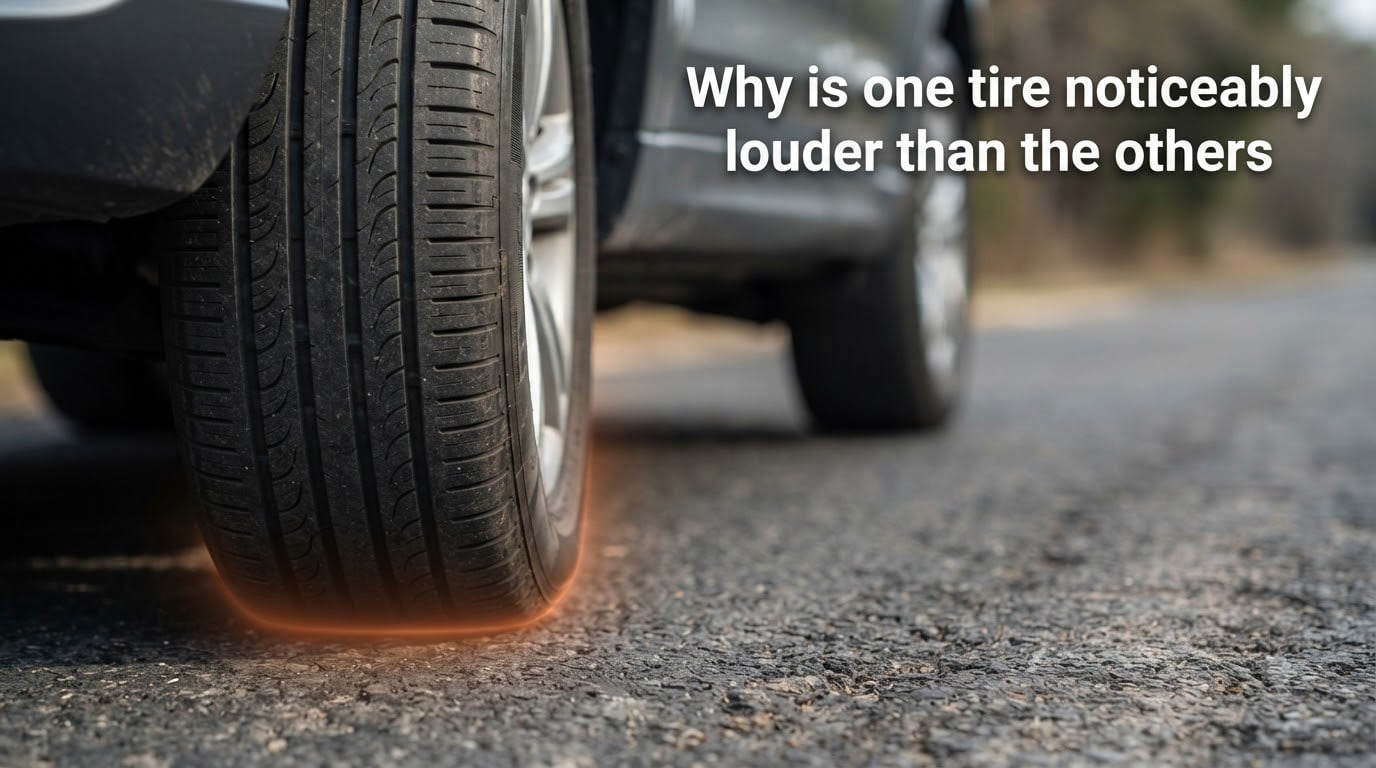
One tire noticeably louder than the others is almost always one of seven things: uneven tire wear on that specific corner, a failing wheel bearing on that wheel, low tire pressure or imbalance isolated to that tire, a wheel-alignment issue showing up on one side, a brake caliper or brake dust shield touching the rotor, a damaged CV axle boot, or a tire that is simply louder because it is a different brand or has a different amount of wear than its three neighbors.
I have been answering tire questions from drivers for years, and this is one of the most common framings I hear. People describe the noise as a hum, a drone, a womp-womp, a roar, or sometimes a rhythmic thump coming from one corner of the car. The reason this question trips drivers up is that tire noise, wheel-bearing noise, and brake noise can sound almost identical at highway speed. The good news is that you can usually figure out which one it is with a 10-minute driveway test and a short road loop.
In this guide I will walk you through the seven most common reasons one tire is louder than the others, how to pinpoint which corner is making the noise, the exact DIY diagnostic our team uses on customer cars, what it typically costs to fix, and when the noise is serious enough to get to a shop this week rather than next month.
Table of Contents
Quick Answer: 7 Reasons One Tire Is Louder Than the Others
Here are the seven causes we see most often, ranked by how frequently they show up in our shop and on owner forums like r/MechanicAdvice and r/tires:
- Uneven tire wear on that corner — cupping, feathering, or scalloping from worn suspension parts.
- Low or uneven tire pressure — one tire below the door-sticker PSI distorts the contact patch.
- Tire imbalance isolated to one wheel — a missing wheel weight or a small bend throws that tire out of balance.
- Failing wheel bearing — a worn bearing produces a hum or growl that rotates with the wheel.
- Wheel alignment issue on one side — a bent control arm or knocked toe setting can wear one tire asymmetrically.
- Brake caliper or dust shield rubbing the rotor — sounds like tire noise but is really a brake component.
- Damaged CV axle boot or joint — clicking in turns, sometimes a hum on acceleration.
Three of these (tire wear, pressure, imbalance) live entirely in the tire itself. Two of them (alignment, suspension) cause uneven tire wear that then shows up as the noise. The last two (bearing, brake, CV axle) are not the tire at all, but they get blamed on the tire more often than anything else. Keep that distinction in mind as you read the diagnostic steps below.
How to Pinpoint Which Tire Is Louder (Front vs Rear, Left vs Right)
Before you can fix the noise, you have to know which corner is making it. This is the step most generic articles skip, and it is the single biggest reason drivers end up replacing the wrong tire or paying for a wheel bearing they did not need.
The Lane-Change Test (2 Minutes)
Find a quiet stretch of road and a steady speed around 35 to 45 mph. Wait until the noise is consistent. Then perform a gentle, deliberate lane change to the left and hold that lane for three seconds. Now do the same lane change back to the right. Listen carefully both times.
- If the noise gets louder when you steer into a turn (loading one side), the problem is on the loaded side. A failing wheel bearing almost always reveals itself here, because the load presses the worn race against the rollers.
- If the noise gets quieter when you steer into a turn, the problem is on the opposite side. The unloaded bearing or tire stops contributing to the sound.
- If the noise does not change at all with steering, the problem is more likely a tire issue (cupping, imbalance) than a bearing. Tire noise does not care about load shifts.
The Pavement Test (1 Minute)
Get off the highway and find a stretch of smooth, freshly-paved asphalt. Drive at the same speed. Now move onto a section of coarse, rough pavement — bridge expansion joints, broken asphalt, or grooved concrete work well. Listen.
- Noise is much louder on rough pavement and almost disappears on smooth pavement → the tire itself is the source. Cupped or scalloped tread blocks slap the surface.
- Noise is roughly the same on both surfaces → the source is mechanical and likely a bearing or drivetrain component, not the tread.
The Visual Confirmation (5 Minutes, in the Driveway)
Crouch at each of the four wheels and run your hand across the tread in the direction of travel, then across it. You are feeling for ridges, dips, and sharp feathered edges.
- Feathering: the tread ribs feel like a saw blade when you run your hand across the tire. One edge of each rib is sharp, the other is rounded. This is an alignment problem.
- Cupping: the tread has alternating low and high spots about an inch apart, like a washboard. Run your hand along the tire and you will feel the dips. This is a worn strut, shock, or ball joint causing the tire to bounce.
- Scalloping: rounded dips on the inner or outer shoulder of the tire, usually on one side only. This is also typically alignment or suspension related.
- Flat spots: one or two distinct bald patches. Often from a locked brake, a long park, or a skid.
You now know which tire is louder, what the noise does in turns and on rough pavement, and what the tread looks like. With those three data points, you can usually identify the cause in under 15 minutes.
Uneven Tire Wear: Cupping, Feathering, and Scalloping Explained
Uneven tire wear is the single most common reason one tire is louder than the other three. The tread blocks on the worn tire hit the road unevenly, and your ear picks that up as a hum, drone, or womp-womp sound that gets louder with speed.
Cupping (the Most Common One-Tire-Noise Cause)
Cupping looks like a series of small cups or scoops worn into the tread, usually spaced an inch or two apart around the circumference. You feel it as a bumpy, washboard texture when you run your hand along the tire.
Cupping on one tire almost always points to a suspension component on that corner: a worn strut, a bad shock, a loose ball joint, or a worn control-arm bushing. When the suspension can no longer keep the tire firmly planted, the tire bounces slightly and certain spots on the tread get hammered into the pavement harder than others.
Drivers on r/MechanicAdvice describe cupped tires as making a steady drone that gets louder around 45 to 55 mph. That speed range matches the natural frequency of a bouncing tire, which is why you hear it there first.
Feathering (the Alignment Tell)
Feathering is when the tread ribs have one sharp edge and one rounded edge, all going the same direction. It almost always indicates a toe-alignment problem.
Toe is the angle of the tire when viewed from above — pointing slightly inward or outward. When toe is off, the tire is essentially being dragged sideways as it rolls, and the tread ribs get sliced into a feathered edge. Feathering usually shows up on both front tires if the alignment is off overall, but it can appear on just one tire if a control arm or tie rod was bent by a pothole.
Scalloping (the Inner/Outer Shoulder Pattern)
Scalloping is a series of smooth, rounded dips, typically on the inner or outer shoulder of the tire. It is a symptom of camber misalignment — the tire leaning too far inward or outward.
Negative camber (top of tire tilted inward) wears the inside shoulder. Positive camber (top tilted outward) wears the outside shoulder. If you see scalloping on the inside shoulder of just one tire, that tire has a camber issue that the other three corners do not have, which usually means a bent knuckle or a collapsed spring on that corner.
Flat Spots (the One-Time Event)
Flat spots are localized bald patches, not a pattern. They happen when the tire slips under hard braking, when the car has been parked for months, or when the wheel locks up in a skid. A flat-spotted tire makes a rhythmic thumping at low speed that smooths out at highway speed — the opposite of a cupped tire, which is loudest at speed.
If only one tire is making noise and it has a flat spot, the cause was almost certainly an isolated event (panic stop, curb hit, long storage). A tire with a true flat spot almost always needs replacement.
Wheel Bearing Noise vs Tire Noise: How to Tell the Difference
This is the single most-searched tire-noise question, and for good reason: wheel bearings and bad tires can sound nearly identical at 60 mph. Here is the diagnostic that works.
What a Bad Wheel Bearing Sounds Like
A failing wheel bearing produces a steady hum, drone, or growl that changes with vehicle speed and changes with steering input. The pitch rises as you accelerate, drops as you slow. It usually does not care about road surface.
The classic test, used by mechanics for decades, is to swerve gently at speed. A bad front bearing will get louder when you turn toward the side with the bad bearing (loading it) and quieter when you turn away. A bad rear bearing does not change much with steering because steering only loads the front wheels.
What Tire Noise Sounds Like
Tire noise, by contrast, is sensitive to road surface and tire construction. A cupped tire roars on rough pavement and quiets down on smooth asphalt. An imbalanced tire hums at one specific speed range and stays roughly the same in turns. Tire noise usually does not change much with steering unless the wear pattern is on the inner or outer shoulder (in which case turning can press more of the shoulder into the road).
The “Rule of One” Cheat Sheet
Here is a quick diagnostic you can do in your head:
- Noise changes with steering → suspect a wheel bearing, especially front.
- Noise changes with road surface → suspect the tire itself.
- Noise changes with vehicle speed but not steering or pavement → suspect imbalance or a constant-velocity joint.
- Noise only happens under acceleration or in turns → suspect a CV axle.
- Noise goes away when you lightly apply the brake → suspect a brake caliper or dust shield.
One Reddit mechanic put it well: “If the noise moves when you change lanes, it’s a bearing. If the noise moves when you change pavement, it’s a tire.” That is the cleanest version of the rule I have heard.
What Else Sounds Like a Wheel Bearing
A worn tire, a brake dust shield, and a damaged CV axle are the three things most often misdiagnosed as a wheel bearing. Multiple threads on r/MechanicAdvice describe drivers who paid for a $500 bearing replacement only to discover the real culprit was a bent dust shield making contact with the rotor on one corner. The dust shield is a thin metal plate behind the rotor, and a slight bend makes it rub with every rotation. That is a $20 to $50 fix in most shops. Always inspect the dust shield before approving bearing work.
Tire Pressure, Imbalance, and Wheel Alignment as Causes
If the noise is genuinely coming from the tire (not a bearing, brake, or axle), three tire-side causes cover most cases: pressure, balance, and alignment.
Tire Pressure (the Free Fix)
An under-inflated tire flexes more in the contact patch, which makes the sidewall flex with every rotation. That extra flex shows up as a low hum that rises with speed. More importantly, an under-inflated tire wears the outer shoulders faster than the center, and once that wear pattern develops, the noise sticks around even after you reinflate.
Check all four tires with a quality gauge when the tires are cold (driven less than a mile or sat for three hours). Compare against the placard on your driver’s door jamb, not the number molded on the tire sidewall. If one tire is 5 PSI or more below the others, that is likely your culprit or at least a contributor. Top it up and see if the noise changes over the next few days of driving.
Cold weather makes this worse. Tire pressure drops roughly 1 PSI for every 10°F drop in temperature, so a 30°F swing can cost you 3 PSI overnight. Drivers who notice new tire noise after the first cold snap of fall or winter are often hearing nothing more than under-inflation.
Tire Imbalance (the Speed-Specific Hum)
An imbalanced tire has uneven weight distribution around the wheel. As the tire rotates, the heavy spot pulls the wheel up and down, producing a hum or shake that is worst at one specific speed and disappears at higher or lower speeds. Imbalance on one tire only is common if a wheel weight fell off after hitting a curb, or if a small bend in the rim shifted the effective balance point.
Imbalance usually shows up around 50 to 70 mph and feels as much as it sounds — a vibration in the steering wheel or the seat at speed. The fix is a rebalance, which most tire shops do in 30 minutes for a single wheel.
Wheel Alignment (the Pattern Problem)
Alignment affects how the tire sits relative to the road and to the other three tires. Three alignment angles matter: toe, camber, and caster. When one is off, the tire drags, scuffs, or leans, producing both a noise and a wear pattern.
Toe misalignment on one corner (caused by a bent tie rod or a knocked wheel after a pothole) produces feathering and a side-specific hum. Camber misalignment on one corner (caused by a bent control arm or a collapsed spring) produces inner or outer shoulder wear and a noise that gets louder in turns.
The tell is almost always in the wear pattern: if you see feathering or scalloping on just one tire, that tire has an alignment problem that the other three do not have, and the alignment shop will be looking at suspension components on that corner rather than doing a standard four-wheel alignment adjustment.
Other Impersonators: CV Axle, Brake Caliper, and Brake Dust Shield
About one in four “my one tire is loud” cases turns out to be something other than the tire, the bearing, or the alignment. These are the most common impersonators.
CV Axle (the Click-in-Turns Clue)
The CV (constant-velocity) axle is the shaft that transfers power from the transmission to the front wheels on a front-wheel-drive or all-wheel-drive car. It has rubber boots at each end that hold grease in and dirt out. When the boot tears, the joint dries out and starts clicking.
The signature is clicking that happens when you turn — louder in tight turns, especially at low speed in a parking lot. The click is rhythmic, one per wheel rotation, and it almost always shows up on the side you are turning toward (because that is the loaded axle). If you hear clicking plus a hum on acceleration, the boot is torn and the joint needs replacement before the grease runs out completely.
Brake Caliper (the Noise-That-Stops)
A sticking brake caliper does not release the pad fully. The pad stays in light contact with the rotor, producing a continuous scraping or grinding that gets louder with speed and often disappears the moment you apply the brake (because the brake piston finally moves and shifts the pad).
To test, drive at a steady 30 mph, lift off the gas, and listen. If the noise fades the instant you touch the brake pedal, you are probably hearing a sticking caliper or a pad that is not fully retracting. A stuck caliper also makes that wheel run noticeably hotter than the other three after driving — touch the wheels (carefully, with the car parked) to confirm.
Brake Dust Shield (the Cheap Fix)
The brake dust shield is a thin metal plate that sits between the rotor and the wheel hub. Its job is to keep brake dust off the wheel. If it gets bent — by a curb, a deep pothole, or even over-torquing the wheel lugs — the inner edge can lightly contact the rotor hat.
The result is a ticking or scraping that sounds like a tire noise and changes with speed but not with steering or pavement. Drivers on r/MechanicAdvice have reported paying for a wheel bearing only to discover a $20 dust shield was the actual cause. A mechanic can usually bend the shield back in 10 minutes.
Step-by-Step DIY Diagnosis You Can Do in Your Driveway
Here is the procedure our team walks customers through when they call about one tire being louder than the others. None of these require tools beyond a tire pressure gauge and a flashlight.
Step 1: Check Tire Pressure on All Four Tires
Use a quality gauge, check cold, and write down each reading. Anything more than 3 PSI below the door-jamb placard is suspect. Inflate to spec. If one tire was 8 PSI low, that tire alone may be your culprit.
Step 2: Visual Inspection of Each Tire
Crouch at each wheel. Run your hand across the tread in both directions. Look for cupping, feathering, scalloping, flat spots, foreign objects (screws, nails), and uneven shoulder wear. Note which tire has the most abnormal wear — that is your suspect corner.
Step 3: Inspect the Sidewalls
Look for bulges, cracks, cuts, and objects still embedded in the rubber. A bulge means the internal cords are broken; that tire is unsafe regardless of noise.
Step 4: Spin Each Wheel by Hand
With the car safely parked and the transmission in park (or in gear for manual transmissions), spin each wheel. Listen and feel. A grinding or rough sensation that does not match the other three points to a bearing. A scraping that gets louder with each spin is usually the dust shield.
Step 5: Rock the Wheel at 12 and 6 O’Clock
Grab the tire at top and bottom and try to rock it in and out. Any play at all means the wheel bearing is worn. Do the same at 9 and 3 o’clock — play there points to a ball joint or tie rod, which causes cupping.
Step 6: The Lane-Change Test
Drive at a steady 40 mph on a quiet road. Listen. Now change lanes gently to the left and hold it. Listen again. Change back. The side that gets louder when loaded is your suspect bearing.
Step 7: The Pavement Test
Drive the same speed on smooth asphalt, then onto rough pavement. If the noise changes drastically with surface, it is the tire. If it stays the same, it is mechanical.
Step 8: The Light Brake Test
At 30 mph, gently tap the brake pedal. If the noise disappears or changes character, suspect a brake component — caliper, pad, or dust shield — rather than the tire or bearing.
If the steps above point to a tire, your fix is rotation, replacement, or alignment. If they point to a bearing, brake component, or axle, the next section will help you decide whether to drive it to a shop this week or schedule a regular appointment.
What If Only One Tire Is New? The Brand-Mismatch and Break-In Issue
This is one of the most common Reddit pain points around tire noise, and almost no general-purpose article addresses it. Here is the scenario: you got a puncture, the shop replaced just the damaged tire, and now the new tire sounds different from the other three. Is something wrong?
Usually, no. There are two reasons the new tire sounds different.
Break-in. New tires have a release agent on the mold that needs to wear off, plus a thin layer of uncured rubber on the tread surface. For the first 200 to 500 miles, a new tire can hum, drone, or squeak slightly more than the worn tires around it. This typically fades on its own.
Brand and model mismatch. This is the bigger issue. If your three older tires are a quiet touring tire and the replacement is a different brand, model, or speed rating, the new tire will have a different tread pattern, different rubber compound, and different noise profile. The difference is most noticeable at 50 to 70 mph, where road noise dominates.
Many tiremakers recommend replacing tires in pairs or full sets for this reason. If you can, replace the opposite side tire as well so the noise profile matches. If a single replacement is all your budget allows, expect some asymmetry for the life of that one tire and know that it is normal.
Cost of the Most Likely Fixes (What You Are About to Spend)
Cost transparency is something almost every competitor article skips, and it is one of the top things drivers ask about on forums. Here are realistic ranges for the most likely repairs in 2026, based on what we see at independent shops and dealerships:
- Tire rotation and balance (all four): typically a low-cost service at most tire shops, often free if you bought the tires there.
- Wheel alignment (two or four wheels): a standard four-wheel alignment generally runs in the lower-to-mid range depending on vehicle and shop. If you need a bent component replaced first, that adds time and parts.
- Single tire replacement: varies widely by tire size and brand. A basic touring tire is on the low end; a low-profile performance tire on the high end. Always replace in pairs when possible.
- Brake dust shield repair: usually billed as shop labor only — a 10 to 30 minute fix in most cases.
- Wheel bearing replacement (single corner): parts and labor on a single front or rear corner typically lands in the mid-hundreds on most cars. Sealed hub assemblies cost more than serviceable bearings.
- CV axle replacement (single side): parts and labor combined for one front axle typically lands in the mid-to-upper hundreds depending on the vehicle.
Prices vary by region, vehicle, and shop. Get a written quote before approving any work, especially on a bearing or axle job. For exact current pricing on parts and tires, your local tire shop or dealership service desk is the right call.
When to Visit a Mechanic (Safety Guidance)
Not every noisy tire is urgent. Here is how to decide.
Drive it to a shop this week: if you feel any play in the wheel when you rock it at 12 and 6 o’clock, if the noise gets dramatically louder when you load one side in a turn, if you see a bulge in the sidewall, if the brakes are pulling to one side, if you see a torn CV boot with grease flung around the inside of the wheel, or if the noise started after a clear impact (pothole, curb).
Schedule a regular appointment: if the tire has uneven wear but no play in the wheel, if the noise is constant but mild, if the car tracks straight and brakes evenly, or if the noise only happens at one specific speed range.
Replace the tire before driving further: if you see a bulge, a deep crack exposing the cords, an active leak, or tread depth below 2/32 inch (the legal minimum in most US states).
A noisy wheel bearing is not a “stranded on the highway tomorrow” failure in most cases, but it can damage the hub, the ABS sensor, and ultimately seize the wheel if ignored for months. Do not delay indefinitely.
Frequently Asked Questions
What does a misaligned tire sound like?
A misaligned tire usually produces a faint hum or drone that rises with speed and is often accompanied by a directional pull or off-center steering. The signature pattern in the tread is feathering: one sharp edge and one rounded edge on each rib, all going the same direction. You will feel it as a saw-tooth texture when you run your hand across the tire.
What can be mistaken for wheel bearing noise?
The most common impersonators are cupped tires (the most-searched mimicker), an imbalanced tire, a bent brake dust shield rubbing the rotor, a sticking brake caliper, and a damaged CV axle. All four produce a hum or drone that sounds like a bad bearing at highway speed. The lane-change test is the best way to separate them: a bearing changes with steering load, a tire changes with road surface, a dust shield stays roughly constant, and a CV axle clicks in turns.
What kind of noise does uneven tire wear make?
Uneven tire wear produces a hum, drone, roar, or rhythmic thump that gets louder as speed increases. Cupping and scalloping are loudest around 45 to 55 mph. Feathering produces a steady hiss. Flat spots produce a rhythmic thumping that fades at higher speeds. The noise almost always correlates with road surface: louder on rough pavement, quieter on smooth asphalt.
Can unbalanced tires make a sound?
Yes. An unbalanced tire produces a speed-specific hum or vibration that is worst at one particular speed range (often 50 to 70 mph) and less noticeable at other speeds. The vibration usually comes through the steering wheel if the imbalance is on a front tire, or through the seat if it is on the rear. A rebalance resolves it in most cases.
How can I tell if it is the front or rear wheel bearing?
Do a gentle lane-change test at a steady 35 to 45 mph. If the noise gets louder when you steer left, suspect the left front bearing. If it gets louder when you steer right, suspect the right front bearing. If the noise stays constant in both directions, the suspect is a rear bearing. Rear bearings do not change much with steering because steering only loads the front wheels.
Can I drive with a noisy front wheel bearing?
Yes, but only for a short time. A noisy front bearing is not an immediate breakdown risk, but it will damage the hub assembly, the ABS sensor, and ultimately the axle if left for months. Drive it to a shop within a week or two. If you feel any play in the wheel when you rock it at 12 and 6 o’clock, treat it as urgent.
How do I fix a noisy tire?
Start with the cheapest checks: confirm tire pressure on all four tires against the door-jamb placard, then do a visual inspection for cupping, feathering, scalloping, and foreign objects. If the wear pattern is even, get a rotation and balance. If one tire is worn unevenly, get an alignment check and replace that tire. If the noise persists, escalate to a bearing, brake, and CV axle inspection at a shop.
Why are my new tires so loud?
Brand-new tires often sound louder for the first 200 to 500 miles due to mold release agent and a thin uncured rubber layer on the tread. This normally fades with break-in. If the noise is on just one new tire among three older ones, the cause is usually a brand or model mismatch — the new tire has a different tread pattern and compound than its neighbors. Replacing in pairs or full sets eliminates the asymmetry.
Final Thoughts
One tire noticeably louder than the others is almost always one of seven causes, and the lane-change test plus the pavement test will narrow it down in under five minutes of driving. Once you know whether the noise is a tire issue, a wheel-bearing issue, or an alignment issue, you can decide whether the fix is a $20 pressure top-up, a rotation, a balance, a single-tire replacement, or a trip to a shop for bearing work.
Start with the cheapest checks first: tire pressure on all four corners, then a visual inspection of each tread. If the wear pattern looks even and the pressure is right, escalate to the lane-change and pavement tests. If the noise persists, get an alignment check and a balance. And if the noise changes when you turn, get the bearings and dust shield looked at this week rather than next month.
For more on tire care, seasonal pressure checks, and how to spot suspension wear before it ruins your next set of tires, our team has put together a complete tire-care guide to walk you through the rest of the process.