
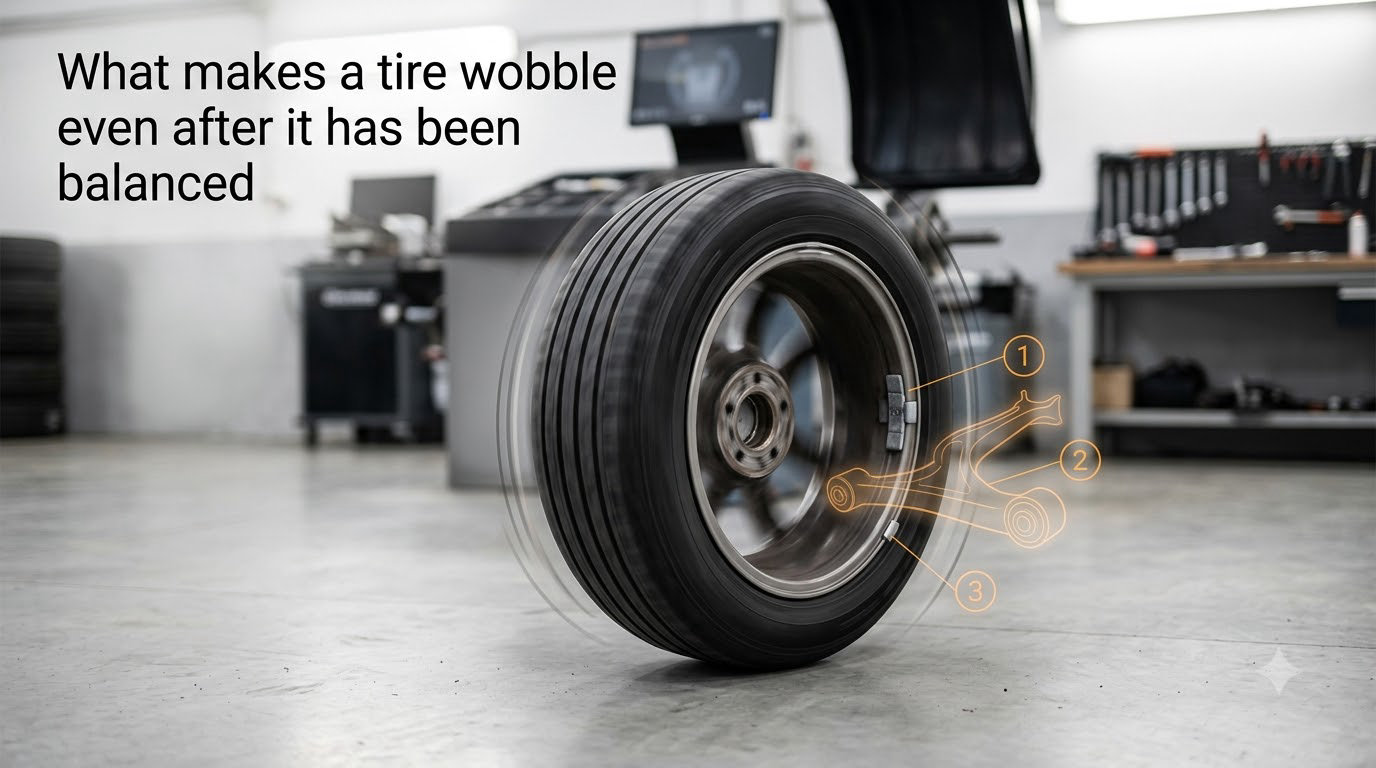
A tire can wobble after balancing because standard wheel balancing only fixes weight imbalance. It cannot detect bent rims, road force variation, worn suspension components, or tire defects. If your car still shakes right after a fresh balance, the culprit is almost always one of those five issues, and each one needs a different fix.
I have spent years talking to drivers and tire techs about this exact frustration. The most common story I hear goes like this: a driver pays for a balance, drives out of the shop, and the steering wheel starts shaking at 60 mph. They go back. The shop rebalances. Still shakes. They try a third shop. Still shakes. The problem is rarely the balance itself. The problem is that balancing never addressed what was actually causing the wobble in the first place.
This guide walks you through every realistic cause of tire wobble after balancing, how to tell which one you have, and what it costs to fix. I will also cover the DIY diagnostic steps you can do at home before spending another dollar at a tire shop.
Table of Contents
What Causes a Tire to Wobble Even After Balancing
Five issues cause most post-balance wobble. Standard wheel balancing fixes weight imbalance, but it cannot fix bent steel or aluminum, suspension wear, internal tire defects, or the road force variation that comes from stiff spots in a tire. Here are the top causes, ranked by how often I see them in real driver reports.
Bent wheel or rim. A pothole, curb, or rough railroad crossing can bend a rim just enough to throw it out of true. The tire itself can be perfectly balanced and still wobble because the wheel it sits on is no longer round. This is the single most common cause of vibration that survives a fresh balance.
Road force variation in the tire. Every tire has slightly stiff and slightly soft spots around its circumference. Standard balancers ignore these. A tire with a heavy stiff spot will hop against the road even when it is perfectly balanced for weight. Only a Road Force balancer can measure this and roll-mount the tire on the wheel to cancel it out.
Improper balancing technique. A wheel that is not centered correctly on the balancer, dirty or worn cones, or a wheel that was never cleaned before weights were applied will read wrong from the start. If the wheel was not re-zeroed or the cones were loose, the weights placed on it do not actually cancel the imbalance.
Worn suspension components. A bad wheel bearing, a loose ball joint, a worn tie rod end, or a failing strut mount lets the wheel move in ways it should not. The tire can be balanced perfectly and the wheel can be true, but a sloppy suspension still produces a shake. Tie rods alone account for a large share of mystery steering wheel vibration complaints on higher-mileage cars.
Tire belt separation or internal defect. A separated belt or broken internal ply creates a bulge that no amount of balancing will hide. This is most common on older tires, retreaded tires, and tires that have been severely underinflated. A bulge almost always means the tire needs to be replaced, not rebalanced.
Why Standard Tire Balancing Sometimes Fails
Standard wheel balancing only corrects for weight imbalance. A spin balancer measures where the heavy spot on the tire and wheel assembly is, and a technician sticks a weight on the opposite side to cancel it out. That is the whole job. It works great for true weight imbalance and nothing else.
What it cannot detect is shape. A wheel that is bent, a tire with a stiff spot, or a tire with a separated belt will all read as perfectly balanced if their weight is evenly distributed. The spin balancer sees a smooth, balanced assembly and gives the green light. The road tells a different story the moment you hit 50 mph.
Standard balancing also depends on the wheel being mounted correctly on the balancer. If the cone is the wrong size, the wheel is not seated against the back plate, or the back cone is loose, the balancer reads the assembly at a slight angle. The weights it suggests will be wrong because the wheel was measured wrong. This is why a rebalance at a different shop sometimes fixes the problem. The new shop mounts it correctly and gets a different reading.
If your tire was balanced and the wobble is identical to before, ask the shop to remount the wheel on the balancer and check the reading again. If it still reads balanced but the wobble persists, the issue is not balance. Move on to road force, runout, or suspension.
Road Force Balancing vs Standard Balancing
Road Force balancing is a different machine and a different process. A Road Force balancer, like the Hunter Road Force Elite, presses a loaded roller against the tire as it spins. That roller simulates the weight of the car pressing down on the tire. The machine measures how much force the tire exerts against the roller at every angle around its circumference. This catches stiff spots, soft spots, and high or low spots that a regular spin balancer cannot see.
The technician then has two options. They can add corrective weights, similar to standard balancing, or they can use a process called match-mounting. Match-mounting means rotating the tire on the wheel until the tire’s high spot lines up with the wheel’s low spot. When the stiffest part of the tire and the lowest part of the wheel sit at the same point, road force variation drops dramatically and so does the vibration.
The table below compares the two methods side by side.
| Feature | Standard Balancing | Road Force Balancing |
|---|---|---|
| Detects weight imbalance | Yes | Yes |
| Detects bent rim | Sometimes | Yes |
| Detects tire runout | No | Yes |
| Detects road force variation | No | Yes |
| Can match-mount tire to wheel | No | Yes |
| Typical cost per wheel | Lower | Higher |
| Equipment availability | Common | Limited |
Road Force balancing costs more per wheel than standard balancing, and not every shop has the equipment. If you have tried standard balancing two or three times and the vibration still shows up at highway speeds, Road Force balancing is the next step. Forum users consistently report it catches problems that two or three standard balances missed, especially after new tire installations.
Speed-Based Diagnosis: When Does the Wobble Show Up
The speed at which vibration appears is one of the strongest diagnostic clues you have. Different problems show up at different speeds, and matching the symptom to the speed narrows the cause list fast.
Wobble at low speed (under 30 mph). Low speed wobble is almost never a balance problem. It is usually a bent wheel, a separated tire belt, or a failing suspension component. If you can see the wheel hop as you pull out of a parking spot, the wheel itself is bent or the tire has a visible bulge.
Wobble between 50 and 70 mph. This is the classic balance and road force zone. Tires that are out of balance, tires with stiff spots, and wheels with minor runout all vibrate most strongly in this window. If the vibration starts around 55 mph, peaks at 65, and fades as you go faster, balance or road force variation is the likely cause.
Wobble only under braking. If the vibration appears or gets much worse when you press the brake pedal, the problem is warped brake rotors, not the tire. The tire and wheel can be balanced perfectly and still shake under braking because the rotor itself is the source. This is a separate repair from tire balancing.
Wobble that increases continuously with speed. A vibration that gets worse the faster you drive usually points to a tire defect, severe wheel runout, or a failing wheel bearing. Wheel bearing noise often accompanies this kind of vibration. Listen for a hum or growl that rises with speed and changes when you turn slightly left or right.
Location-Based Diagnosis: Where Do You Feel the Wobble
Where you feel the vibration in the car tells you which end of the car and which system to investigate first.
Steering wheel shake. When vibration comes through the steering wheel, the front wheels are usually responsible. Front tires, front wheels, and front suspension components all tie directly to the steering system. A steering wheel shake that starts around 60 mph almost always traces back to a front tire balance issue, a front wheel runout issue, or a front suspension problem.
Seat or floor vibration. Vibration you feel through the seat or floorboard without much steering wheel movement usually points to the rear wheels or a driveshaft issue on rear-wheel-drive cars. If the shake is in the seat and not the steering wheel, start by checking the rear tires for balance, runout, and bulges.
Pulling to one side. If the car pulls left or right while wobbling, suspect tire conicity or an alignment issue. Conicity is a manufacturing variation where a tire is shaped slightly like a truncated cone. The car pulls in one direction even when the wheels are aligned. Match-mounting the tire on the wheel, which a Road Force balancer can do, often cancels conicity. If pulling persists after match-mounting, the alignment itself needs to be checked.
DIY Diagnostic Steps Before Visiting a Shop
Before you pay for another balance or drive to a third shop, run through these checks at home. They take about twenty minutes and can save you the cost of a diagnostic visit that goes nowhere.
Step 1: Visual inspection. Look at each tire closely. Check for bulges, cracks in the sidewall, objects stuck in the tread, and uneven wear across the tread face. A bulge on the sidewall means the tire is unsafe and needs replacement regardless of balance. Uneven wear across one tire often points to a bent wheel.
Step 2: Tire pressure check. Check all four tires, including the spare, with a reliable gauge. A tire that is 10 psi low will shake badly at highway speed and make a balanced tire feel out of balance. Inflate to the pressure listed on the door jamb sticker, not the number on the tire sidewall.
Step 3: Road test at multiple speeds. Drive at 30 mph, 50 mph, 65 mph, and 75 mph if safe. Note when the vibration starts, peaks, and fades. Note whether the steering wheel or the seat carries the shake. This information tells the technician where to look first.
Step 4: Swap test. Swap the front tires to the rear and the rear tires to the front. If the vibration moves to the rear of the car, you have confirmed it is tire-related. If it stays in the steering wheel, suspect a front suspension component instead. Many forum users reported that a simple front-to-rear swap revealed the problem tire immediately.
Step 5: Lug nut and torque check. Loose or unevenly torqued lug nuts can mimic a balance problem. If the wheels were installed recently, confirm they were tightened with a torque wrench to the manufacturer specification. Overtorqued or undertorqued wheels can warp a rotor and produce a vibration that feels exactly like a balance issue.
Common Suspension and Wheel Components That Cause Wobble
When balancing and road force have been ruled out, the suspension becomes the next area to check. Four components cause the majority of suspension-related wobble complaints.
Wheel bearings. A worn wheel bearing lets the hub move slightly under load. This shows up as a hum that rises with speed and a vibration that gets worse through turns. A bad bearing often gets louder on one side of a turn and quieter on the other. Replacement typically runs in a moderate price range per wheel and is not a DIY job for most drivers.
Ball joints and tie rods. Loose ball joints let the wheel shift forward and backward under acceleration and braking. Worn tie rod ends let the wheel toe in or out unpredictably. Both produce a shake that feels like balance but is actually play in the steering linkage. A shop can check these with a quick lift and a pry bar test in under five minutes.
Hub-centric rings. Hub-centric rings are plastic or metal rings that center aftermarket wheels on the hub. Many aftermarket wheels are lug-centric only, which lets the wheel sit slightly off-center on the hub even when lug nuts are tight. The result is a vibration at speed that no amount of balancing will fix. Installing the correct hub-centric rings for your vehicle solves it. Forum users on enthusiast sites report this is one of the most overlooked causes after a wheel change.
Wheel runout and conicity. Wheel runout is the side-to-side or up-and-down wobble of a wheel measured at the tire mounting surface. Most wheels have some runout, but more than about 0.040 inch of lateral runout starts to cause noticeable vibration. Conicity, the truncated cone shape mentioned earlier, is harder to measure and usually requires a Road Force balancer to detect. Both can be solved by match-mounting the tire on the wheel.
How Much Does It Cost to Fix Tire Wobble
Cost varies widely by repair type, vehicle, and region. The ranges below reflect typical out-of-pocket pricing at independent shops in the United States. Your local dealer or specialty shop may charge more.
Standard balancing per wheel. Standard computer balancing is one of the most affordable shop services. Many shops include balancing with a new tire purchase. Standalone balancing is a low-cost service at most tire shops. If a shop charges extra for balancing with new tires, ask whether Road Force is included.
Road Force balancing per wheel. Road Force balancing costs more per wheel than standard balancing because the equipment is expensive and the process takes longer. Many shops charge a premium per wheel or a flat rate for all four. The premium is usually worth it after one or two failed standard balances.
Wheel straightening. A bent alloy wheel can sometimes be straightened by a specialty shop. Straightening cost depends on the size of the bend and the wheel material, but most shops will quote it after inspecting the wheel. A wheel that is too far out of round is usually not safe to straighten and should be replaced.
Suspension component replacement. Ball joints, tie rod ends, and sway bar links are moderate-cost parts with labor that depends on the vehicle. Wheel bearing replacement cost varies significantly by whether the bearing is a separate part or pressed into the hub assembly. Some vehicles require hub assembly replacement, which costs more than a simple bearing repack.
Tire replacement. If the diagnosis points to a separated belt or a bulge, no balancing will fix it. The tire must be replaced. Tire cost depends on size, brand, and speed rating, but the labor to mount and balance a new tire is usually rolled into the tire price.
When to See a Mechanic About Tire Wobble
Some wobble situations need a professional diagnosis rather than another balance. The warning signs below tell you it is time to stop diagnosing at home and book a service appointment.
Visible tire damage. Any bulge, crack, or large cut on the sidewall means the tire is unsafe. Do not drive on a tire with a sidewall bulge. Have it replaced or removed before the next drive.
Vibration that started after a specific impact. If the wobble began right after hitting a pothole, curb, or debris, the wheel is likely bent. Visual inspection may not catch a small bend. A shop with a tire balancer can measure runout and confirm whether it is within spec.
Steering wander or uneven braking. If the car pulls strongly to one side, the steering feels loose, or the car pulls more under braking than during steady driving, the suspension or brake system is involved. These symptoms are beyond a tire shop’s scope and need a general mechanic or alignment shop.
Noise accompanying the vibration. A hum, growl, or clicking noise alongside the shake usually points to a wheel bearing, CV joint, or brake issue. None of those are balance problems. Describe the noise clearly to the shop so they can target the right system.
When you take the car in, tell the shop three things: when the vibration started, what speed it appears at, and where you feel it. That short description alone cuts diagnostic time significantly. Ask whether they have a Road Force balancer. If they do not, ask for a referral to a shop that does. There is no point in paying for a third standard balance if road force variation is the actual cause.
Frequently Asked Questions
Why is my car still shaking after getting my tires balanced?
Standard balancing only fixes weight imbalance. It cannot detect bent rims, road force variation, worn suspension components, or tire defects. If your car still shakes after a fresh balance, one of those four issues is the real cause, and each one needs a different repair than another balance.
Can an unbalanced tire cause a wobble?
Yes. A tire with significant weight imbalance will produce a wobble, usually between 50 and 70 mph. However, a balanced tire can also wobble because of bent rims, tire runout, road force variation, or suspension wear, which is why balancing alone does not always solve vibration complaints.
Why is my car wobbling after I change the tires?
New tire wobble usually comes from one of four causes: the new tires were not Road Force balanced, the wheels were not match-mounted, the aftermarket wheels lack hub-centric rings, or the lug nuts were not torqued to specification. A Road Force balance and a torque check resolve most post-installation wobble.
At what speed do unbalanced tires shake?
Unbalanced tires usually start to shake between 50 and 70 mph, with the vibration peaking around 60 mph and often fading above 75 mph. The exact speed depends on the size of the imbalance, the wheel and tire size, and the vehicle. If vibration appears at a different speed window, the cause is usually something other than balance.
How do I fix tire wobble after balancing?
Start with a Road Force balance to rule out road force variation, runout, and tire defects. If that does not solve it, inspect the wheels for bends, check tire pressure, verify lug nut torque, and have a shop test the suspension components. Replacement is the only fix for a tire with a separated belt or visible bulge.
Is it safe to drive with a wobbling tire?
A mild wobble at highway speed is usually safe for short drives, but it accelerates tire wear and can damage suspension components over time. A wobble accompanied by a visible bulge, severe pulling, steering looseness, or unusual noise is not safe and should be addressed before the next long drive.
How much does it cost to fix tire wobble?
Cost depends on the cause. Standard balancing is one of the lowest-cost shop services. Road Force balancing costs more per wheel but catches problems standard balancing misses. Suspension repairs vary widely by part and vehicle. Tire replacement is necessary when the wobble comes from a separated belt or bulge.
Key Takeaways on Tire Wobble After Balancing
A tire that wobbles after balancing is telling you that balance was never the cause. The five issues responsible for most post-balance wobble are bent wheels, road force variation in the tire, improper balancing technique, worn suspension components, and tire belt separation. Each one has a different fix, and none of them is another standard balance.
Start your diagnosis with the speed at which the vibration appears and the location where you feel it. Then run through the DIY checklist at home before paying for another shop visit. If standard balancing has been tried more than once without success, your next step is a Road Force balance at a shop that has the right equipment. From there, move on to suspension inspection only if Road Force does not solve the problem.
The fastest path to a quiet ride is matching the symptom to the cause before spending money. Standard balancing is a fix for one specific problem, and it is a good fix for that problem. The wobble that survives a balance needs a different tool.