
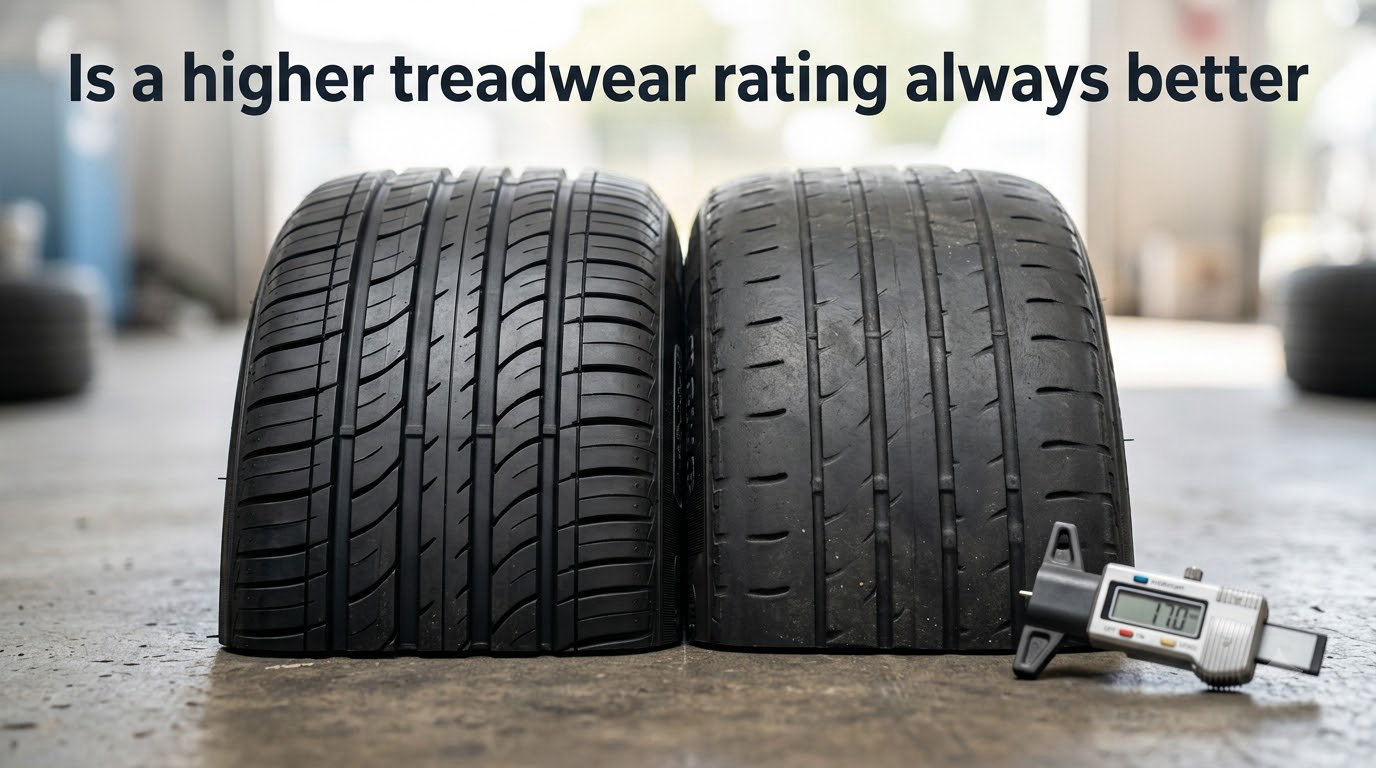
No, a higher treadwear rating is not always better. A treadwear rating tells you how long a tire’s rubber is expected to last relative to a government control tire rated 100, and a higher number signals a harder compound built for mileage. That same hardness reduces wet grip, cold grip, ride comfort, and handling precision. The right treadwear rating depends on whether you prioritize longevity or performance, and on where, how, and how much you drive.
I have been researching and writing about tires for years, and the treadwear question is the one that confuses drivers the most. People assume “higher number = better tire,” the same way a higher octane rating feels like an upgrade. The comparison does not work that way. A 700 treadwear tire is not a luxury version of a 300 treadwear tire; it is a different tool for a different job.
In this guide, our team breaks down what a treadwear rating measures, why the hard-rubber trade-off exists, how to read the number on your sidewall, and how to pick the rating that actually fits your driving. You will also get a cost-per-mile framework and a quick decision tree so you can stop second-guessing the number and pick with confidence.
Table of Contents
What a Treadwear Rating Actually Measures
A treadwear rating is a comparative number, not a mileage promise. It comes from the Uniform Tire Quality Grading (UTQG) system, a labeling program created by the National Highway Traffic Safety Administration (NHTSA) in the late 1970s and still printed on the sidewall of every new passenger and light-truck tire sold in the United States.
UTQG has three grades stamped on the sidewall: treadwear, traction, and temperature. The treadwear grade is the one drivers ask about most, and it works like this: manufacturers mount the test tire and a control tire on the same vehicle, run them on a government-specified course for 7,200 miles under controlled conditions, and compare how much rubber each one loses. The control tire is graded at 100, and the test tire gets a relative number.
So a treadwear 500 tire wore five times slower than the control tire under those test conditions. A treadwear 300 tire wore three times slower. A treadwear 200 tire wore twice as slow. The math sounds simple, but here is the part most articles skip: the manufacturer runs the test, not NHTSA. NHTSA sets the rules and audits results, but the actual wear data comes from the tire maker’s own course.
That setup matters. It means the treadwear rating is most reliable when you compare two tires from the same brand, tested on the same course, in the same season. Across brands, the numbers drift. Drivers on forums routinely report that a 600-rated tire from one brand wore out faster than a 400-rated tire from another. The system is honest about its limits once you know the limits exist.
The Hard-Rubber Trade-Off: Why Higher Isn’t Always Better
Here is the core of the answer. Tire engineers can make a tire last longer by using a harder rubber compound, and they can make a tire grip better by using a softer one. They cannot do both at the same time with the same compound, which is exactly why a higher treadwear number is not always a better tire.
A harder compound resists the friction that wears tread down. That is how a 700-rated tire squeezes 60,000 to 80,000 miles out of its tread. The trade-off is grip. Harder rubber deforms less against the road surface, which means less mechanical grip in the dry, less bite in the wet, and almost no give in cold weather below about 40 degrees Fahrenheit. Hard compounds also tend to transmit more road noise into the cabin and feel less compliant over bumps.
A softer compound does the opposite. It conforms to road texture, displaces water more effectively, and grips harder in the dry and the wet. It also wears faster, often by a factor of two or three. A 200-rated ultra-high-performance summer tire might deliver phenomenal handling and braking, then be done at 20,000 miles. That is not a defect. It is the design.
There is one more layer worth understanding. UTQG rates treadwear against a control tire rated 100, but traction is graded AA, A, B, or C based on wet-stopping performance. A tire with a 700 treadwear grade and a C traction grade is legal and common, and it will last a long time on dry pavement. In a heavy rainstorm, the same tire can struggle to stop compared to a 400-rated tire with an A traction grade. The two UTQG scores interact, and a “better” treadwear number can quietly mean a worse safety margin in the wet.
Treadwear Ratings by Tire Category
Numbers mean more once they are tied to a tire type. Below is a typical treadwear range for each major passenger and light-truck category. These are not absolutes, but they are the bands most manufacturers land in.
| Tire Category | Typical Treadwear Range | Best For |
|---|---|---|
| Ultra-High-Performance Summer | 100 – 300 | Track days, autocross, dry-weather sports cars |
| High-Performance All-Season | 300 – 500 | Sporty sedans and coupes driven year-round |
| Standard Touring All-Season | 500 – 800 | Daily commuters, family vehicles, highway driving |
| Grand-Touring All-Season | 500 – 700 | Luxury sedans, longer wheelbase vehicles |
| All-Terrain (Light Truck / SUV) | 400 – 700 | Mixed on-road and off-road use |
| Mud-Terrain | 300 – 500 | Serious off-road, lower on-road longevity |
| Highway / Light-Truck Rib | 500 – 800 | Long-haul trucks and tow vehicles on pavement |
| Track / R-Compound | Under 200 | Closed-course driving only |
| Winter / Snow (Studless) | 400 – 700 | Cold climates; not a treadwear-driven category |
Two patterns jump out. First, the tires designed for grip live on the low end of the scale, and the tires designed for longevity live on the high end. Second, the “middle” of the scale (around 400 to 600) is where most all-season passenger tires land, and that is exactly the band that balances daily usability with reasonable life.
Now the PAA-style questions you typed into Google, answered directly:
- Is a 320 treadwear rating good? A 320 rating is on the lower end and usually means a high-performance all-season or a soft-compound summer tire. It is good if you want grip and handling, but expect 25,000 to 35,000 miles of real-world life.
- Is 500 treadwear a good tire? Yes, a 500 treadwear rating is a solid middle-ground number for most daily drivers. It usually pairs with an A traction grade and delivers 50,000 to 70,000 real-world miles when properly inflated and rotated.
- Is 700 a good treadwear rating? A 700 rating is good for longevity-focused drivers. It signals a harder compound built for 70,000 to 90,000 miles of life, with the trade-off being slightly reduced wet grip and a firmer ride.
- Is 420 treadwear good? A 420 rating is a healthy mid-pack number for a performance all-season. You give up some life compared to a 600-rated touring tire, but you typically gain wet braking and steering feel.
- What is a good treadwear rating? For most passenger drivers, 500 to 700 is the sweet spot. Performance drivers will be happier at 200 to 400. Track-day and r-compound tires sit below 200.
- What does treadwear 600 mean? A treadwear 600 tire wore six times slower than the control tire in the UTQG test. In real-world driving, you can typically expect 60,000 to 80,000 miles.
- Treadwear rating 300? A 300 rating is the boundary between performance all-season and ultra-high-performance summer. You get sharper handling and shorter life, usually 30,000 to 40,000 miles.
- Is 300 treadwear good? It is good for performance use. For a daily commuter who drives 15,000 miles a year, it is overkill in the wrong direction.
Reading the Sidewall Marking
You do not need any special tool to find your treadwear rating. It is stamped on the tire’s sidewall, usually near the bead and on the outboard side. Look for a string of three codes that looks like this:
TREADWEAR 500 TRACTION A TEMPERATURE A
That exact marking is real and common. The first number is the treadwear grade. The second letter is the traction grade, which ranges from AA (highest) down to C. The third letter is the temperature grade, which ranges from A (best) to C. All three are part of the same UTQG block.
If you cannot find the marking because the sidewall is dirty, you can also check the tire’s spec sheet on the manufacturer’s website or the retailer listing. The treadwear grade is required by federal law to be present on the sidewall, so any new tire sold in the U.S. will have one. Used tires may have worn markings, but the spec sheet lookup still works.
One more detail that catches drivers: the treadwear rating on the sidewall of a single tire is the same on all four corners of the same model. It is not a per-tire measurement; it is a model-level grade assigned at the factory.
Real-World Factors That Override the Rating
The UTQG treadwear grade is run on a smooth government course under ideal conditions. Your driveway, your commute, and your climate are not a government course, which is why the rating is a starting point, not a verdict. A few real-world factors routinely override the number.
- Driving style. Spirited acceleration, hard braking, and fast cornering scrub rubber faster than the test simulates. An aggressive driver on a 500-rated tire might see 35,000 miles; a calm driver on the same tire might see 70,000.
- Inflation pressure. Under-inflated tires wear the shoulders. Over-inflated tires wear the center. Either condition can cut real-world life by 20 percent or more compared to the spec.
- Wheel alignment. Misaligned toe or camber produces uneven, fast wear on one edge. A car pulling slightly to the left can destroy the right-front tire in 15,000 miles regardless of treadwear rating.
- Climate. Heat accelerates rubber aging. Cold hardens the compound and reduces grip even on a 700-rated tire. Drivers in Phoenix should expect shorter life than drivers in Seattle on the same tire.
- Load and towing. Heavy loads and trailer towing push tires harder and shorten life. A 600-rated light-truck tire used for towing can wear like a 400-rated tire.
- Rotation and balance. Tires rotated every 5,000 to 7,500 miles typically last 15 to 20 percent longer than tires that are never rotated.
So how many miles is a 500 treadwear rating, really? In the controlled UTQG test, it is exactly five times the control tire’s wear. In the real world, the answer is usually 50,000 to 70,000 miles for a passenger car driven normally, inflated to spec, rotated on schedule, and parked in a garage. Drivers who push hard or skip rotations can see the same tire give up at 35,000 miles.
How long do 400 treadwear tires last? Plan on 35,000 to 50,000 real-world miles for a passenger car, less if you drive aggressively or live in a hot climate.
How to Pick the Right Treadwear Rating for You
Now that you know what the number means, the question becomes how to use it. Our team built this decision tree by walking through it with hundreds of drivers, and it covers the four most common profiles.
- Daily commuter / family vehicle (10,000 to 15,000 miles a year): Aim for a 500 to 700 treadwear rating in a standard touring all-season. This range balances wet grip, cold compliance, noise, and life. You will replace tires every four to six years, not every two.
- Performance driver / sport sedan or coupe: Aim for a 300 to 500 rating in a high-performance all-season or a max-performance summer. You give up some life, but you gain the steering feel and braking response the car was engineered around.
- Track day or autocross enthusiast: Look at 200 and below in a 200-treadwear ultra-high-performance summer or an r-compound tire. NASA and most club-race rules cap minimum treadwear at 180 or 200 for competition classes. These tires are not streetable for daily commuting and they hate cold pavement.
- Light-truck, SUV, or towing: Aim for a 500 to 700 rating in an all-terrain or highway tire for on-road use, or a 400 to 600 rating in a more aggressive all-terrain if you go off-road regularly. Mud-terrain tires drop to 300 to 500 and trade road life for traction in loose surfaces.
- Cold-climate driver (below 40 degrees F for months): Consider a dedicated winter tire with a treadwear in the 400 to 700 range. The soft winter compound stays pliable in the cold, and the treadwear number is less important than the biting edges and siping.
A quick rule of thumb from our team’s experience: if you replace tires every two years or less, you bought a rating that is too low for your mileage. If you replace tires every seven years or more, you probably bought too high a rating and gave up grip and comfort you did not need to give up.
Cost-Per-Mile Math: When Higher Actually Saves Money
Treadwear rating is really a cost-per-mile question in disguise. Here is a worked example using realistic numbers, no specific brand, and no quoted retail price; the math is what matters.
- Tire A: treadwear 500, expected life 60,000 miles.
- Tire B: treadwear 300, expected life 35,000 miles.
If Tire A costs noticeably more per tire but lasts almost twice as long, your cost per mile of tread life can be lower on Tire A. If Tire B is much cheaper and you only drive 8,000 miles a year, Tire B can be the cheaper option because you will not wear it out before it ages out anyway.
The general rule: divide the price you pay by the expected real-world miles for your driving style. The tire with the lowest cost per driven mile wins on value. A higher treadwear rating does not automatically win this math, especially if you drive low miles, store the car seasonally, or simply do not need the extra grip.
Common Myths About Treadwear Ratings
A few things float around forums and tire-shop counters that are not true. Our team keeps this short list handy when drivers ask.
- Myth: A higher treadwear rating means a quieter, more comfortable ride. Wrong. Higher treadwear usually comes from harder rubber, which transmits more road noise and vibration. Touring tires feel quieter because of tread pattern and sidewall engineering, not because of the rating.
- Myth: Treadwear ratings are comparable across brands. Wrong. Each manufacturer runs its own UTQG test, and the control tire’s batch, course, and conditions vary. Use treadwear to compare within a brand first, across brands second.
- Myth: A higher rating is always a safer tire. Wrong. A 700 treadwear tire with a C traction grade can be less safe in the wet than a 400 treadwear tire with an A traction grade. Read all three UTQG scores together.
- Myth: A 100 treadwear tire is junk. Wrong. A 100 treadwear tire is a r-compound or extreme-performance summer tire designed for the track. Its “low” rating reflects a deliberate design choice for grip, not a quality problem.
The honest summary of the rating: it is a useful, comparative number that loses meaning the moment you treat it as an absolute score. Pair it with traction and temperature grades, your climate, your driving style, and your annual mileage, and you have the full picture.
Frequently Asked Questions
Is a higher treadwear rating always better?
No. A higher treadwear rating signals a harder rubber compound built for longer life, but that same hardness reduces wet grip, cold-weather grip, ride comfort and handling precision. The right rating depends on your driving style, climate, and whether you prioritize longevity or performance.
What is a good treadwear rating?
For most daily drivers and commuters, a treadwear rating between 500 and 700 is the sweet spot. Performance drivers typically prefer 300 to 500, while track-only r-compound tires sit below 200. The right number depends on how much grip and how much mileage you actually need.
How many miles is a 500 treadwear rating?
In the controlled UTQG test, a 500 rating means the tire wore five times slower than the control tire. In real-world driving, a properly inflated and rotated 500-rated passenger tire typically delivers 50,000 to 70,000 miles. Aggressive driving, misalignment, or under-inflation can cut that number significantly.
Is a 320 treadwear rating good?
A 320 treadwear rating is good for performance use. It signals a softer, grippier compound suited to high-performance all-season or summer tires, with typical real-world life of 25,000 to 35,000 miles. It is not ideal for a high-mileage daily driver.
Is 500 treadwear a good tire?
Yes. A 500 treadwear rating is a strong middle-ground choice for most drivers. It pairs well with an A traction grade and typically delivers 50,000 to 70,000 real-world miles when properly maintained. It is the most common rating on standard touring all-season tires.
Is 700 a good treadwear rating?
A 700 treadwear rating is good for drivers who prioritize longevity. It signals a harder compound built for 70,000 to 90,000 real-world miles, with a small trade-off in wet grip, cold grip, and ride comfort. It is common on long-life touring and highway tires.
Is 420 treadwear good?
A 420 treadwear rating is a healthy mid-pack number for a performance all-season tire. You give up some life compared to a 600-rated touring tire, but you typically gain wet braking and steering response. It suits sporty daily drivers who want grip without going to a track-only compound.
What does treadwear 600 mean?
A treadwear 600 tire wore six times slower than the government control tire in the UTQG test. In real-world driving, expect roughly 60,000 to 80,000 miles from a properly inflated and rotated 600-rated passenger tire.
How long do 400 treadwear tires last?
Plan on 35,000 to 50,000 real-world miles for a 400 treadwear tire on a passenger car driven normally. Aggressive driving, hot climates, or under-inflation can shorten that to 25,000 miles or less.
Does a higher treadwear rating mean a quieter ride?
Not usually. Higher treadwear comes from harder rubber, which tends to transmit more road noise and vibration into the cabin. Quieter rides come from tread pattern design, sidewall engineering, and sound-dampening foam, not from the treadwear number itself.
The Bottom Line on Treadwear Ratings
A higher treadwear rating is not always better; it is just longer-lasting. The right number depends on your vehicle, your climate, and how you actually drive. Match the rating to the job: 500 to 700 for daily commuters and family vehicles, 300 to 500 for sporty daily drivers, under 200 for closed-course use, and 400 to 700 for light-truck and SUV duty. Always read the treadwear grade next to the traction and temperature grades, and remember that the manufacturer, not NHTSA, runs the test that produces the number.
If you are shopping for new tires, our team’s advice is simple. Start with the tire category that matches your vehicle and use case. Then narrow by traction and temperature grade. Then use treadwear as a tiebreaker between two finalist tires. Treated that way, the rating stops being a confusing spec and becomes a useful tool, which is exactly what it was designed to be in the first place.