
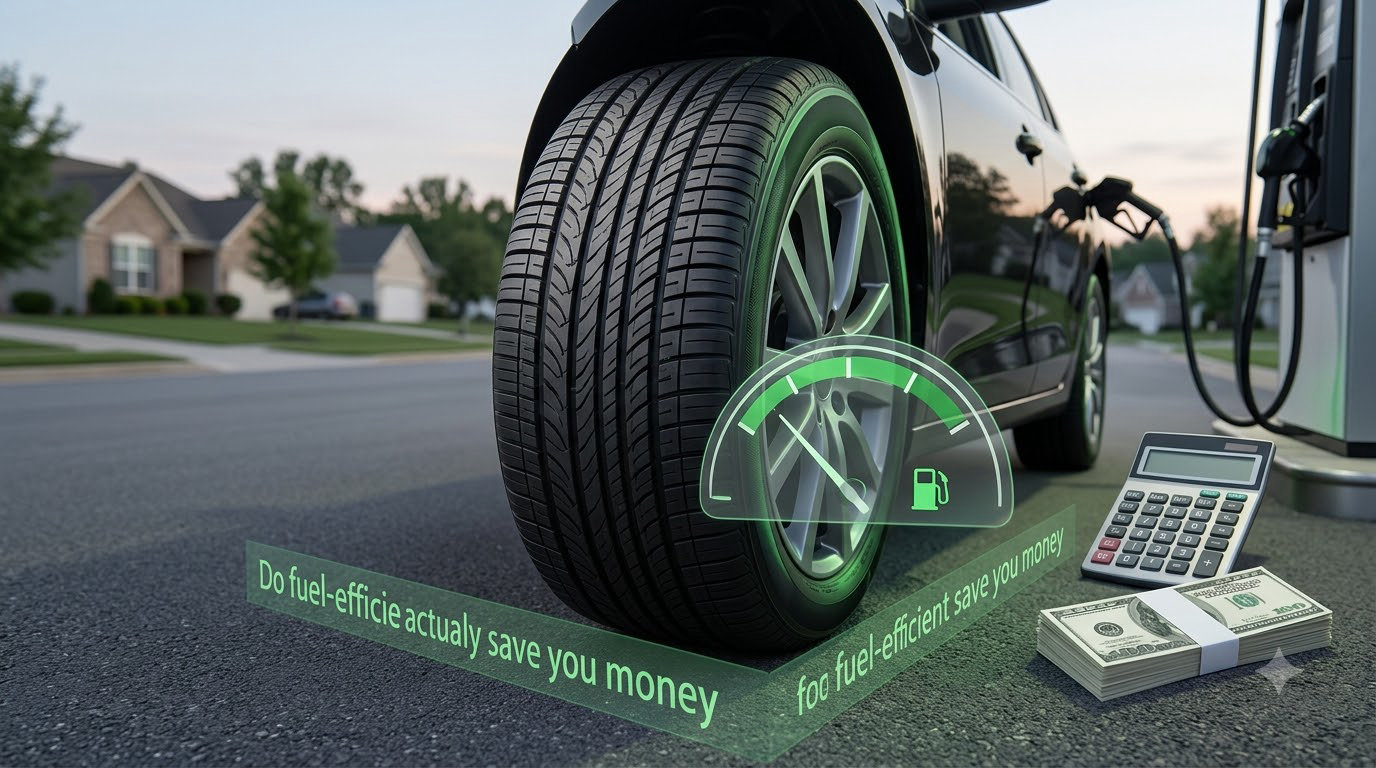
Yes – for most drivers, fuel-efficient tires actually do save you money. Independent tests from the U.S. Tire Manufacturers Association (USTMA) and the Department of Energy show that low-rolling-resistance (LRR) tires improve fuel economy by roughly 1-4%, which works out to about $30 to $80 a year for the average commuter.
That sounds modest on paper, so the honest question is whether the savings beat the higher sticker price. We pulled the EPA, USTMA, and Department of Energy numbers, ran the break-even math across three real driving profiles, and looked at what forum users on Reddit and Mechanics StackExchange actually report after living with these tires.
Short version: if you drive over 12,000 miles a year and do a fair share of highway miles, fuel-efficient tires usually pay for themselves and then some. If you are a low-mileage city driver or already own an EV, the math gets much less interesting. Here is how to figure out which side of the line you are on.
Table of Contents
What Are Fuel-Efficient Tires, Really?
Fuel-efficient tires – sometimes called low-rolling-resistance (LRR), eco, or green tires – are tires engineered so your engine spends less energy keeping them rolling. They do this with three main tricks: silica-rich tread compounds that flex with less heat loss, stiffer sidewalls that squirm less under load, and tread patterns tuned to reduce drag.
The technical term for the energy being saved is hysteresis. Every time a tire deforms against the road, a small amount of energy is lost as heat instead of being returned to forward motion. LRR compounds are formulated to recover more of that energy instead of bleeding it off, which is the same physics that lets hybrid tires squeeze extra miles out of a tank.
Why this matters at all: the U.S. Department of Energy estimates that tires account for roughly 20-30% of a vehicle’s total fuel consumption. That makes rolling resistance one of the few knobs a driver can turn that affects every single fill-up, not just one.
How Much Fuel Do Fuel-Efficient Tires Actually Save?
The USTMA has been one of the most-cited sources here because it pulled real test data rather than modeling it. Their finding: a 10% improvement in rolling efficiency translates to roughly $36 per year in fuel savings at $3 per gallon, scaling up or down with current gas prices.
Department of Energy figures and tire-industry testing cluster in the 1-4% fuel-economy improvement range for production LRR tires versus standard all-season tires. Translated to real numbers for a driver putting 15,000 miles a year into a 30 MPG car at $3.50 a gallon:
- 1% improvement = roughly 5 extra gallons per year, or about $18
- 2% improvement = about 10 gallons and $36
- 4% improvement = about 20 gallons and $70
That is the per-year number. Over a 50,000-mile tire lifespan (typical for LRR touring tires), the cumulative savings land somewhere between $90 and $350 depending on the exact vehicle and gas price. That is the figure we will use to check break-even next.
The Break-Even Math: Will They Pay for Themselves?
Here is the simple formula our team uses when a customer asks at the counter: take the price premium of the LRR set over a comparable standard all-season set, then divide by the annual fuel savings. That tells you how many years until the tires pay for themselves.
Worked example for a typical sedan commuter:
- Standard all-season set: baseline cost
- Fuel-efficient LRR set: roughly $80 to $160 more for the set of four
- Annual fuel savings at 1-4%: $18 to $70
- Break-even point: roughly 1.5 to 4 years, well inside the tire’s 50,000-mile life
What shifts the math the most is annual mileage. A driver logging 20,000 miles a year hits break-even roughly twice as fast as someone driving 10,000. Highway miles count for more too, because rolling resistance is the dominant force at speed, while stop-and-go fuel loss is dominated by braking and idling.
Standard All-Season vs Fuel-Efficient LRR at a Glance
| Factor | Standard All-Season | Fuel-Efficient LRR |
|---|---|---|
| Typical set price | Baseline | Modest premium per set |
| Expected lifespan | 40,000 to 60,000 miles | 50,000 to 70,000 miles |
| Rolling resistance class | Standard | Low (often graded A on EU label) |
| Real-world MPG gain | 0% baseline | 1 to 4% |
| Lifetime fuel savings (15K mi/yr) | $0 | About $90 to $350 |
| Wet braking grip | Strong baseline | Slightly lower (small) |
Notice the lifespan row – many LRR touring tires are warrantied for more miles than standard all-seasons, which is itself a quiet second saving on top of the fuel math.
The Honest Cons: What You Give Up for Fuel Savings
The trade-off the tire industry tries not to lead with is grip. A tire compound optimized to deform less under load also transmits a touch less force to the road, which is why Mechanics StackExchange threads consistently flag wet braking as the main compromise. On dry pavement the gap is small. In a hard rain, it is more noticeable.
A second honest con is the up-front cost. LRR models from premium brands like Michelin, Bridgestone, and Continental sit at the upper end of the price ladder, and the savings arrive in small weekly increments rather than as a single payoff. For cash-strapped drivers, the math can feel backward even when it pencils out.
One quirk worth knowing: brand-new tires, including LRR tires, can actually return slightly lower MPG for the first few hundred miles until the tread surface scuffs in. That window is short, but it is why some drivers report a temporary drop right after installation.
When Fuel-Efficient Tires Do NOT Save You Money
This is the section most competitor articles skip, and it is where Reddit skepticism lives. There are three driving profiles where the LRR upgrade genuinely does not pay off, and we tell every customer who walks in with one of these patterns to consider a standard all-season instead.
Low-mileage drivers. If you log under 8,000 miles a year, the fuel savings are too small to ever recoup the premium within the tire’s life. A $120 premium divided by $18 of annual savings takes nearly seven years to break even, and most tires will be worn out long before then.
Mostly-city, short-trip drivers. Rolling resistance matters most at steady highway speeds. If your driving is five-minute errands with a cold engine every time, fuel is being burned on warm-up cycles and idling, not on rolling drag. LRR tires will not move the needle much here.
EV owners watching range. Electric vehicles are already two to three times more efficient than gas cars, so each percentage point of MPG-equivalent range is worth less in dollars. LRR tires do help extend range, but the payback period against the price premium stretches out considerably compared with a gas commuter.
If you fall into one of those buckets, a high-quality standard all-season from the same brand family will give you better grip and a quieter ride for the same money, with no fuel savings to chase.
Tire Pressure vs Tire Choice: Which Saves More Gas?
This is the comparison that surprised even our service writers the first time we ran the numbers. The EPA estimates that every 1 PSI of under-inflation reduces fuel economy by about 0.2%. A tire that is 10 PSI low across all four corners is therefore costing you roughly 2% of fuel economy – on its own, before you change a single tire.
Put that against a top-end LRR tire that delivers about 4% improvement, and a chronically under-inflated set of premium tires is leaving half the savings on the table. The cheap, five-minute fix is to check your pressures monthly, especially as temperatures swing between seasons (tire pressure drops roughly 1 PSI for every 10°F drop in air temperature).
The order of operations matters here. If your budget allows one upgrade, proper inflation and a fresh alignment typically beat swapping tire brands for pure dollar-per-dollar fuel savings. If your budget allows both, do them together.
Real Fuel-Efficient Tire Models Worth Considering
For shoppers ready to pull the trigger, here are the LRR models we recommend most often at our stores, grouped by what they do best.
- Michelin Energy Saver A/S – the long-running benchmark for low rolling resistance and a 60,000-mile warranty on most sizes
- Bridgestone Ecopia EP422 Plus – strong wet grip for an LRR tire, popular on sedans and compact crossovers
- Goodyear Assurance Fuel Max – fuel-focused touring tire with solid all-season traction
- Continental TrueContact Tour – consistent top-tier marks for balanced efficiency and longevity
- Pirelli P4 Four Seasons Plus – a quieter ride with above-average tread life for the category
Bring your vehicle’s exact trim and tire size to our store, and our team will line up the LRR options that match your wheels and driving profile. The right pick depends as much on your annual mileage and typical roads as it does on the tire itself.
Frequently Asked Questions
Are fuel-efficient tires worth it?
Yes, for most drivers who log 12,000+ miles a year and drive a fair share of highway. Expect 1-4% better fuel economy, roughly $30 to $80 saved annually, and a break-even point that usually falls inside the tire’s lifespan. Low-mileage city drivers and many EV owners see less benefit.
What is the 3% rule for tires?
The 3% rule is shorthand for the estimate that roughly 3% of a vehicle’s fuel consumption comes from tire rolling resistance (some Department of Energy figures go up to 4%). It is the rough ceiling for how much switching to low-rolling-resistance tires can improve.
Is 40,000 miles a lot on tires?
40,000 miles is in the typical lifespan range for a standard all-season tire and the low end for a fuel-efficient LRR touring tire. Premium LRR models from Michelin, Continental, and similar are usually warrantied for 50,000 to 70,000 miles.
How much MPG will I lose with all-terrain tires?
Switching from a highway all-season to an all-terrain (AT) tire typically costs 1 to 3 MPG because AT tires are heavier and have higher rolling resistance. The exact hit depends on the specific AT model and your driving mix.
Is 60 mph more efficient than 70 mph?
Yes. Aerodynamic drag rises quickly above 50 mph, and most vehicles see noticeably better fuel economy at 60 mph than at 70 mph. Driving speed is often a bigger fuel-economy lever than tire choice once you are above 55 mph.
Are fuel-efficient tires good in winter?
Most LRR all-season tires handle light winter conditions fine but are not a substitute for a dedicated winter tire in heavy snow or prolonged freezing. If you face real winters, look for an LRR tire with the three-peak mountain snowflake symbol or budget for a winter set.
The Bottom Line
Fuel-efficient tires do save you money for the typical driver, and the savings are big enough that the USTMA and Department of Energy both point to LRR technology as one of the easiest fuel-economy wins a consumer can make. The break-even point for most commuters falls well inside the tire’s lifespan, and the side benefit of longer tread life sweetens the math further.
The exceptions are real though. If you drive short city trips, log low annual mileage, or already own an efficient EV, put the premium toward better grip or a quieter ride instead. And before you spend a dime on new tires, check your pressures – a properly inflated standard tire often saves more gas than an under-inflated premium LRR set.
Stop by your nearest American Tire location with your vehicle’s trim and tire size, and our team will line up the LRR options that match your driving. We will give you the break-even number for your actual mileage before you commit.