
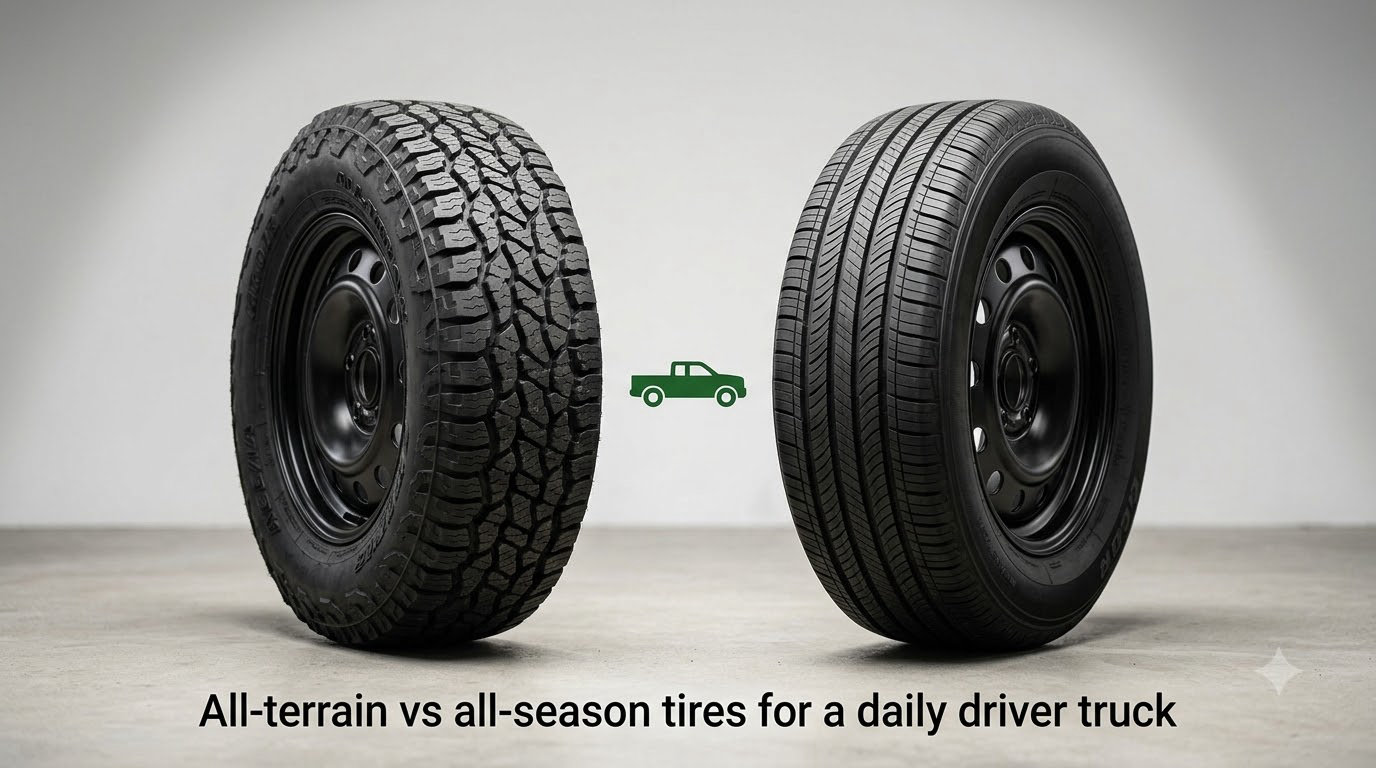
Picking between all-terrain and all-season tires for a daily driver truck comes down to one question: how often do you actually leave pavement. If 90 percent or more of your miles are paved highway and city, all-season tires deliver a quieter ride, longer tread life, and better fuel economy. If you regularly drive dirt roads, gravel jobsites, boat ramps, campgrounds, or pull a trailer through snow, all-terrain tires earn their keep with tougher sidewalls, deeper tread voids, and 3PMSF severe-snow traction. I have run both setups on a daily-driven F-150 and a Ram 1500 over the last several years, and the trade-offs are real but predictable.
Table of Contents
Quick Answer: Which Tire Should a Daily Driver Truck Get?
- Choose all-season tires if your truck is a pure commuter with rare off-pavement duty. You will get a quieter cabin, longer tread life (often 60k to 80k miles), and roughly 1 to 3 MPG better fuel economy than all-terrain.
- Choose all-terrain tires if your truck regularly sees gravel, dirt, mud, boat ramps, light trails, or snowy commutes. Expect more road noise, a firmer ride, faster wear, and about a 3 percent fuel-economy penalty.
- Choose all-weather tires if you want a true middle ground: 3PMSF severe-snow rating with a quieter, longer-wearing tread than a traditional A/T.
- Mind the sizing: P-metric and LT-metric tires behave very differently on a half-ton or three-quarter-ton truck. This decision matters as much as the A/T vs all-season choice.
- No A/T replaces a true winter tire on glare ice. For deep winter duty in the upper Midwest or mountain states, run a set of dedicated winter tires.
What Are All-Season Tires?
All-season tires are designed first and foremost for paved roads in mild to moderate weather. They use a denser network of small tread blocks, lots of fine siping, and a tread pattern that prioritizes even contact with asphalt. The rubber compound is tuned for a wide temperature window so the tire stays flexible in cool weather without going soft in summer heat.
Most all-season tires for light trucks carry an M+S (mud and snow) marking on the sidewall, which means the tread pattern meets a basic geometric standard for snow traction. A smaller subset of modern all-season tires now carry the 3-Peak Mountain Snowflake (3PMSF) symbol, indicating they have passed a more rigorous severe-snow traction test on a standardized test surface. If you live in a region with light snow and plowed highways, a 3PMSF-rated all-season is often all you need.
On a daily-driven truck, all-season tires generally deliver:
- Quieter highway ride with less tread-pattern hum
- Longer tread life, often backed by 60k to 80k mileage warranties
- Better fuel economy thanks to lower rolling resistance
- Shorter stopping distances on dry and wet pavement
- A more compliant ride over expansion joints and broken asphalt
The main limitation is construction. All-season tires for trucks use thinner sidewalls, shallower tread depth, and tighter void patterns than all-terrain tires, so they can struggle in loose gravel, mud, or fresh snow over a few inches. They also offer less protection against curb and rock damage on the sidewall.
What Are All-Terrain Tires?
All-terrain tires split the difference between highway tires and mud tires. They keep enough on-road manners to live with daily commuting, but add the construction features truck owners need when the road ends. Look for larger tread blocks, wider voids between them, deeper tread depth, reinforced sidewalls, and a tougher rubber compound. The result is a tire that bites into dirt, grips gravel, plows through mud, and shrugs off rock chips.
Most modern all-terrain tires carry the 3PMSF severe-snow symbol on the sidewall. That certification, combined with a more aggressive siping pattern, gives meaningful winter traction on plowed highways, unplowed side streets, and even moderate mountain commutes. As one long-running AirForums thread puts it, all-terrain tires have more open space between the tread blocks, which helps in mud or wet grass or snow. None of the A/T tires replace dedicated winter tires on glare ice, but they are far better than a basic M+S all-season in real snow.
For a daily-driven truck, all-terrain tires typically offer:
- Strong grip on dirt, gravel, mud, wet grass, and snow
- Reinforced sidewalls that resist punctures and support heavy loads
- 3PMSF severe-snow certification on most current models
- Better look, which matters more to some owners than capability
- Higher load ratings for towing and hauling when sized in LT-metric
The trade-offs are equally real: more road noise above 45 to 55 mph, a firmer ride over bumps, faster tread wear on pavement-only drivers, and a small hit to fuel economy. An r/f150 owner summed it up: you will get better dry, wet, and ice traction and even snow other than really deep stuff, but the cabin hum is part of the deal.
Head-to-Head Comparison: All-Terrain vs All-Season
Dry Grip and Handling
On dry pavement, all-season tires typically post shorter stopping distances and crisper turn-in response because their denser tread blocks put more rubber on the road. All-terrain tires use larger, more widely spaced blocks that flex slightly more under hard cornering, so a spirited driver will notice a small drop in steering sharpness. For typical commuting, light towing, and highway merging, both tire types are safe and predictable.
Wet Traction
Both categories use full-depth circumferential grooves to channel water and resist hydroplaning. All-season tires usually win on wet pavement because their higher siping density creates more biting edges for the rubber to wipe water off the road. All-terrain tires still perform well in rain thanks to wider voids that evacuate water, but a heavy A/T on a wide wheel can hydroplane slightly earlier than a comparable all-season in standing water.
Snow and Winter Performance
This is where the 3PMSF symbol matters most. A 3PMSF-rated all-terrain tire outperforms a basic M+S all-season in fresh snow, packed snow, and slush, and it does so on the same truck without swapping wheels. A 5th Gen Ram owner on 5thgenrams.com put it this way: the mpg dropped about 2 MPG going from highway tires to A/T, but the confidence in rain and snow made it worth it. For deep winter, ice, or mountain passes, neither category matches a true winter tire, but among year-round options, a 3PMSF A/T is the better truck tire for snow.
Road Noise
All-terrain tires are noticeably louder at highway speeds than all-season tires. The larger tread blocks and wider voids create more airborne noise, especially above 50 mph. The Tacoma4G community reports the familiar A/T lug hum, which one owner described as a weird resonance at highway speed on certain models. Quieter A/T designs such as the Continental TerrainContact A/T and Michelin Defender LTX use tighter center tread patterns and noise-tuned blocks to reduce the hum, but they do not eliminate it. If your commute is 60 percent highway, budget for the noise.
Ride Comfort
All-season tires, with their thinner tread blocks and softer compounds, deliver a more compliant ride over expansion joints, broken pavement, and speed bumps. All-terrain tires feel firmer because of their stiffer sidewalls, deeper tread, and reinforced construction, especially when mounted on the LT-metric sizes common on half-ton and three-quarter-ton trucks. Daily commuters notice every crack in the road more on A/T tires.
Tread Life
All-season tires for trucks typically carry 60k to 80k mileage warranties, while most all-terrain tires for trucks are warranted for 50k to 60k miles. Real-world results vary. Pavement-only drivers report 20 to 40 percent shorter life on A/T versus all-season. Mixed-use drivers who actually use the A/T capability often see the full warranty mileage or better, because the tire was built for the conditions it lives in.
Fuel Economy and MPG
Highway and all-season tires deliver 1 to 3 MPG better fuel economy than all-terrain tires on the same truck, mostly because of lower rolling resistance from the smoother tread pattern and softer compound. Car and Driver has measured roughly a 3 percent efficiency drop when swapping from all-season to A/T on the same truck. Owners on r/ram_trucks report preferring the much better ride of a highway tire plus the great long lifespan and slightly better mpg. For a daily driver that racks up 15,000 miles a year, that 3 percent adds up at the pump.
Price and Value
All-terrain tires for trucks generally cost more per tire than comparable all-season tires, both up front and over the life of the tire, because they wear faster and have stiffer compounds. The premium buys you capability you may or may not use. A truck that never leaves pavement spends that money on noise, vibration, and harshness. A truck that hauls, tows, or works dirt roads gets genuine value from the upgrade.
What Is the 3-Peak Mountain Snowflake (3PMSF) Symbol?
The 3-Peak Mountain Snowflake, often shortened to 3PMSF, is a sidewall marking that means the tire has passed an industry-standard severe-snow traction test on a standardized packed-snow surface. Compared with the basic M+S (mud and snow) marking, which only certifies the tread pattern geometry, 3PMSF certifies actual winter performance. For a daily-driver truck in a region that sees real snow at least a few times a year, a 3PMSF-rated tire, whether all-terrain or all-weather, is the practical minimum.
If a tire has no M+S or 3PMSF marking at all, it is not designed for any sustained winter use. The M+S symbol alone is a low bar. The 3PMSF symbol is the one to look for when you actually drive on snow.
Truck-Specific Factors Most Comparisons Skip
P-Metric vs LT-Metric Sizing
This is the most overlooked detail in the A/T vs all-season debate, and it matters more than people think. P-metric tires are designed for passenger vehicles and are optimized for ride comfort, lower noise, and better fuel economy. LT-metric (light truck) tires use stronger sidewalls, higher load ratings, and stiffer construction to support the payload and towing demands of a pickup. Half-ton trucks often come from the factory with P-metric tires for ride comfort, but most A/T and many all-season owners step up to LT-metric when they start towing or hauling. If your truck tows a camper, hauls tools, or carries a slide-in, LT-metric is the safer choice regardless of A/T vs all-season.
Towing and Hauling
All-terrain tires in LT-metric sizes handle trailer sway and load stability better than most P-metric all-season tires because of the stiffer sidewall construction. For a daily-driver truck that pulls a camper a handful of times a year, a quiet A/T in LT-metric such as the Continental TerrainContact A/T or Falken Wildpeak A/T Trail can serve double duty as both commuter and tow tire. If you tow thousands of miles a season, look at the tire maker’s load range E options for the A/T line.
Popular Truck Platform Notes
- Ford F-150 daily driver: runs well on all-season in P-metric for pure commuters. Owners who tow or hit jobsites usually upgrade to LT-metric A/T for load support and puncture resistance.
- Chevy Silverado 1500 daily driver: the OEM all-season is comfortable but soft on the sidewall. Switching to LT-metric A/T gives the same quietness with better load capacity.
- Ram 1500 daily driver: the coil-spring rear end is already compliant, so most owners do not feel a ride-quality penalty stepping up to LT-metric A/T.
- Toyota Tundra daily driver: heavier curb weight than the domestic half-tons, so LT-metric A/T is almost always the right call for anything beyond pure commuting.
- Toyota Tacoma daily driver: the most A/T-favorable platform on this list. Owners regularly run aggressive A/T tires year-round with little complaint because the truck is smaller and lighter.
Who Should Choose Which Tire
Here is the decision framework I use when a friend asks me which tire to put on their truck.
Pick all-season if: 90 percent or more of your miles are paved, you live in a region with mild winters or mostly plowed highways, you do not tow heavy loads, and you care about a quiet cabin and long tread life.
Pick all-terrain if: you regularly drive dirt roads, gravel jobsites, campgrounds, boat ramps, or unplowed side streets, you tow a camper or haul a bed load, you want tougher sidewalls against curb and rock damage, and you are okay with the noise, firmer ride, faster wear, and 1 to 3 MPG fuel-economy hit.
Pick all-weather if: you live in a four-season climate and want a 3PMSF-rated tire that behaves like a quiet all-season on summer highways and grips like a winter tire in real snow, all in one set.
Pick a true winter tire in addition to all-season if: you regularly drive mountain passes, unplowed rural roads, or face prolonged ice conditions. No A/T or all-weather replaces a dedicated studded or non-studded winter tire on glare ice.
Frequently Asked Questions
Are all-terrain tires good for daily driving?
Yes. Modern all-terrain tires are engineered for both on-road comfort and off-road traction, so most daily-driver trucks can run them year-round. The trade-offs are more road noise, a firmer ride, slightly lower fuel economy, and faster tread wear compared to all-season tires.
What are the best truck tires for daily driving?
The best tires for a daily driver truck depend on where you actually drive. If 90 percent or more of miles are paved, choose a quiet, long-lasting all-season such as the Michelin Defender LTX or Continental ProContact. If you regularly hit dirt, gravel, or snow, choose a 3PMSF-rated all-terrain such as the Continental TerrainContact A/T, Falken Wildpeak A/T Trail, or BFGoodrich All-Terrain T/A KO3.
What are the downsides of using all-terrain tires?
The main downsides of all-terrain tires on a daily driver truck are noticeably more road noise at highway speeds, a firmer ride over bumps, shorter tread life (typically 20 to 40 percent fewer miles than all-season), about a 3 percent drop in fuel economy, and a higher purchase price for truck sizes.
Do highway tires get better gas mileage than all-terrain tires?
Yes. Highway and all-season tires typically deliver 1 to 3 MPG better fuel economy than all-terrain tires because their tread compounds and patterns create less rolling resistance. Real-world tests show roughly a 3 percent efficiency penalty when switching from all-season to A/T on the same truck.
Are all-terrain tires noisy on the highway?
All-terrain tires are noticeably louder than all-season tires on the highway. The aggressive tread blocks and wider voids create more airborne noise, especially above 45 to 55 mph. Quieter A/T models such as the Continental TerrainContact A/T and Michelin Defender LTX minimize but do not eliminate the difference.
What are the quietest all-terrain tires for highway driving?
The quietest all-terrain tires for daily-driver trucks are typically the Continental TerrainContact A/T, Michelin Defender LTX (M/S), Falken Wildpeak A/T Trail, and Cooper Discoverer Road + Trail A/T. These use tighter center tread patterns and noise-tuned tread blocks to reduce highway hum.
Is it okay to drive with all-terrain tires on daily commute?
Yes. All-terrain tires are designed for daily on-road use plus occasional off-road duty, and millions of truck owners run them as their daily commuter tire. Expect modest trade-offs in noise, ride comfort, tread life, and fuel economy compared to all-season tires, but nothing that makes the truck unsafe or unpleasant for commuting.
What is the best all-terrain tire for everyday driving?
For everyday driving, the best all-terrain tires balance on-road manners with off-road capability. Top picks include the Continental TerrainContact A/T, Falken Wildpeak A/T3W, Toyo Open Country A/T III, BFGoodrich All-Terrain T/A KO3, and Cooper Discoverer AT3 4S, all available with the 3PMSF severe-snow rating.
The Bottom Line
For a daily driver truck, the all-terrain vs all-season tires decision is really a question of where you live, where you drive, and what you haul. If 90 percent of your miles are paved, all-season tires are the rational pick: quieter, longer-lasting, and more efficient. If you regularly leave pavement or pull a trailer, all-terrain tires earn their premium with stronger grip, tougher sidewalls, and 3PMSF severe-snow capability. Either way, mind the P-metric vs LT-metric sizing, and remember that no all-terrain tire replaces a true winter tire on glare ice.