
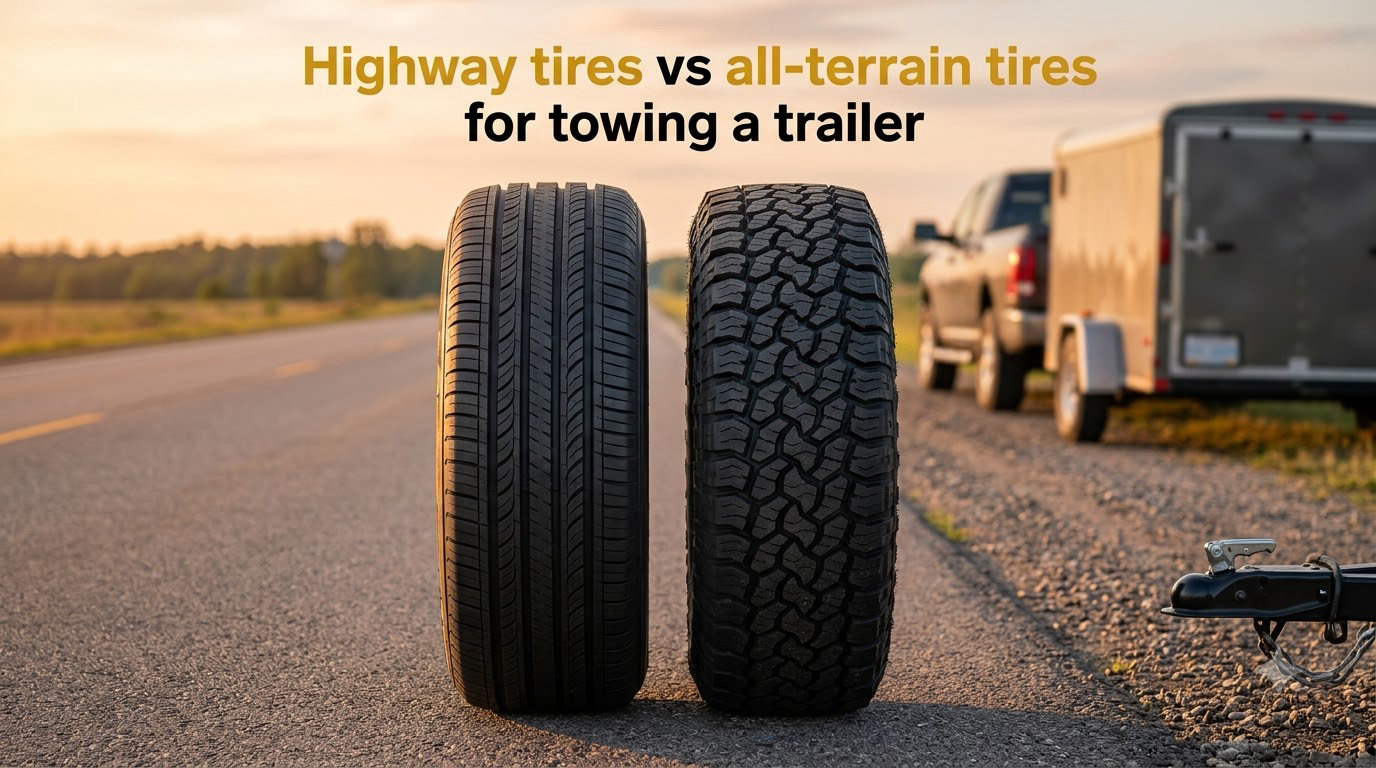
Trying to decide between highway tires vs all-terrain tires for towing a trailer? Here is the short answer our team gives every driver who asks: pick highway-terrain (HT) tires if 90 percent or more of your tow miles are paved, and pick all-terrain (AT) tires if you regularly pull on gravel, dirt, snow, or unpaved campground access roads. Either way, you need an LT light-truck tire rated Load Range E (10-ply) that meets or exceeds the load number on your door placard.
That single sentence is the entire decision in a nutshell. The rest of this guide explains why those rules hold, how to read the numbers on your tire sidewall, and where forum owners actually disagree about which tire wins. We pulled in real driver experiences from r/GoRVing, r/overlanding, RVNetwork, and the Good Sam Club to back up the recommendations.
Table of Contents
What Are Highway Tires (HT)?
Highway-terrain tires are light-truck tires built for paved roads. Their tread pattern uses tightly spaced blocks, continuous circumferential grooves, and shallow tread depth, which keeps the tire quiet at highway speed and helps it roll easily.
The trade-off is grip off pavement. Because HT tires have shallower tread and smaller void areas between blocks, they struggle to bite into loose dirt, mud, or fresh snow. They also have thinner sidewalls than most AT tires, which means a sharper rock or piece of construction debris is more likely to puncture them.
Strengths: better fuel economy (typically 2 to 3 MPG over a comparable AT), lower cabin noise, longer mileage warranties (60,000 to 80,000 miles is common), and a more stable feel under load at 65 to 75 mph.
Weaknesses: weaker traction on loose surfaces, more frequent punctures on construction sites and gravel, and limited capability if you ever need to back a trailer down a soft boat ramp.
What Are All-Terrain Tires (AT)?
All-terrain tires are light-truck tires designed for mixed on-road and off-road use. They have deeper tread, larger void areas between tread blocks, and reinforced sidewalls that resist punctures and shoulder damage.
That aggressive tread costs you fuel and noise. AT tires typically deliver 2 to 3 MPG less than an equivalent HT tire, generate more tread hum at highway speed, and often come with shorter mileage warranties (40,000 to 60,000 miles). Drivers on RVNetwork and r/GoRVing frequently describe AT tires as “squirmy” on pavement when new — the softer block compounds flex more during turns, especially under heavy tongue weight.
Strengths: much better grip on gravel, dirt, and graded campground roads; stronger sidewalls that shrug off rocks and potholes; many carry the 3PMSF (three-peak mountain snowflake) symbol for severe snow service; and they handle loose surfaces when you need to back a boat trailer or horse trailer into a soft spot.
Weaknesses: more road noise, lower MPG, faster wear on pavement, and that initial “squirm” feel until the blocks wear in.
Highway vs All-Terrain: Side-by-Side Comparison
| Attribute | Highway Tires (HT) | All-Terrain Tires (AT) |
|---|---|---|
| Tread pattern | Tight blocks, shallow depth | Aggressive blocks, deep void areas |
| Road noise | Low (quieter cabin) | Moderate to high (tread hum) |
| Fuel economy | Baseline (better MPG) | 2 to 3 MPG lower |
| Tread life warranty | 60,000 to 80,000 miles | 40,000 to 60,000 miles |
| Load range availability | Common in E (10-ply) | Common in E (10-ply) |
| Puncture resistance | Moderate (thinner sidewalls) | High (reinforced sidewalls) |
| Off-road traction | Poor | Strong |
| Snow traction (with 3PMSF) | Limited without 3PMSF | Good when 3PMSF-rated |
| Ride stability under tow load | Excellent | Good (some squirm reported) |
| Typical tread depth new | 10/32 to 13/32 inch | 14/32 to 18/32 inch |
Load Range and Ply Ratings for Towing
Tread design matters, but load rating is the safety floor. Towing puts more vertical load on each tire than daily driving — tongue weight can transfer 10 to 15 percent of trailer weight to the rear axle of your tow vehicle, and a fifth wheel can transfer even more.
For most half-ton and three-quarter-ton trucks towing travel trailers or 5th wheels, the industry standard is Load Range E tires rated 10-ply. You will find this load range in both HT and AT categories, so load rating alone does not force you to pick one type over the other.
Look at three numbers on every tire:
- Load Index — the numeric code (for example, 121) that translates to a maximum load in pounds.
- Load Range — a letter code (B, C, D, E, F) that groups tires by ply rating and inflation pressure.
- LT — the light-truck designation. LT tires have reinforced sidewalls built for heavier loads; P-metric (passenger) tires do not.
The numbers on your door placard are the legal minimum for your vehicle when loaded. Always meet or exceed them, and remember that the load capacity of your lowest-rated tire sets the ceiling for the whole axle.
Fuel Economy and Cost of Ownership
The HT vs AT cost-of-ownership question comes down to two variables: fuel burned and tires replaced.
Across most half-ton and three-quarter-ton tow rigs, drivers consistently report a 2 to 3 MPG difference between highway and all-terrain tires. Over 60,000 miles, that gap adds up. At typical fuel prices in 2026, a 2 MPG loss on a truck that averages 14 MPG while towing translates into roughly 8,500 extra gallons burned over the tire’s life.
On the other side of the ledger, AT tires usually wear out 20,000 to 30,000 miles sooner than HT tires. If a set of HT tires lasts 70,000 miles and a comparable AT set lasts 45,000 miles, you might buy one extra set of AT tires in the same period.
The break-even calculation is simple: total the extra fuel cost and subtract the tire replacement savings. For most drivers who tow less than 10,000 miles a year on pavement, the fuel savings of HT tires outweigh the longer life of AT tires. For drivers who split time between pavement and serious off-road access, the reverse is usually true — replacing AT tires more often is cheaper than getting stuck.
Use-Case Decision Guide: Which Tire Do You Actually Need?
Match the tire to the road, not to the marketing. These four scenarios cover the vast majority of tower profiles:
Paved-only towers: If your tow route is highway and paved city streets, pick an HT tire in Load Range E. You will get the best fuel economy, the quietest ride, and the longest tread life. Examples include Michelin Defender LTX, Continental TerrainContact H/T, and Toyo Open Country H/T II.
Mixed-use towers (paved plus occasional gravel): Drivers in this group — the largest segment — have two real options. Stay with HT if “occasional” really means a few hundred yards of gravel a year. Switch to AT if you regularly pull into graded campground roads, farm lanes, or rural construction sites. A “hybrid” tire like the Falken Wildpeak A/T Trail or the Yokohama Geolandar A/T G015 bridges the gap if you cannot decide.
Off-road and ranch access: If you tow into unpaved ranch roads, job sites, or backcountry camps more than a few times a season, AT tires pay for themselves in confidence. Pick a model with the 3PMSF snowflake symbol so you also get winter capability. Good picks include the BFGoodrich All-Terrain T/A KO2, Goodyear Wrangler Duratrac, and Nitto Ridge Grappler.
Winter and snow towers: Neither HT nor AT handles ice like a true winter tire, but a 3PMSF-rated AT tire is the best year-round compromise for towers in northern climates. Look for the mountain-and-snowflake symbol molded into the sidewall — it certifies the tire meets a defined snow-traction threshold.
Tow Vehicle vs Trailer: Where Do AT Tires Belong?
This is the single most common forum question on RVNetwork and r/overlanding: if you put AT tires on the truck, do you also need them on the trailer? The short answer is no.
A trailer follows the tow vehicle. Steering, braking, and stability control all live on the truck. The trailer’s tires mostly carry load and roll. A highway-terrain tire on the trailer paired with an all-terrain tire on the tow vehicle is a perfectly sensible setup — and several r/overlanding regulars report it as their preferred configuration.
Put AT tires on the trailer only if you actually launch a boat on a sandy ramp, cross deep mud to access a campsite, or store the trailer long-term outside in snow country. For everyone else, HT trailer tires in the correct load range are quieter, last longer, and cost less over time.
Winter and Snow Towing: HT vs AT
No competitor in the top results covers winter towing head-on, which is a real gap given how many towers drive through snowbelt states.
Plain HT tires are not great in snow. Their shallow tread and tightly packed blocks do not evacuate snow effectively, and they usually lack the 3PMSF certification. The good news: a few HT tires (the Michelin X-Ice Snow and the Continental VikingContact 7 line, in SUV/light-truck sizes) carry the 3PMSF symbol and deliver genuine winter grip.
AT tires with the 3PMSF symbol — including the Goodyear Wrangler Duratrac, BFGoodrich KO2, and Falken Wildpeak A/T3W — handle snow much better than non-rated AT tires. Their deeper tread and more aggressive siping give them real bite in fresh snow, though they still cannot match a dedicated winter tire on glare ice.
If you tow through winter, the simplest rule is to choose the tire that carries the 3PMSF symbol, regardless of HT or AT category, and accept the fuel-economy and noise trade-offs that come with the more aggressive tread.
Tire Pressure, Age, and Towing Safety
Most towing tire failures trace back to one of three causes: underinflation, overloading, or age. The first two you can manage run-to-run; age catches even experienced towers off guard.
Tire pressure: Inflate to the pressure on the door placard for normal loaded driving, and bump to the maximum sidewall pressure listed on the tire when towing at or near maximum trailer weight. Underinflation is the leading cause of tow-tire blowouts because the sidewall flexes too much under load, generates heat, and fails.
DOT date code: Every tire has a four-digit DOT code on the sidewall — the last four digits are the week and year of manufacture (for example, “1522” means the 15th week of 2022). Tire manufacturers and safety organizations including NHTSA recommend replacing tires at six years of age regardless of tread depth, and many tow-safety advocates call for five years on tow vehicles. Heat, UV, and load all accelerate the breakdown of the rubber compounds.
Rotation: Rotate every 5,000 to 7,500 miles to keep wear even across all four (or six) tow positions. Uneven wear on a tow vehicle is a stability risk, especially on the rear axle.
Common Mistakes That Cause Towing Tire Failures
The same mistakes show up on the forums again and again. Avoid these and you avoid most tow-tire trouble:
- Mixing tire types across an axle. Two HT tires and two AT tires on the same vehicle create uneven grip and unpredictable handling under load. Match all four.
- Ignoring tire age. A six-year-old tire with good tread is still a six-year-old tire. Replace by age, not by mileage alone, on any tow vehicle or trailer.
- Underinflating for tow loads. Some drivers drop pressure to “soften the ride.” That is exactly what causes a blowout. Run the pressure the tire was designed for at the load you carry.
- Using P-metric tires for heavy towing. P-metric (passenger) tires do not have the sidewall strength for sustained heavy loads. Switch to LT (light-truck) tires in the correct load range.
- Skipping the spare. A flat on a tow rig in the wrong place is worse than a flat on a daily driver. Carry a matching spare and check its pressure every oil change.
Recommended Tire Models for Towing
Use this list as a starting point. Every tire here is available in Load Range E for popular half-ton and three-quarter-ton trucks, and every pick has solid owner feedback in towing forums.
Highway-terrain picks:
- Michelin Defender LTX M/S — the consensus r/GoRVing pick for paved towing. Excellent wet braking, 70,000-mile warranty, very quiet.
- Continental TerrainContact H/T — strong wet and dry grip with a 70,000-mile warranty. Slightly lower cost than the Michelin.
- Toyo Open Country H/T II — a value HT that still delivers solid tow stability and a 60,000-mile warranty.
- Cooper Discoverer HT3 — budget-friendly LT tire with good load range E availability and predictable highway manners.
All-terrain picks:
- BFGoodrich All-Terrain T/A KO2 — the benchmark AT tire. 3PMSF-rated, excellent on gravel and snow, legendary sidewall strength.
- Goodyear Wrangler Duratrac — the most aggressive pick on this list. 3PMSF-rated, exceptional in snow, but louder on pavement.
- Falken Wildpeak A/T3W — a balanced AT with 3PMSF, 55,000-mile warranty, and quieter road manners than the Duratrac.
- Nitto Ridge Grappler — a hybrid AT/MT that tows well, looks aggressive, and runs quieter than its tread suggests.
- Yokohama Geolandar A/T G015 — long mileage warranty (60,000 miles), 3PMSF-rated, and competitively priced in Load Range E sizes.
Frequently Asked Questions
Should I get highway tires or all-terrain tires?
Pick highway-terrain (HT) tires if 90 percent or more of your tow miles are paved. Pick all-terrain (AT) tires if you regularly pull on gravel, dirt, snow, or unpaved campground access roads. Either way, the tire must be LT-rated Load Range E to handle tow loads safely.
Are all-terrain tires better for towing?
All-terrain tires are better for towing on loose surfaces because they have deeper tread and reinforced sidewalls. On paved highways, they cost 2 to 3 MPG, run louder, and wear out 20,000 to 30,000 miles sooner than highway-terrain tires.
What type of tire is best for towing?
The best tire for towing is an LT (light-truck) tire in Load Range E (10-ply) that meets or exceeds the load index on your door placard. Choose highway-terrain tread for paved towing or all-terrain tread for mixed and unpaved towing, and look for the 3PMSF snowflake symbol if you tow in winter.
Do off-road tires make a difference on a trailer?
Off-road (all-terrain) tires rarely make a meaningful difference on a trailer because a trailer follows the tow vehicle and does not steer. Save money and run a quality highway-terrain trailer tire in the correct load range unless you regularly launch a boat on sand or cross deep mud.
Can I mix and match tires on my trailer?
Mixing brands or tread types across an axle creates uneven grip and is not recommended. You can run HT trailer tires with AT tow-vehicle tires as long as each axle has a matching pair. Never mix radial and bias-ply tires on the same trailer.
How does tire pressure affect towing?
Tire pressure directly affects tow safety. Inflate to the door-placard pressure for daily driving and to the maximum sidewall pressure listed on the tire when towing at or near maximum trailer weight. Underinflation is the leading cause of tow-tire blowouts.
What is the 3 tire rule?
The 3 tire rule says tires should not be more than 3 years apart in age, and a full set should be replaced when any tire reaches 6 years of age regardless of remaining tread depth. This is especially important on tow vehicles and trailers where heat and load accelerate aging.
Final Verdict
The highway tires vs all-terrain tires for towing a trailer decision is really a road-surface decision. Match the tread to where you actually drive, and you cannot go wrong.
If you spend 90 percent of your tow miles on pavement, choose a Load Range E highway-terrain tire like the Michelin Defender LTX or Continental TerrainContact H/T. You will save fuel, run quieter, and replace tires less often. If you regularly pull on gravel, dirt, or snow, switch to a 3PMSF-rated all-terrain tire like the BFGoodrich KO2 or Falken Wildpeak A/T3W. The 2 MPG hit and the extra noise are a fair trade for the grip and confidence.
Whichever path you choose, run LT Load Range E tires, check the DOT date code before you buy, and inflate to the right pressure for the load you carry. Those three habits solve most towing tire problems before they start.