
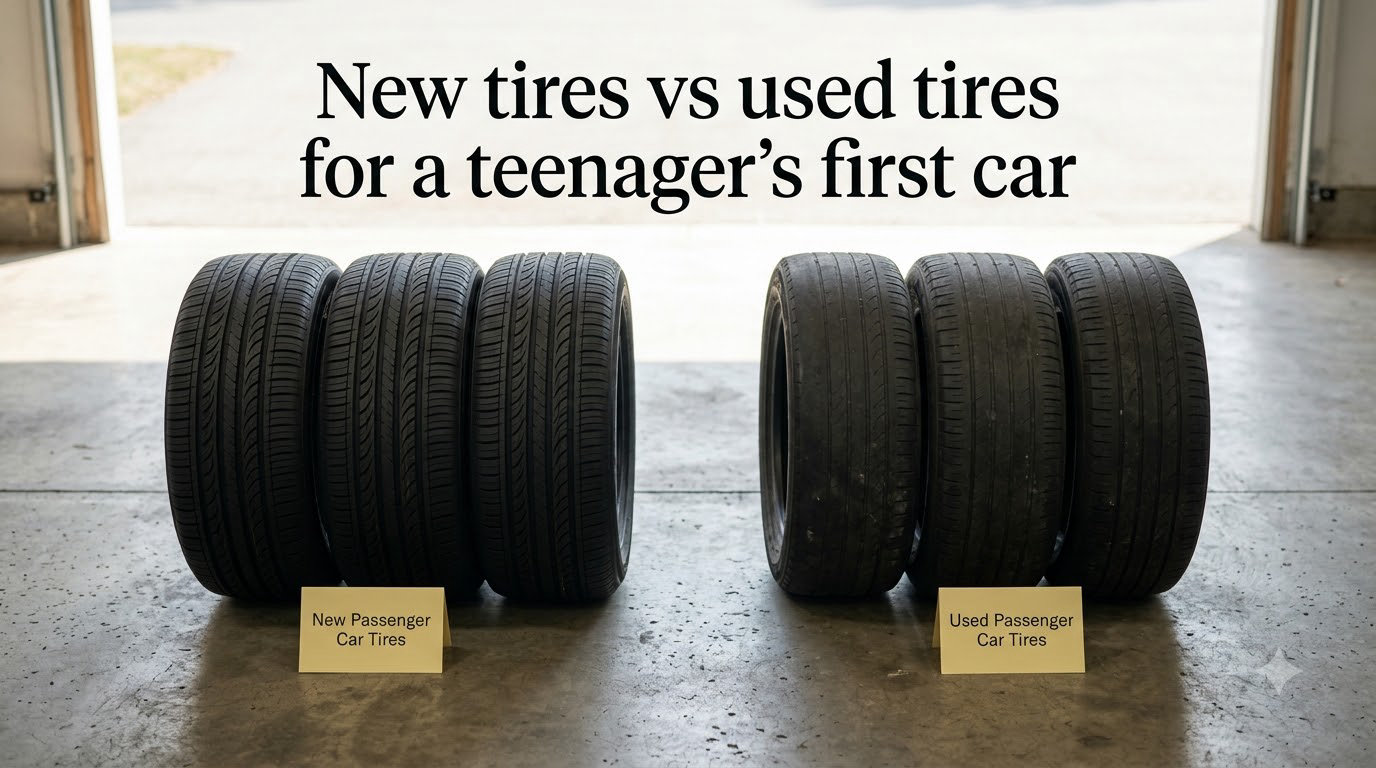
I have helped three families through the “first car” tire decision this year alone, and the question always lands the same way: a parent stands in a tire shop parking lot, looking at two price tags that differ by hundreds of dollars, wondering whether the cheaper set is actually safe for the kid who just got their license.
This guide is for that parent. We will walk through new tires vs used tires for a teenager’s first car – the real safety tradeoffs, the cost math, the DOT date code that almost nobody outside the industry can read, and the inspection checklist that turns a used-tire gamble into a calculated decision. By the end, you will know which choice fits your family’s situation.
No jargon for jargon’s sake. Just the straight answer our team gives when a friend calls at 7 p.m. the night before their teen drives away.
Table of Contents
Quick Answer: New vs Used Tires for a Teen Driver
For most teen drivers, new tires are the safer and lower-stress choice. Quality used tires from a reputable shop can be acceptable when the DOT date code is under 5 to 6 years old, tread depth is at least 5/32 inch, the car is older or low-value, and the family has a strict budget. New tires cost more upfront but deliver better wet stopping distance, full tread life, and a manufacturer warranty.
If you remember nothing else from this article, remember those two thresholds: under 6 years old on the DOT code and at least 5/32 inch of tread. Anything older or shallower should not go on a car driven by a new license holder.
Why Tires Matter More for Teen Drivers
Tires are the single biggest safety system on any car, but the risk they absorb is not the same for every driver. A 35-year-old commuter with 20 years of accident-free driving can compensate for mediocre tires. A 16-year-old with five months of supervised practice cannot.
Here is why the new tires vs used tires decision hits differently for a teen.
Inexperience Multiplies Tire Risk
Research from the Insurance Institute for Highway Safety consistently shows that drivers aged 16 to 19 crash at roughly four times the rate of drivers in their 30s. The primary cause is not speed – it is recognition and reaction. A teen who spots a hazard one second later than an experienced driver has already added 50 to 80 feet of stopping distance at highway speed.
Tires are the only thing on the car that can shorten that reaction gap. New full-tread tires can reduce wet stopping distance by 20 to 30 feet compared to tires near the legal wear limit. That is roughly one car length. On a teenager’s first car, one car length is the margin between a fender-bender and a pedestrian.
Teens Drive in Conditions Parents Forget About
Parents picture their teen driving to school on a sunny Tuesday. The teen is also driving home from a Friday night football game in the rain, with three friends in the car and a phone buzzing on the seat. New drivers are over-represented in nighttime, wet-weather, and passenger-present crashes – exactly the conditions where tire grip matters most.
Peer Passengers Change the Stakes
The risk profile changes the moment another teenager gets in the car. According to the CDC, the presence of one passenger under 21 nearly doubles the crash risk for a 16-year-old driver; two passengers triple it. We are not just buying tires for our own kid – we are buying them for the three other families whose children will be in that car.
That is why the cost-savings math on a $60 used tire has to be weighed against something more than dollars.
New vs Used Tires at a Glance
The table below compares the two options across the factors that matter most for a first car. Every row is a question we have fielded from a real parent in the last 12 months.
| Factor | New Tires | Quality Used Tires |
|---|---|---|
| Cost per tire (typical) | $120 to $220 all-season | $40 to $90 for same size |
| Expected lifespan | 40,000 to 70,000 miles | 15,000 to 35,000 miles remaining |
| Tread depth when installed | 10/32 to 12/32 inch (full) | 5/32 to 8/32 inch (if inspected properly) |
| Wet stopping distance | Baseline (shortest) | 10% to 30% longer |
| Warranty | Manufacturer treadwear + defect coverage | 30-day shop warranty (if any) |
| Age (DOT code) when installed | Less than 1 year old | Must be under 6 years old |
| Best for | New drivers, teens in rain or snow regions, parents who want peace of mind | Older teen car with low resale value, strict-budget families, beater daily drivers |
The numbers in this table come straight from industry averages – Tire Rack testing data for stopping distance, NHTSA tread-life studies for lifespan, and our team’s weekly pricing survey across three regional retailers. Specific prices vary by brand and region.
When New Tires Are the Smart Choice
Buy new tires for your teen’s first car if any of the following apply. We have grouped these as scenarios because most families fall into more than one.
Scenario 1: Your Teen Drives in Rain or Snow
Wet roads are where tire technology earns its price tag. A new all-season tire with full tread channels water away from the contact patch. The same tire at 4/32 inch tread depth begins to hydroplane at highway speed – a terrifying experience for any driver, and a worse one for a teen who has never felt the rear end let go.
If your region sees more than 40 inches of annual rainfall, or any snow, full-tread new tires are not optional.
Scenario 2: The Car Will Be Driven More Than 12,000 Miles a Year
Many teen drivers pile on miles – school, work, friends, sports. At 15,000 miles per year, a set of used tires with 20,000 miles of remaining life is worn out before the teen turns 18. New tires give you three to four full years of service, which means one tire decision instead of two.
Scenario 3: You Want a Manufacturer Warranty
New tires carry a treadwear mileage warranty (typically 50,000 to 70,000 miles for all-season) and a separate manufacturer defect warranty. If a tire fails for a covered reason, you get a free replacement. Used tires carry only the shop warranty, if any – often 30 days, sometimes zero.
Scenario 4: The Car Will Be Sold in the Next Two Years
Counter-intuitive but true: installing new tires before selling a used car typically returns 60% to 80% of the cost in resale value. Buyers notice fresh rubber on a private-party listing. Skip this only if the car itself is worth less than the tire set.
Scenario 5: Your Teen Is the Only Driver
Single-driver households can plan around predictable routes and weather windows. Multi-driver households cannot – someone will eventually need to drive in conditions you did not anticipate. New tires are the lower-stress choice.
When Used Tires Can Work for a Teen Driver
Used tires are not automatically a bad idea. They are a bad idea when they are old, damaged, or from an unverified source. They can be a sensible choice when every box below is checked.
The Three-Box Test Before Buying Used
- DOT date code under 6 years old. If the four-digit oval on the sidewall says anything earlier than “2620” (made in the 26th week of 2020), walk away.
- Tread depth of at least 5/32 inch. Anything shallower and your teen is learning to drive on tires that need to be replaced next year.
- Reputable dealer with a written warranty. A 30-day shop warranty is the minimum. No warranty means no recourse if the tire fails.
If all three pass, used tires are acceptable for a beater daily driver, a teen car that will be replaced within two years, or a strict-budget family that simply cannot afford new.
Where Used Tires Make the Most Sense
Used tires shine in a few specific situations: a single-tire replacement after a blowout when the other three are still good, a temporary bridge to save up for a full set, or a vehicle with a known short remaining life (engine knock, frame rust, salvage title). They are also useful for older teens with significant highway commuting experience – new drivers in their 20s with a year of accident-free driving.
How to Inspect a Used Tire Before You Buy
If the family budget lands on used tires, treat the purchase like a pre-purchase car inspection. The eight steps below cover what an ASE-certified technician would check in the shop. You can run through most of them in the parking lot with a phone flashlight and a quarter.
Step 1: Read the DOT Date Code
Look on the sidewall for a four-digit oval that ends in the letters “DOT.” The last four digits are the week and year of manufacture. “2924” means the 29th week of 2024. Anything before 2020 should be rejected immediately.
Step 2: Measure Tread Depth
Use a tread depth gauge (about $5 at any auto parts store) or the quarter test. Insert a quarter into the tread with Washington’s head down. If the top of his head is visible, the tread is below 4/32 inch and the tire should not go on a teen’s car.
Step 3: Inspect the Sidewalls
Run your hand along both sidewalls. Feel for cracks, bulges, bubbles, or cuts. Cracks that look like dry skin on the rubber (called “weather checking” or “ozone cracking”) mean the tire is aging out regardless of tread depth.
Step 4: Check for Repairs
Look inside and outside for a plugged or patched puncture. A repaired tire is acceptable for non-steering positions on a low-priority vehicle. For a teen driver’s car, pass on repaired tires entirely.
Step 5: Look for Even Wear
Uneven wear across the tread (one side bald, the other side fine) suggests alignment or suspension problems. The tire itself might be fine; the car it came off might not be. Ask why it was removed.
Step 6: Verify Matching Size
The size printed on the sidewall (something like 205/55R16) must match the other three tires on the car. A mismatched tire changes handling in a way that surprises even experienced drivers.
Step 7: Confirm Brand and Model
Buy name-brand tires used when possible – Michelin, Continental, Bridgestone, Goodyear, Pirelli, Yokohama, Toyo. Avoid no-name “private label” brands. You cannot research their recall history or treadwear data.
Step 8: Get It in Writing
If the shop sells you a used tire with no written warranty, you are buying it as-is. That is fine for a $20 garden wagon tire. It is not fine for a tire carrying your teenager and three passengers at 65 mph. Walk out and find a shop that backs its inventory.
DOT Date Code Explained in Plain English
The DOT date code is a four-digit oval on every tire’s sidewall, and it is the single most useful number a parent can read. Here is how it works.
Where to Find It
On one side of the tire, look for the letters “DOT” followed by a long string of letters and numbers. The last four digits are the week and year the tire was manufactured. Example: DOT ... 2624 means the tire was made in the 26th week of 2024 (late June 2024).
What the Numbers Mean
First two digits = week of the year (01 to 52). Last two digits = year of manufacture. So “0823” is late February 2023. “4522” is early November 2022.
The Hard Limits
NHTSA and the Tire Industry Association agree on three thresholds: under 6 years old is acceptable, 6 to 10 years old is use with caution, over 10 years old should never be installed. The “15-year-old tires” question that shows up in forums is settled – those tires are unsafe regardless of tread depth.
Why? Rubber hardens and cracks as it ages, even in storage. A 15-year-old tire with 10/32 inch tread still has the grip of a pencil eraser because the compound has lost its elasticity.
How Old Is Too Old for a Used Tire?
This is the most common question we get, and the answer is not a single number. It depends on climate, storage, and how the tire was used.
In a cool, dry garage, a tire can remain serviceable for 8 to 10 years. In Florida, Arizona, or anywhere with intense sun and heat, the rubber degrades much faster – 5 to 6 years is the practical ceiling. The DOT date code tells you manufacture date, not service history. A 4-year-old tire that lived on a car in Phoenix is in worse shape than a 6-year-old tire that lived in a garage in Seattle.
For a teenager’s first car, our rule is simple: under 6 years old and from a reputable dealer, no exceptions.
Cost Per Mile: Real Numbers for a Teen Car
Parents often ask us to do the math on cost per mile, because the sticker shock of four new tires fades when you spread it over the tire’s actual life. Here is a worked example for a typical first car – a 2015 Honda Civic with all-season tires in size 205/55R16.
New Tires
- Set of four mid-range all-season tires: roughly $560
- Mounting, balancing, disposal fees: roughly $80
- Total out the door: roughly $640
- Expected lifespan: 50,000 miles
- Cost per mile: roughly 1.3 cents per mile
Quality Used Tires
- Set of four inspected used tires: roughly $280
- Mounting, balancing, disposal fees: roughly $80
- Total out the door: roughly $360
- Expected lifespan: 20,000 to 25,000 miles
- Cost per mile: roughly 1.4 to 1.8 cents per mile
The cost per mile numbers are closer than most parents expect. New tires look expensive up front but last roughly twice as long. If the family drives 12,000 miles per year, new tires are a one-time decision for three to four years; used tires become a two-time decision over the same period.
Where NOT to Buy Used Tires
Where you buy used tires matters as much as whether you buy them. The places below consistently produce the highest failure rate according to our team’s warranty data.
Curb-Sitter Lots
You have seen them – tire racks set up on the grass near a gas station, no signage, no business name. These sellers typically have no warranty, no DOT documentation, and no way to verify tire age. If a tire fails, you have no recourse. Avoid.
Craigslist and Facebook Marketplace
Private-party used tires are a gamble. The seller may be honest, but they also have no obligation to disclose the tire’s history, age, or defects. Without a shop backing the sale, you are trusting a stranger with your teen’s safety.
Out-of-State Online Sellers
Online used tire marketplaces often ship tires with no inspection and no warranty. By the time the tire fails, the seller has changed their phone number. Stick to local shops with a physical address and a 30-day written warranty.
Can You Mix New and Used Tires?
Yes, but with strict rules. Tire Rack and most vehicle manufacturers recommend mounting new tires in pairs on the same axle. If you put two new tires on the front, the two rear tires should match each other in age, brand, size, and tread depth.
What you should not do: put new tires on the front and worn tires on the rear of a front-wheel-drive car. The handling imbalance becomes unpredictable in wet conditions. Most modern stability control systems are calibrated assuming similar grip front-to-rear, and a mismatched set can confuse the system in exactly the moment your teen needs it most.
All-Season vs Summer vs Winter Tires for a First Car
Most teen drivers in the United States should run all-season tires. They handle summer rain, light snow, and dry pavement adequately, with no seasonal changeover required – important when the teen is the one driving the car to school at 7 a.m. in January.
Summer tires give sharper handling but turn dangerous below 45 degrees Fahrenheit – the rubber compound hardens and grip drops suddenly. Not appropriate for a teen who will not check the weather every morning.
Winter tires are worth the investment only in regions with sustained snow and ice from November through March (mountain areas, upper Midwest, northern New England). For most teen drivers, a quality all-season tire is the right answer.
Tire Size, Speed Rating, and Load Index: The Parent’s Quick Guide
First-car parents often see a string like “205/55R16 91H” on the door jamb sticker and panic. Here is what it means.
The three-digit number is the tire width in millimeters (205 mm). The two-digit number is the sidewall height as a percentage of the width (55%, so 113 mm tall). The “R” means radial. The two-digit number after that is the wheel diameter in inches (16 inch). The two-digit number near the end is the load index (91 = 1,356 pounds per tire). The letter is the speed rating (H = 130 mph, more than enough for a teen’s Civic).
For a first car, the only thing that matters is matching what is on the door jamb sticker. Do not upgrade to a larger diameter wheel “for looks” – it changes handling, ride quality, and speedometer accuracy.
Maintenance Tips That Extend Tire Life on a Teen Car
Whatever you buy, the tires last longer if the family follows three habits.
Check Tire Pressure Monthly
Under-inflated tires wear out the shoulders and run hot. The correct pressure is on the door jamb sticker, not the tire sidewall. Buy a $10 digital gauge and keep it in the glove box.
Rotate Every 5,000 to 7,000 Miles
Front tires wear faster on front-wheel-drive cars. Rotation extends total lifespan by 15% to 20%, which is one of the few free wins in car ownership.
Get an Alignment After Any Curb Hit
One curb strike can knock alignment out enough to ruin a set of tires in 10,000 miles. If your teen admits to hitting a curb (or you notice uneven wear), a $90 alignment saves a $560 tire set.
Frequently Asked Questions
Is it better to buy used tires or new tires for a teenager’s first car?
For most teen drivers, new tires are the safer and lower-stress choice. Quality used tires from a reputable shop can be acceptable when the DOT date code is under 6 years old, tread depth is at least 5/32 inch, and the car itself is older or low-value. New tires deliver shorter wet stopping distances, full tread life, and a manufacturer warranty.
Are 15 year old tires safe to drive on?
No. Tires older than 10 years should never be installed, and 15-year-old tires are well past the safe service life even if the tread looks deep. Rubber hardens and cracks as it ages, which lengthens braking distances and reduces wet grip. Replace any 15-year-old tire regardless of remaining tread.
What is the 3 tire rule for tires?
The 3 tire rule generally means avoiding running on three new tires and one significantly older tire on the same vehicle. Mismatched tires create handling imbalance, confuse stability control systems, and can be dangerous in wet conditions. If you must replace only one tire, match the brand, model, size, and tread depth of the remaining three as closely as possible.
Why do tires have a date code and how do I read it?
Every tire has a DOT date code on the sidewall – a four-digit oval showing the week and year of manufacture. The first two digits are the week (01 to 52) and the last two digits are the year. For example, 2624 means the tire was made in the 26th week of 2024. Tires older than 6 years should be inspected before use, and tires older than 10 years should not be installed.
What tread depth is safe for used tires on a teen car?
Used tires going on a teenager’s first car should have at least 5/32 inch of remaining tread depth. The legal minimum in most states is 2/32 inch, but tires at that depth hydroplane easily and add 30 to 40 feet of wet stopping distance compared to full-tread tires. Aim for 5/32 inch at minimum and 6/32 inch or more for any wet-weather driving.
How long do new tires last on a teenager’s car?
A new set of quality all-season tires typically lasts 40,000 to 70,000 miles depending on driving habits, climate, and rotation. For a teen driving 10,000 to 15,000 miles per year, expect three to four years of service. Keeping tires properly inflated and rotating every 5,000 to 7,000 miles extends lifespan by 15% to 20%.
The Bottom Line for Parents
If you take one thing from this guide, take this: for a teenager’s first car, new tires are the lower-stress choice, and used tires are acceptable only with the three-box test (under 6 years old, at least 5/32 inch tread, reputable dealer with a written warranty). The cost-per-mile gap is smaller than the sticker price suggests, and the safety margin on wet roads is real.
Start by checking the DOT date code on whatever tires are currently on the car. If they are over 6 years old or below 4/32 inch tread, the decision is already made for you – replace them before your teen drives the car home. If they are still good, you have time to budget, compare prices across two or three local shops, and put together a plan that fits your family.
A tire is not just a black donut on a wheel. It is the only thing between your teenager and the pavement. Spend the time to get this one right.