
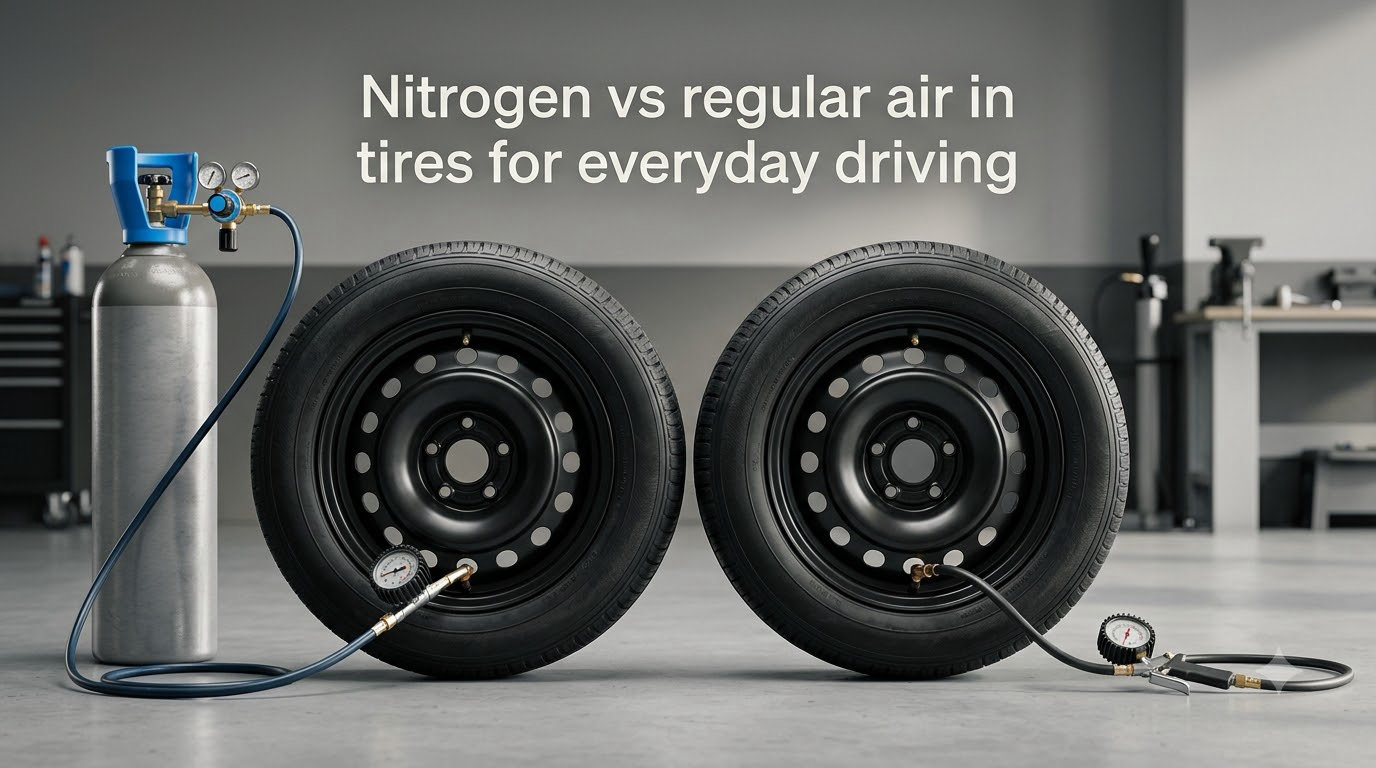
You pull into the tire shop for a routine rotation. The technician points to the green valve caps on your wheels and says, “Oh, you’ve got nitrogen—want a top-off? Only 20 bucks for all four.” You pause. Is that a good deal, or just another upsell wrapped in a colored cap?
If you’ve ever wondered whether nitrogen tire inflation is worth the cost for your daily commute, you’re not alone. This guide breaks down nitrogen vs regular air in tires for everyday driving—backed by real test data, not marketing claims. I’ll cover the science, the costs, and the one thing that matters more than what’s inside your tires.
Table of Contents
The Quick Verdict: Nitrogen vs Air in Tires
For everyday driving, regular compressed air is perfectly fine. Consumer Reports ran a 12-month test on 31 tire models and found that air-filled tires lost about 3.5 psi while nitrogen-filled tires lost roughly 2.2 psi. That’s a difference of only 1.3 psi over an entire year—negligible for a daily commuter who checks tire pressure monthly.
Nitrogen does hold pressure slightly longer because its larger molecules escape through rubber more slowly. But the practical benefit for passenger cars is minimal. What actually matters is checking your tire pressure regularly, regardless of fill type. Monthly checks with free air at any gas station will keep you safer and save money compared to paying for nitrogen fills.
What Is Nitrogen Tire Inflation?
Regular compressed air—what you get from a gas station pump or home compressor—is already about 78% nitrogen and 21% oxygen, with small amounts of water vapor and other gases. When a shop fills your tires with “nitrogen,” they’re simply using a higher-purity blend, typically 93% to 95% nitrogen or better.
The key difference isn’t the nitrogen itself—you already have plenty of that in your tires. It’s what gets removed. High-purity nitrogen fills strip out most of the oxygen and moisture that’s normally present in compressed air. That’s where the claimed benefits come from: less water vapor means less internal corrosion, and less oxygen means slower rubber oxidation over time.
You can spot nitrogen-filled tires by their green valve stem caps. This color coding helps technicians identify them quickly, though it’s not a guarantee—some owners swap caps without realizing what they mean, and some shops use green caps as a marketing signal.
How Does Nitrogen Compare to Regular Air?
The science behind nitrogen inflation centers on molecular behavior. Nitrogen molecules are larger than oxygen molecules, which means they permeate through tire rubber at a slower rate. In laboratory conditions, this translates to measurably better pressure retention.
But real-world data tells a more nuanced story. In Consumer Reports’ rigorous 12-month study, they tested 31 tire models filled with both air and nitrogen. The results showed:
- Air-filled tires lost an average of 3.5 psi over 12 months
- Nitrogen-filled tires lost an average of 2.2 psi over 12 months
- The net difference: roughly 1.3 psi per year
To put that in perspective, the recommended tire pressure for most passenger cars sits between 30 and 35 psi. Losing 1.3 extra psi over a year is well within the margin that a single monthly check catches. The NHTSA (National Highway Traffic Safety Administration) has also studied this and concluded that while nitrogen does reduce permeation and oxidation, the safety benefit for typical passenger vehicles is marginal.
Where nitrogen shines is consistency under stress. Race car tires, for example, experience extreme temperature swings that cause regular air to fluctuate wildly in pressure. Nitrogen’s stable properties help maintain consistent handling lap after lap. But if your tires never see a racetrack, this advantage mostly stays theoretical.
Pros of Nitrogen in Tires
Nitrogen isn’t without merits. Here’s what it genuinely offers:
- Slower pressure loss: Nitrogen permeates through rubber about 30-40% more slowly than oxygen. This means longer intervals between top-offs—useful if you tend to neglect tire maintenance.
- Reduced internal corrosion: Compressed air contains moisture. Over time, water vapor inside a tire can corrode the wheel rim and degrade the rubber from the inside. Pure nitrogen is dry, eliminating this risk.
- More stable pressure in extreme conditions: If you live somewhere with harsh winters and hot summers, nitrogen’s resistance to temperature-driven pressure swings can provide slightly more consistent performance.
- Less rubber oxidation: Oxygen accelerates the breakdown of tire rubber. By replacing most of the oxygen, nitrogen theoretically extends tire lifespan—though the real-world effect on a 4-5 year tire lifespan is small.
For drivers who rarely check their tires, nitrogen’s slower leak rate could actually matter. But that’s a maintenance habit problem, not a fill-type problem.
Cons of Nitrogen in Tires
The downsides are practical and financial:
- Cost: A nitrogen fill typically runs between 5 and 30 dollars per tire. Over the life of your tires, that adds up to hundreds of dollars versus free air at any gas station.
- Availability: You can find free or cheap compressed air nearly everywhere—gas stations, car washes, even your garage with a portable compressor. Nitrogen requires a special machine, usually only found at tire shops and dealerships.
- Marginal benefit: As the Consumer Reports data shows, the actual pressure retention difference for everyday driving is about 1.3 psi per year. That’s not enough to impact fuel economy, tire wear, or safety in any meaningful way for daily commuters.
- Dealership upsell pressure: Many car buyers report feeling pressured into paying for nitrogen fills at dealerships, sometimes without clear disclosure. Forum users on Reddit’s r/Cartalk and r/AskEngineers frequently describe nitrogen as “basically a sales gimmick” for passenger cars.
- False sense of security: Some drivers assume nitrogen means they can skip regular pressure checks. This is dangerous—tires lose pressure from punctures, valve leaks, and bead issues regardless of fill type.
One mechanic on Reddit put it bluntly: “Air is 78% nitrogen. You’re paying a premium for an extra 17%.” While that oversimplifies the moisture and oxygen removal benefits, the practical takeaway for everyday drivers is accurate.
When Nitrogen IS Worth It
Nitrogen inflation isn’t a scam—it’s just not designed for the average commuter. Here’s where it genuinely makes a difference:
- Race cars and track use: At high speeds, tire temperatures spike dramatically. Regular air’s oxygen and moisture content cause pressure to fluctuate unpredictably. Nitrogen keeps pressures consistent, which translates to predictable handling when you’re pushing limits.
- Aircraft tires: Planes experience extreme temperature changes during flight—from ground-level heat to sub-zero altitudes. Nitrogen is non-flammable and stable across these ranges, making it the aviation standard.
- Commercial trucks and fleet vehicles: When you’re managing hundreds of tires across a fleet, even small pressure inconsistencies add up to significant fuel costs. Nitrogen reduces the frequency of pressure checks and improves fuel efficiency at scale.
- Heavy-duty and off-road vehicles: Mining equipment, military vehicles, and heavy construction machinery operate in extreme conditions where pressure stability is critical for safety and performance.
- Electric vehicles: EVs are heavier than comparable gas cars due to battery weight. This increased load makes consistent tire pressure more important for tire longevity and range. Nitrogen’s stability can offer a slight advantage here, though regular checks still matter.
If your vehicle falls into one of these categories, nitrogen is a legitimate tool—not a gimmick. For a Honda Civic doing school drop-offs and grocery runs? Save your money.
5 Nitrogen Tire Myths Debunked
Misinformation runs rampant on both sides of this debate. Let’s separate fact from fiction:
Myth 1: Nitrogen in tires is a complete scam.
Fact: Nitrogen does offer real benefits—slower permeation, less moisture, reduced oxidation. The science is sound. The problem is that these benefits barely matter for everyday passenger car use, not that they don’t exist.
Myth 2: Nitrogen will noticeably improve your gas mileage.
Fact: Properly inflated tires improve fuel economy regardless of fill type. The 1.3 psi/year advantage of nitrogen translates to an immeasurable difference in MPG for daily driving. You’d save more fuel by removing a few pounds of junk from your trunk.
Myth 3: If your car came with nitrogen, you can only use nitrogen.
Fact: You can safely mix air and nitrogen in any ratio. The nitrogen purity will drop slightly, but there’s no chemical reaction, no damage, and no safety issue. If you’re stranded and only have access to a regular air pump, use it without worry.
Myth 4: Green valve caps guarantee nitrogen inside.
Fact: Green caps are a convention, not a guarantee. Some shops use them as a marketing signal. Some owners buy green caps online for aesthetics. The only way to know for sure is to ask what’s in your tires.
Myth 5: Dealerships are required to fill new cars with nitrogen.
Fact: No manufacturer requires nitrogen for standard passenger vehicles. Some dealerships add it as a value-added service (or profit center). If you didn’t specifically request it, there’s a good chance your “nitrogen-filled” tires actually contain regular air with a green cap upsell.
Can You Mix Air and Nitrogen in Tires?
Yes, absolutely. Mixing air and nitrogen is completely safe and will not damage your tires, wheels, or valve stems. If you have nitrogen-filled tires and need a top-off on a road trip where only regular air is available, go ahead.
What happens when you mix them? The nitrogen purity in your tire simply decreases. If you started with 95% nitrogen and top off with regular air (78% nitrogen), your tire might end up at 85-90% nitrogen. The pressure retention benefits decrease proportionally, but there’s no harm done.
This is one of the biggest practical arguments against paying for nitrogen: the moment you top off with regular air—which most people eventually do—you’ve diluted the benefit you paid for. And that’s perfectly fine.
Temperature and Seasonal Pressure Changes
Here’s something most nitrogen articles skip: temperature affects tire pressure regardless of fill type. The rule of thumb is that tire pressure drops about 1 psi for every 10°F decrease in ambient temperature.
This means if you set your tires to 35 psi on a warm 80°F September day and winter brings 20°F mornings, your tires could read 29 psi—well below the recommended pressure on your tire placard. Nitrogen and air respond to temperature changes nearly identically; the difference is negligible.
The practical takeaway:
- Check your tire pressure at the start of each season
- Always check when tires are cold (driven less than a mile)
- Don’t forget your spare tire—Continental recommends checking it every time you check your regular tires
- The pressure listed on your tire placard (usually inside the driver’s door jamb) is the target, not the maximum number on the tire sidewall
Seasonal pressure changes affect every driver, regardless of fill type. A monthly check with any available air source keeps you safe through all four seasons.
How to Maintain Your Tires Properly
The fill type in your tires matters far less than your maintenance habits. Here’s what actually keeps you safe on the road:
- Check pressure monthly: Use a reliable tire pressure gauge (digital ones are easiest to read). Check when tires are cold for the most accurate reading.
- Follow your tire placard: The recommended pressure is on a sticker inside the driver’s door jamb or in your owner’s manual. Don’t use the maximum pressure printed on the tire—that’s a different number entirely.
- Inspect tread depth: Use the penny test: insert a penny head-first into the tread. If you can see all of Lincoln’s head, it’s time for new tires.
- Rotate tires regularly: Every 5,000 to 8,000 miles, or with every oil change. This promotes even wear and extends tire life.
- Watch for uneven wear: If one tire is wearing faster than the others, it could indicate alignment or suspension issues that need professional attention.
- Don’t ignore the TPMS light: Your tire pressure monitoring system warns you when pressure drops 25% below recommended levels. By that point, you’re already driving on significantly underinflated tires.
These habits cost nothing beyond a 5-dollar gauge and a few minutes each month. They’ll do more for your safety and tire longevity than any nitrogen fill ever could.
Frequently Asked Questions
Are there any downsides to using nitrogen in tires?
The main downsides are cost (5 to 30 dollars per tire versus free air), limited availability compared to gas station air pumps, and minimal practical benefit for everyday driving. Consumer Reports testing shows only a 1.3 psi per year difference in pressure retention, which monthly checks easily account for.
Is it better to put nitrogen or air in your tires?
For everyday passenger car driving, regular compressed air is the better choice. It is free, available everywhere, and the performance difference is negligible. Nitrogen offers marginal benefits in pressure retention and moisture reduction that only meaningfully matter in racing, aviation, and commercial fleet applications.
Do dealerships actually put nitrogen in tires?
Some dealerships do fill tires with nitrogen, often as a paid add-on or included in a vehicle preparation package. However, no manufacturer requires nitrogen for standard passenger vehicles. If nitrogen was not specifically requested, it is worth asking what is actually in your tires before paying for a nitrogen top-off.
How often do nitrogen-filled tires need topping off?
Nitrogen-filled tires lose pressure more slowly than air-filled tires, typically needing a check every 2-3 months instead of monthly. However, you should still check pressure monthly for safety, especially before long trips or when temperatures change significantly between seasons.
What happens if you put regular air in a tire with nitrogen?
Nothing harmful happens. The nitrogen purity in your tire simply decreases. If you started with 95% nitrogen and add regular air (about 78% nitrogen), your tire might end up around 85-90% nitrogen. The pressure retention benefits decrease slightly, but there is no damage or safety concern.
What is the 3% tire rule?
The 3% tire rule is a maintenance guideline suggesting you should check your tire pressure if it drops more than 3% below the recommended level. For a tire rated at 35 psi, that means checking if pressure falls below about 34 psi. This small drop can affect fuel economy and tire wear over time.
Does nitrogen help extend the lifespan of tires?
Nitrogen may slightly extend tire life by reducing internal oxidation and moisture-related corrosion. However, real-world evidence shows the effect is minimal for everyday drivers. Proper inflation pressure, regular rotation, and alignment maintenance have a much larger impact on tire lifespan than the fill type used.
The Bottom Line for Everyday Drivers
So, nitrogen vs regular air in tires for everyday driving—which should you choose? Go with regular air. The science supports nitrogen’s benefits in theory, but the real-world difference for daily commuters is so small that it doesn’t justify the cost or inconvenience.
What matters far more than what fills your tires is how often you check them. A 5-dollar tire gauge and five minutes each month will do more for your safety, fuel economy, and tire life than any nitrogen fill. Save the nitrogen for the racetrack, the runway, and the fleet yard—and keep a gauge in your glove box instead.