
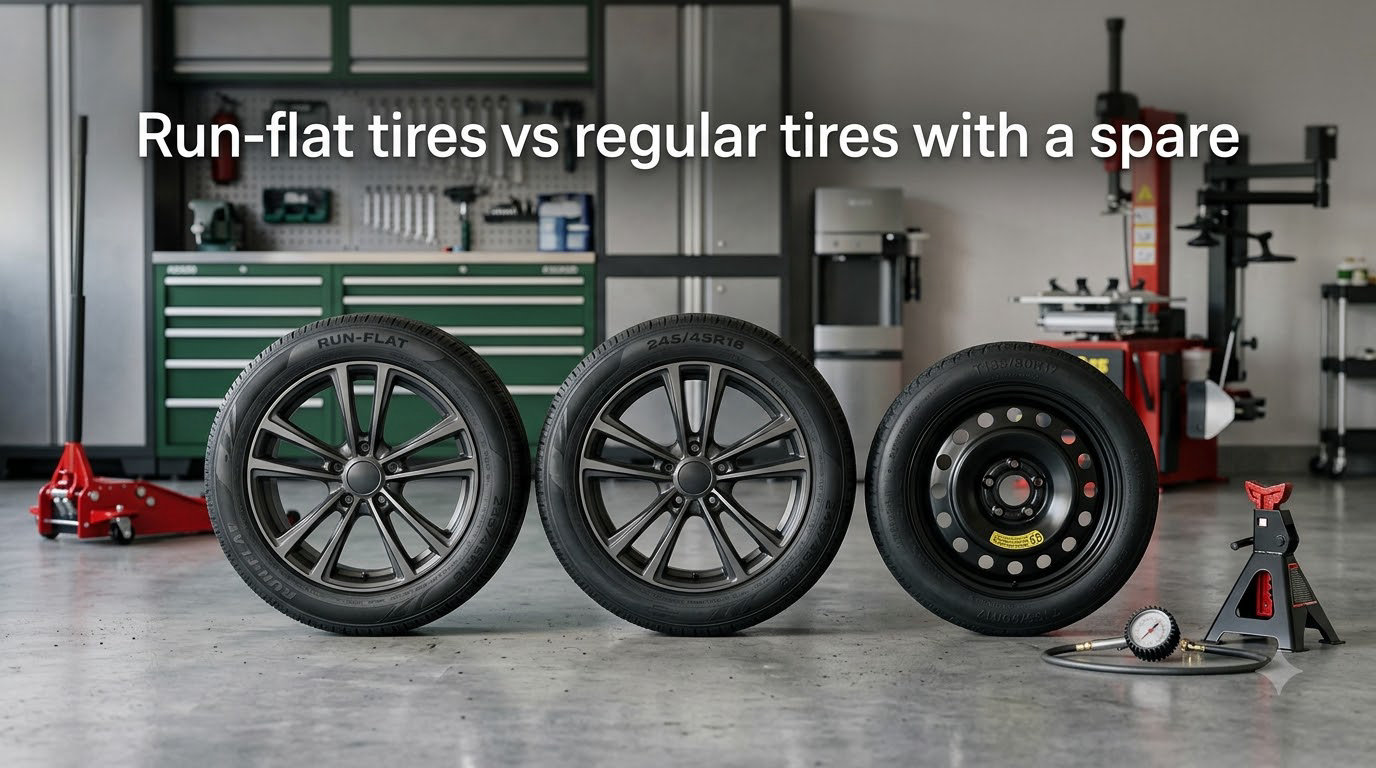
Picking between run-flat tires and regular tires with a spare is one of those decisions that seems small until you’re standing on the shoulder of I-95 with traffic whizzing past at 70 mph. I’ve been there, and it’s not fun. Run-flat tires promise to eliminate that scenario entirely. Regular tires with a spare keep things simple and affordable, but they ask you to do the work yourself when something goes wrong.
Our team has spent weeks digging through owner forums, manufacturer specs, Consumer Reports data, and tire industry research to put together this 2026 guide. We’re going to break down exactly how run-flat tires work, what they cost, why BMW owners complain so much about them, and when a regular tire plus spare combination is the smarter choice. By the end, you’ll know which setup fits your driving life.
Table of Contents
What Are Run-Flat Tires and How Do They Work?
Run-flat tires are specially engineered tires with reinforced sidewalls that can support your vehicle’s weight even after losing all air pressure. Instead of going flat and leaving you stranded, a run-flat keeps you rolling for a limited distance at a limited speed.
Most run-flat tires use one of two designs. Self-supporting run-flats have stiff, reinforced sidewalls made with heat-resistant rubber compounds that hold the vehicle’s weight when air pressure drops to zero. Self-sealing run-flats include an extra inner lining that automatically seals small punctures as they happen. Both types rely on a working Tire Pressure Monitoring System (TPMS) to alert you when pressure drops, since you can’t always see a run-flat is flat just by looking at it.
The industry standard for run-flat capability is the “50/50 rule”: you can drive up to 50 miles at speeds up to 50 mph after a complete loss of pressure. That window is designed to get you to a tire shop or your home, not to keep driving indefinitely. Bridgestone’s DriveGuard line, Goodyear’s Eagle RS-A2, and Continental’s ContiSeal are among the most common run-flat models you’ll find on the road in 2026.
Here’s something most people don’t realize: run-flat technology has been around since the 1980s, but it didn’t hit the mainstream until the mid-2000s when BMW started making run-flats standard equipment on 3 Series models. Since then, run-flats have become the factory tire for many luxury vehicles, performance cars, and electric vehicles where trunk space and weight matter a lot.
One critical point: run-flats don’t work on every car. Your vehicle needs a TPMS to warn you about pressure loss, and your wheels must be compatible with run-flat design. You can’t just swap run-flats onto a car that came with regular tires without checking with the manufacturer first.
Benefits of Run-Flat Tires
Run-flat tires solve one specific problem better than anything else: they keep you moving after a puncture. That single benefit cascades into several real-world advantages.
Safety on the roadside. According to National Highway Traffic Safety Administration data referenced by US News, someone is killed or injured changing a tire on the roadside every 3-4 days in the United States. Run-flats eliminate the need to stop and change a tire in traffic. You drive to a safe location, then deal with the problem. On a dark highway at night or in heavy rain, that safety margin is enormous.
No spare tire needed. Vehicles equipped with run-flats typically don’t carry a spare. That frees up your trunk space, and on smaller cars it can mean the difference between having a usable cargo area and losing it to a donut spare and jack kit. BMW, MINI, and many EV manufacturers have eliminated the spare entirely on run-flat models to save weight and space.
Weight savings. A conventional spare tire, jack, and lug wrench typically weighs 40-50 pounds. Eliminating that hardware improves fuel economy. More importantly for EVs, every pound saved extends driving range. That’s one reason Tesla and other electric vehicle makers have leaned into run-flat designs.
Peace of mind on long trips. If you’ve ever had a sidewall blowout 200 miles from home, you understand the appeal. Run-flats let you keep driving to a town with tire service instead of waiting for roadside assistance on a deserted stretch of highway. For road-trippers and rural drivers, that reliability is worth a lot.
No roadside tire changes in bad conditions. Changing a tire in snow, ice, or heavy rain is miserable and dangerous. Run-flats let you drive out of the bad situation before addressing the tire problem. This is the scenario run-flat advocates point to most often.
Forum users on Reddit’s r/BMW and r/cars consistently mention this benefit. One BMW owner wrote: “I got a nail in my rear tire on the highway at 11 PM. The car told me I had 50 miles of range. I drove home, called my tire shop in the morning, and dropped the car off. No standing on the shoulder, no waiting for AAA.” That’s the run-flat promise delivered.
Drawbacks of Run-Flat Tires
Run-flats aren’t perfect, and the complaints about them are loud and specific. Here’s what gives drivers pause.
Higher upfront cost. Run-flat tires cost 25-100% more than comparable regular tires, depending on the brand and model. A set of four run-flats for a mid-size sedan can run significantly more than the same size in a conventional tire. If you’re buying new tires every few years, that difference adds up fast.
Shorter tread life. According to Consumer Reports testing cited by Kelley Blue Book, run-flat tires require replacement roughly 6,000 miles sooner than regular tires on average. The reinforced sidewalls and stiffer construction mean faster wear, especially if you’re driving aggressively or on rough roads. A tire rated for 50,000 miles as a regular tire might only last 40,000-44,000 miles as a run-flat.
Harsher ride quality. This is the #1 complaint in BMW and MINI owner forums. Run-flats transmit more road vibration and noise into the cabin because of their stiffer sidewalls. On smooth highways, the difference is subtle. On rough pavement, broken asphalt, or expansion joints, run-flats feel noticeably harsher. Multiple BMW owners on r/BmwTech have described the ride as “punishing” on certain roads.
Limited repairability. Once a run-flat has been driven on while flat, even for a short distance, most manufacturers consider it non-repairable. The internal structure can be compromised in ways that aren’t visible from outside. That means a single puncture often means a full tire replacement, not a cheap patch job.
Fewer size and brand options. Run-flats aren’t available in every tire size. If you drive an older or less common vehicle, you might have one or two run-flat options versus dozens of regular tire choices. When you need a replacement in a hurry in a rural area, that limited availability is a real problem.
Worse cold-weather performance. Some drivers report run-flats perform poorly in extreme cold or snow because the stiffer sidewalls don’t flex as well as conventional tires. This is anecdotal rather than universal, but it’s worth considering if you live in a region with harsh winters.
One MINI owner summed up the frustration perfectly on r/MINI: “I love not having a spare taking up cargo space. I hate paying twice as much for tires that wear out faster and feel like I’m riding on wooden wheels.” That tension between convenience and cost is the core run-flat dilemma.
Regular Tires With a Spare: The Classic Setup
Before run-flats existed, every car came with a spare tire, a jack, and a lug wrench. That setup is still the default for most vehicles on the road today, and for good reason.
Regular tires cost less upfront. A standard all-season tire in a common size might cost a fraction of what the equivalent run-flat costs. Over the life of a car, you’re potentially saving thousands on tires alone.
Regular tires also tend to last longer. Without the reinforced sidewalls adding stiffness, they wear more evenly and slowly. Many drivers get 50,000-70,000 miles from a set of regular tires, compared to 35,000-50,000 for run-flats in similar conditions.
Ride quality is another advantage. Conventional tires have more flex in the sidewalls, which absorbs road imperfections and creates a smoother, quieter ride. If you’ve ever switched from run-flats to regular tires on the same car, the difference can be dramatic. Several BMW owners on r/BmwTech who made the switch reported the car felt like a different vehicle.
The spare tire adds weight and takes up trunk space, but it also gives you options. You can carry a full-size spare that matches your other tires, or a compact “donut” spare that saves space but limits your speed to 50 mph. Some drivers carry a tire repair kit and inflator instead of a spare, which saves space but assumes you can find a safe place to stop and patch the tire.
Repairability is where regular tires shine. Most punctures in the tread area can be patched and plugged for a modest fee at any tire shop. A run-flat with the same damage usually means a full replacement. Over the life of a set of tires, you might patch a regular tire once or twice and squeeze out extra miles.
The main downside of regular tires is the roadside change scenario. You need to know how to change a tire, you need to do it safely, and you need to do it in whatever conditions you find yourself in. If you’re not comfortable changing a tire, or if you drive mostly in heavy traffic, that’s a real concern.
Cost Comparison Over the Lifetime of Ownership
The sticker price difference doesn’t tell the whole story. Let’s look at total cost of ownership over time.
Upfront cost per tire. A regular all-season tire in a common 225/65R17 size runs considerably less than the run-flat equivalent. For a luxury vehicle with larger wheels, the gap widens. A set of four run-flats can cost twice as much as a set of four regular tires.
Replacement frequency. If run-flats wear out 6,000 miles sooner (Consumer Reports data) and you’re driving 15,000 miles per year, that’s an extra tire replacement every 4-5 years. Over 15 years of ownership, you’re looking at potentially two extra sets of run-flats compared to regular tires.
Repair vs. replacement. A punctured regular tire can often be repaired for a modest fee. The same puncture in a run-flat usually means a full replacement. If you drive in areas with construction debris or rough roads, that difference matters.
Roadside assistance savings. Run-flat owners may need fewer tow trucks and roadside service calls, since they can drive to a shop on their own. But AAA or manufacturer roadside programs often cover tire changes for free, so this “savings” depends on your existing coverage.
Run the numbers over 10 years of typical driving, and regular tires with a spare usually come out ahead on pure cost. Run-flats close the gap if you factor in time savings, convenience, and the value of not changing tires on dangerous roads. But for budget-focused drivers, regular tires are the more economical choice.
Which Is Right for You?
The right answer depends on how you drive, where you drive, and what you value. Here’s a framework to help you decide.
Choose run-flat tires if you:
- Drive frequently on highways or in heavy traffic where roadside tire changes are dangerous
- Own a vehicle that came with run-flats and don’t want to modify the setup
- Value trunk space and lower vehicle weight (especially with EVs)
- Live in regions with extreme weather where stopping on the roadside is risky
- Take long road trips through rural areas with limited tire service options
- Don’t want to learn how to change a tire yourself
Choose regular tires with a spare if you:
- Drive mostly in urban or suburban areas with easy access to tire shops
- Prioritize ride comfort and a quieter cabin
- Want the lowest possible tire cost over time
- Live in regions with harsh winters and need maximum cold-weather grip
- Are comfortable changing a tire and have roadside assistance as backup
- Drive a vehicle without run-flats and don’t want to invest in the conversion
The hybrid approach. Some drivers, especially BMW owners, switch from run-flats to regular tires and add a spare tire kit. This gives you the comfort and cost benefits of regular tires with the security of a backup. It requires buying different wheels in some cases, but for high-mileage drivers, the math works out over time.
One thing to consider: if your car came with run-flats from the factory, switching to regular tires may affect your warranty or insurance coverage in some edge cases. Check with your dealer before making the switch.
Frequently Asked Questions
What is the downside of run-flat tires?
The main downsides of run-flat tires are higher upfront cost (25-100% more than regular tires), faster tread wear (roughly 6,000 miles sooner on average), harsher ride quality due to stiffer sidewalls, limited repairability after a puncture, and fewer size and brand options. Many drivers also report increased road noise and vibration, especially on rough pavement.
Should I replace run-flat tires with regular tires?
You can replace run-flat tires with regular tires in most cases, but check your vehicle manufacturer’s recommendations first. Many BMW, MINI, and luxury vehicle owners switch to regular tires plus a spare for better ride quality and lower costs. However, you may need to add a spare tire kit and confirm your TPMS still works properly with non-run-flat tires.
Is BMW phasing out run-flat tires?
BMW has been gradually reducing its reliance on run-flat tires across many models. Several newer BMW vehicles now offer regular tires as standard equipment with a spare tire kit, or come with run-flats only as an option. This shift reflects customer feedback about ride harshness and replacement costs. However, BMW still uses run-flats on many performance and M models.
How many years should run-flat tires last?
Run-flat tires typically last 3-5 years or 35,000-50,000 miles, depending on driving habits, road conditions, and climate. Consumer Reports data shows run-flats wear out roughly 6,000 miles sooner than comparable regular tires. Check tread depth regularly and replace run-flats immediately after any significant pressure loss event, as they are usually non-repairable after being driven on while flat.
The Bottom Line on Run-Flat vs Regular Tires
The run-flat tires vs regular tires with a spare decision comes down to what you value most. If safety, convenience, and peace of mind matter more than upfront cost and ride comfort, run-flats deliver exactly what they promise. If you’re budget-conscious, prioritize a smooth ride, and don’t mind the occasional roadside tire change, regular tires with a spare are the proven, cost-effective choice.
Both setups work. Neither is wrong. The key is matching the tire choice to your actual driving life, not the marketing pitch. Think about how often you drive on highways, how comfortable you are changing a tire, and whether your vehicle came with run-flats from the factory. That honest self-assessment will point you to the right answer faster than any comparison chart.