
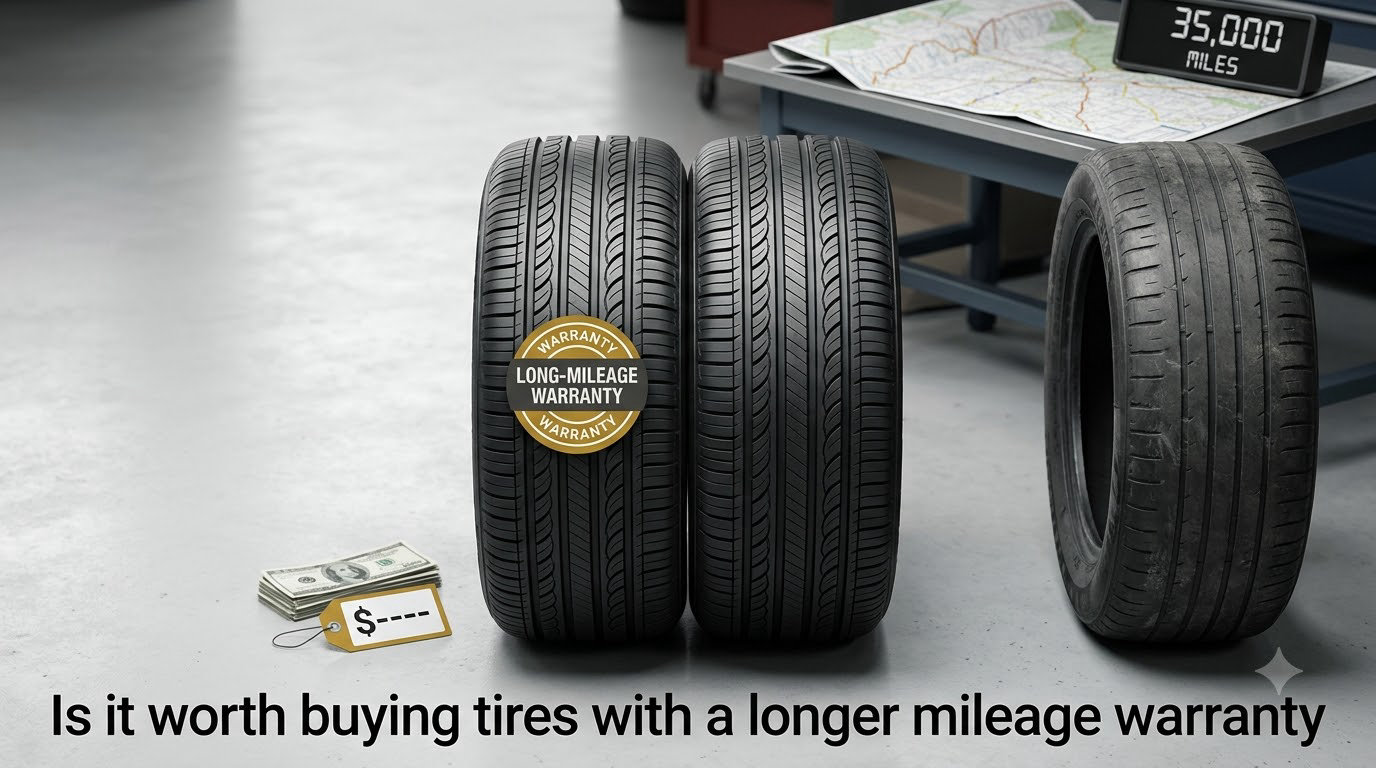
Yes, a longer tire mileage warranty is usually worth it – if you actually drive enough miles to reach it and you keep the maintenance receipts. No, it is not worth chasing if you drive under 7,000 miles a year, own staggered-fitment wheels, or ignore rotation records. The warranty number is a manufacturer’s promise, not a guarantee, and we have seen plenty of 80,000-mile claims get denied at 50,000 miles for missing paperwork.
We have walked buyers through this exact decision for years at american-tire.com, and the answer almost always comes down to three things: how many miles you drive, whether your vehicle has the same tire size on all four corners, and whether you will actually keep the rotation log. This guide breaks down how mileage warranties work, what they really mean, and how to decide if the extra outlay makes sense for you.
Table of Contents
Quick Answer: Is a Longer Mileage Warranty Worth It?
It depends on three factors: your annual mileage, your wheel fitment, and your maintenance habits. Drivers who log 15,000+ miles a year on a non-staggered setup almost always benefit. Drivers who log under 7,000 miles a year, run staggered front and rear sizes, or skip rotations are usually better off buying the cheaper tire.
A mileage warranty is a manufacturer’s prorated credit, not a free replacement. If your tire wears out at 30,000 miles on a 60,000-mile warranty, you get roughly half off a new tire – you still pay the rest, plus mounting, balancing, and any road-hazard fee. Many buyers do not realize that until they file a claim.
Key Takeaways
- A 60,000-mile warranty is the modern baseline; 80,000 and 100,000 tiers are marketing tools backed by softer rubber compounds.
- Real-world tire life runs 25 to 40 percent below the warranty number – assume 80,000-mile tires will deliver around 50,000 to 60,000 miles.
- The biggest warranty denials we see are for missing rotation records, expired time limits, and staggered fitments.
- Road-hazard add-on coverage is a separate product and almost never worth it on premium tires that already include it.
- For most drivers, paying 15 to 25 percent more for a longer mileage warranty on a tire you will actually use to its limit beats buying the cheaper tire twice.
What a Tire Mileage Warranty Actually Means
A tire mileage warranty (also called a treadwear warranty) is a manufacturer’s promise that the tire will deliver a stated number of miles before the tread wears down to a measurable minimum. If the tire falls short, the manufacturer issues a prorated credit toward a replacement set. You still owe the remaining percentage of the new tire’s price, plus mounting, balancing, disposal fees, and taxes.
Most mileage warranties today run from 30,000 to 100,000 miles. The 40,000-mile tier is common on performance and winter tires, 60,000 is the mainstream all-season baseline, and 80,000 to 100,000 appears on touring and long-life compounds. The number is set using a controlled-track test standardized under the federal Uniform Tire Quality Grading (UTQG) system.
The crucial part most buyers miss: a mileage warranty is not a guarantee. It assumes ideal conditions – proper inflation, regular rotation, correct alignment, and moderate driving. Drive aggressively, run over potholes, or skip rotations, and your real-world mileage can drop by half. We have seen brand-new 80,000-mile tires wear out at 38,000 miles because a front-end alignment was off by a quarter inch.
What the Warranty Number Does Not Cover
Mileage warranties exclude damage from road hazards (nails, potholes, curbs), accidents, improper installation, racing or off-road use, and cosmetic issues like sidewall scuffing. They also exclude uneven wear caused by suspension problems. For those scenarios, you need a separate road-hazard warranty or out-of-pocket repair.
How Manufacturers Set Mileage Warranty Numbers (UTQG Explained)
The mileage warranty number comes from the federal Uniform Tire Quality Grading (UTQG) system, which assigns each tire a comparative treadwear rating. A tire rated 400 should last twice as long as a tire rated 200 under identical test conditions. The mileage warranty advertised on the tire then translates that grade into a real-world mile estimate – typically using a multiplier that produces a conservative round number.
UTQG also grades traction (AA, A, B, or C for wet stopping) and temperature (A, B, or C for heat resistance at speed). A high treadwear number paired with an A traction grade is the sweet spot for daily drivers. Touring tires usually hit treadwear 600+ with traction A; performance summer tires often drop to treadwear 200-300 with traction AA but trade longevity for grip.
You can find the UTQG stamp on each tire’s sidewall. It is one of the few unbiased ways to compare two tires that advertise different mileage warranties. A 60,000-mile warranty tire with a UTQG treadwear of 500 may actually outlast an 80,000-mile warranty tire with a UTQG treadwear of 400 – the warranty number is rounded for marketing, the UTQG number is the raw test result.
Manufacturer Warranty vs. Road Hazard Add-On
These are two different products, and conflating them is the most common mistake we see at the counter. A manufacturer tire warranty is included in the price of every new tire and covers premature treadwear and defects. A road hazard warranty is an optional add-on sold by tire retailers that covers accidental damage – nails, glass, potholes, curb impact – and usually includes free flat repair and replacement for a defined period.
| Coverage Type | Manufacturer Mileage Warranty | Road Hazard Add-On |
|---|---|---|
| What it covers | Premature treadwear, manufacturing defects | Punctures, impact damage, sometimes theft |
| How long it lasts | Warranted miles or 5 to 6 years, whichever comes first | Typically 12 to 36 months from purchase |
| Typical cost | Included in tire price | Often a flat fee per tire |
| Payout | Prorated credit toward new set | Free repair or replacement of damaged tire |
| Best for | High-mileage drivers, long-term owners | Urban drivers, construction-zone commuters, low-profile tires |
Our take: the manufacturer warranty is almost always worth using because it is already included. The road-hazard add-on is worth it only if your commute includes serious pothole risk, your tires are low-profile, or you cannot afford an unexpected tire replacement. Most buyers skip it without regret.
Pros: When a Longer Mileage Warranty IS Worth It
A longer mileage warranty pays off when the conditions actually line up. Here is when the math works in your favor.
1. You Drive 15,000 or More Miles per Year
At 15,000 miles annually, a 60,000-mile tire will be worn out in four years; an 80,000-mile tire will last over five years. The longer warranty matches your driving pattern instead of forcing a mid-cycle replacement. This is the single biggest factor.
2. You Keep Your Vehicles for 6+ Years
Long-term owners extract every warranted mile. Short-term owners (3 years or less) hand the unused warranty to the next buyer with no transferability on most brands.
3. You Use the Same Tire Size on All Four Wheels
Same-size all around means full warranty applies. Staggered setups (wider rear than front, common on rear-wheel-drive sports cars and some EVs) trigger the manufacturer’s reduced-mileage clause – up to 50 percent less in some brands.
4. You Keep Rotation and Alignment Receipts
Documentation is the difference between a paid claim and a denial. Buyers who rotate every 6,000 to 8,000 miles and keep the receipts almost always win prorated credits.
5. The Cost-per-1,000-Mile-of-Warranted-Life Is Lower
This is the framework no editorial competitor publishes. Divide the tire’s price by the warranted miles, then multiply by 1,000.
| Warranty Tier | Example Tire Price (Set of 4) | Warranted Miles | Cost per 1,000 Miles of Warranted Life |
|---|---|---|---|
| 60,000-mile tire | Around $520 | 60,000 | About $8.67 |
| 80,000-mile tire | Around $620 | 80,000 | About $7.75 |
| 100,000-mile tire | Around $720 | 100,000 | About $7.20 |
The cost-per-1,000-mile math is what actually matters, not the headline warranty number. If the 100,000-mile tire only costs 25 percent more than the 60,000-mile tire, it is the better buy even if you never claim a cent of warranty.
Cons: When a Longer Mileage Warranty Is NOT Worth It
There are five situations where paying extra for a longer mileage warranty is a waste of money.
1. You Drive Under 7,000 Miles per Year
At 5,000 miles a year, you would need 12 years to use a 60,000-mile warranty – and the time limit kicks in at year 5 or 6. The warranty will expire by calendar before you ever burn through the tread. Low-mileage drivers should buy the cheapest tire that meets their safety needs and ignore the warranty number entirely.
2. Your Vehicle Has a Staggered Fitment
Owners of rear-wheel-drive sports cars, performance sedans, and many EVs run a wider tire on the rear axle than the front. Most manufacturers halve the mileage warranty on staggered setups because the rear tires do more work accelerating and cornering. A 60,000-mile tire effectively becomes a 30,000-mile tire. We have watched Tesla and Kia Stinger owners learn this the hard way at the warranty counter.
3. You Will Not Keep Rotation Records
Rotation records are the single most common reason warranty claims get denied. If you know you will not save the receipts or cannot commit to rotating every 6,000 to 8,000 miles, do not pay extra for the warranty – you will never collect on it.
4. The Cheap-Tire Paradox
One r/tires user got 85,000 miles out of a set of cheap all-seasons and replaced them with a set that wore out at 50,000 miles. The cheaper tire delivered more real-world life than the expensive one. This happens more often than the warranty numbers suggest. If a budget tire has a UTQG treadwear of 500 and a premium tire has 600, the difference is often the rubber compound, not the construction quality.
5. You Plan to Sell the Vehicle Within 3 Years
Most mileage warranties are non-transferable or transfer only with a fee and documentation. If you sell the car before the warranty miles are used, the warranty dies with the original owner.
How Proration Works: A Worked Example
Let us walk through a real claim to demystify the math. You buy a set of four tires with a 70,000-mile mileage warranty for around $640 total. At 30,000 miles, the front pair wears down to 2/32 inch and needs replacement.
Step 1: Calculate the Percentage of Miles Used
30,000 actual miles / 70,000 warranted miles = about 43 percent used.
Step 2: Calculate the Percentage of Miles Unused
100 percent minus 43 percent = about 57 percent unused.
Step 3: Calculate the Prorated Credit per Tire
Manufacturer credit = (unused miles / warranted miles) × current tire price. The current tire price may differ from what you paid – manufacturers price the credit off the original MSRP, not your sale price. For our example tire at $160 each, the credit per tire would be roughly 57 percent × $160 = about $91 per tire.
Step 4: Apply the Credit at the Retailer
You pay the remaining 43 percent of the new tire’s price, plus mounting, balancing, disposal, and taxes. On our example, you would owe roughly $69 per tire plus fees – and you only get the credit on the worn pair, not all four.
One r/personalfinance commenter put it well: a tire warranty is a discount coupon for the next set, not a free replacement. Plan accordingly.
Maintenance Requirements That Keep Your Warranty Valid
Every major manufacturer requires the same four maintenance steps to keep a mileage warranty valid. Skip any one of them and your claim can be denied.
1. Tire Rotation Every 6,000 to 8,000 Miles
Front tires wear faster on front-wheel-drive vehicles, rear tires wear faster on rear-wheel-drive vehicles. Rotating evens out the wear so all four tires reach the warranty mileage together. Keep every receipt – paper or digital.
2. Tire Inflation Checked Monthly
The 3 percent rule (one of the most-asked PAA questions) refers to keeping inflation within 3 percent of the vehicle’s recommended pressure. Underinflation causes shoulder wear, overinflation causes center wear, and both shorten real-world mileage dramatically.
3. Wheel Alignment Annually
A single pothole can knock alignment off enough to cause uneven wear. Annual alignment checks – or any time you hit a major impact – protect the warranty and extend tire life.
4. Documentation of All Maintenance
This is where claims live or die. Keep a folder (paper or phone-scanned) with every rotation receipt, alignment invoice, and tire purchase record. When you file a claim, the manufacturer’s representative will ask for these before approving any prorated credit.
Safety Warning: The Traction vs. Treadwear Tradeoff at 2/32 Inch
Most states require tires to be replaced at 2/32 inch of remaining tread – that is the legal minimum. But wet-traction performance drops off sharply once tread depth falls below 4/32 inch. Chasing the last 2,000 miles of warranted credit on a tire that is hydroplaning in moderate rain is a false economy. Replace tires when they hit 4/32 inch if you drive in wet climates, and treat the warranty credit as a bonus rather than a goal.
Frequently Asked Questions
Is an extended warranty on tires worth it?
A mileage warranty is worth it if you drive over 15,000 miles a year, run the same tire size on all four wheels, and keep rotation records. It is usually not worth it for low-mileage drivers, staggered-fitment vehicles, or anyone who will not document maintenance. The credit you receive is prorated, not a free replacement.
What is a good mileage warranty for tires?
A 60,000-mile warranty is the modern baseline for all-season passenger tires. 80,000 to 100,000-mile warranties exist on long-life touring tires but typically use harder rubber compounds that may sacrifice wet traction. Performance and winter tires usually start at 30,000 to 40,000 miles.
Is 40,000 miles a lot on tires?
40,000 miles is the typical lifespan of performance all-season or winter tires and represents about 2 to 3 years for an average driver. It is not a lot for a tire in absolute terms, but it is normal for tires optimized for grip rather than longevity.
How long is a tire warranty usually good for?
Most mileage warranties last either the warranted miles OR 5 to 6 years from the purchase date, whichever comes first. A 60,000-mile warranty on a car driven 5,000 miles a year expires at year 5 or 6 with 25,000 to 30,000 miles unused.
How does a 70,000 mile tire warranty work?
If your tires wear out before 70,000 miles and you have documented rotation, alignment, and inflation records, the manufacturer calculates the unused mileage percentage and applies it as a prorated credit toward a new set. You pay the remaining percentage plus mounting, balancing, and any applicable fees.
Is 30,000 miles on tires a lot?
30,000 miles is on the low end of typical tire life and usually indicates performance tires, winter tires, aggressive driving habits, or suspension issues like misalignment. It is not inherently bad, but a tire that wears out at 30,000 miles is unlikely to deliver the warranty mileage its label advertises.
What does a tire mileage warranty actually mean?
A tire mileage warranty is the manufacturer’s stated estimate of how many miles the tire should deliver under ideal conditions. If the tire wears out before that mileage and you have maintained it properly, the manufacturer issues a prorated credit toward replacement tires – not a free set.
What does a 60,000 mile warranty on tires mean?
A 60,000-mile warranty means the manufacturer estimates the tire will last 60,000 miles under ideal maintenance and driving conditions. If it wears out sooner, you receive a prorated credit for the unused mileage. Real-world tire life typically runs 25 to 40 percent below this number.
What is the 3 percent rule for tires?
The 3 percent rule for tires refers to keeping inflation pressure within 3 percent of the vehicle manufacturer’s recommended pressure. Deviating more than 3 percent in either direction accelerates uneven wear and can shorten tire life enough to void a mileage warranty claim.
What is a good tire mileage warranty?
A good tire mileage warranty depends on your driving habits. 60,000 miles works for most commuters. 80,000 to 100,000 miles is better for high-mileage drivers who keep vehicles long-term. Anything above 100,000 miles usually involves harder compounds that trade wet traction for longevity.
Which tire brand has the highest mileage warranty?
Several brands offer 80,000 to 100,000-mile warranties on flagship touring lines, including Michelin (Defender), Continental (PureContact), and General (AltiMAX). The highest mileage warranty number does not always mean the longest-lasting tire – check the UTQG treadwear grade for an apples-to-apples comparison.
Is the tire warranty worth it?
The built-in manufacturer tire warranty is worth using because it is included in the tire price and the cost-per-1,000-mile-of-warranted-life is usually lower on warrantied tiers. Optional road-hazard add-on warranties are worth it only for urban drivers with pothole exposure or owners of low-profile tires prone to curb damage.
The Bottom Line
A longer tire mileage warranty is worth buying when you drive enough miles to reach it, your vehicle has matching tires on all four corners, and you will keep the maintenance records. It is not worth buying when you drive under 7,000 miles a year, run a staggered fitment, or cannot commit to rotation logs. Use the cost-per-1,000-miles-of-warranted-life framework instead of the headline warranty number, replace tires by 4/32 inch in wet climates rather than chasing the last 2/000th of warranted credit, and treat the prorated credit as a bonus rather than the reason for the purchase.