
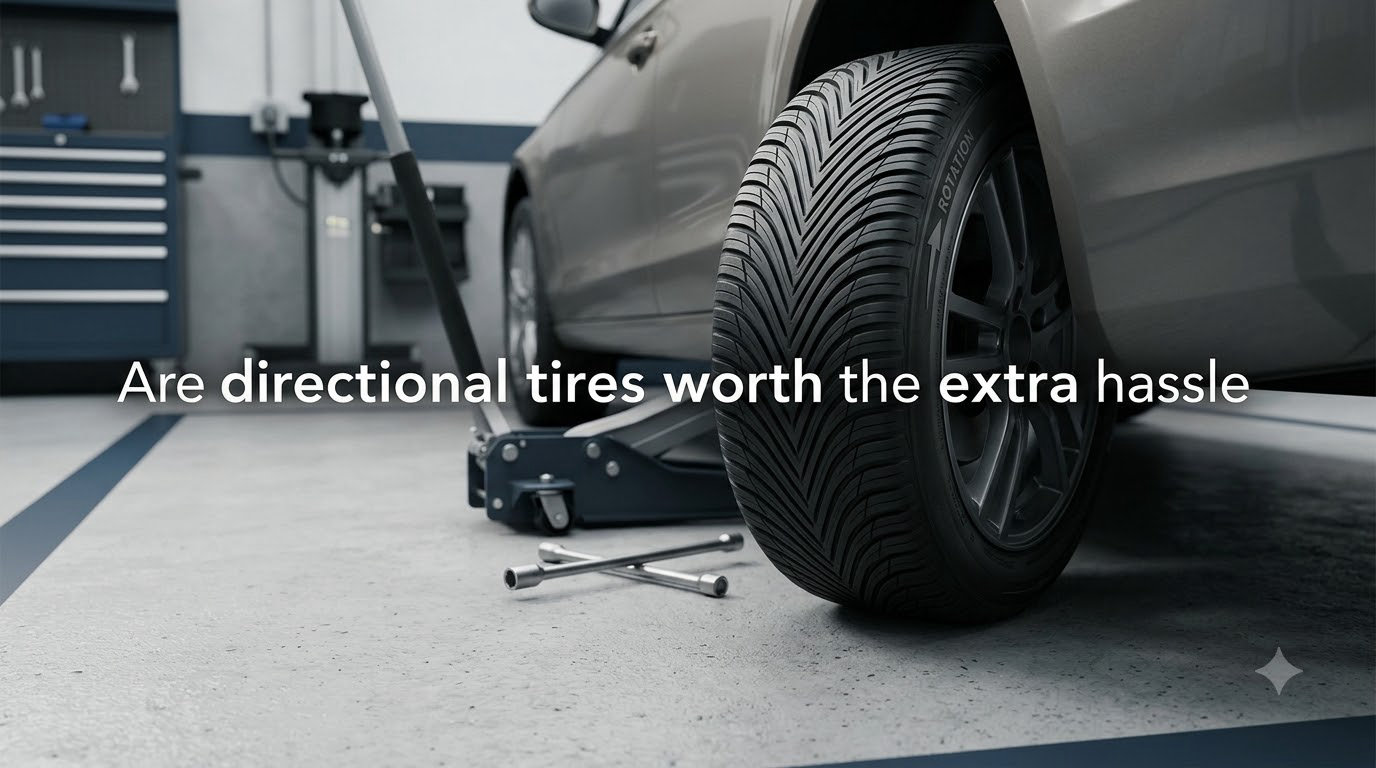
If you drive somewhere that actually rains, directional tires are usually worth it. The V-shaped tread pattern moves water out from under the tire fast, which means shorter stopping distances on wet pavement, stronger grip in standing water, and a noticeably steadier feel at highway speeds. The catch is real: they cost more, can only be rotated front-to-back, and a single blowout can turn into a small parts-and-labor headache. In 2026, the answer for most daily drivers in wet climates is yes; for everyone else, a quality symmetrical or asymmetric tire is the smarter buy.
I have run both setups on the same car over the past several years — a non-directional set as the OEM replacement and a directional set the next season — and the difference in wet-weather confidence was bigger than I expected. The “hassle” the question refers to is real, but it is also smaller than forum threads make it sound, as long as you know the rules before you buy.
Table of Contents
Quick Answer: Should You Buy Directional Tires?
Yes, if you regularly drive in rain or snow, own a performance car, or care about high-speed stability. No, if you live in a dry climate, drive a commuter car, or want the cheapest, most flexible tire to own. The honest middle answer for most people: it depends on where you live, what you drive, and how long you plan to keep the tires.
Here is the short version of the trade:
- Buy directional tires if your weekly forecast shows rain more than 30% of the time, you drive a sports car or performance SUV, or you do any track days.
- Skip directional tires if you live in the desert Southwest, drive a sedan or minivan on a budget, or you want maximum rotation flexibility and the lowest total cost of ownership.
- Consider asymmetric tires instead if you want some of the wet-grip benefit of directional without giving up side-to-side rotation.
What Are Directional Tires (and How Can You Tell You Have Them)?
Directional tires are tires built with a V-shaped or arrow-shaped tread pattern that is engineered to roll in one specific direction. Look at the sidewall and you will see a small arrow (sometimes labeled “ROTATION”) pointing in the direction the tire is supposed to spin when the vehicle moves forward. That arrow is the giveaway: if you see one, the tire is directional.
The V-shaped grooves are not decorative. Each groove is angled to channel water from the center of the tire out toward the edges, like a wedge pushing liquid sideways as the tire rolls over it. Symmetrical (non-directional) tires use straight grooves or block patterns that look the same regardless of which way they spin. Asymmetric tires split the difference — they have two different tread designs, one for the outer shoulder and one for the inner side.
Three quick ways to confirm a tire is directional before you mount it:
- Sidewall arrow. A small arrow molded into the sidewall, often next to the size markings, with the word “ROTATION” near it.
- Tread pattern shape. The grooves form a clear V or chevron pointing in one direction when you look head-on at the tire.
- Brand markings. Many directional tires also print “Outside” and “Inside” labels for the side facing out, but only the arrow tells you the rotation direction.
How Directional Tires Work: Water Displacement and Hydroplaning
The job of any tread pattern is to manage the small triangle of contact where the tire meets the road. On dry pavement, almost any modern tire grips well. On wet pavement, water gets in the way — and that is where tread design starts to matter.
Hydroplaning is what happens when water builds up under the tire faster than the tread can push it out. The tire lifts off the road surface and slides on a thin film of water. You feel it as a sudden loss of steering response, usually above 40 mph on a wet road. Directional tires fight this by using the V-shaped grooves as funnels: water enters the wide end of the V at the center of the tire and gets squeezed out the wide end at the shoulder. The faster the tire spins, the more aggressively the grooves pump water away.
Rolling resistance is the second piece of the puzzle. Directional tread patterns, when mounted correctly, tend to deform less as they roll, which means slightly less energy lost to heat. Independent tire testing has shown roughly 1 to 4 percent fuel-economy improvement over comparable non-directional designs, which is small but real over a year of commuting.
If you want the wet-grip benefit but cannot deal with rotation restrictions, asymmetric tires offer a partial answer. Their outer tread blocks handle water evacuation at the shoulders, while the inner blocks stay solid for dry grip and even wear.
The Real Benefits of Directional Tires
Wet traction is the headline. In testing, directional tires typically shorten wet braking distances by 5 to 15 percent compared with a symmetrical tire of the same quality. That is not a marketing number — independent tire reviews and AAA-style wet-brake tests have shown this range consistently across performance and all-season categories.
Cornering precision is the second big benefit. Because the tread blocks are braced against each other in the direction of travel, the tire feels more responsive when you turn in. Performance and sports-car drivers tend to describe the difference as “the front end plants sooner” or “the car tracks truer mid-corner.”
High-speed stability is the third. The continuous rib pattern down the center of a directional tire stays in constant contact with the road, which calms the steering at highway speeds and reduces wandering in crosswinds.
Fuel economy is the quiet fourth benefit. The lower rolling resistance I mentioned earlier shows up at the pump — 1 to 4 percent better fuel economy on most vehicles, which adds up over a 30,000-mile tire life.
Looks are the final benefit, even if it is shallow. Most performance tires — Michelin Pilot Sport, Continental ExtremeContact, Goodyear Eagle F1 — are directional, and the V-pattern simply looks more aggressive than a blocky symmetrical tread.
The Real Drawbacks: Cost, Rotation, and Lifespan
Cost is the first hurdle. Directional tires typically cost 10 to 25 percent more than a comparable symmetrical tire. On a set of four, that adds up fast.
Rotation is the second, and the one the question is really about. Directional tires can only be rotated front-to-back on the same side of the car. You cannot cross them side-to-side without dismounting the tire from the wheel and remounting it backward. A standard rotation at a tire shop runs $20 to $40; a dismount-and-remount adds another $15 to $30 per tire, and it must be done every time you want to swap sides.
Shorter lifespan is the third complaint. Many directional tires use softer rubber compounds to maximize grip, which wears faster than the harder compounds on a typical all-season. Forum users on Reddit r/tires report seeing 25,000 to 35,000 miles on directional all-seasons versus 40,000 to 60,000 on symmetrical ones. The Pep Boys guide and the Wheelsetgo guide both flag this trade-off.
Blowout logistics are the fourth, and the one nobody mentions until they hit it. If one directional tire fails and your spare is also directional (or worse, a non-directional temporary spare), you have a problem: you cannot mount the spare on the wrong-side wheel without dismounting a good tire first. Cartalk user pleasedodgevan summed up the forum consensus: “Don’t get directional tires. There seems to be some hassle at the tire place if one has a blowout.”
Road noise can be a fifth, smaller drawback. Some drivers report a faint hum from directional tires at highway speed, caused by the angled grooves. It is usually quieter than an aggressive all-terrain tire, but louder than a symmetrical touring tire.
Directional vs Symmetrical vs Asymmetric: A Side-by-Side Comparison
None of the top-ranking competitors use a comparison table for these three tread types, which is a missed opportunity. Here is how they stack up against each other on the five factors drivers actually care about.
| Factor | Directional | Symmetrical (Non-Directional) | Asymmetric |
|---|---|---|---|
| Wet traction | Excellent — V-grooves evacuate water fast | Good — straight grooves handle light rain | Very good — outer blocks manage water at the shoulder |
| Dry handling | Very good — continuous center rib | Good — depends on compound | Excellent — solid inner shoulder |
| Upfront cost | Higher (10-25% premium) | Lowest | Mid-range, closer to directional |
| Rotation options | Front-to-back only | Any pattern, including cross-rotation | Front-to-back and limited side-to-side (depends on design) |
| Tread life | 25k-40k miles typical | 50k-70k miles typical | 40k-60k miles typical |
| Road noise | Low to moderate | Lowest | Low |
| Best for | Wet climates, performance cars, highway stability | Daily commuters, dry climates, budget buyers | Drivers wanting wet grip plus rotation flexibility |
How to Rotate Directional Tires (Front-to-Back Only)
Rotating directional tires is simpler than people think, because the rule is just one: keep each tire on the same side of the car. You can move the left front to the left rear and the right front to the right rear. That is it. No crossing, no swapping.
The basic procedure:
- Check the sidewall arrow on every tire before loosening the lug nuts. If the arrow is pointing in the wrong direction on any tire, that tire is mounted backward and must be remounted before rotation.
- Loosen the lug nuts on all four wheels while the car is on the ground, then lift it.
- Move left front to left rear and right front to right rear. The arrows should still point forward on all four wheels.
- Torque the lug nuts to the vehicle specification (usually 80 to 100 lb-ft for a passenger car) in a star pattern.
- Check tire pressure on all four tires and adjust to the placard on the door jamb.
Rotate every 5,000 to 7,000 miles if you want even wear. AutoGeekOnline forum users who follow that interval report even wear across all four corners, even on directional winter tires.
What you must not do: cross-rotate without dismounting. If you really need to swap a tire to the other side of the car, the tire has to come off the wheel, flip around, and remount — a job for a tire shop, not a driveway.
Who Should Buy Directional Tires (and Who Should Skip Them)
By climate, the case is strongest in rainy regions. The Pacific Northwest, the Southeast, the Mid-Atlantic, and anywhere with regular standing water on the road benefits most. If your local forecast shows rain more than a third of the days in a year, the wet-braking improvement alone justifies the premium.
By vehicle type, performance cars and SUVs are the natural fit. Anything you would consider a sports sedan, a sports car, a hot hatch, or a performance SUV was likely specced with directional tires from the factory. Replacing them with directional keeps the original handling balance. Commuter sedans, minivans, and pickup trucks used for work see less benefit and give up more flexibility.
By budget, the honest math works out like this. A directional tire that costs 15 percent more but lasts 30 percent fewer miles ends up costing more per mile driven. Run the numbers on your expected annual mileage before you commit. Drivers under 10,000 miles per year will rarely see the wet-grip difference pay off; drivers over 15,000 miles in a wet climate usually come out ahead.
By vehicle tech, two newer categories deserve attention. EVs and hybrids benefit disproportionately from low rolling resistance, so directional tires can stretch real-world range by 2 to 4 percent on a Model 3, Mustang Mach-E, or similar. AWD and 4WD vehicles add a constraint: all four tires must match in brand, model, size, and tread depth (within 2/32 inch) to avoid drivetrain damage. If you go directional on an AWD car, you are committing to replacing all four at once, every time.
When to skip directional tires entirely: dry climates (Arizona, Nevada, inland Southern California), budget-focused buyers, drivers who want maximum tire life, anyone running an AWD vehicle with mismatched tire-age risk, and drivers who frequently drive on loose surfaces like gravel or dirt where V-grooves clog quickly.
What Happens When a Directional Tire Fails (Spare Tire Reality)
This is the scenario directional-tire owners talk about most, and it is the one forum threads complain about loudest. Picture this: you are on the highway, a nail kills the right rear tire, and you pull over to swap on the spare. If your spare is a full-size directional tire and you have not rotated it into service in a while, it may be pointing the wrong way for the right rear position.
Your options, in order of preference:
- Carry a matching directional spare rotated into service like a fifth tire. This is the “five-tire rotation” approach used by ClubLexus owners and serious track-day drivers. All five tires wear at the same rate, and any one of them can drop onto any wheel position.
- Carry a temporary spare (the small “donut”) for emergencies only. Drive slowly to a tire shop, then replace with a matching directional tire. This is the cheapest approach and what most automakers ship from the factory.
- Dismount and remount a good directional tire from the opposite side of the car onto the failed wheel’s position, then mount the spare or a borrowed tire on the now-empty side. This costs $60 to $120 in labor but solves the directional mismatch without buying a fifth tire.
The Cartalk user mcparadise summed up the regret that drives the forum chatter: “I put directional tires on my car last time, but I will try to find non-directional tires next time.” That is a common reaction after one bad roadside swap, and it is the kind of experience that turns people away from directional even when the wet-weather performance is genuinely better.
Frequently Asked Questions
Is there a benefit to directional tires?
Yes. Directional tires deliver measurably better wet traction, shorter wet braking distances, stronger high-speed stability, and slightly lower rolling resistance than symmetrical tires of the same quality. The trade is a higher upfront cost, rotation limited to front-to-back on the same side, and a shorter typical tread life due to softer rubber compounds.
What happens if I put directional tires on the wrong way?
On dry pavement you usually notice almost nothing — independent tests by NoMoneyMotorsports and Dotheton showed no measurable dry-braking penalty. On wet pavement the V-shaped grooves stop channeling water away from under the tire, hydroplaning resistance drops sharply, and wet braking distances can lengthen by 10 percent or more. The fix is to dismount the tire from the wheel and remount it so the sidewall arrow points in the direction of forward travel.
Are non-directional tires good?
Yes. Non-directional (symmetrical) tires are the most common tread pattern on the road, and a high-quality symmetrical tire will outperform a cheap directional tire in nearly every condition. For daily commuting, dry climates, and budget-focused buyers, symmetrical tires are the smarter choice. You give up the wet-grip edge of a directional tire but gain side-to-side rotation, longer tread life, and lower cost.
How often should directional tires be rotated?
Every 5,000 to 7,500 miles, or at every oil change. Because directional tires can only swap front-to-back on the same side of the car, the rotation is simple but the interval matters — going longer than 8,000 miles usually shows up as uneven shoulder wear on the front tires, especially on front-wheel-drive vehicles.
Can you do tire rotation on directional tires?
Yes, but only front-to-back on the same side of the car. You cannot cross-rotate a directional tire from left to right without dismounting it from the wheel and remounting it backward. Many tire shops will handle the basic front-to-back rotation as a normal service; side-to-side swaps require a dismount/remount charge of $15 to $30 per tire.
What happens if you rotate directional tires wrong?
If the tires end up rolling against the direction of the sidewall arrow, you lose most of the wet-grip benefit because the V-grooves push water back toward the center of the tire instead of out to the shoulders. Dry handling usually feels fine. The fix is to remount any backward-facing tire so the arrow points forward in the direction of travel.
How to tell if directional tires are on correctly?
Look at the sidewall of each tire and find the small arrow (often labeled ROTATION). When you stand in front of the car and look down at the front tires, the arrow should point forward in the direction the car travels. The same applies to the rear tires when you stand behind the car. If any arrow points backward, that tire is mounted wrong and needs to be dismounted and remounted.
Final Verdict: Are Directional Tires Worth the Hassle in 2026?
For most drivers who deal with real rain, yes — directional tires are worth the extra hassle. The wet-braking improvement is measurable, the high-speed stability is real, and the rotation rule is easier to live with than forum threads suggest. The cost premium and shorter life are real drawbacks, but they are predictable, and a 5-tire rotation plan solves the spare-tire problem entirely.
If you are on the fence, start with the climate test: more than 100 rainy days a year, buy directional. Fewer than 50, buy a quality symmetrical tire and rotate it freely. Drivers in the middle should look at asymmetric tires, which give up a little wet grip in exchange for the rotation flexibility that most owners end up wanting.