
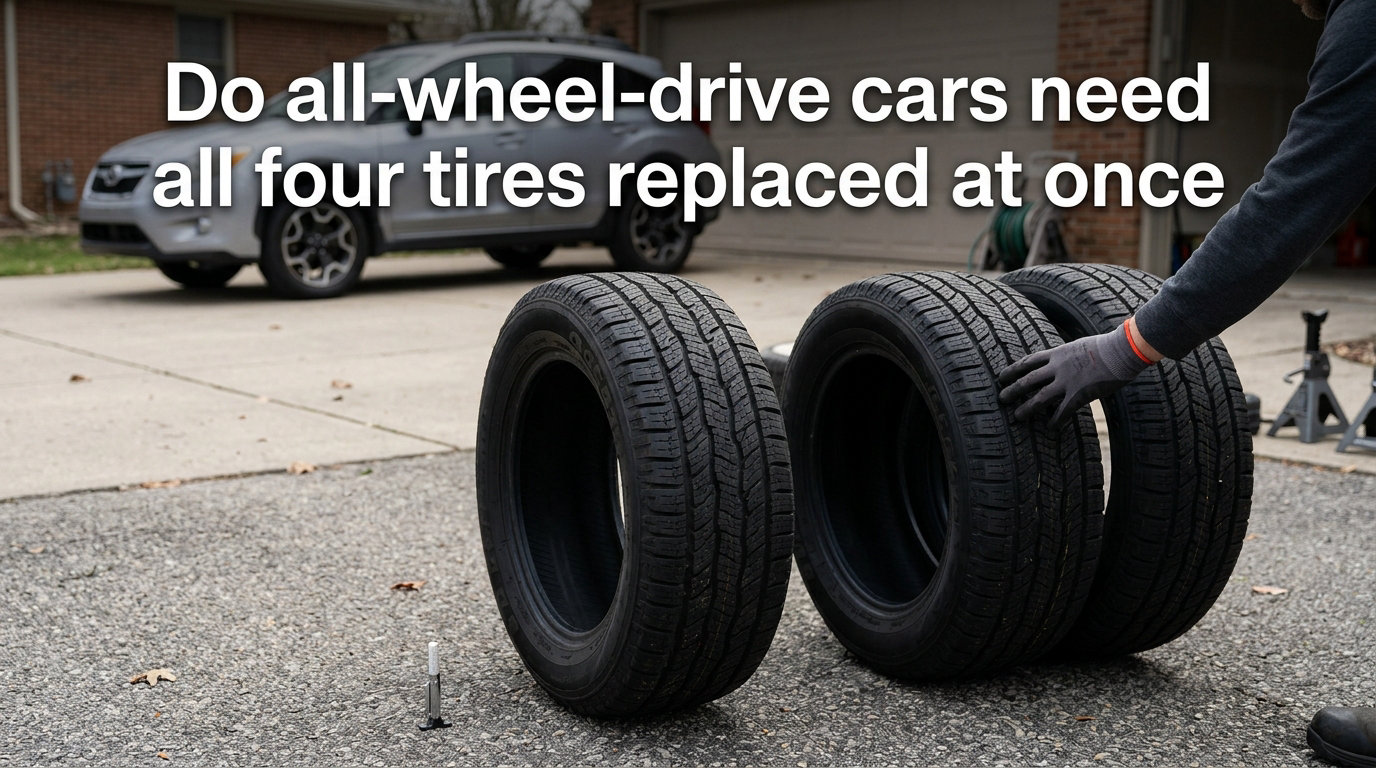
If you drive a Subaru, an Audi quattro, a Toyota RAV4 with AWD, or any other vehicle with four driven wheels, you’ve probably heard the rule: replace all four tires at the same time. But is that always true? In our experience working with AWD owners across dozens of forums and service bays, the answer is usually yes, with one important exception. This guide covers exactly do all-wheel-drive cars need all four tires replaced at once, why mismatched tires can quietly destroy a transfer case, and the one workaround (tire shaving) that lets you replace a single tire without trashing your drivetrain.
We walk through the mechanical reason behind the rule, what actually happens when AWD tires are mismatched, when it’s safe to break the rule, and a step-by-step plan for when you get a flat on an AWD vehicle tonight.
Table of Contents
Quick Answer: Yes in Most Cases, But You Have One Workaround
Yes. In most cases, all-wheel-drive (AWD) cars need all four tires replaced at once because the AWD system depends on four tires that share the same tread depth, brand, model, and size. When even one tire rolls at a slightly different circumference, the AWD computer detects phantom wheel slip and overworks the transfer case and transmission.
Here is the short version drivers keep asking us about:
- Full-time AWD (Subaru, Audi quattro, Acura SH-AWD): Replace all 4.
- On-demand AWD (RAV4, CR-V, Rogue): Replace all 4 as a default; shaving is the documented workaround.
- Part-time 4WD truck: Replace in axle pairs (2 front, then 2 rear) as long as you disconnect 4WD on dry pavement.
- The exception (tire shaving): If your remaining tires still have 6/32 inch or more tread, a shop can shave the new tire down to match their depth, saving you from buying three more.
If you are stranded at a tire shop right now, jump to our action checklist. Otherwise, keep reading for the full reasoning.
Why AWD Needs Matched Tires: Tread Depth, Circumference, and Wheel Speed
The rule isn’t a dealer upsell. It comes straight out of how an AWD system reads the road. Tire circumference changes as tread wears down, and AWD vehicles have wheel-speed sensors at each corner that constantly compare how fast each tire is turning.
Picture two tires on the same axle. The newer tire with 10/32 inch of tread has a slightly larger diameter than the worn tire with 4/32 inch. When both cover the same stretch of road, the worn tire has to spin more times per mile to keep up. The AWD control module interprets this as wheel slip and pumps torque across the drivetrain to “correct” something that isn’t really slipping.
How Tread Depth Changes Tire Circumference
A new passenger tire typically starts with 10/32 inch of tread. Replace it at 2/32 inch (the legal minimum in most U.S. states). The diameter difference between a fresh tire and a worn one is small in inches but huge in revolutions per mile. Consumer Reports and Tire Rack both cite roughly a 2-3 percent rolling circumference gap as the threshold where most AWD systems start to complain.
That threshold translates to roughly a 4/32 inch tread-depth gap. Anywhere under 2/32 inch between your freshest and most-worn tire, and you are inside the safe zone. Beyond that, you are stressing components that were never designed to absorb the constant compensating work.
Why All Four Tires Must Match
AWD doesn’t just compare left and right. It compares front-to-rear and diagonally, because every tire contributes to the rotational story the differential is reading. Replace just the two front tires on a Subaru and the rear pair is now the odd set out. Replace just the left rear and three corners are working against one tire’s circumference. In every case, the system overcompensates in some direction.
What Happens When AWD Tires Are Mismatched
We have talked to dozens of owners on r/cars, r/MechanicAdvice, and r/tires who ran mismatched tires for months with no obvious warning light – and then woke up to a transfer-case repair bill north of two thousand dollars. The drivetrain doesn’t fail loudly, it fails quietly through accelerated wear.
The Damage Chain
- Permanent transfer-case wear: The clutch packs and chain inside the transfer case are designed to react to brief slip events (icy patches, wet leaves). They are not designed to react on every mile of every drive. Chronic overcompensation wears the clutch material down 2-3x faster.
- Transmission stress: On vehicles where the transmission feeds the transfer case (most transverse-mounted AWD crossovers), the constant torque correction adds heat and wear to bands and clutch packs that already have a hard life.
- Traction-control confusion: Stability control lights, ABS warnings, and traction-control intervention at low speeds are the early warning signs. Owners report these as “phantom warning lights” that come and go before the more expensive damage shows up.
- Premature tire wear on the new tire: Ironically, the tire that is supposed to be the replacement often wears unevenly because the system is fighting it the whole time.
What It Costs When It Goes Wrong
A new transfer case for a mainstream AWD crossover runs $1,800 to $3,200 installed. Transmission repairs climb higher. The shock of writing that check after skipping a $200-$400 set of tires is exactly the pain point driving the Reddit conversation. The rule exists because the repair costs make tire matching the bargain by comparison.
AWD vs 4WD vs FWD: Tire Replacement Rules at a Glance
No top-ranking competitor puts this comparison in one table. Here is the at-a-glance version drivers ask us about. Use it to figure out which rule actually applies to your vehicle before you spend any money.
| Drivetrain | Examples | Tire Replacement Rule | Tire Shaving Allowed? |
|---|---|---|---|
| Full-time AWD | Subaru Outback, Audi Quattro, Acura SH-AWD | Replace all 4 together | Yes, up to ~6/32 remaining |
| On-demand AWD | Toyota RAV4 AWD, Honda CR-V AWD, Nissan Rogue | Replace all 4 to be safe | Yes, up to ~6/32 remaining |
| Part-time 4WD | Ford F-150 4×4, Chevy Silverado 4×4, Jeep Wrangler | Replace in axle pairs; disengage 4WD on dry pavement | Yes (some manufacturers allow mixing axles) |
| Front-wheel drive (FWD) | Honda Civic, Toyota Corolla, base-model CR-V | Replace in axle pairs (2 front, then 2 rear) | Yes |
| Rear-wheel drive (RWD) | BMW 3 Series, Ford Mustang, base-model pickup | Replace in axle pairs | Yes |
The single most common point of confusion: part-time 4WD is not AWD. It is designed to be locked only in low-traction conditions (snow, mud, off-road). If your truck has a 2H/4H/4L selector and you can switch AWD off, the matched-tire rule relaxes considerably. Always confirm which system you have before assuming the all-4 rule applies.
When You Must Replace All Four AWD Tires
There are six scenarios where no workaround fits, and you should plan on a full set. If any of these describe your situation, save the search time and book the four-tire install.
Scenario 1: The Tread-Depth Gap Is Larger Than 4/32 Inch
If your worn tires are at 3/32 inch and a fresh tire would be at 10/32 inch, the gap is too big for a shave to fix. Even if you grind the new tire down, you can’t legally run tires below 2/32 inch. The math doesn’t work.
Scenario 2: Your Vehicle Has Sidewall Damage on More Than One Tire
Sidewall punctures cannot be repaired. If two tires have taken nails in the sidewall from the same parking-lot curb, you are looking at a minimum two-tire replacement that puts you back into all-four territory.
Scenario 3: The Remaining Tires Are Already Worn Out
If your three remaining tires are already at the wear bars (around 2/32 inch), shaving them lower to match a new tire is illegal and unsafe. Full set, no discussion.
Scenario 4: You Drive a Full-Time AWD Performance Vehicle
Vehicles like the Audi RS models, Subaru WRX STI, and certain BMW M-cars use full-time AWD with tighter tolerances than mainstream crossovers. The owner’s manuals for these vehicles often go further than “match” and require four identical tires from the same production run. Check your manual before assuming any tire swap is acceptable.
Scenario 5: Your Tires Have Aged Out (DOT Code)
Most tire manufacturers recommend replacing tires at six years from the DOT date code, regardless of remaining tread. If your three remaining tires are seven years old and the new tire would be fresh, you already have a wear-factor mismatch even if the tread depth looks fine. Replace the set.
Scenario 6: The Dealer or Manufacturer Recommends It
Some manufacturers (Subaru is the most notable example) explicitly recommend replacing all four tires together in the owner’s manual. If your manual says “always replace in sets of four,” follow it. Doing otherwise can void AWD-related warranty coverage.
When It’s OK to Replace Just One or Two Tires
Even with the all-four rule, there are practical situations where partial replacement is acceptable. We want to be honest about this because Reddit users in r/cars have been burned by blanket “always replace four” advice that turns out to be dealer policy, not mechanical truth.
Scenario 1: Tire Shaving Makes the Match
If your three remaining tires are at 7/32 to 9/32 inch and you need one new tire, a tire shop can shave the new tire’s tread down to match. This is the only widely accepted workaround for full-time AWD. More on how this works in the next section.
Scenario 2: Part-Time 4WD Truck With Engaged Front Hubs Off
If your 4WD truck is in 2H mode and you have a tow package or manual lockout hubs, you are effectively running a rear-wheel-drive truck on dry pavement. Replace the two rear tires together and the two front tires together at the next rotation. Subaru this is not.
Scenario 3: Low-Mileage Vehicle With Newer Tires
If your car is two years old, has 12,000 miles, and one tire is damaged while the others have 9/32 inch of tread left, you have a near-perfect candidate for tire shaving. The savings here can run $400-$600 versus a full set.
Scenario 4: Identical Same-Brand, Same-Model Pair (2-Tire on FWD-Based AWD)
Some manufacturer guidance allows for matched-pair replacement on specific crossovers as long as both tires are the same brand, same model, same size, same load index, and same speed rating as the ones remaining. This is more common on FWD-based AWD platforms where the rear tires wear slowly because most torque still goes forward.
Tire Shaving Explained: The Money-Saving Workaround
Tire shaving is the single most important concept to understand if you want to break the all-four rule without trashing your drivetrain. It is also the most misunderstood. Here is how it actually works.
What Tire Shaving Is
A tire-shaving machine is a specialized lathe that grinds tread off a new tire in controlled amounts, typically in 1/32 inch increments. The goal is to bring a fresh 10/32 inch tire down to whatever depth matches your remaining three tires, often 7/32 or 8/32 inch. Tire Rack, Discount Tire, and many independent shops offer the service.
What It Costs
Our research across Tire Rack and major independent chains shows tire shaving runs $25 to $35 per tire when bundled with a new-tire purchase, and $40 to $75 per tire as a stand-alone service. Compared to buying three additional tires at $150-$250 each, the math is obvious.
When Tire Shaving Won’t Work
Tire shaving has two hard limits. First, you cannot shave below 2/32 inch (the legal minimum tread depth). If your remaining tires are already at 4/32 inch, there is no way to grind a new tire down that far and stay road-legal. Second, tire age and brand still have to match even when tread does. A shaved new tire is a great match for a 2-year-old tire of the same model; it is not a great match for a 6-year-old tire of a different brand.
How to Get a Tire Shaved
- Measure remaining tread: Use a tread-depth gauge ($5-$10 at any auto parts store) on each of your three surviving tires. Write down the depth in 32nds of an inch.
- Buy the matching tire: Order the exact same brand, model, size, load index, and speed rating as your existing tires.
- Request shaving at purchase: Tire Rack and Discount Tire offer shaving at the time of order. If your local shop doesn’t, ask which nearby dealer does – many Les Schwab, Pep Boys, and independent performance shops have shaving equipment.
- Install in matched axle pair: Most installers will mount the shaved tire on the non-driven axle (rear on FWD-based AWD, front on RWD-based AWD) to minimize transfer-case strain if there is any residual mismatch.
The Consumer Reports piece on tire shaving is the canonical reference for this technique and covers it in more detail than we can fit here.
Always Check Your Owner’s Manual and Manufacturer Guidance
Generic advice only gets you so far. Tire-replacement rules vary by manufacturer, and your owner’s manual is the legal source of truth for your specific vehicle. Here is the short version of what the major AWD manufacturers tell owners.
Subaru Symmetrical AWD
Subaru’s owner’s manuals consistently state that all four wheels must have tires of the same size, brand, model, tread pattern, and wear level. Subaru also explicitly recommends replacing all four tires together. Tire shaving is the accepted workaround.
Audi Quattro
Audi takes a similarly strict position. The owner’s manual specifies four identical tires and recommends replacing all four at the same time. Mismatched tires can damage the quattro drivetrain and may void the AWD-related portion of the powertrain warranty.
Honda i-VTM4 and Acura SH-AWD
Honda and Acura owner’s manuals require four tires of matching size and speed rating. For SH-AWD on vehicles like the Acura MDX and TLX, the manual is even stricter, requiring the same brand and same model across all four wheels.
Toyota AWD (RAV4, Highlander)
Toyota’s AWD manuals require matching size, load index, and speed rating across all four tires. The brand and model do not have to be identical but must be compatible. Toyota is one of the few manufacturers that allows some flexibility for tire shaving.
BMW xDrive
BMW xDrive requires four tires of the same brand, model, and tread depth to avoid damaging the xDrive transfer case. Performance models with staggered fitments (different size front and rear) cannot use tire shaving to mix brands.
Check your specific owner’s manual before following any of this advice. The rules above are accurate as of 2026 but manufacturers update guidance with each new model year.
How to Measure Tire Tread Depth (the Right Way)
Before you talk to a tire shop about any of this, you need to know your starting point. Measuring tread depth is quick and doesn’t require a trip to a service bay.
The Penny Test (Free, Built-In)
Take a U.S. penny and insert it into the tread groove with Lincoln’s head facing down. If you can see the top of Lincoln’s head, your tread is below 2/32 inch and the tire is at the legal limit. The penny test is a binary check; it tells you “replace now” or “still has tread” but doesn’t tell you how much.
The Tread Depth Gauge (Best Method)
A tread depth gauge is a $5-$15 tool that gives you the exact reading in 32nds of an inch. Measure the center, the inside edge, and the outside edge of each tire. Uneven readings across one tire often point to an alignment or suspension issue rather than a tire-quality problem.
Where to Look on the Tire
Modern tires have built-in tread-wear indicator bars – small rubber bars that run across the tread grooves. When the surrounding tread wears down to the level of the indicator bar, the tire is at 2/32 inch and due for replacement regardless of the penny test result.
What to Do If You Get a Flat Tire on an AWD Vehicle Tonight
The moment a tire blows out or takes a nail is when most AWD tire questions turn urgent. Here is the action plan our team runs through when an AWD owner calls us with a flat.
The Same-Night Checklist
- Pull over safely. Get off the road, turn on your hazards, set the parking brake. Do not drive on a flat tire – one trip at speed will destroy the sidewall and the wheel.
- Find the damage. Sidewall damage cannot be repaired and means a new tire. A tread-area puncture under 1/4 inch can usually be plugged and patched from the inside.
- Use the spare carefully. If your spare is a full-size tire of the same brand and model, you can drive normally but at reduced speeds (under 50 mph is typical). If your spare is a temporary “donut” or space-saver, drive under 50 mph and only as far as you need to reach a tire shop.
- Skip 4WD mode if you have part-time 4WD. On a part-time 4WD truck, run in 2H mode while the spare is on. The donut’s smaller diameter will fight the transfer case if 4WD is engaged.
- Tow rather than drive if the tire is shredded, the sidewall is damaged, or you don’t have a matching spare. Many roadside-assistance plans cover towing for AWD vehicles flat.
This Week’s Plan
Measure the tread depth on the three surviving tires. If they are at 7/32 inch or deeper and the same brand and model as before, look into tire shaving for the replacement. If they are at 4/32 inch or below, plan for a full set. Don’t assume the shop’s first recommendation is the only option – tire shaving is a real alternative.
This Month’s Plan
After the repair, get a four-wheel alignment. A tire failure often comes with a curb strike or pothole impact that knocks the alignment out of spec. A bad alignment is the fastest way to wear out your new tires unevenly, which puts you right back into the mismatched-tire scenario.
Tire Rotation and Routine Maintenance for AWD Vehicles
Mismatched tires is also a problem that can sneak up on you through uneven wear rather than a single damaged tire. AWD systems put torque to all four wheels, which means all four tires wear roughly evenly if your alignment is correct. If the alignment is off, the wear is uneven and you end up with a tread-depth gap anyway.
How Often to Rotate
Most AWD manufacturers recommend tire rotation every 5,000 to 7,500 miles. Subaru, Audi, BMW, and Toyota all sit in the same range. Skipping rotations accelerates uneven wear and shortens the life of all four tires.
Why Rotation Matters More on AWD
On a FWD or RWD car, an uneven tire wear pattern only affects handling. On an AWD car, it directly feeds into the matched-tire rule – the front pair wears faster than the rear on FWD-based AWD crossovers, and a missed rotation creates a front-to-rear tread gap that mimics a mismatched set. Rotation keeps the four tires within 1/32 to 2/32 inch of each other, which keeps you inside the safe zone.
When to Suspect Suspension or Alignment
If a single tire wears down much faster than the other three (cupping pattern on one edge, smooth on the others), the cause is almost always a worn strut, weak spring, or an alignment issue that hasn’t been corrected. Replace the suspension components before you put new tires on, or the new tires will inherit the same wear pattern.
For more on tire rotation patterns, alignment intervals, and how to read wear patterns, your tire shop’s service writer can usually walk you through the diagnosis in ten minutes.
Frequently Asked Questions
Is it okay to replace only one tire on my AWD vehicle?
In most cases, no. Full-time AWD and on-demand AWD systems need four tires with closely matched tread depth, brand, and model. The only widely accepted workaround is tire shaving, where a new tire is ground down to match the depth of your three remaining tires. Part-time 4WD trucks can usually replace a single axle pair without issue.
Is it okay to replace only two tires on an AWD?
Sometimes, but only under specific conditions. The two new tires must be the same brand, model, size, load index, and speed rating as the remaining two, and the tread-depth gap should stay under 2/32 inch to keep the AWD system happy. For most full-time AWD vehicles, replacing two and shaving to match the other two gives a longer-lasting result than mixing new and worn tires.
What happens if you don’t change all four tires on an AWD?
Mismatched tires force the AWD transfer case and traction-control system to constantly compensate for phantom wheel slip. Over months, this accelerates wear on the transfer-case clutch packs, transmission bands, and differential components. Early signs include traction-control warning lights, ABS messages, and uneven tire wear on the newest tire. Left alone long enough, the repair bill runs from $1,800 for a transfer case to over $4,000 for a transmission.
How long should tires last on an AWD car?
Most AWD tires last 40,000 to 60,000 miles with proper rotation and alignment, which is similar to FWD and RWD vehicles. However, AWD vehicles wear tires slightly faster because torque is sent to all four wheels. All-season touring tires run longer; performance tires run shorter. Rotating every 5,000 to 7,500 miles extends tire life by 15 to 20 percent.
Is it bad to replace one tire on an AWD?
It is risky if the remaining tires are meaningfully worn, but not always bad. If the new tire is shaved to match the existing tread depth and brand, replacing one tire is mechanically acceptable. If the new tire is left at full tread and the others are already worn, the AWD system will overwork the transfer case for as long as those tires are mounted. The risk scales with the tread-depth gap.
Should I replace all tires on an AWD?
Yes, in most cases. Subaru, Audi, Acura, BMW, and most other AWD manufacturers recommend replacing all four tires at the same time, and the owner’s manual is the source of truth for your specific vehicle. Replacing the full set eliminates the risk of mismatched-tire damage and gives you a fresh warranty start date.
What is the typical lifespan of AWD tires?
AWD tires typically last 40,000 to 60,000 miles on all-season touring compounds, 30,000 to 40,000 miles on performance all-season compounds, and 20,000 to 30,000 miles on summer performance compounds. Tire age matters alongside mileage: most manufacturers recommend replacing tires at six years from the DOT date code regardless of remaining tread.
Final Word on Whether All-Wheel-Drive Cars Need All Four Tires Replaced at Once
So, do all-wheel-drive cars need all four tires replaced at once? In our team’s view, yes, with the tire-shaving exception. The all-four rule exists for a mechanical reason that survives dealer scrutiny: AWD systems transfer torque to all four wheels, and any size or depth mismatch forces constant compensation through the transfer case and transmission.
If you are facing a tire replacement on an AWD vehicle right now, here is what we recommend: check your owner’s manual for the manufacturer-specific rule, measure your remaining three tires with a tread-depth gauge, and ask the tire shop about shaving a new tire to match if the gap is under 4/32 inch. These three steps protect both your drivetrain and your wallet. If you drive a part-time 4WD truck, the rules relax considerably, but the manual is still the source of truth.
Still have questions about your specific vehicle? Drop the year, make, model, and current tread depth (in 32nds) in a comment below, and our team will do its best to walk you through the call.