
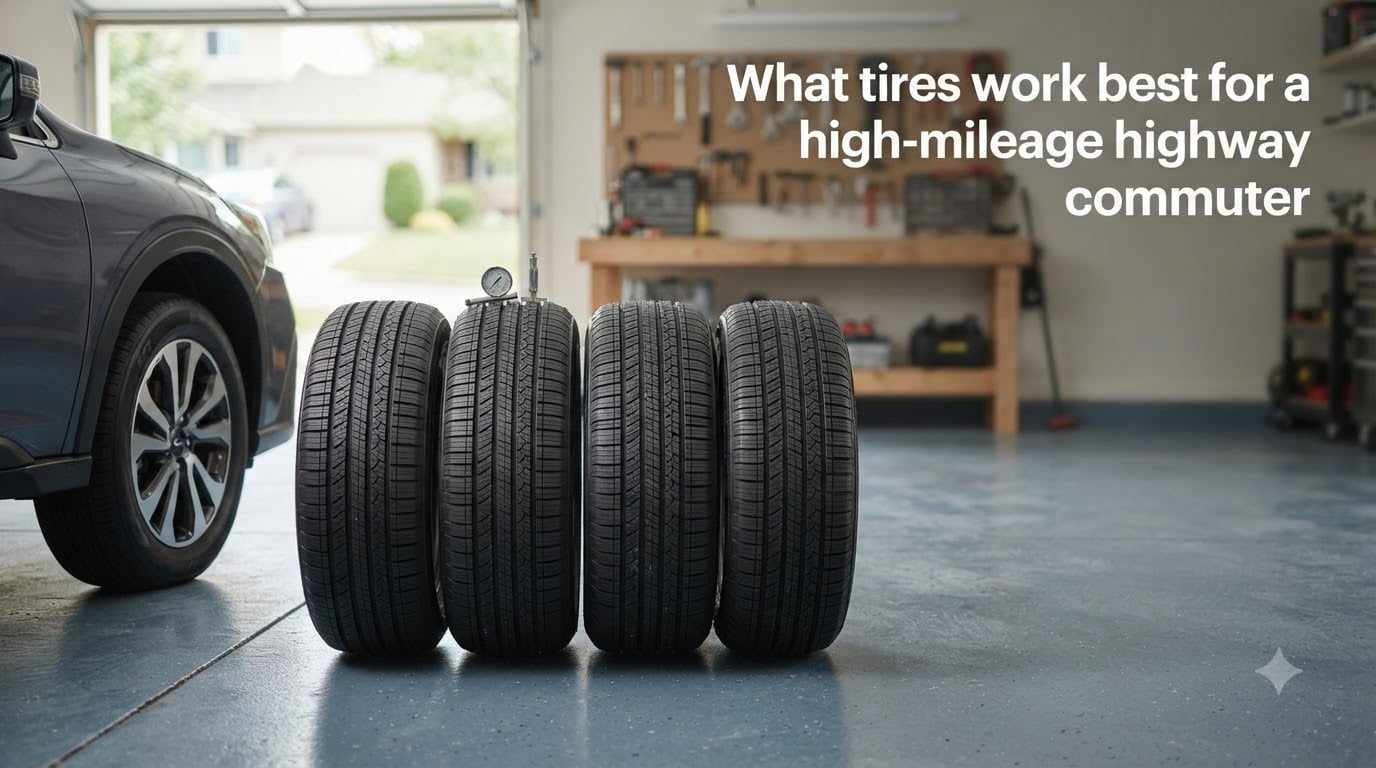
If you rack up 20,000 miles a year or more on the highway, the best tires for you are highway touring all-season tires with a UTQG treadwear rating of 700 or higher and a mileage warranty of at least 80,000 miles. Look for a silica-rich rubber compound, a symmetric or asymmetric tread pattern, even-wear shoulders, and a speed rating that matches your vehicle.
I have helped highway commuters pick tires at our shop for years, and the same pattern shows up every season. The drivers who get the most miles out of their tires are not the ones who buy the most expensive option. They are the ones who match the tire category to their driving and stay disciplined about maintenance. This guide breaks down exactly how to do that.
Table of Contents
What Counts as a High-Mileage Highway Commuter?
A high-mileage highway commuter is a driver who logs roughly 15,000 to 30,000+ miles per year, with the majority of those miles on paved highways and interstates. That includes daily commuters, rideshare drivers (Uber, Lyft), traveling sales reps, regional delivery drivers, and anyone whose car lives on the freeway.
Tire choice matters more for this group than for casual drivers. If you run 20,000 miles a year, you will replace tires every 2 to 3 years instead of every 4 to 5 years. Picking the right category can save you real money, fewer shop visits, and fewer roadside disruptions. Drivers on r/MechanicAdvice consistently report that premium touring tires outwear budget options by 20,000 to 40,000 miles, which is the difference between one and two sets of tires over five years.
Highway Touring All-Season Tires vs. Other Tire Categories
Not all all-season tires are built for the highway. The category you choose determines how long your tires last, how they feel at 70 mph, and how they hold up in the rain. Here are the four categories you will actually see on the shelf.
Highway touring all-season tires are designed for sedans, minivans, and crossovers that spend most of their life on paved roads. They have a stiffer tread block arrangement, deeper sipes for wet grip, and a tread compound tuned for low rolling resistance. Average UTQG around 720. These are the sweet spot for most commuters.
Grand touring all-season tires sit one step above highway touring. They add more refined sidewall construction for a quieter, smoother ride, plus slightly better wet and light-snow traction. UTQG usually lands between 600 and 700. A great pick if comfort matters more than raw mileage.
All-weather tires carry the mountain/snowflake symbol and are legal in winter tire mandates. They sacrifice some tread life for cold-weather and snow capability. UTQG averages around 540 to 600. Pick these only if you regularly drive through real winter conditions.
All-season touring tires (sometimes called standard all-season) are the entry-level category. UTQG averages 500 to 600. They work fine for casual drivers, but they wear out faster under sustained highway use. Skip these if you commute long distances.
Here is a quick comparison of average UTQG ratings by tread type, based on industry data:
- Highway touring all-season: ~720 UTQG
- All-season highway touring: ~608 UTQG
- Highway terrain (SUV/truck): ~591 UTQG
- Performance touring all-season: ~515 UTQG
- All-weather: ~540 to 600 UTQG
Understanding UTQG and Treadwear Ratings
UTQG stands for Uniform Tire Quality Grading, a U.S. Department of Transportation rating system that compares a tire’s treadwear, traction, and temperature resistance. The treadwear number is the one that matters most for longevity. A tire with a UTQG of 600 should last about twice as long as a control tire rated at 300 under the same conditions.
The rating is not a mileage guarantee. UTQG is calculated from a controlled government test on a specific course, so it is a relative comparison, not a real-world prediction. For a high-mileage highway commuter, treat UTQG as a screening tool rather than a promise. Anything below 600 is a budget-tier tire. Anything 700 or higher is engineered for long life.
What actually drives long tread life is the rubber compound. Modern long-lasting tires blend silica (for wet grip and low rolling resistance) with carbon black (for abrasion resistance and heat tolerance). Highway speeds generate a lot of heat in the contact patch, and a heat-tolerant compound resists the kind of wear that kills budget tires by 25,000 miles.
Drivers on r/tires often ask how reliable UTQG really is. The honest answer: it is reliable for ranking tires within the same category, and less reliable for predicting exact mileage in your specific car. Your driving style, tire pressure, alignment, and climate all swing the result by 20 to 30 percent.
What Specs to Look for in Long-Lasting Highway Tires
Once you have narrowed the category to highway touring all-season, here is the checklist we walk customers through at our counter.
1. Mileage warranty of 80,000 miles or higher. Most premium touring tires carry an 80,000 to 90,000-mile warranty. Some go to 95,000 or even 100,000. The warranty is the manufacturer’s confidence in real-world tread life, and it is your best proxy for projected miles.
2. UTQG treadwear rating of 700+. Anything below this is built for a different use case. Highway touring tires in the 700 to 820 range are the sweet spot for commuters.
3. Speed rating that matches your vehicle. For most commuters, T (118 mph) or H (130 mph) is correct. Higher speed ratings (V, W, Y) usually mean softer compounds and faster wear. You do not need them unless you actually drive that fast.
4. Load index appropriate for your car. Check your door jamb for the required load index. Undersized tires wear unevenly and run hot. For most sedans and crossovers, this is non-issue, but for SUVs and light trucks carrying passengers or cargo daily, it matters.
5. Even-wear tread design. Look for symmetric or asymmetric patterns with reinforced shoulders. These distribute load across the contact patch and resist the shoulder wear that plagues budget tires on highway commuters.
6. Low road noise. Highway touring tires are tuned with variable pitch tread blocks and foam liners to dampen noise at 60 to 75 mph. If you commute two hours a day, this is not a luxury, it is sanity.
7. Fuel efficiency rating. Low rolling resistance saves you 1 to 2 percent on fuel. Over 20,000 miles a year, that adds up. Many highway touring tires now carry a fuel-economy badge from the manufacturer.
Matching Tires to Your Commuter Profile
The right tire depends on what you drive and where you drive it. Here is how we match tires to common commuter profiles.
Sedan commuter (Camry, Accord, Civic, Tesla Model 3): Standard highway touring all-season. UTQG 700+, 80,000-mile warranty. This is the volume sweet spot and where you find the most options.
SUV commuter (RAV4, CR-V, Highlander, Model Y): Look for the SUV/CUV version of highway touring all-season. These carry higher load indices and often have sidewall reinforcement for heavier vehicles. UTQG 600 to 700 is normal here because of the extra weight. Expect 65,000 to 80,000 miles.
Light truck commuter (F-150, Silverado, Tacoma): Highway terrain (H/T) tires are the right category. UTQG averages around 590, which sounds worse than sedan tires, but the compounds are built for the load. Pick a tire with an 60,000 to 70,000-mile warranty.
EV commuter (Model 3, Model Y, Mustang Mach-E, Ioniq 5): EVs are heavier and quieter, so the noise floor matters more. Many manufacturers now offer EV-ready highway touring tires with low rolling resistance (for range), reinforced sidewalls (for the extra weight), and foam liners (for cabin quiet). If you commute an EV, prioritize low rolling resistance over maximum tread life.
Climate zones: If you live where summers hit 95+ and winters are mild, standard highway touring is fine. If you see real snow (more than a few storms per year), look at all-weather tires with the mountain/snowflake symbol and accept slightly shorter tread life. If you live in a four-season climate with both hot summers and cold winters, all-weather is the most flexible pick.
Maintenance Checklist to Make Highway Tires Last
The single biggest tire-life multiplier is not the tire you buy. It is how you maintain it. We see the same commuters come in every 18 months with worn-out tires and other commuters come in every 4 years with plenty of tread left. The difference is almost always maintenance.
Check tire pressure every month. Underinflation by even 5 psi causes uneven wear and heat buildup. The number on your door jamb is the target, not the number on the tire sidewall. Most modern cars have a Tire Pressure Monitoring System (TPMS), but it only alerts when pressure is already dangerously low, so check manually.
Rotate tires every 5,000 to 7,500 miles. Front tires wear faster on front-wheel-drive cars. Rotating front-to-rear (and crossing sides for non-directional tires) keeps wear even across all four tires and extends total tread life by 15 to 25 percent.
Get a four-wheel alignment once a year. Hitting a curb or a deep pothole can knock your alignment out by enough to cause rapid shoulder wear. If you notice the car pulling to one side, or the steering wheel sitting off-center, get it checked immediately.
Balance tires when you feel vibration at highway speed. Unbalanced tires wear in patches and shorten life. Balancing is cheap and takes 30 minutes.
Smooth out your driving. Hard acceleration, hard braking, and fast cornering all scrub tread off faster than steady cruising. If your commute includes city traffic, expect 10 to 20 percent shorter tire life than pure-highway drivers.
Avoid potholes and road debris. A hard impact can break a belt inside the tire, leading to a bulge or early failure even with plenty of tread left. Slow down for potholes and steer around debris when it is safe to do so.
Check tread depth every 6 months. Tires are legally worn out at 2/32 inch of remaining tread. Replace them before they hit that line, especially if you commute in the rain. Hydroplaning risk climbs sharply below 4/32 inch.
Cost Per Mile and Total Cost of Ownership
The cheapest tire is rarely the cheapest tire over its life. Here is how we walk customers through the math.
Take a budget all-season tire with a projected 50,000-mile life, and a premium highway touring tire with a projected 85,000-mile life. Divide the per-tire cost by the projected mileage. The premium tire almost always comes out ahead on cost per mile, sometimes by 30 to 40 percent.
The math gets even better when you factor in fuel efficiency. Low rolling resistance tires save roughly 1 to 2 percent on fuel. Over 80,000 miles at 30 mpg, that is 25 to 50 gallons of gas saved, plus fewer rotations and alignments because the tires wear evenly. Premium highway touring tires can save a high-mileage commuter $400 to $800 over five years once you add it all up.
The road hazard warranty is a separate item from the treadwear warranty. Treadwear covers premature wear under normal use. Road hazard covers damage from potholes, nails, and debris. If you commute on rough roads, road hazard coverage is worth the small upcharge.
Frequently Asked Questions
What brand tire lasts the longest?
Michelin, Continental, and Goodyear consistently rank at the top of long-lasting tire lists across Consumer Reports, Tire Rack, and owner forums. Specific touring models like the Michelin Defender2, Continental TrueContact Tour 54, and Goodyear Assurance MaxLife are engineered for 80,000 to 90,000 miles of real-world tread life under normal commuting conditions.
How accurate is UTQG in predicting tire life?
UTQG is a reliable relative comparison within the same tire category, but it is less accurate for predicting exact mileage in your specific car. Real-world tire life varies by 20 to 30 percent depending on driving style, tire pressure, alignment, climate, and load. Use UTQG as a screening tool, and use the manufacturer’s mileage warranty as a better proxy for projected life.
What is a good treadwear rating?
For a high-mileage highway commuter, a UTQG treadwear rating of 700 or higher is the threshold to look for. Anything between 600 and 700 is acceptable for SUV and light truck commuters. Anything below 600 is built for casual use and will wear out faster under sustained highway driving.
Can tires last 100,000 miles?
Yes, some premium highway touring tires now carry 100,000-mile warranties and can reach that mileage under ideal conditions: steady highway driving, correct tire pressure, regular rotation, and proper alignment. Most drivers will see 70,000 to 90,000 miles from a top-tier touring tire. Budget tires rarely exceed 50,000 miles.
How long do tires last with high mileage?
A high-mileage commuter running 20,000 miles a year will replace tires every 2 to 3 years with a premium touring tire, or every 1.5 to 2 years with a budget tire. Even the longest-lasting tire compounds wear out from heat, road surface, and time, so plan on replacing tires based on actual tread depth rather than calendar years alone.
Are high mileage tires worth it?
Yes, premium touring tires almost always win on cost per mile once you factor in longer tread life, better fuel efficiency, and even wear. A high-mileage commuter can save $400 to $800 over five years by choosing a premium touring tire over a budget option, even when the upfront cost is higher.
The Bottom Line
The best tires for a high-mileage highway commuter are highway touring all-season tires with a UTQG treadwear rating of 700+ and a mileage warranty of at least 80,000 miles. Match the spec to your vehicle type and climate, and stay disciplined about monthly pressure checks, rotations every 5,000 to 7,500 miles, and an annual alignment.
Start by checking your current tire’s UTQG on the sidewall, then browse the highway touring all-season options that fit your vehicle. Bring your driving habits and typical commute distance to your local tire dealer, and ask for the cost-per-mile math on the two or three tires that match your spec list. That conversation usually saves more money than any coupon.