
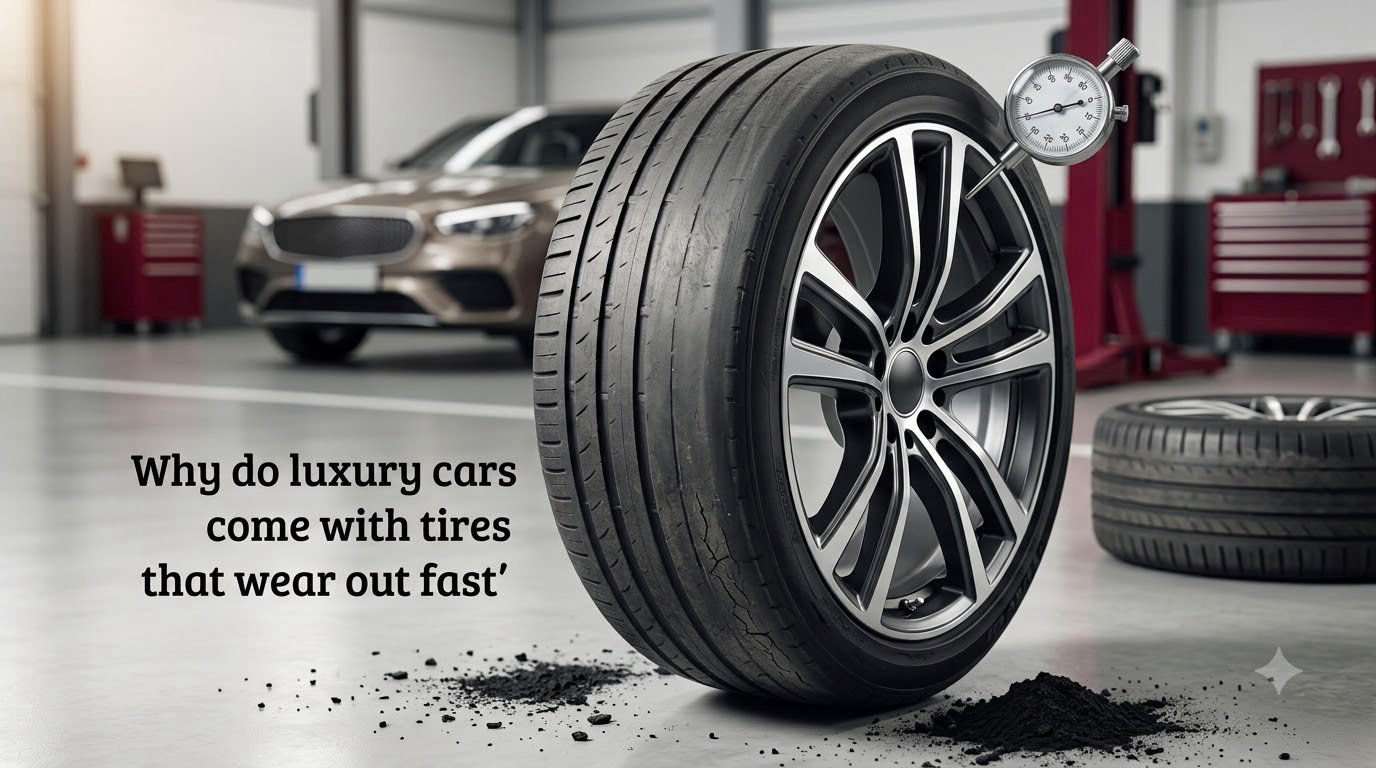
Luxury cars come with tires that wear out fast because manufacturers prioritize handling, safety, and aesthetics over tread longevity. The four biggest culprits are run-flat sidewall construction, low-profile aspect ratios, softer performance rubber compounds, and aggressive alignment settings like negative camber. Each design choice delivers a real benefit on the road, but together they cut tire life roughly in half compared to standard tires.
I have spent years talking with luxury car owners who are shocked when their German sport sedan needs new tires at 18,000 miles. The explanation is not a defect. It is a series of deliberate engineering trade-offs that the owner rarely sees explained anywhere. This guide walks through each one, so you understand what your car came with and what your options are when it is time to replace.
Table of Contents
The 4 Main Reasons Luxury Car Tires Wear Out Fast
If you only have 30 seconds, here is the short answer. Luxury car tires wear out fast for four reasons that compound each other:
- Run-flat sidewalls. Reinforced rubber sidewalls add weight and run hotter, which shreds tread faster.
- Low-profile aspect ratio. Shorter sidewalls mean a smaller contact patch cushion and more direct impact transfer to the tread.
- Soft performance rubber compounds. Stickier rubber grips better but sacrifices tread life.
- Aggressive alignment settings. Negative camber and staggered fitments create uneven wear patterns that shorten overall life.
Each reason on its own would only cost you a few thousand miles. Together, they can cut expected tire life from the typical 50,000-70,000 miles of a standard touring tire down to 15,000-30,000 miles on a luxury car. Let us unpack each one in detail.
Run-Flat Tires and Why Luxury Brands Standardize Them
A run-flat tire is built with a reinforced sidewall thick enough to hold the weight of your car even after the tire loses all air pressure. After a puncture, you can drive roughly 50 miles at speeds under 50 mph to reach a service shop, which is precisely why luxury brands adopted them.
BMW, Mercedes-Benz, Audi, Cadillac, and Lexus have all shipped run-flats as standard equipment on many models. The original pitch was elegant. Drivers would never need to change a flat on the side of a highway. Trunk space previously devoted to a spare tire could become usable cargo room. The tire pressure monitoring system (TPMS) could warn the driver before a failure became dangerous.
The trade-off lives in the sidewall itself. Run-flat sidewalls are stiffer and heavier than conventional sidewalls. That extra mass and rigidity creates two problems at once. First, the tire carries more unsprung weight, which puts extra stress on the tread during cornering. Second, the stiffer sidewall transmits more vibration and impact energy directly into the tread blocks instead of absorbing it. Both effects accelerate wear.
The lifespan penalty is real. BMW owners on forums like e90post.com consistently report OEM run-flat tires lasting 15,000-25,000 miles, sometimes less on staggered setups. A conventional touring tire on the same car would reasonably reach 40,000-60,000 miles.
Why luxury brands still choose them
The decision is partly safety marketing and partly engineering convenience. Luxury buyers expect to never deal with a flat tire on a commute. Removing the spare also lets designers shape trunk interiors and underbody aerodynamics more freely. For the manufacturer, it is a competitive feature, even if it shortens tire life.
Low-Profile Tires and the Performance Trade-Off
Low-profile tires have a low aspect ratio, which is the sidewall height expressed as a percentage of the tire width. A 255/40R19 tire has a sidewall that is 40% as tall as the tire is wide. That is low-profile. A standard family sedan might run 215/65R16, where the sidewall is 65% of the width.
Luxury cars wear low-profile tires because they deliver exactly what luxury buyers feel: sharper turn-in, less body roll, more responsive steering, and a sportier stance. The shorter sidewall flexes less during cornering, so the car feels more planted. It is one of the easiest performance upgrades a manufacturer can make.
Why low-profile tires wear faster
The shorter sidewall has less rubber to absorb impacts. Every pothole, curb, and expansion joint sends more force into the tread and the internal structure. The tire also has a wider, flatter contact patch by design, which is great for grip but spreads wear across a larger area unevenly when alignment is not perfect. The result is faster tread wear, more vulnerability to impact damage, and a noticeably harsher ride.
Most low-profile tires also pair with larger diameter wheels (19 inch, 20 inch, even 22 inch on some luxury SUVs). Larger wheels mean heavier wheels, and heavier wheels mean more rotational mass and more stress on the tire during braking and acceleration.
Performance Rubber Compounds: Grip vs. Longevity
Every tire is a blend of natural rubber, synthetic rubber, carbon black, silica, and other compounds. The recipe determines grip, rolling resistance, noise, and tread life. Softer compounds with higher silica content grip the road better, especially in wet and dry cornering. Harder compounds last longer but feel vague and slide earlier.
Luxury cars almost always ship with softer performance compounds because the driving experience demands it. A BMW 3-Series with rock-hard compound tires would feel disconnected and would understeer through the same corners a Michelin Pilot Sport or Pirelli P Zero handles with confidence.
The longevity cost
Soft rubber wears faster. This is not a secret. The trade-off is built into the engineering. RNR Tires, in their comparison of performance vs. touring tires, notes that softer compounds are designed to maximize grip, and that this very property is what leads to faster tread wear. The same Reddit thread that surfaced in our research had a Subaru Legacy GT owner who burned through Bridgestone Potenza performance tires in 25,000 miles while the Turanza touring tires on the same car lasted 50,000-plus.
For luxury car owners, the typical expectation is 20,000-30,000 miles on a set of OEM tires. That is roughly half the life of a standard all-season tire on a regular sedan.
Staggered Fitments and Negative Camber: Hidden Wear Accelerators
Here is where most articles stop, and where luxury owners get blindsided. Two more design choices can quietly halve your tire life again: staggered fitments and negative camber alignment.
What staggered fitments are
A staggered fitment means the rear tires are wider than the front tires. You will see this on rear-wheel-drive performance sedans like the BMW M3, Mercedes-AMG C63, and many Audi S and RS models. The reasoning is sound. Wider rear tires put more rubber on the road for the driven wheels, which helps acceleration and cornering grip.
The cost is practical and financial. You cannot rotate staggered tires front to back, so the fronts wear out first and you must replace them in pairs. The rear tires, with their wider footprint, can sometimes last longer but can also wear unevenly because they carry different loads than the fronts. Mercedes owners on staggered setups routinely report replacing front tires every 15,000-20,000 miles.
What negative camber does
Camber is the vertical tilt of the tire when viewed from the front of the car. Negative camber means the top of the tire tilts inward toward the center of the car. Luxury and performance cars use negative camber to keep the tire flat against the road during hard cornering, which improves grip.
The trade-off is inside-edge wear. The inside shoulder of the tire carries more load than the outside, so the tread there disappears first. A modest negative camber setting of about 0.5 to 1.0 degrees might be barely noticeable in tire life. An aggressive 1.5 to 2.5 degrees setting, common on performance suspensions, can wear the inside shoulder down to the wear bars in 10,000-15,000 miles.
This is the most common reason luxury car owners feel their tires wear out “way too fast” without understanding why. The alignment is working as designed. The tire is wearing exactly where the geometry says it should.
Why BMW Is Moving Away From Run-Flat Tires
If run-flat tires are so common on luxury cars, why is BMW quietly phasing them out on newer models? The answer is customer feedback.
BMW owners have complained for years about harsh ride quality, road noise, expensive replacements, and short tread life on OE run-flats. By around 2020, BMW began shipping some models with conventional tires plus a tire mobility kit or compact spare. The 2024 and newer 5-Series and X5 lines, for example, ship with non-run-flat tires on many trim levels.
Mercedes-Benz has followed a similar path on entry-level models, though AMG performance variants still ship with run-flats to preserve trunk space and weight distribution. Audi has been more inconsistent, keeping run-flats on some models and dropping them on others.
The industry shift tells you something important. When luxury manufacturers themselves conclude that run-flats cost more in customer satisfaction than they save in convenience, you know the trade-off is real. If you own an older BMW or Mercedes with run-flats, you are not imagining the problem. The engineering has known limits.
Replacement Costs and Your Options
When the time comes to replace OEM luxury tires, you have three paths. Each has its own trade-off.
Stick with OEM-spec run-flats
This is the easiest option. Your car was engineered around run-flat sidewall stiffness, TPMS sensors, and the suspension geometry that pairs with them. Replacing with the same specification preserves the original driving feel. The downside is the same wear pattern repeats itself, and you will likely replace tires again in 20,000-30,000 miles.
Switch to non-run-flat replacement tires
This is the option many owners switch to after one or two sets of OEM run-flats. Conventional touring tires in the correct size typically last 40,000-60,000 miles, sometimes more. The ride is softer and quieter. You give up the ability to drive on a flat, so most owners carry a compact spare or roadside assistance membership.
Hybrid options: longer-lasting performance tires
Some tire makers now offer ultra-high-performance all-season tires that balance grip and longevity better than older performance compounds. Michelin Pilot Sport All-Season 4, Continental ExtremeContact Sport, and Pirelli P Zero All-Season are common picks. They do not match the ultimate grip of a track-focused summer tire, but for daily driving they offer a meaningful life extension without giving up much in feel.
How to Make Luxury Car Tires Last Longer
You cannot undo the engineering choices your manufacturer made, but you can squeeze more life out of the tires you have. A few habits matter more than the rest.
Check tire pressure monthly
Run-flat tires especially run hot when underinflated, and heat is the number one enemy of tread life. TPMS sensors typically warn at 25% below the recommended pressure. By then, damage may already be done. Check pressure cold, once a month, and keep it at the door-sticker specification.
Rotate on a schedule (if you can)
Standard luxury sedans with same-size tires front and rear should rotate every 5,000-7,000 miles. If you have a staggered setup, you cannot rotate front to rear, but you can still swap left and right on the same axle to even out wear.
Get an alignment check every year
A small shift in camber or toe, caused by a curb hit or a pothole, can wipe out thousands of miles of tire life. An annual alignment check is cheap insurance, especially on cars with non-standard alignment settings.
Avoid aggressive driving when tires are cold
The first few minutes of driving, when tires are cold and the rubber is stiff, are when the most wear happens. Gentle acceleration and braking for the first 10 minutes extends tread life noticeably.
Frequently Asked Questions
Why do OEM tires wear out so fast?
OEM tires wear out fast because luxury cars ship with run-flat sidewalls, low-profile aspect ratios, softer performance rubber compounds, and aggressive alignment like negative camber. Each trade-off improves handling or safety but shortens tread life. Together, they can cut expected tire life from 50,000-70,000 miles down to 15,000-30,000 miles.
Do performance tires wear faster?
Yes. Performance tires use softer rubber compounds with higher silica content to grip the road better in dry and wet conditions. Softer rubber physically abrades faster than harder rubber, so tread life is shorter. A performance tire on a luxury car typically lasts 20,000-30,000 miles, while a standard touring tire on the same car can reach 50,000 miles or more.
Why is BMW moving away from run-flat tires?
BMW began phasing out standard run-flat tires on newer models around 2020 because of long-running customer complaints about harsh ride, road noise, short tread life, and expensive replacements. Newer 5-Series and X5 models now ship with conventional tires plus a tire mobility kit or compact spare in many cases.
What is the lifespan of run-flat tires?
Run-flat tires on luxury cars typically last 15,000-25,000 miles, with some owners reporting life as short as 10,000 miles on staggered setups with negative camber. The reinforced sidewalls are heavier and stiffer than conventional sidewalls, which transmits more energy into the tread and accelerates wear.
What are the common problems with BMW run-flat tires?
BMW owners consistently report four problems with OEM run-flat tires: a harsh, noisy ride; tread life of 15,000-25,000 miles; replacement costs that run higher than conventional tires; and the inability to repair many run-flat punctures, which forces replacement in pairs.
How long do run-flat tires last on a BMW?
On most BMW models with staggered fitments and aggressive alignment, OEM run-flat tires last 15,000-25,000 miles on the front axle and 20,000-30,000 miles on the rear. Owners who switch to non-run-flat replacement tires on the same car typically see tread life extend to 40,000-60,000 miles.
Which tires wear down the most?
Soft-compound performance tires and ultra-low-profile tires wear down the fastest, often in 15,000-25,000 miles. Run-flat tires wear faster than conventional tires of the same size. Standard all-season touring tires typically last the longest, often 50,000-70,000 miles, because of harder compounds and taller sidewalls.
What tires should I stay away from?
Avoid the cheapest run-flat options that do not match your OE specification, ultra-low-profile tires below a 30-series aspect ratio if you drive on rough roads, and any performance summer tire if you live in a climate with cold winters. Mismatched load index or speed rating tires can also trigger TPMS warnings and ABS faults on luxury cars.
The Bottom Line on Why Luxury Cars Wear Out Tires Fast
Luxury cars come with tires that wear out fast because every part of the tire was engineered for something other than longevity. Run-flat sidewalls prioritize safety. Low-profile aspect ratios prioritize handling. Soft performance compounds prioritize grip. Negative camber and staggered fitments prioritize cornering performance. None of these choices is wrong on its own. Together, they add up to a tire that may need replacement every 20,000 miles or so.
As an owner, your best move is to understand the trade-offs your manufacturer made for you. If you want to restore the original feel, replace with OE-spec run-flats. If you want longer life and a quieter ride, consider switching to a high-quality non-run-flat tire in the correct size. Either way, keep up with tire pressure, alignment, and rotation habits, and your tires will give you every mile they were designed to deliver.