
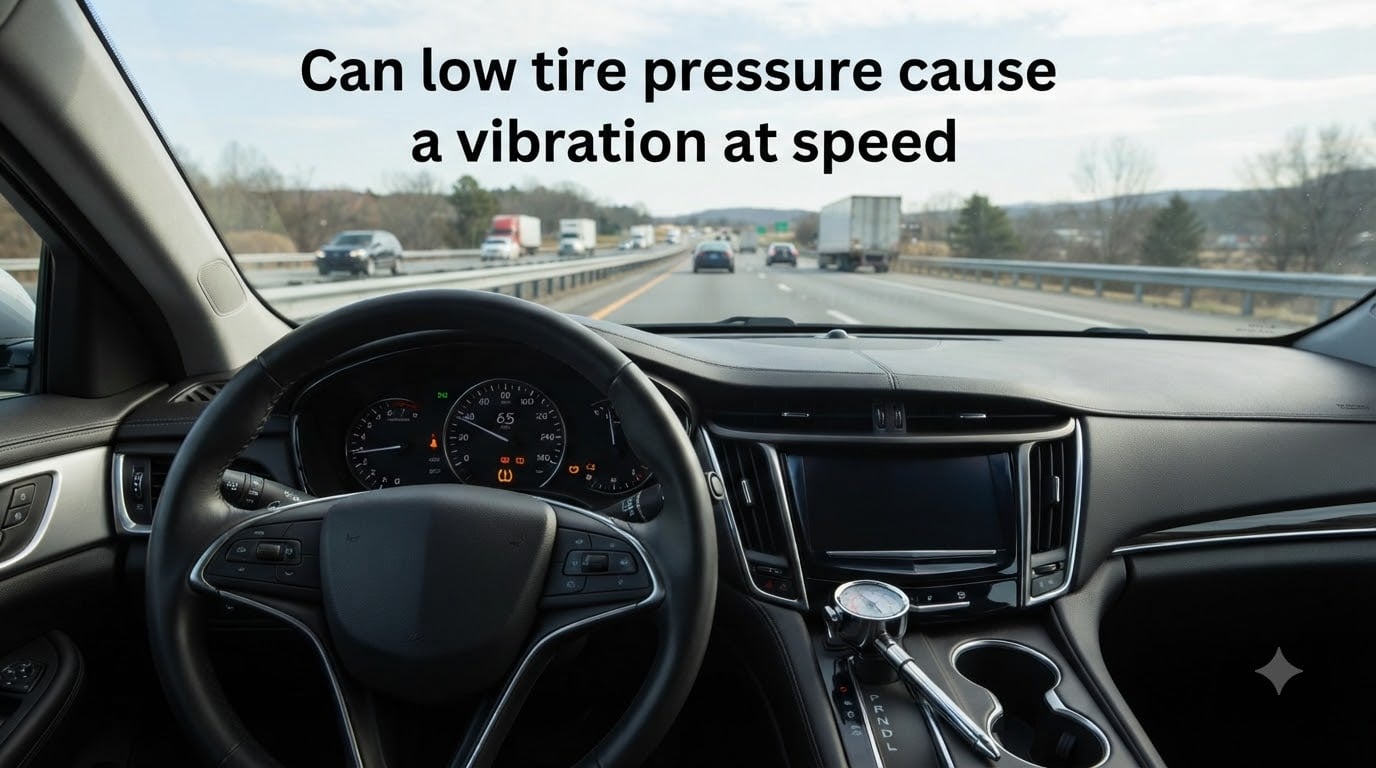
You’re cruising down the highway at 65 mph when a subtle vibration creeps through the steering wheel. At first you ignore it, but by the time you hit 70 mph, the whole car is buzzing. Before you panic about expensive suspension repairs, check your tire pressure. Low tire pressure is one of the most common and overlooked causes of vibration at highway speeds.
In this guide, I’ll explain exactly how low tire pressure causes vibration, what PSI levels trigger the problem, and how to tell if your tires are the culprit. We’ll also cover other vibration causes so you can rule them out.
Table of Contents
Can Low Tire Pressure Cause a Vibration at Speed?
Yes, low tire pressure absolutely causes vibration at speed. When your tires are underinflated, the rubber flexes more than it should, creating an uneven contact patch with the road. At highway speeds, this uneven contact generates vibration that travels through your suspension and into the steering wheel or seat.
The relationship between tire pressure and vibration is direct. A tire inflated just 5 PSI below the recommended level can produce noticeable shaking at 60 mph. Drop it 10 PSI below spec, and the vibration becomes impossible to ignore. The faster you drive, the worse it gets because speed amplifies the flexing motion.
This is why so many drivers notice vibration on highway on-ramps or during long road trips. The combination of sustained high speed and slightly low pressure turns a minor inflation issue into a driving problem.
How Low Tire Pressure Creates Vibration
Understanding why underinflated tires vibrate helps you diagnose the problem faster. Here’s what happens inside a tire running below its recommended PSI.
The Contact Patch Problem
Every tire touches the road through a flat area called the contact patch. When properly inflated, this patch is roughly the size of your hand and shaped evenly. Underinflation causes the contact patch to spread and deform, creating a larger but uneven footprint.
That uneven footprint means different parts of the tire grip the road with different force. As the tire rotates, these inconsistencies create a wobbling effect. At low speeds you might not feel it, but at highway velocity the wobble becomes a pronounced vibration.
Sidewall Flex and Heat Buildup
Underinflated tires don’t just affect the tread. The sidewalls flex excessively with every rotation, generating heat and instability. This flexing absorbs energy that should go into smooth rolling, instead converting it into vibration.
The sidewall acts like a spring. Properly inflated, it’s firm and predictable. Low pressure makes it soft and erratic, bouncing unpredictably as the tire spins. This erratic movement is what you feel as vibration through the steering column.
Speed Amplifies the Effect
A tire that feels fine at 35 mph can shake badly at 65 mph. The vibration frequency increases with speed because the tire completes more rotations per minute. Each rotation with an uneven contact patch adds another pulse of vibration.
Think of it like a slightly bent wheel. At walking speed, you’d never notice. Spin it fast enough, and the imbalance becomes violent. Low tire pressure works the same way, just with less dramatic deformation.
Where You Feel the Vibration: Steering Wheel vs Seat
One useful diagnostic trick involves noting where you feel the vibration. This can help you identify which tire is the problem.
Vibration in the steering wheel usually points to a problem with the front tires. Since the front wheels are connected to the steering system, any imbalance transfers directly to the wheel in your hands. If your steering wheel shakes at highway speed, check the front tires first.
Vibration in the seat or floor typically indicates a rear tire issue. The rear wheels connect to the chassis rather than the steering column, so problems there manifest as a buzzing sensation through the seat. Some drivers describe it as feeling like sitting on a washing machine.
If you feel vibration in both locations, you may have multiple underinflated tires. This is common after a cold snap when all four tires lose pressure simultaneously.
At What PSI Does Vibration Start?
Most passenger car tires are rated for 30 to 35 PSI. Vibration typically becomes noticeable when pressure drops 5 to 8 PSI below the manufacturer’s recommendation. For a tire rated at 35 PSI, that means you might feel shaking around 27 to 30 PSI.
However, the threshold varies by tire type and vehicle weight. Performance tires with stiffer sidewalls can tolerate slightly lower pressure before vibrating. Heavier vehicles like trucks and SUVs may experience vibration at higher PSI levels because the tire bears more load.
Real-world experience backs this up. One driver on Reddit reported that bumping tire pressure from 30 to 33 PSI completely eliminated highway front-end vibrations on their 4Runner. Multiple forum users have shared similar stories, noting that adding just 3 to 5 PSI made a dramatic difference in ride smoothness.
If your TPMS light comes on, you’re already well below the threshold where vibration starts. Most TPMS systems trigger around 25% below the recommended pressure, which is deep into vibration territory.
Over-Inflation vs Under-Inflation: How Each Affects Vibration
Both over-inflation and under-inflation cause problems, but they produce different symptoms.
Under-inflation creates the vibration pattern we’ve been discussing: a wobbling, buzzing sensation that worsens with speed. The tire flexes excessively, generates heat, and wears unevenly on the outer edges. This is the more dangerous condition because it increases blowout risk.
Over-inflation makes the tire rigid and bouncy. You’ll feel every bump and crack in the road, and the ride becomes harsh and uncomfortable. The center of the tread wears faster because the tire bulges outward. Over-inflated tires don’t typically cause vibration, but they reduce traction and make the ride jarring.
The sweet spot is the manufacturer’s recommended PSI, usually found on a sticker inside the driver’s door jamb or in the owner’s manual. This number accounts for your vehicle’s weight, handling characteristics, and tire size.
Cold Weather and Tire Pressure Vibration
Tire pressure drops about 1 PSI for every 10-degree Fahrenheit decrease in temperature. If you set your pressure on a warm fall day and a cold front moves through overnight, you could wake up to noticeably lower pressure and new vibrations.
This is one of the most common triggers for sudden vibration complaints. Drivers in northern climates often notice their car shaking on the first cold morning of the season. The tires didn’t suddenly develop a problem. They simply lost pressure as the air inside contracted.
Check your tire pressure during seasonal transitions. A quick adjustment in early fall and late spring prevents cold-weather vibration and keeps your tires wearing evenly. If you live somewhere with dramatic temperature swings, consider checking monthly.
Other Causes of Vibration at Speed to Rule Out
Low tire pressure isn’t the only reason your car might vibrate at highway speeds. Here are the other common culprits to investigate.
Tire imbalance occurs when the weight distribution around the wheel is uneven. A small lead weight falling off during a pothole strike can cause vibration that feels similar to low pressure. This typically requires a tire shop visit for rebalancing.
Wheel alignment issues cause the tires to track at slight angles, creating uneven wear patterns that vibrate. If your car pulls to one side in addition to vibrating, alignment is likely the problem.
Warped brake rotors produce vibration when you apply the brakes, not during coasting. If the shaking only happens when braking, look at your rotors rather than your tires.
Worn suspension components like ball joints, tie rod ends, or wheel bearings can cause vibration that worsens with speed. These usually come with clunking or clicking sounds.
The quickest way to rule out tire pressure as the cause is simple: check it. If all four tires are at the correct PSI and you still have vibration, move on to these other possibilities.
How to Check and Fix Your Tire Pressure
Checking tire pressure takes five minutes and costs nothing if you own a gauge. Here’s the process.
Step 1: Buy a reliable tire pressure gauge if you don’t have one. Digital gauges are easier to read, but a quality pencil gauge works fine.
Step 2: Check pressure when tires are cold, meaning the car has been parked for at least three hours or driven less than a mile. Driving heats the tires and gives a false high reading.
Step 3: Remove the valve cap, press the gauge firmly onto the valve stem, and read the number. Compare it to the recommended PSI on the driver’s door jamb sticker, not the maximum PSI printed on the tire sidewall.
Step 4: Add air at any gas station with an air pump until you reach the correct pressure. Most pumps have built-in gauges, but verify with your own gauge afterward for accuracy.
Step 5: Replace the valve caps and check monthly. Tire pressure naturally decreases over time, so regular checks catch slow leaks before they cause vibration.
Frequently Asked Questions
Can low tire pressure cause a vibration?
Yes. Underinflated tires create an uneven contact patch with the road surface. At highway speeds, this uneven contact generates vibration that transfers through the suspension into the steering wheel or seat. Even 5 PSI below the recommended level can cause noticeable shaking.
Why is my car vibrating at 70 mph while I’m driving?
The most common causes are low tire pressure, tire imbalance, or wheel alignment issues. Start by checking tire pressure when the tires are cold. If pressure is correct, have a shop check tire balance and alignment. Warped brake rotors can also cause vibration, but only during braking.
Can low tire pressure cause shakiness?
Yes. Low tire pressure makes the sidewalls flex excessively and creates an uneven contact patch. This produces a wobbling sensation that feels like shakiness, especially at highway speeds. The vibration typically worsens as speed increases.
Why does my car shake at 60 mph even with new tires?
New tires can still vibrate if the pressure is incorrect or if they weren’t properly balanced during installation. Check that pressure matches the door jamb recommendation. If pressure is correct, return to the shop that installed them and ask for a rebalance. Even new tires can have slight weight imbalances.
Conclusion
Low tire pressure is one of the easiest vibration problems to diagnose and fix. If you’re experiencing vibration at highway speeds, check your tire pressure before assuming the worst. A few minutes with a gauge and an air pump can save you from unnecessary mechanic visits and keep your tires lasting longer.
Remember: underinflated tires don’t just cause vibration. They waste fuel, wear out faster, and increase your risk of a blowout. Checking tire pressure monthly is one of the simplest things you can do for your car’s safety and your driving comfort.