
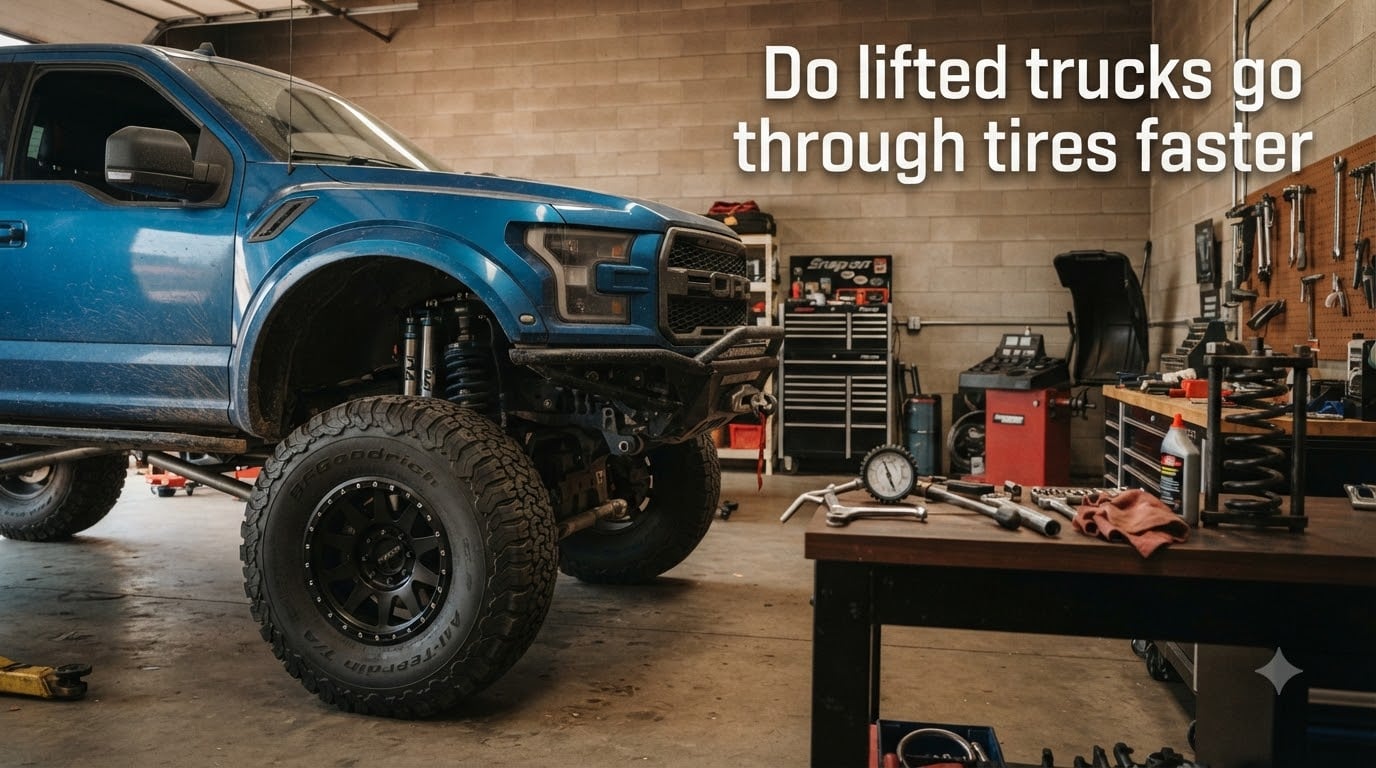
If you’ve been asking “do lifted trucks go through tires faster?” – yes, they do, and the gap is usually bigger than most owners expect. In our experience reviewing owner reports across lifted-truck forums, lifted trucks typically replace tires 1.5x to 2x more often than stock-height trucks.
Some of that is mechanical (alignment, suspension geometry, heavier rubber). Some of it is sneaky: an uncorrected speedometer quietly inflates your real mileage. We walk through all of it below, plus what you can actually do to push your tires closer to a normal lifespan.
Table of Contents
Quick Answer: Do Lifted Trucks Go Through Tires Faster?
Yes. Lifted trucks wear through tires faster than stock trucks because a lift changes four things at once: suspension geometry (camber, toe, caster), wheel-and-tire weight, rotational mass, and the accuracy of your speedometer/odometer. Any one of those can shorten tire life; together they usually cut it in half.
- Suspension geometry shifts: camber and toe angles move outside factory spec, which causes uneven shoulder wear on the front tires.
- Bigger, heavier tires: added unsprung weight and rotational mass stress the rubber and the drivetrain.
- Speedometer error: an uncalibrated speedometer undercounts real miles, so tires age faster than the odometer suggests.
- Tire compound choice: aggressive mud-terrain tires wear 2x to 3x faster than highway-terrain tires even before you add a lift.
How Long Do Tires Last on a Lifted Truck?
Most stock trucks get 40,000 to 60,000 miles out of a set of all-season or all-terrain tires. Lifted trucks typically see 20,000 to 35,000 miles – roughly half the lifespan. Owners on r/liftedtrucks and TacomaWorld regularly report burning through a set in under two years of daily driving.
Three things drive that number down:
- Lift height: a 6 inch lift eats tires noticeably faster than a 2 inch leveling kit.
- Tire type: mud-terrain (MT) compounds are softer and wear faster than all-terrain (AT).
- Maintenance: skipping post-lift alignment or going 10,000+ miles between rotations compounds the problem.
One r/ToyotaTundra owner summed it up: “decreased fuel economy, decreased towing capacity, reduced braking efficiency, increased wear on suspension components.” Tires are the most visible line item on that list, but they’re part of a bigger pattern.
Why Lifted Trucks Wear Tires Faster
A lift kit doesn’t just raise your truck. It pushes every wheel alignment angle out of factory spec, adds weight in the worst possible place (the unsprung corners), and usually pairs with larger tires. Here’s what each of those does to your rubber.
1. Suspension Geometry Changes After a Lift
Stock alignment specs assume the suspension sits at stock height. When you raise the truck, control arms, tie rods, and steering knuckles rotate into new positions. The three angles that change are:
- Camber: the tilt of the wheel in or out at the top. Positive camber (top tilted out) scuffs the outside shoulder of the tire.
- Toe: whether the front of the tires point in or out. Excessive toe-in or toe-out causes feathered, rapid edge wear.
- Caster: the angle of the steering axis. Bad caster settings cause pull and uneven wear across the tread face.
One r/keitruck owner with a 2 inch lift reported “really bad tire wear on the outside edge of the front tires” – a textbook camber problem. Another r/liftedtrucks post blamed “too much toe in on alignment” for similar wear. Both are geometry failures that didn’t exist before the lift.
2. Bigger, Heavier Tires Add Rotational Mass
Lifting a truck is almost always paired with going up a tire size – typically from 32 inch or 33 inch stock to 35 inch or 37 inch. Each step up adds 5 to 15 pounds per tire. That extra weight is unsprung (it moves with the wheel, not the body), and it has to be spun up and braked down every time you move.
More rotational mass means more heat in the rubber, more stress on the tread, and harder launches from a stop – all of which wear the tire faster. It’s the same physics that makes a bigger wheel slower to spin up on a bicycle.
3. The Speedometer Reads Low, So the Odometer Does Too
This is the silent killer of lifted-truck tires. When you put taller tires on a truck that wasn’t reprogrammed for them, the speedometer reads lower than your actual speed. Drive 60 mph on the gauge and you’re actually doing closer to 64 or 65 mph on 35s.
That same error applies to the odometer. Your truck “thinks” it has driven fewer miles than it actually has, so by the time the odometer reads 30,000 miles, your tires have actually lived through 32,000 to 34,000 real miles of wear. The tire doesn’t care what the dashboard says – it’s aging in real time.
4. Tire Type Compounds the Wear Rate
Not all tires wear at the same rate, even on identical trucks. Mud-terrain tires are designed for grip in loose dirt, which means softer compounds and more open tread blocks. They wear 2x to 3x faster than all-terrain tires. Rugged-terrain (RT) tires sit in between.
If your lifted truck is wearing through tires fast and you’re running mud-terrains, half of that is the compound – not the lift.
How Lift Height Affects Tire Wear
Lift height is the single biggest controllable variable in how fast your tires wear. The taller the lift, the more the suspension geometry shifts away from factory settings, and the more aggressive the alignment corrections have to be.
| Lift Height | Geometry Impact | Typical Tire Wear Effect | Alignment Difficulty |
|---|---|---|---|
| Leveling kit (1.5 to 2 inch, front only) | Mild camber change on the front axle | 10 to 20 percent faster than stock | Easy – within factory adjustment range |
| 3 to 4 inch suspension lift | Noticeable camber and caster shift; aftermarket control arms often needed | 30 to 50 percent faster than stock | Moderate – requires alignment shop with lifted-truck experience |
| 6 inch or taller lift | Major geometry change; often paired with 35 to 37 inch tires | Up to 2x faster than stock | Difficult – aftermarket components needed |
An r/liftedtrucks user with a 2016 F150 and a 4 inch Rough Country lift reported front tires “wearing on the very inside” – the classic 4 to 6 inch lift wear pattern. A separate TFL Truck article citing AEV’s engineering team noted that a 10 percent increase in tire diameter effectively reduces GVWR by about 10 percent, which means more stress on the tires that remain in spec.
Alignment After a Lift Kit
A post-lift alignment is not optional – it’s the single most important thing you can do for tire life. We recommend getting aligned within the first 500 miles of driving on the new setup, then again at 5,000 miles, and at every oil change after that. Lifted-truck owners on multiple forums report needing alignments every 5,000 to 10,000 miles, far more often than the “every 30,000 miles” schedule most drivers follow.
Two extra steps matter:
- Use a shop that aligns lifted trucks regularly. General mechanic shops don’t always have the aftermarket-spec sheets for lifted geometry. A misaligned wheel alignment causes uneven tire wear, and the wrong alignment on a lifted truck wears tires even faster than the lift itself does.
- Ask for a “before and after” alignment sheet. Numbers you can compare over time tell you whether your suspension is drifting (worn ball joints, control arm bushings) before the tires start scuffing.
How to Make Tires Last Longer on a Lifted Truck
You can’t reverse the lift, but you can stack the deck in your tires’ favor. Our team pulled together the most consistent advice from lifted-truck owners and tire specialists:
- Get aligned right after the lift, then stay on schedule. Every 5,000 to 10,000 miles, not every 30,000.
- Rotate tires every 5,000 miles. Front tires on a lifted truck wear two to three times faster than rears. Regular rotation spreads the damage.
- Recalibrate the speedometer. A handheld tuner or dealership flash for your specific tire size closes the odometer gap. Your tires stop aging faster than the dashboard says.
- Re-gear if you went up two or more tire sizes. Stock gears with taller tires mean the engine runs at higher RPM for the same speed, which adds heat and wear to the drivetrain – and to the tires during hard acceleration.
- Match tire type to your actual use. If 90 percent of your driving is pavement, run an all-terrain or rugged-terrain tire. Save mud-terrains for trucks that actually go mudding.
- Check tire pressure monthly. Lifted trucks often run heavier tire-and-wheel combos that drift in pressure faster. Underinflation is one of the top causes of shoulder wear on any vehicle.
- Verify load index and speed rating. Bigger tires need higher load ratings to support the added weight. Underspec’d tires run hotter and wear faster.
An F150forum user noticed bad wear at 10,000 km after a dealer-installed lift. The post-lift alignment was the first thing they checked – and the dealer had skipped it. Skipping the alignment is the single most expensive mistake in lifted-truck ownership.
Frequently Asked Questions
Do lifted trucks go through tires faster?
Yes. Lifted trucks typically replace tires 1.5x to 2x more often than stock trucks. The lift changes suspension geometry, adds rotational mass from bigger tires, and creates speedometer error that undercounts real miles – all of which shorten tire life.
How long do tires last on a lifted truck?
Most lifted-truck owners report 20,000 to 35,000 miles per set, compared to 40,000 to 60,000 miles on a stock truck. Aggressive mud-terrain tires on a 6 inch lift can wear out in under 25,000 miles.
Are lifted trucks harder on tires than stock trucks?
Yes. They are harder on tires for four reasons: suspension geometry shifts after the lift, bigger tires add unsprung weight, the speedometer reads low so the odometer undercounts real miles, and most lifted trucks run more aggressive tire compounds.
Will a 3 inch lift cause uneven tire wear?
A 3 inch lift causes noticeable camber and caster change, which leads to outside-shoulder wear on the front tires if not corrected with a post-lift alignment. Most 3 inch lifts can be aligned within factory adjustment range, but aftermarket control arms or cam bolts are sometimes needed.
How often should I get an alignment after a lift kit?
Get an alignment immediately after the lift is installed (within 500 miles), then again at 5,000 miles. After that, plan on alignments every 5,000 to 10,000 miles – far more often than the 30,000-mile interval most drivers follow on stock trucks.
Does a leveling kit cause faster tire wear?
A 1.5 to 2 inch leveling kit causes mild but real camber change on the front axle, which wears the front tires 10 to 20 percent faster than stock. It is the gentlest lift option, but it still requires a post-install alignment to keep tire wear in check.
The Bottom Line on Lifted Trucks and Tire Wear
Lifted trucks do go through tires faster – usually 1.5x to 2x faster than stock, sometimes more on big lifts with aggressive tires. The causes are well understood: suspension geometry changes, heavier rotating mass, speedometer error that inflates real mileage, and softer tire compounds. None of those are deal-breakers, but each one stacks.
The owners who get the most miles out of their tires do the same four things: align right after the lift and on a tight schedule, rotate every 5,000 miles, recalibrate the speedometer, and match the tire compound to actual use. If you’re choosing a tire for a lifted daily driver and want help weighing the trade-offs between all-terrain, rugged-terrain, and mud-terrain options, our team at American Tire can walk you through what’s available for your specific wheel size and driving pattern.