
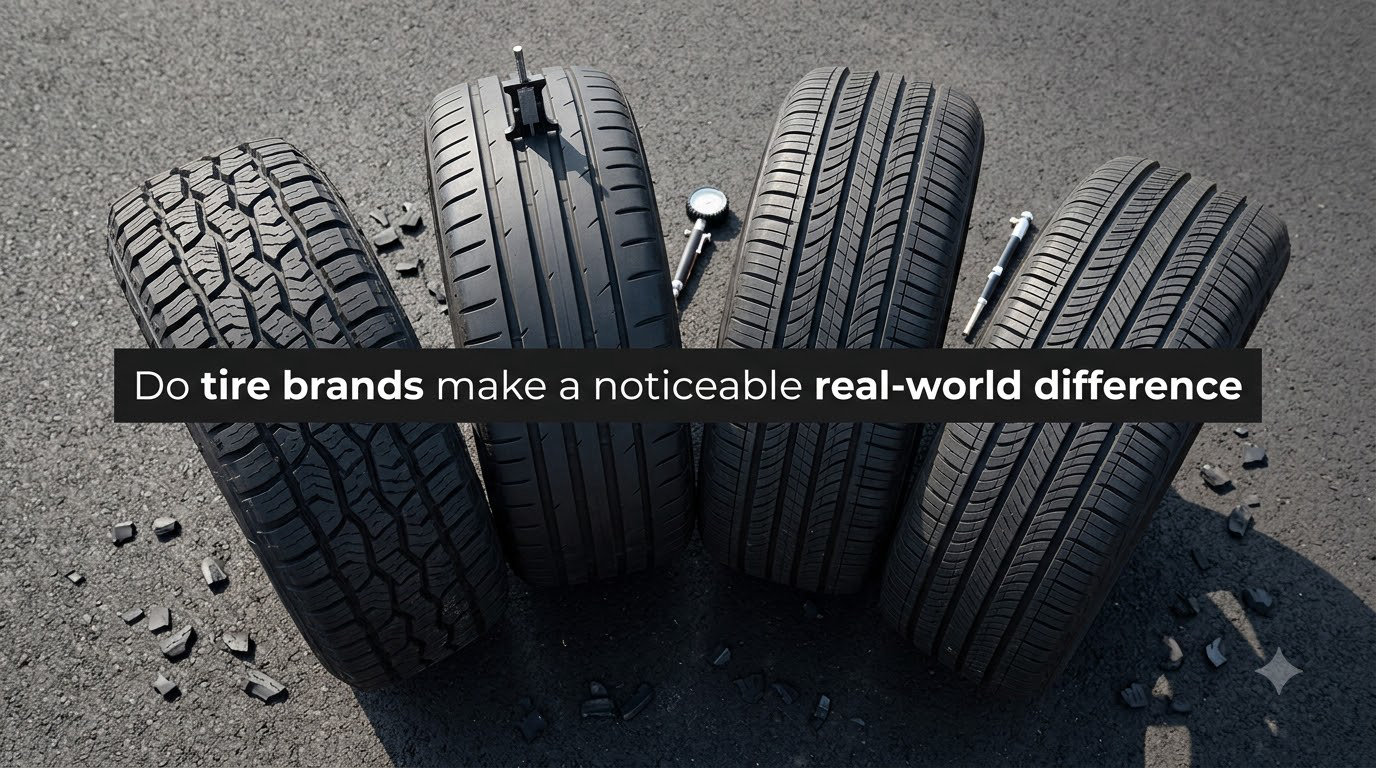
If you’ve ever stood in a tire shop staring at a wall of options and wondered whether the price gap is engineering or marketing, you’re asking the right question. Yes, tire brands make a noticeable real-world difference — but not always in the way shoppers expect.
I’ve spent the last several weeks digging through independent tire tests from Tire Rack and Consumer Reports, reading hundreds of owner reviews on Reddit’s r/tires and r/MechanicAdvice, and comparing warranty terms and manufacturing details across the major manufacturers. What follows is the honest answer, with the numbers to back it up.
The short version: do tire brands make a noticeable real-world difference? Absolutely. The gap between a budget tire and a premium tire in a 50-tire braking test was roughly 30 feet on dry pavement and 47 feet on wet pavement at highway speed — that’s two car lengths. But the more useful answer is that mid-range tires from brands like Continental, General Tire, Hankook, and Cooper often deliver 85-90% of a premium tire’s performance for noticeably less money, and that’s where most everyday drivers should be shopping.
Table of Contents
Quick Answer: Do Tire Brands Make a Noticeable Real-World Difference?
Yes, tire brands make a noticeable real-world difference because rubber compounds, tread designs, internal construction, and quality-control standards vary widely between manufacturers. In independent wet-braking tests, the gap between the best and worst tires in a single size can exceed 50 feet at 60 mph — often the difference between a controlled stop and a collision. The brand on your sidewall is a real signal of engineering investment, manufacturing consistency, and warranty support.
What Actually Changes Between Tire Brands
Tires look almost identical from five feet away, so it’s reasonable to assume they’re basically the same product. They aren’t. Three engineering choices drive nearly every performance difference you’ll feel on the road.
Rubber Compound
The tread compound is where premium brands spend their research dollars. A premium tire might use five or six different rubber blends layered across the tread — a sticky silica-rich compound on the outside for grip, a stiffer compound on the inner shoulder for cornering, and a wear-resistant base layer underneath. Budget tires typically use one or two off-the-shelf compounds.
That chemistry shows up where it matters. Softer, high-silica compounds grip better in cold and wet conditions but wear faster. Harder compounds last longer but lose grip below 40°F. Premium brands balance both; budget brands usually optimize for one and ignore the other.
Tread Design
Look at a premium all-season tire and a budget all-season tire side by side. The premium tire has more sipes (the small slits in the tread blocks), more varied block shapes, and often asymmetric or directional patterns engineered to evacuate water. The budget tire usually has fewer sipes and simpler block shapes because simpler molds are cheaper to produce.
Those sipes and channels are what resist hydroplaning. In a 50-tire comparison test, the worst-performing budget tires needed 47 more feet to stop from 60 mph on wet pavement than the best premium tires. That’s almost entirely a tread-design story.
Internal Construction
Inside the tire, a premium product uses two or more steel belts, a polyester carcass ply, and a nylon cap ply that stabilizes the tread at highway speed. Budget tires may use a single steel belt, lighter-gauge polyester, and skip the nylon overlay entirely. The result is softer sidewalls that flex more under load, faster wear on the shoulders, and a less stable feel at 70+ mph.
Construction also affects rolling resistance. A well-built tire with tight ply tolerances can save a measurable amount of fuel over its life. A poorly built tire fights you every mile.
The Tire Tier Framework: Premium, Mid-Range, Budget
The tire market sorts itself into three loose tiers. Knowing which tier you’re shopping in lets you set the right expectations.
Premium Tier
Michelin, Bridgestone, Goodyear, Continental, and Pirelli lead this tier. These companies pour hundreds of millions into R&D, run their own proving grounds, and engineer compounds in-house. Their flagship all-season products — Michelin Defender, Continental TrueContact, Bridgestone Turanza — typically deliver the best wet braking, the longest real-world tread life, and the strongest warranties in their categories.
Mid-Range Tier
This is where most everyday drivers get the best value. General Tire, Cooper, BFGoodrich, Hankook, Kumho, Falken, Toyo, Yokohama, and Uniroyal sit here. These are often owned by the same parent companies as the premium brands (more on that below), but they sell simpler product lines with less aggressive compounds and shorter warranties. The performance gap from premium is real but small — usually 10-15% on the metrics most drivers care about.
Budget Tier
Douglas, Westfield, Telluride, Compass, AKS, and most private-label tires sold under Walmart, Discount Tire, or local-shop house brands occupy this tier. Some are rebadged mid-range products from reputable manufacturers — those are usually fine on a secondary vehicle. Others are genuine off-brands with limited testing and inconsistent quality control. The risk isn’t that every budget tire is bad; the risk is that you can’t tell which is which from the sidewall.
Where the Difference Actually Shows Up on the Road
Engineers can argue compounds and belts all day, but what matters is what you feel behind the wheel. Here are the four places brand choice produces real-world differences.
Wet Braking Distance
This is the single biggest gap between tire brands. In Tire Rack’s standardized 60-to-0 wet braking tests, the spread between the best and worst tires in a single size category routinely exceeds 40 feet. At highway speed, that’s the difference between stopping behind a stalled car and rear-ending it. Premium tires consistently land at the top of these rankings; budget tires consistently land at the bottom.
Tread Life
Manufacturer treadwear ratings are notoriously optimistic — every brand publishes a number and every brand overshoots it. Real-world tire tests tell a different story. Premium tires typically deliver 90-110% of their rated mileage. Budget tires often deliver 50-70% before the tread wears below the legal limit. A premium tire rated for 70,000 miles might actually go 65,000; a budget tire rated for 50,000 might be done at 32,000.
Road Noise and Ride Quality
Sidewall stiffness, tread block sequencing, and carcass construction all affect cabin noise. Premium tires use computer-modeled tread patterns that break up the harmonic frequency that creates the droning highway hum. Budget tires usually don’t. The difference on a long highway drive is the difference between arriving relaxed and arriving tired.
Cold-Weather Grip
Below 40°F, the rubber compound matters more than the tread pattern. Hard-budget compounds turn stiff and lose grip; premium compounds stay pliable. If you live anywhere with real winters, this is where brand choice matters most — and it’s also where the Three-Peak Mountain Snowflake (3PMSF) certification becomes relevant. The 3PMSF symbol means the tire has been independently tested and meets a defined snow-traction threshold. The older M+S (mud and snow) designation is a self-claimed label with no minimum performance standard, so it’s far less meaningful.
Brand Ownership Map: Who Really Makes Your Tire
Tire brand names are a little misleading. Most of the “different” brands on the shelf are owned by the same parent companies, sharing factories, technology, and in some cases entire product lines.
- Michelin Group owns Michelin, BFGoodrich, Uniroyal, and Riken. They share some plant capacity but run distinct product development.
- Goodyear Tire & Rubber owns Goodyear, Dunlop (in North America), Kelly, and Cooper Tires (acquired in 2021). Cooper and General Tire now operate together under Goodyear’s umbrella.
- Continental AG owns Continental, General Tire (in some markets), and Barum. General Tire in the U.S. operates as a sister brand to Continental with overlapping technology.
- Bridgestone Corporation owns Bridgestone, Firestone, and Fuzion. Firestone sits in the mid-range tier alongside Continental’s General Tire.
- Pirelli remains independent and focuses on premium and ultra-high-performance segments.
This matters because a mid-range General Tire or Cooper often shares more technology with its premium sibling than the brand badge suggests.
Per-Mile Cost: Why Premium Tires Are Often Cheaper Long-Term
The sticker shock of premium tires is real. The total cost over the life of the tire usually tells a different story.
Do the math on a typical commuter sedan driven 15,000 miles a year:
- A premium tire with a 70,000-mile rating and a higher upfront price per tire delivers roughly 0.29 cents per mile over its life.
- A mid-range tire with a 55,000-mile rating at a noticeably lower per-tire price delivers about 0.24 cents per mile — often the cheapest option per mile.
- A budget tire at the lowest per-tire price that actually delivers 32,000 real-world miles works out to roughly 0.28 cents per mile, similar to the premium tire but with worse wet grip and noise along the way.
Add in fuel economy (premium tires with lower rolling resistance can save a measurable amount per year), and the per-mile cost gap shrinks further. The mid-range tier almost always wins on cost-per-mile while delivering near-premium safety margins.
Which Tire Brand Tier Is Right for You
The right tier depends on how, where, and what you drive.
Daily Commuter Sedan or Hatchback
Shop the mid-range tier. Continental TrueContact, General Tire Altimax, Hankook Kinergy, Cooper Endeavor, and Kumho Solus deliver 85-90% of premium performance at 60-70% of the price. You’ll barely notice the difference in daily driving and you’ll save real money.
Truck or SUV Owner
Brand matters more here because of the weight and the towing loads. Look at premium and upper mid-range: Michelin Defender LTX, Continental CrossContact, Bridgestone Alenza, BFGoodrich Advantage, or Goodyear Assurance. For trucks that see dirt roads or light off-roading, all-terrain tires like the BFGoodrich All-Terrain or Toyo Open Country are worth the premium.
Performance or Sports Car
This is where premium pays off most clearly. Summer performance tires from Michelin (Pilot Sport), Continental (ExtremeContact), and Pirelli (P Zero) deliver grip levels budget tires can’t approach. On a 911, a Corvette, or even a hot hatchback driven hard, this is a safety conversation, not a comfort conversation.
Leased Vehicle
Most leases require the same tire brand and model on all four corners when you return the car, and many require tread depth above a set threshold (often 4/32″). Budget tires are fine here as long as they meet the lease terms. Just avoid mixing brands, which can violate the return agreement and trigger wear-and-tear charges.
EV Owner
Electric vehicles are heavier and deliver instant torque, which wears tires faster. EV-specific tires from Michelin (Pilot Sport EV), Continental (EcoContact), and Goodyear (ElectricDrive) carry reinforced sidewalls and lower rolling resistance to preserve range. If you don’t switch to an EV-specific tire, plan on replacing standard tires 20-30% sooner than the same tires on a gas car.
Tire Age, Cold-Weather Certification, and Other Buying Traps
A few details that don’t show up in marketing copy but matter in real life.
Check the DOT Date Code
Every tire has a DOT stamp on the sidewall ending in four digits: the week and year it was manufactured. “2624” means the 26th week of 2024. Rubber degrades slowly even when sitting on a shelf, and tires more than a few years old can have reduced grip before they ever touch pavement. Aim for tires manufactured within the last 12 months.
3PMSF vs M+S
If you deal with snow, the Three-Peak Mountain Snowflake (3PMSF) symbol is the one that matters. It’s awarded only after the tire passes an independent snow-traction test. The older M+S label is a self-declared designation with no minimum performance threshold — meaning a budget tire can slap M+S on the sidewall without any verification. Don’t confuse the two.
Brands Worth Avoiding
A handful of off-brands show up in owner reviews with recurring complaints about premature wear, inconsistent quality, and limited warranty support. The names change year to year, but the warning signs are the same: no published test data, no US-based customer support line, and warranty claims that require shipping the tire to an overseas office at your expense.
Mixing Brands
On a single replacement (one new tire to match three older ones), match the brand and model as closely as possible. Mixing brands across an axle is legal but compromises handling, especially in wet weather. All four tires should ideally be the same brand, model, and age.
Frequently Asked Questions
Is there really a difference in tire brands?
Yes. Independent testing from Tire Rack and Consumer Reports consistently shows significant performance differences in wet braking, tread life, noise, and cold-weather grip. The best and worst tires in a single size category can differ by more than 40 feet in 60-to-0 wet braking tests, often two car lengths or more at highway speed. Brand choice is a real engineering decision, not just a marketing label.
What is the 3% rule for tires?
The 3% rule is a maintenance guideline: tire pressure should be checked when the tire is cold and should not differ by more than about 3% between any two tires on the same axle. Larger pressure mismatches cause uneven wear, reduce wet grip, and hurt fuel economy. It is unrelated to which brand you buy, but it matters more on a budget tire because their construction is less tolerant of pressure variation.
Do more expensive tires really make a difference?
They do, but with diminishing returns. In Tire Rack tests, the gap between the best premium tire and a strong mid-range tire is usually 10-15%, while the gap between premium and the cheapest budget tire is 30% or more on wet braking. Most drivers shopping mid-range get nearly all the real-world safety benefit of premium without the top-end cost.
Will different brand tires make a difference?
Different brands will perform differently, especially in wet and cold conditions. What matters more than brand is matching the specific model to your priorities: a flagship mid-range tire often outperforms a budget tire from the same parent company. Buy by tested model, not by brand alone.
Are cheap tires dangerous?
Cheap tires are not inherently unsafe, but they are more likely to deliver poor wet braking, shorter real-world tread life, and louder highway ride. In standardized testing, the worst-performing budget tires routinely need 30-50 more feet to stop from highway speed on wet pavement than the best premium or mid-range tires. For a secondary low-mileage vehicle that is acceptable. For a family car driven daily, the risk-reward math usually favors at least mid-range.
Is it worth buying the most expensive tire?
Usually not. The flagship premium tire delivers measurable gains in wet braking and tread life over mid-range options, but most of those gains go unused unless you drive aggressively or in extreme weather. A mid-range tire from Continental, General Tire, Hankook, Cooper, or Kumho delivers roughly 85-90% of premium performance at 60-70% of the price, and that is the sweet spot for most drivers.
Are brand-name tires worth the extra cost?
Brand-name tires are worth the extra cost when you buy mid-range over budget, and not always worth the jump from mid-range to premium. Independent testing shows the biggest safety and longevity gains come from escaping the budget tier. Within the mid-range and premium tiers, the per-mile cost differences are small enough that your driving conditions, vehicle, and warranty preferences should drive the choice.
What is the cheapest tire worth buying?
The cheapest tire worth buying is a well-known mid-range model from a brand with published independent test results and a US-based warranty process. Names like General Tire Altimax, Cooper Endeavor, Hankook Kinergy, Kumho Solus, and Falken Sincera consistently outperform the cheapest private-label options in testing while staying close to them on price. Avoid no-name brands with no published test data and limited warranty support.
Does tire brand matter for a leased vehicle?
Yes, in two ways. First, most leases require the same brand and model on all four corners at return, so mixing brands can cost you money. Second, tires with shorter real-world tread life (most budget options) are more likely to fall below the lease return threshold (often 4/32 inch) before the lease ends, triggering charges. Mid-range tires with realistic 50,000+ mile real-world life are usually the safest lease choice.
Do tire brands matter for trucks and SUVs?
Brand matters more for trucks and SUVs than for passenger cars because of the higher vehicle weight, towing loads, and often larger contact patch. Premium and upper mid-range tires (Michelin Defender LTX, Continental CrossContact, Bridgestone Alenza, BFGoodrich Advantage, Goodyear Assurance) deliver noticeably better stability under load, shorter wet braking from heavier mass, and longer real-world tread life than budget options in the same size category.
Final Verdict on Tire Brands
So, do tire brands make a noticeable real-world difference? Yes — measurable, repeatable, and worth caring about. The smart move for most drivers is to skip the cheapest budget tier, look closely at the mid-range offerings from Continental, General Tire, Hankook, Cooper, Kumho, or BFGoodrich, and reserve the premium jump for cases where you genuinely drive in extreme conditions or push the vehicle hard.
Before you buy, check the DOT date code for tire age, look for the 3PMSF symbol if you deal with snow, and verify the specific model in independent testing rather than trusting the brand badge alone. The right tire for you is the one whose tested performance matches how, where, and how much you actually drive.