
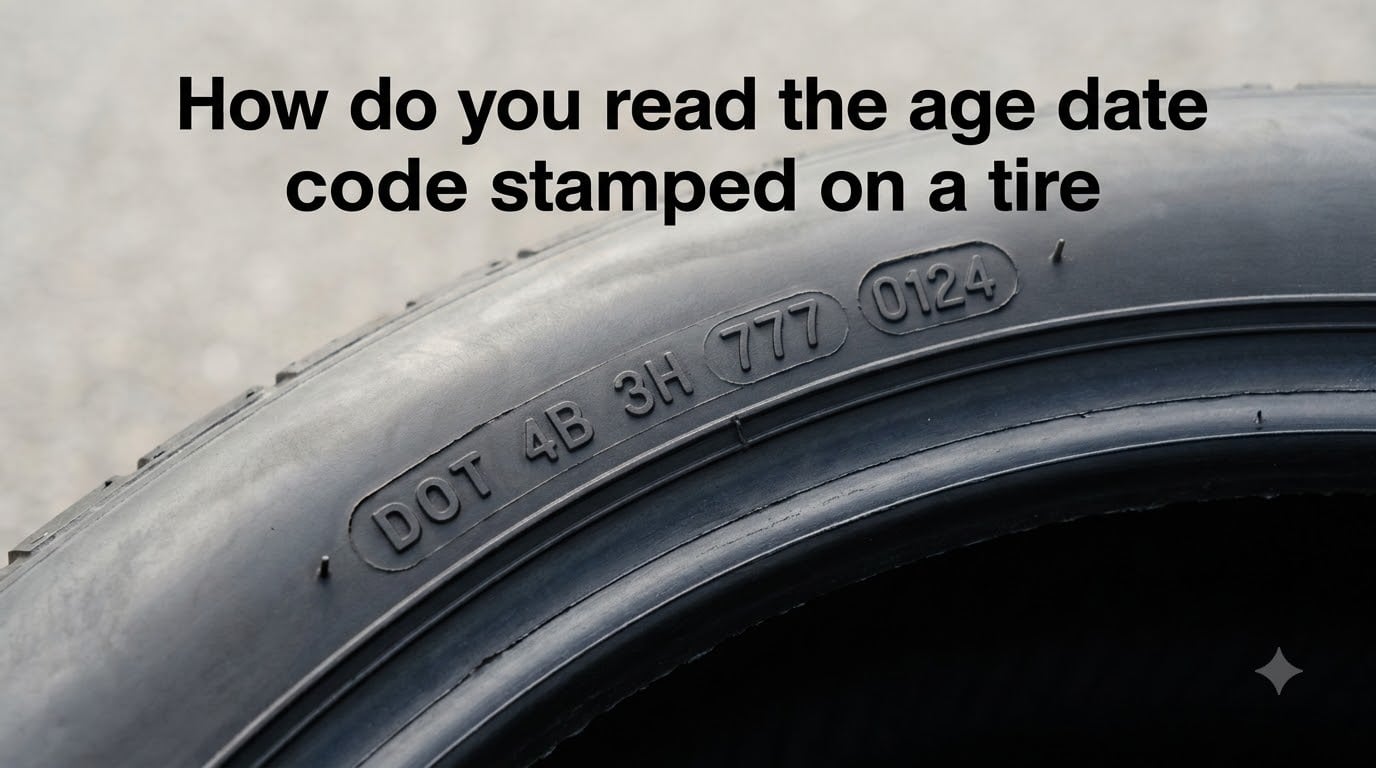
Learning how to read the age date code stamped on a tire takes about 30 seconds once you know where to look. Every tire sold in the United States carries a Department of Transportation code on its sidewall, and the final 3 or 4 digits tell you exactly when that tire was manufactured. Our team put this guide together because we keep hearing the same question from drivers: how do you tell if a tire is actually new, or just new to the shelf?
In the next few minutes, I’ll walk you through the full DOT code, show you where it’s hidden on a mounted tire, decode the date in plain English, and cover what to do when the number looks wrong. By the end, you’ll be able to glance at any tire and know its real age in seconds.
Table of Contents
Quick Answer: How to Read a Tire’s Age Code
The tire age date code is the last 3 or 4 digits of the DOT Tire Identification Number stamped on the sidewall. Since the year 2000, the format has been 4 digits where the first two are the week of manufacture (01 through 52) and the last two are the year. For example, 3815 means the tire was made during the 38th week of 2015. Tires made before 2000 used a 3-digit code where the last digit only indicates the year within its decade.
- Find the letters “DOT” on the tire sidewall, followed by a string of letters and numbers.
- Skip to the very end of that DOT string and read the last 4 digits.
- The first 2 of those 4 digits = week of the year (01-52) the tire was made.
- The last 2 of those 4 digits = the year (for example, 24 means 2024).
What Is the DOT Code and Tire Identification Number (TIN)?
The DOT stands for the U.S. Department of Transportation. Every tire made for sale in the U.S. must carry a DOT code proving it meets federal motor vehicle safety standards. The full string is called the Tire Identification Number, or TIN, and it can be up to 13 characters long.
Here’s what a typical TIN looks like, broken down into its parts:
DOT 2A B5C4 DE XXXX 3815
↑ ↑ ↑ ↑
| | | |
Compliance Plant Size Date code
mark code code (week + year)
From left to right, the TIN contains:
- DOT — the compliance mark showing the tire meets U.S. Department of Transportation standards.
- Plant code (2 or 3 characters) — identifies the specific factory where the tire was made.
- Tire size code (up to 4 characters) — a vendor-specific reference; the format varies by manufacturer.
- Manufacturer’s optional code — extra letters or numbers some brands add; ignore these for age purposes.
- Date code (3 or 4 digits) — the part that tells you when the tire was made.
Only the last group of digits matters for tire age. Everything before it is for tracking and compliance.
Where to Find the DOT Code on Your Tire
The DOT code is stamped on the tire’s sidewall, the rubber wall between the tread and the wheel rim. Look for the letters “DOT” sitting just before a string of numbers and letters, often set inside a raised oval outline. You can spot it by running your fingers across the sidewall until you feel that oval.
Here’s the catch that trips up most drivers: the full TIN is only required to appear on one sidewall. The opposite sidewall may show only the DOT mark, the plant code, and the size code — but not the date. And once a tire is mounted on a vehicle, the sidewall with the full TIN may face inward toward the suspension, leaving you staring at the short side.
To check the date on a mounted tire, try these steps:
- Crouch behind the tire and look at the side facing you. Check whether you can read “DOT” followed by a long string ending in 4 digits.
- If you only see the short side (DOT plus a partial code), use a flashlight and a small mirror to peek behind, or turn the steering wheel to rotate the tire slightly.
- As a last resort, the tire may need to be removed from the wheel for a clear reading.
When buying new tires at a shop, ask the installer to point out the DOT code on each tire before they go on the car. A reputable shop will show you without hesitation.
How to Read the Last Four Digits (Week + Year)
For any tire made from the year 2000 onward, the date is encoded in the final 4 digits of the TIN. Here’s the rule, plain and simple:
- First 2 digits = the week of manufacture, counting from 01 (the first week of January) through 52 (the last week of December).
- Last 2 digits = the year of manufacture, written as the last two digits of the calendar year (for example, 24 means 2024).
Here are some real decoded examples you’ll see in the wild:
| Date code | Week (first 2) | Year (last 2) | Manufactured |
|---|---|---|---|
| 3815 | 38th week | 2015 | Mid-September 2015 |
| 4714 | 47th week | 2014 | Late November 2014 |
| 2524 | 25th week | 2024 | Late June 2024 |
| 1217 | 12th week | 2017 | Late March 2017 |
| 0100 | 1st week | 2000 | First week of January 2000 |
You may also see a few extra letters or numbers after the 4-digit date. These are optional vendor codes — brand or line identifiers added by the manufacturer. Ignore them for age purposes; the 4-digit block is always the date.
One common point of confusion: some folks see a 5-character ending like 3815A or 2524L. Those trailing letters are not part of the date. Read only the first 4 characters.
How to Read a 3-Digit DOT Code (Tires Made Before 2000)
If a tire has only 3 digits at the end of its TIN, it was manufactured before the year 2000, when the current 4-digit format was introduced. The older format worked like this:
- First 2 digits = the week of manufacture (same as today, 01-52).
- Last digit = the year within the decade. The catch: the decade itself is not encoded.
For example, a code of 228 means the 22nd week of a year ending in 8. It could be 1988, 1998, or even 1978. There’s no way to know for certain without documentation.
There’s also a wrinkle with the very oldest tires: codes made in the 1970s used a slightly different layout where the decade is implied. Some tire collectors and restorers reference Rubber Manufacturers Association guides to narrow the window.
Safety warning: Any tire with a 3-digit date code is at least 25+ years old. The rubber has almost certainly hardened, micro-cracks may have formed in the sidewall, and the tire should be retired immediately, regardless of how much tread remains. Do not put a pre-2000 tire on a vehicle you intend to drive.
Reading the Manufacturer Plant Code and Tire Size Code
The characters between the DOT mark and the date code identify where and how the tire was made. While you don’t need these to determine age, they can be useful for recall verification and quality investigations.
The plant code is typically 2 or 3 letters and numbers identifying the specific factory. For example, “2A” might mean the tire came from a particular plant in Tennessee, while “B5C4” codes a different facility. These codes are assigned by the Department of Transportation and are publicly searchable through the NHTSA database.
The tire size code that follows is a vendor-specific reference. Unlike the standardized 4-digit date, the format varies by manufacturer. Some use 3 characters, others use 4, and a few use mixed letters and digits. This code links back to the manufacturer’s internal tracking for materials, batch, and production run.
If you ever need to confirm a recall, copy the entire TIN (everything after “DOT”) and enter it into the NHTSA tire recall lookup tool at nhtsa.gov. The system will tell you whether that specific tire, from that plant, in that size, is part of any active recall campaign.
What About the Colored Dots Near the DOT?
You’ll sometimes see a small red, yellow, or white dot stamped near the DOT code on a brand-new tire. These are not date codes and they don’t affect tire age.
The red dot marks the high point of the tire — where the tire is heaviest or most out of round. Mounting technicians align this dot with the lowest point on the wheel (marked by a yellow dot on the rim) to minimize vibration.
The yellow dot indicates the lightest point of the tire. When present without a matching red dot, it serves the same balancing purpose.
Some tires also carry a white dot marking the tread’s high point, used during uniformity checks at the factory. None of these relate to manufacture date.
Why Tire Age Matters: Safety and Replacement
Even when a tire has plenty of tread left, the rubber itself degrades over time. UV light, heat cycles, ozone, and humidity slowly break down the polymers that give the tire its flexibility. The result is hardening, micro-cracks in the sidewall known as dry rot, and a higher risk of sudden blowout — especially at highway speeds.
Most tire manufacturers and the Rubber Manufacturers Association recommend replacement after 6 to 10 years, regardless of remaining tread depth. Some brands, like Michelin, advise closer inspection after 5 years and replacement by 10 years no matter what the tread gauge says. Check your specific tire manufacturer’s published guidance for the exact window.
The DOT date code lets you apply this rule objectively. Add the year and week to today’s calendar and you’ll know the tire’s exact age. A tire stamped 3815 is now a decade old and should be inspected immediately if still in service.
Beyond the age threshold, watch for these physical warning signs that a tire has aged out:
- Cracks or fissures in the sidewall rubber, even hairline ones.
- A dull, gray, or faded appearance on what should be deep black rubber.
- Uneven hardening that makes the tire feel “plastic” rather than supple.
- Visible bulging or blistering on the tread or sidewall.
For recalls, every TIN can be checked through the NHTSA recall lookup tool at nhtsa.gov/recalls. The system ties the plant code, size code, and production week to specific recall campaigns. Running a tire’s full TIN takes about a minute and can catch a known defect before it becomes a roadside emergency.
Practical Tips: Buying New and Used Tires
Whether you’re shopping for a fresh set or inspecting a used vehicle, the DOT code is your best friend. Here’s a quick checklist our team uses when evaluating tires at the point of purchase:
- Check all four tires individually. Mismatched production dates on a single vehicle can signal uneven wear or a partial replacement.
- Aim for tires less than 18 months old from the date code. Rubber begins a slow decline the moment it leaves the factory, even when stored properly.
- Refuse any pre-2000 (3-digit code) tire. The rubber is too old to trust, no matter how good the tread looks.
- Inspect the DOT on the inner sidewall before mounting. A reputable shop will let you see the full TIN on every tire before installation.
- Ask for NHTSA recall clearance. Run the full TIN through the NHTSA lookup at nhtsa.gov before signing off on the sale.
- Check the spare tire too. Spare tires often sit untouched for 10+ years and age out well before they’re ever used.
- Document the date code at purchase. Snap a photo of each tire’s DOT code for your records, especially for warranty claims.
For used vehicles, the same checklist applies but with extra urgency. A 10-year-old tire on a used car might look fine in the lot’s lighting but could have dry rot setting in. Always inspect in daylight with a flashlight if needed.
Frequently Asked Questions
How long are tires good by date code?
Most tire manufacturers and the Rubber Manufacturers Association recommend replacing tires after 6 to 10 years from the date code, regardless of remaining tread depth. Some brands advise closer inspection after 5 years and replacement by year 10 as a hard rule.
Can a 20 year old tire still be good?
A 20-year-old tire should not be used regardless of tread depth. The rubber has almost certainly hardened, sidewall cracking is likely, and blowout risk is high. Tires with any age-related cracking visible on the sidewall should be replaced immediately.
How to read a 3 digit DOT code?
A 3-digit DOT code means the tire was made before 2000. The first 2 digits are the week (01-52) and the last digit is the year within the decade. The actual decade is not encoded, so a code like 228 could be 1978, 1988, or 1998. Any pre-2000 tire should be retired immediately.
Is it okay to buy 2 year old new tires?
Yes, tires up to about 2 years old are generally fine to buy, provided they have been stored properly in a climate-controlled warehouse. Aim for under 18 months when possible. The DOT date code tells you the factory age; check tread depth, sidewall condition, and storage history before buying.
Are 7 year old tires too old?
Seven-year-old tires are approaching the replacement window. Many manufacturers recommend inspecting them closely for sidewall cracking and replacing them by year 10 regardless of tread. If the tires show any signs of dry rot or hardening, replace sooner.
Is a tire from 2017 still good?
By today’s calendar, a tire with a 2017 date code is 8 to 9 years old. That puts it at or past the typical replacement window. Have it inspected by a tire professional for sidewall cracking and tread separation, and plan to replace it soon even if tread looks adequate.
Conclusion
Knowing how to read the age date code stamped on a tire puts real safety information at your fingertips in seconds. The last 4 digits of the DOT Tire Identification Number tell you the exact week and year your tire was made, and the answer to whether that tire is still safe to drive. Check every tire you own, every tire you buy new, and every tire on a used vehicle you’re considering. When in doubt, run the full TIN through the NHTSA recall lookup and have a tire professional inspect for dry rot and sidewall damage.