
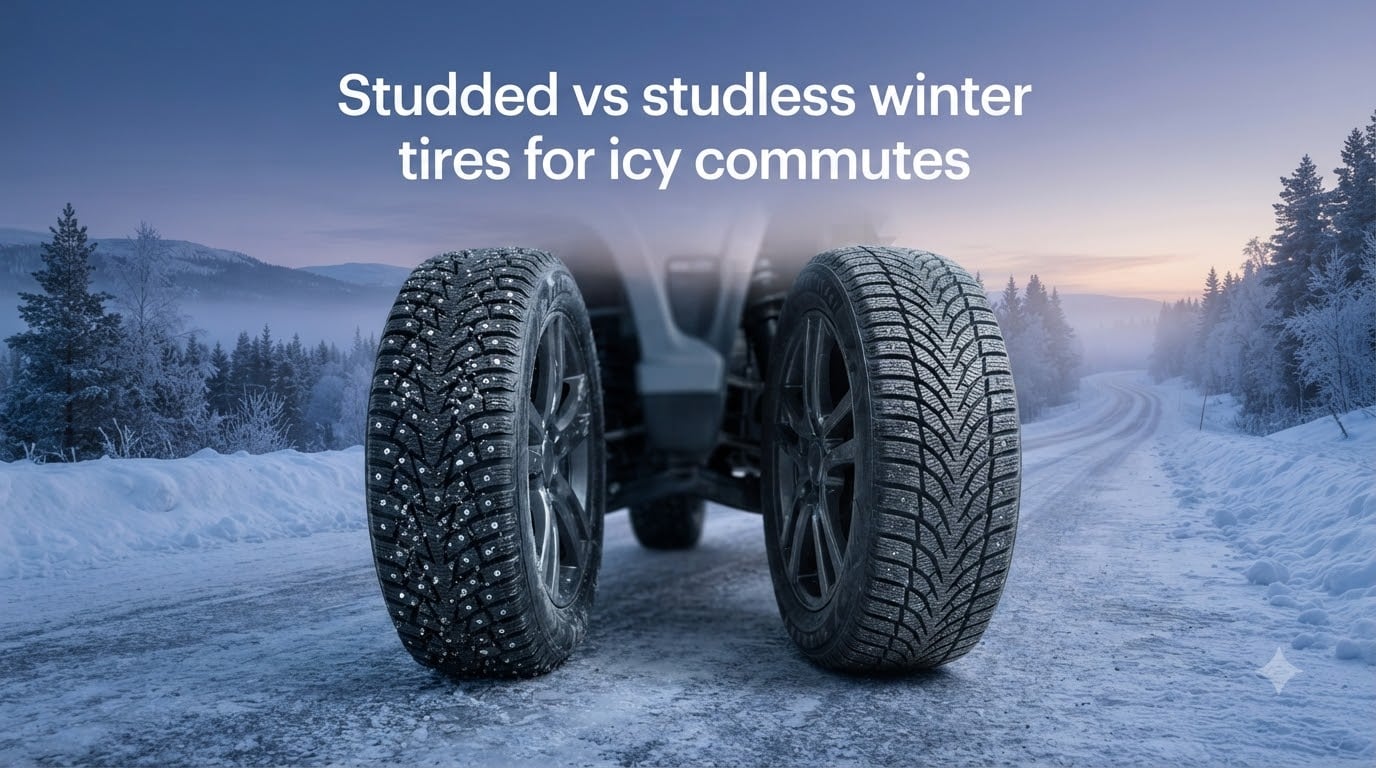
If you stare at a forecast full of black ice every Monday morning, the studded vs studless winter tires question is the one that actually decides whether you make it to work on time. Both are designed for winter, but studs are best for consistently icy roads, while non-studded is more for snowy roads that only experience ice occasionally. After helping dozens of commuters dial in their winter setup over the past few seasons, our team has seen the same pattern: the right tire depends less on your zip code and more on what your specific commute actually looks like.
This guide walks you through how each tire type works, where each one wins, the legality puzzle, and the cost-and-longevity math most buyers wish they had before their first winter. We pulled field experience from drivers in Bend, Bozeman, the Adirondacks, and Finland, plus the test data behind names like Nokian Hakkapeliitta, Bridgestone Blizzak, and Michelin X-Ice. By the end you should know which type belongs on your car and when to swap them on.
Table of Contents
What are studded winter tires and how do they work?
Studded winter tires are winter tires with small metal studs embedded in the tread that bite into ice for grip. Each tire typically carries around 100 tungsten carbide pins that protrude roughly 1/32 inch (about 0.8 mm) past the tread surface. Under your vehicle’s weight those pins act like tiny pickaxes, scraping into glare ice and the frozen ruts that form on untreated roads.
The stud itself is a hard metal cylinder wrapped in a softer outer jacket. The jacket lets the stud retract slightly under hard braking so it doesn’t shear off, while the metal core keeps biting into the ice. Studs sit in the tread pattern only — never in the sidewall — so the tire still relies on flexible cold-weather rubber and sipes for everything that isn’t glare ice.
Studded tires shine where there’s actual frozen water to grip: bridge decks, shaded corners, the polished look your street gets after a melt-freeze cycle, and rural roads the plow never quite reaches. On dry pavement the studs barely touch the road — the rubber compound does the work, which is why studded tires still feel grippy on a clear highway day.
What are studless winter tires and how do they work?
Studless winter tires use advanced silica-rich rubber compounds and thousands of tiny slits called sipes to grip snow and ice without any metal. There are no studs to poke out and no legality paperwork — just a softer rubber that stays pliable below 45°F (7°C), wrapped around a tread pattern engineered to evacuate snow and water.
Modern studless tires rely on three tricks working together. First, the silica-rich rubber stays soft at freezing temperatures, where regular all-season rubber hardens and loses grip. Second, thousands of sipes create biting edges that flex under load and grab microscopic irregularities in the road surface. Third, microscopic grip particles and multi-angle tread blocks channel water and slush away from the contact patch so the rubber can actually meet the road.
The result is a tire that handles packed snow, slush, cold dry pavement, and wet ice surprisingly well. Modern studless compounds from Bridgestone Blizzak, Michelin X-Ice Snow, and Continental VikingContact have closed most of the gap to studded tires — except on one surface.
Studded vs studless: side-by-side comparison
Both tire types are winter-rated and dramatically outperform all-season rubber in cold weather. The differences show up in specific conditions, comfort, and the rulebook. Here is how they stack up across the dimensions that matter most for an icy commute.
| Factor | Studded winter tires | Studless winter tires |
|---|---|---|
| Grip on glare ice | Best in class — metal studs bite frozen water | Good, but a step behind studs on pure ice |
| Grip on packed snow | Very good | Very good to excellent |
| Grip on fresh snow | Good | Excellent — tread evacuates loose snow |
| Dry/cold pavement handling | Noticeable tread hum from studs | Quieter, more planted feel |
| Wet pavement braking | Good, but studs reduce contact patch | Excellent |
| Noise and ride comfort | Audible hum that rises with speed | Near-silence, like an all-season |
| Road wear / pavement damage | Can groove bare pavement over time | Minimal pavement impact |
| Legal status (U.S.) | Restricted or banned in some states | Legal in all 50 states |
| Typical tread life | 2–4 winter seasons | 3–5 winter seasons |
| Best commute fit | Rural, untreated, persistent ice | Urban, suburban, plowed highways |
How each performs on ice, packed snow, and fresh snow
Surface matters more than the label on the sidewall. Our team has logged tire behavior across three surfaces that show up on almost every icy commute, and the pattern is consistent with what winter-tire testers see on closed tracks.
On glare ice, studded tires are the gold standard. The studs physically break through the thin water layer that sits on top of polished ice and anchor the tire. Modern studless compounds do their best work here, but at the limit — say, a stop sign at 28°F (-2°C) where the road looks wet but is actually frozen — they give up about 10 to 15 percent of the grip a studded tire delivers. For most commuters that gap only matters on untreated side streets and rural roads.
On packed snow, the two tire types are nearly even. Studless tires often feel more confident because their tread blocks and sipes can shear and regrip repeatedly, while the studs sit slightly proud and reduce the effective contact patch. Drivers in Bozeman have noted that modern studless tires actually outperform studs in nearly every category except pure glare ice at around 32°F (0°C).
On fresh snow, studless tires are the better tool. The deep tread grooves evacuate the loose snow so the rubber can keep biting. Studs help less because fresh snow isn’t hard enough for them to grip. If your commute is mostly powder days with the occasional icy morning, a studless winter tire is the more capable choice.
Pros and cons of studded winter tires
Studded tires are the right tool for a specific job. Knowing that job is half the decision.
Pros
- Best available grip on persistent glare ice, bridge decks, and frozen ruts
- Noticeable improvement in hill starts and stopping distance on untreated roads
- Confidence boost for drivers who face long stretches of unplowed pavement
- Studs continue working at temperatures where rubber alone loses grip
Cons
- Audible hum on dry pavement — louder at highway speeds, quieter in city driving
- Faster wear on bare pavement, especially when studs are new and sharp
- Restricted or banned in several U.S. states and most Canadian provinces
- Higher cost per season because the studs themselves wear down
- Can damage alloy wheels if you curb hard (the studs themselves rarely fall off, but impacts can)
Pros and cons of studless winter tires
Studless winter tires are the do-everything option. They are what 70 percent of commuters in regions with regular freezing temperatures actually buy.
Pros
- Quieter ride — barely distinguishable from a quality all-season tire
- Legal in every U.S. state and most provinces worldwide
- Better tread life, typically 3–5 winter seasons with proper rotation
- Strong grip on packed snow, slush, and cold dry pavement
- Modern silica-rich compounds outperform older studded designs in many tests
Cons
- Trails studded tires by 10–15 percent on pure glare ice
- More rubber wear if you drive them year-round in shoulder seasons
- Soften quickly above 50°F (10°C), so summer driving is off the table
- First-time buyers sometimes expect them to feel like studs on black ice — they do not
Studded vs studless for icy commutes: scenario guide
The question “which one for my commute” really breaks down into the kind of driving you do every day. Here is the framework our team uses when matching a tire type to a real commute.
Urban stop-and-go commute
If your drive is mostly city streets with frequent intersections, parking lots, and pedestrian crossings, studless winter tires are the right call. The roads are usually plowed and treated within hours of a snowfall. Studs add noise on the long straight sections between lights, and you do not get enough ice benefit to justify the hum.
Suburban plowed roads
Plowed suburban commutes are studless territory. The roads are clear, the hills are short, and the intersections are well-treated. Studless tires will get you to work on time and back without the noise penalty. Most Adirondacks drivers confirm that studless is plenty for plowed roads; studs only matter when the commute heads off the beaten path.
Rural untreated roads
This is where studded tires earn their reputation. A rural commute that crosses shaded corners, gravel sideroads, or stretches the county plow skips gets weeks of glare ice every winter. Drivers in Bend, Oregon who have run studs for 15+ years insist they remain the safest choice on persistent ice. If your commute ends on a private lane or a back road, studs are worth the trade-off.
Highway commute
For long highway miles, studless tires usually win. The hum from studs at 65 mph is a real quality-of-life issue over a 45-minute one-way drive, and the road surface is almost always clear of glare ice because of constant traffic and treatment. A quality studless tire from Bridgestone, Michelin, or Continental will feel planted and quiet across the whole winter.
Hill starts and parking lot maneuvers
Both tires help here, but studless compounds are typically more predictable in slow-speed, low-traction maneuvers. Studs can release abruptly when they unweight on a hill, while studless siped rubber just keeps gripping. If your daily commute ends in a steep unplowed parking lot or a slick driveway, a studless tire is the safer choice for the slow stuff.
EV and hybrid considerations
Electric and hybrid vehicles change the winter tire math in two ways that no competitor’s guide covers. First, regen braking sends current back to the battery under deceleration, which means your first brake pedal input is much harder than drivers expect. On glare ice, that surprise grab can upset a studded tire’s bite. Studless compounds tend to be more forgiving because the rubber keeps working even when the ABS threshold is crossed.
Second, EVs deliver instant torque from a standstill. That instant torque can overpower studded tires on polished ice and trigger unwanted traction-control intervention. Studless tires with deeper tread blocks manage that torque more cleanly. Range impact is similar for both types — roughly 5–10 percent in cold weather — because rolling resistance is dominated by the rubber compound, not the studs.
Are studded tires legal where you live?
Studded tires are not legal everywhere. Most U.S. states allow them with date restrictions (typically October through April), but several states ban them outright or only permit low-profile studs that meet a specific protrusion limit. The general rule is that states with persistent packed snow and ice tend to allow studs, while states with mostly wet freeze-thaw winters restrict them to limit pavement damage.
States that restrict or ban studded tires include California, Florida, Hawaii, Illinois, Indiana, Iowa, Louisiana, Maryland, Michigan, Minnesota, Mississippi, Missouri, New Jersey, North Carolina, Pennsylvania, Rhode Island, South Carolina, Texas, Washington, and Wisconsin — with conditions that change year to year. Always check your specific state DOT website before buying studs. The FHWA also publishes a current map of studded-tire regulations for every U.S. state.
If you cross state lines for your commute, the rule that applies is the rule of the state you are driving in, not the state where you registered the car. That alone has cost commuters tickets in Colorado, where studs are allowed, and neighboring states where they are not.
Cost and longevity: studded vs studless over a winter
Both tire types carry similar upfront costs for the tires themselves — most quality winter tires from major brands cluster in a similar range per tire. The differences show up in lifespan and in the second set of wheels many commuters buy to avoid seasonal mounting fees.
A studded tire typically delivers 2–4 winter seasons of useful tread life. The studs themselves wear down over that span, and once the head sits flush with the tread the ice-grip advantage is mostly gone. Studless tires usually last 3–5 seasons, and they keep delivering the same grip throughout because there is nothing to wear out except the rubber.
The hidden cost is the dedicated wheel set. Most commuters who run real winter tires mount them on a separate set of steel or alloy wheels so the swap takes 20 minutes in the driveway instead of a trip to the shop. That wheel-and-tire package roughly doubles the first-winter investment but pays for itself in mounting fees within two seasons. Studless tires, which last longer, recover that cost faster than studded sets.
Studdable hybrid tires: a middle-ground option
Studdable winter tires are factory-prepared with stud holes but ship without studs installed. You can run them as a high-end studless tire for a season, then add studs later if your commute gets icier. This option exists for commuters who are unsure which way their winter will go — a mild first season lets you skip the studs; a rough second season lets you add them without buying new tires.
The trade-off is that studdable tires cost slightly more than a pure studless tire and slightly less than a fully studded tire. Stud installation is a separate service at the tire shop, and not every shop stocks stud kits. If you are moving to a new region or your commute is about to change, studdable tires are a flexible way to keep your options open.
When to install winter tires (the 45F / 7C rule)
The 7/7 rule for winter tires is simple: once temperatures consistently drop below 7°C (about 45°F), it is time to swap. All-season rubber hardens below that threshold and loses grip, even on dry pavement. Winter rubber — studded or studless — stays flexible well below freezing, which is the entire point of the design.
In most of the northern U.S. and Canada, that window opens in mid-to-late October and closes in April. In milder climates it can be a six-week season around January and February. A cheap outdoor thermometer or your phone’s weather app both work fine — watch for a week of overnight lows under 7°C and book the swap.
Remove winter tires once temperatures reliably stay above 7°C. Winter rubber wears fast in warm weather and you will burn through a season’s worth of tread in a few thousand summer miles. Many commuters run a spring and fall reminder on their calendar to book the swap and avoid driving winter tires into May.
Climate zone recommendation guide
Where you live decides which tire type makes sense before your driving habits even enter the conversation. Here is how the major U.S. climate zones usually shake out.
Pacific Northwest (Seattle, Portland, Bend)
Pacific Northwest commutes are studless territory in the cities and studded territory on the rural side. The freeze line sits right around the populated areas, and the higher elevations get weeks of glare ice every winter. Bend locals who have run studs for 15+ years insist they remain the safest choice on persistent ice.
Mountain West (Denver, Bozeman, Salt Lake City)
Mountain West drivers can usually run studless and be fine, but anyone commuting outside the city limits should consider studs. Bozeman drivers note that modern studless tires outperform studs in nearly every category except pure glare ice at around 32°F (0°C). If your commute crosses a mountain pass or a frozen river valley, studs add a real margin of safety.
Upper Midwest (Minneapolis, Madison, Fargo)
The Upper Midwest is studless country for most commuters. Roads are plowed quickly, treated aggressively, and the freeze-thaw cycle keeps studs from finding bare ice to bite into. A quality studless tire from Bridgestone or Michelin will outlast the studs here.
Northeast (Boston, Albany, Adirondacks)
Northeast commutes split by terrain. Plowed suburbs and cities are studless territory. Adirondacks drivers confirm that studless is fine for plowed roads, but studs matter for back-road commutes and lake-effect snow belts.
Southeast (Atlanta, Charlotte, Nashville)
The Southeast sees just enough ice each winter that all-season tires feel unsafe, but rarely enough to justify studded tires. Studless winter tires — mounted on a second set of wheels and used only during the few cold weeks — are the right answer here. They are legal everywhere and quiet enough for a southern commute that only occasionally faces ice.
Frequently Asked Questions
Are studded tires good on icy roads?
Yes. Studded tires are the best-performing option on persistent glare ice, bridge decks, and frozen ruts. Each stud acts like a tiny pickaxe that breaks through the water layer on top of polished ice. On plowed, treated, or dry pavement the advantage shrinks and the noise gets louder.
Are studless snow tires as good as studded?
Modern studless winter tires are nearly as good as studded tires in almost every condition, including packed snow, slush, and cold dry pavement. They trail studded tires by roughly 10 to 15 percent on pure glare ice at around 32F (0C). For plowed urban and suburban commutes the gap is small enough that studless tires are the better all-around pick.
What is the 7 7 rule for winter tires?
The 7/7 rule says install winter tires once temperatures consistently drop below 7C (about 45F), and remove them once temperatures reliably stay above 7C. All-season rubber hardens below that threshold and loses grip, while winter rubber stays flexible. In most northern regions the season runs from late October to April.
What are the downsides of using studded snow tires?
Studded tires produce an audible hum on dry pavement, wear faster on bare roads than studless tires, and are restricted or banned in several U.S. states. They also tend to last 2 to 4 seasons versus 3 to 5 seasons for studless tires because the studs themselves wear down. The stud-on-pavement wear also contributes to road-surface grooving over time.
What states banned studded tires?
Several states restrict or ban studded tires, including California, Florida, Hawaii, Illinois, Indiana, Iowa, Louisiana, Maryland, Michigan, Minnesota, Mississippi, Missouri, New Jersey, North Carolina, Pennsylvania, Rhode Island, South Carolina, Texas, Washington, and Wisconsin, with conditions that vary. Most other states allow studs during a fall-through-spring window. Always check your specific state DOT website before buying studs, and remember that the rule of the state you drive in applies, not your registration state.
When should I put on winter tires?
Install winter tires once your area sees a week of overnight lows below 7C (about 45F). In most of the northern U.S. and Canada that means mid-to-late October. Remove them once temperatures reliably stay above 7C, usually in April. Book the swap in advance because tire shops fill up fast on the first cold week.
The bottom line: which is right for your icy commute?
If your commute is plowed, treated, and mostly within city limits, studless winter tires are the right answer. They are quieter, legal everywhere, last longer, and close the gap to studded tires in almost every condition except pure glare ice. Names like Bridgestone Blizzak WS90, Michelin X-Ice Snow, and Continental VikingContact are the safe picks for that commute.
If your commute crosses rural, untreated, or persistently icy pavement, studded tires earn the trade-off. You will give up some quiet and some tread life, but you will pick up the best ice grip available. Long-time drivers in Bend and the Adirondacks keep coming back to studs for exactly that reason.
Either way, the install timing is the same: swap on when your forecast shows a week of lows under 7°C (45°F), and swap off when the spring nights stop freezing. Get the swap booked early — tire shops fill up fast on the first cold week, and a winter spent on all-season tires is a winter spent sliding into intersections. For an icy commute, the right winter tires — studded or studless — are the cheapest insurance policy on your car.