
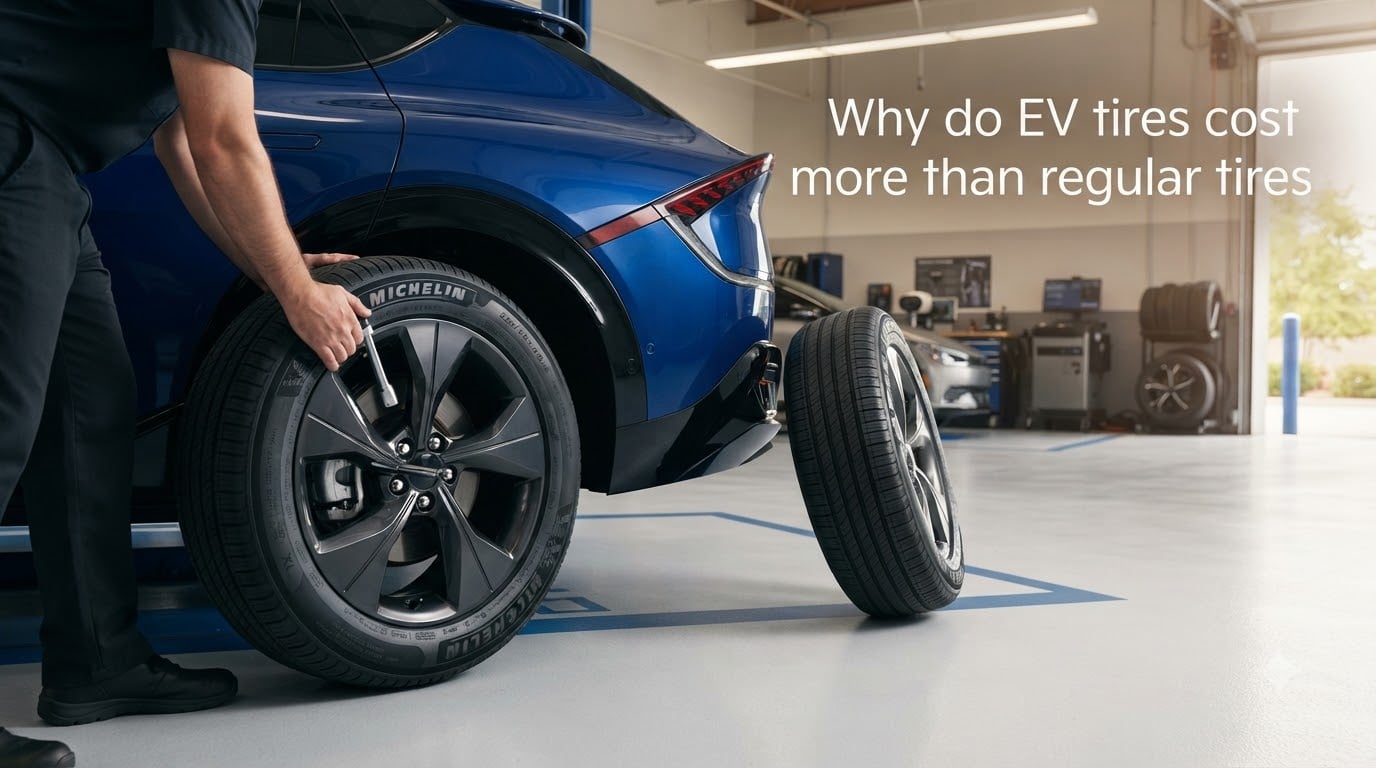
If you’ve ever shopped for tires for a Tesla, Rivian, or Mustang Mach-E, you’ve probably noticed the price tag. EV tires cost more than regular tires for clear engineering reasons: they’re built with reinforced sidewalls, premium rubber compounds, low-rolling-resistance designs, and often acoustic foam to keep an already quiet cabin even quieter. Layer on smaller production volumes, premium brand positioning, and the R&D cost of designing for instant torque, and you end up paying roughly 50% more per tire than for a comparable gas-car tire.
In this guide, I’ll break down exactly where that extra cost comes from, why EV tires wear faster than regular tires, whether you really need EV-specific rubber, and how to make your EV tires last longer. I’ll also answer the most common questions I hear from EV owners and hybrid drivers shopping for replacements in 2026.
Table of Contents
Why Are EV Tires More Expensive Than Regular Tires?
EV tires cost more because they solve a different engineering problem than a regular tire. A gasoline car’s tire just needs to handle a roughly 3,500-pound vehicle, provide wet grip, and last 50,000 miles. An EV tire has to support a 4,500- to 6,000-pound vehicle, survive instant electric torque, sip energy to preserve driving range, and hush road noise that an internal-combustion engine used to mask.
Six cost drivers explain the gap:
- Specialized rubber compounds. EV tires use silica-rich, low-rolling-resistance tread compounds that cost more to source and blend than standard all-season compounds.
- Reinforced sidewalls and construction. Extra ply layers, aramid or nylon reinforcement, and stiffer sidewalls handle heavier battery weight. More material per tire means a higher bill of materials.
- Acoustic foam. Many EV tires have polyurethane foam liners bonded inside the carcass to dampen road noise. The foam adds material cost and makes the tire more difficult to repair.
- Lower production volumes. EV-specific tires are still a fraction of total tire production. Smaller runs mean per-unit R&D and tooling costs aren’t spread as thin as they are for a mass-market all-season.
- R&D amortization. Designing a tire that handles 700 lb-ft of instant torque, regenerates braking force cleanly, and meets an automaker’s range target takes years of engineering. That cost is baked into the selling price.
- Larger OEM wheel diameters. Most new EVs ship on 19-, 20-, or 21-inch wheels. Larger diameter tires use more rubber and rare raw materials, so the same technology costs more at 20 inches than it does at 17.
Industry data from AlixPartners puts the math bluntly: EV tires cost roughly 50% more than comparable ICE tires and wear out about 20% faster. That’s the double hit every EV owner eventually feels at the tire shop.
How EV Weight and Reinforced Construction Drive Cost
The single biggest reason EV tires cost more is weight. A Tesla Model Y weighs about 4,400 pounds. A Ford F-150 Lightning tips past 6,000. That mass sits directly on four small contact patches.
To handle it, EV tires carry higher load indices (often 104+ for crossovers and 116+ for trucks) and use stiffer, reinforced sidewalls. You can see the difference by looking at the sidewall: an EV tire usually has two- or three-ply sidewalls with aramid or hybrid reinforcement, where a regular all-season might have a single polyester ply.
That extra material and engineering costs money. It also changes how the tire drives: stiffer sidewalls mean sharper turn-in but a slightly harsher ride over potholes. Manufacturers tune the construction carefully so the tire still feels compliant on rough roads while supporting the battery pack without flex damage.
If you tow with an electric truck or carry heavy loads in an EV SUV, this reinforced construction is doing real work. Skimping on load rating is one of the fastest ways to overheat a tire and end up with a blowout on the highway.
Instant Torque and the Engineering It Demands
EVs deliver maximum torque from zero RPM. A dual-motor Model Y can push 700 lb-ft to the wheels the instant you tap the accelerator. A gas engine has to rev up to its torque peak, which gives the tire a moment to find grip.
EV tires are engineered with stickier tread compounds and reinforced internal structures specifically to handle that shock load. Without it, the tread face would scrub off in tens of thousands of miles instead of lasting a reasonable service life. The rubber chemistry that resists this kind of breakaway wear costs more than a basic all-season compound.
If you drive your EV like a sensible commuter, you’ll see normal wear. If you launch hard at every green light, even a premium EV tire will struggle. The tire isn’t the weak link because it’s under-engineered; it’s working exactly as hard as the rest of the drivetrain.
Low Rolling Resistance and Range Optimization
Range is the EV owner’s obsession, and tires are the single biggest drag factor at highway speed. Low rolling resistance tires can add 5-10% to your real-world range, which is the difference between making it to the next charger and pulling over early.
To lower rolling resistance, manufacturers use thinner, harder tread caps, optimized tread block shapes that flex less, and silica-rich compounds that don’t fight the road as much. Designing those compounds and validating them across thousands of miles of testing costs real R&D money, which shows up in the price.
The trade-off is grip. A super-low-rolling-resistance summer tire will not corner like a performance tire. Most EV-specific products aim for a balance: enough grip for safe wet braking, low enough resistance to preserve range. That’s a tight engineering window and it isn’t cheap to hit.
Noise Reduction Engineering and Acoustic Foam
Without an engine to cover tire noise, every cabin sound comes through. EV owners notice this immediately when they switch from a gas car: the tires suddenly sound loud.
To fix it, tire makers bond a ring of open-cell polyurethane foam inside the tire carcass. The foam absorbs the high-frequency cavity resonance that would otherwise drone into the cabin. The result is a noticeably quieter ride, often 3-5 decibels lower than the same vehicle on standard tires.
The foam adds material cost and manufacturing complexity. It also has a practical downside: many shops won’t repair a foam-lined tire because the foam is glued to the inner liner and can’t be reseated after a patch. A regular tire might be patched for $30; an EV tire with acoustic foam often has to be replaced outright.
EV-Specific vs EV-Compatible Tires: What’s the Difference?
This is the question nobody on the sales lot wants to answer clearly. Here’s the distinction:
- EV-specific (or EV-dedicated) tires are designed from the ground up for electric vehicles. They carry an “EV” or “ELECT” marking on the sidewall and meet the automaker’s load, noise, and rolling-resistance targets. Examples: Michelin Pilot Sport EV, Continental EcoContact 6 Q, Goodyear ElectricDrive, Bridgestone Turanza EV.
- EV-compatible tires are conventional all-season or summer tires that meet an EV’s load index and speed rating but weren’t engineered exclusively for EVs. Many modern premium all-seasons qualify, including some Michelin CrossClimate 2 sizes and Continental PureContact LS options.
If you own a Tesla Model 3, Mustang Mach-E, or similar EV that ships with EV-dedicated tires, you can usually replace them with EV-compatible tires if the load index and size match. You’ll give up some range and cabin quietness but save real money. If you own a heavy EV truck or performance model, sticking with EV-specific tires is the safer bet.
Hybrid owners: a RAV4 Prime or Prius doesn’t need EV-specific tires. The battery pack is small, the curb weight is close to a regular Toyota, and the instant-torque stresses are minimal. A standard all-season is fine.
Why Do EV Tires Wear Out Faster?
EV tires wear faster for three compounding reasons:
- Extra weight. More mass per tire means more friction per mile. Heavier EVs can eat through a rear set of tires in 25,000 miles where a comparable gas car would get 40,000.
- Instant torque. Even moderate launches scrub the tread face. Hard launches accelerate wear dramatically.
- Regenerative braking. When you lift off the accelerator, the motor becomes a generator and pushes energy back into the battery. That same force tries to slow the front tires through the steering axis, which loads the tread shoulders unevenly.
Many EV owners report faster shoulder wear on the rear tires and faster center wear on the fronts. Rotating every 5,000 to 7,500 miles evens out the pattern and extends total life. Skipping rotation is the most expensive mistake you can make with EV tires.
Are EV Tires Worth the Higher Price?
Yes, in most cases. The math works out like this: an EV-specific tire might cost 30-50% more than a regular tire of the same size, but it can return 5-10% in range, drop 3-5 decibels of cabin noise, and last a comparable number of miles if you rotate on schedule.
Where EV tires don’t make sense is on older, lighter EVs or hybrids with small battery packs. A 2015 Nissan Leaf or a Prius doesn’t need acoustic foam or reinforced sidewalls built for 800-volt architecture. A standard touring all-season will perform nearly identically and save you real money.
The deciding factors are weight, torque, and cabin noise sensitivity. Heavy EV with strong regen and a quiet cabin? Buy EV-specific. Light EV or hybrid? Buy a quality conventional tire in the right load index.
How to Extend the Life of Your EV Tires
EV tires are expensive to replace. These habits protect your investment:
- Rotate every 5,000 to 7,500 miles. EV-specific wear patterns hit shoulders and centers unevenly. Rotation is the single highest-ROI maintenance task.
- Check pressure monthly. EVs are heavy enough that underinflation causes rapid shoulder wear. The door-jamb sticker on your EV lists the exact PSI; follow it, don’t guess.
- Avoid aggressive launches from stops. Treat the accelerator like a dimmer switch, not a light switch. Smooth inputs extend tread life dramatically.
- Get an alignment at the first sign of uneven wear. A slightly bent steering angle can chew through an EV tire set in 10,000 miles.
- Use regen levels matched to traffic. Heavy regen on the highway loads the front tires. Lower regen on long descents and use it mainly in stop-and-go.
Owners who follow this routine routinely report 35,000-45,000 miles from a set of EV-specific tires. That’s competitive with conventional tires on a similarly heavy SUV.
EV-Specific vs Regular Tires: Key Differences at a Glance
| Feature | EV-Specific Tire | Regular Tire |
|---|---|---|
| Load Index | Typically 104-116+ (XL marked) | Usually 95-102 |
| Sidewall Construction | Reinforced, multi-ply, often aramid | Single or dual ply polyester |
| Rolling Resistance | Optimized for range (low) | Standard, higher |
| Noise Engineering | Acoustic foam common | Foam rare |
| Tread Compound | Silica-rich, torque-rated | Standard all-season or summer |
| Typical Cost (single tire) | Premium tier pricing | Standard tier pricing |
| Repairability | Often limited due to foam | Generally patchable |
| Best For | Heavy EVs, performance EVs, quiet cabins | Light EVs, hybrids, ICE vehicles |
Frequently Asked Questions
Do EV tires really make a difference?
Yes. EV tires are engineered for heavier curb weights, instant torque, and the absence of engine noise. They use reinforced sidewalls, low-rolling-resistance compounds, and often acoustic foam. The result is better range, quieter cabins, and safer handling under EV-specific loads compared with a standard tire of the same size.
How much more expensive are EV tires compared to regular tires?
Industry data from AlixPartners shows EV tires cost roughly 50% more than comparable ICE tires. The exact premium varies by size and brand, but EV-specific products in common 19- to 20-inch sizes typically run noticeably higher than the equivalent conventional touring tire.
Can I use EV tires on a regular car?
You can, but there’s no benefit. EV tires are tuned for heavy loads and instant torque, neither of which a gas car delivers. Mounting EV-specific rubber on a Civic just adds cost without improving grip, range, or noise. Use a regular touring tire for a gas car and an EV-specific or EV-compatible tire for an EV.
Do I need special tires for my EV?
You need tires rated for your EV’s load index and speed rating. Whether those tires are EV-specific or EV-compatible is a choice. Most EV owners benefit from EV-specific tires for range and cabin quietness, while lighter EVs and hybrids do fine on a quality conventional all-season in the right size.
Why do EV car tires wear out so fast?
EV tires wear faster because of three combined factors: heavier battery weight loads each contact patch, instant electric torque scrubs the tread face harder than a gas engine’s gradual torque curve, and regenerative braking puts uneven force through the front tires. Rotating every 5,000 to 7,500 miles is the most effective way to extend life.
Final Verdict: Why EV Tires Cost More
EV tires cost more than regular tires because they’re doing more work with less production volume. Reinforced sidewalls carry heavy battery packs. Premium compounds survive instant torque. Low-rolling-resistance designs protect range. Acoustic foam quiets a cabin with no engine noise to mask road drone. Every one of those features adds material, engineering, or manufacturing cost, and smaller production runs mean those costs aren’t spread across millions of units the way conventional tires are.
If you own an EV in 2026, budget for the premium, rotate religiously, and match the tire category to your vehicle. Heavy performance EV: EV-specific. Light commuter EV or hybrid: a quality EV-compatible all-season. The right tire in the right size pays you back in range, comfort, and miles.