
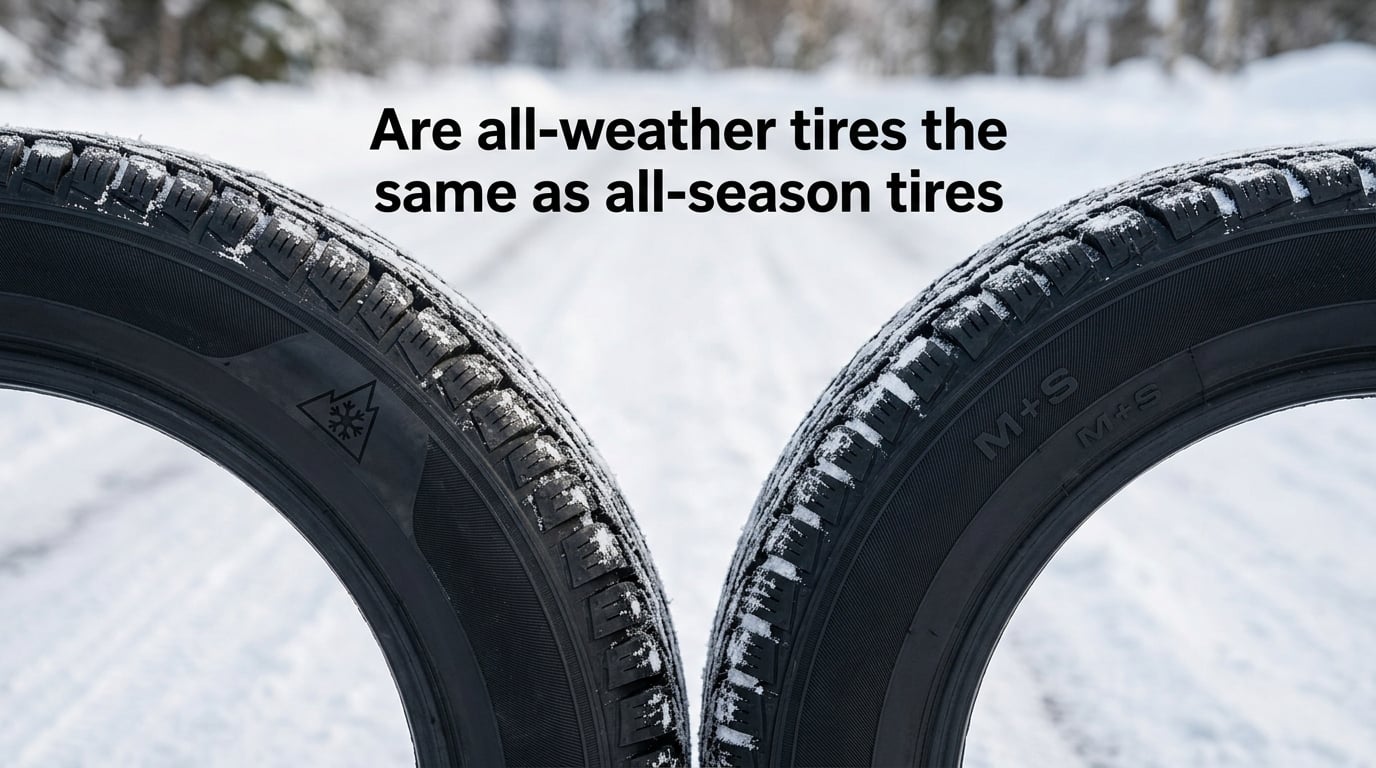
No, all-weather tires and all-season tires are not the same thing. All-season tires are three-season tires designed for spring, summer, and fall, carrying only a basic M+S (Mud and Snow) marking that does not certify winter performance. All-weather tires are true year-round tires that meet the severe-snow standard and carry the Three-Peak Mountain Snowflake (3PMSF) symbol, giving them legal cold-weather certification that all-season tires simply do not have.
If you’ve ever stared at a tire sidewall wondering what those mountain-and-snowflake icons actually mean, you’re not alone. Our team put this guide together after fielding the same question from drivers in every region of the country. Here is the clear breakdown.
Table of Contents
Key Differences at a Glance
- Winter Capability: All-season tires handle light winter conditions but stiffen below 45°F and are NOT 3PMSF certified. All-weather tires stay flexible in freezing temperatures and carry the 3PMSF symbol for severe-snow performance.
- Certifications: All-season tires typically carry only an M+S marking. All-weather tires earn the Three-Peak Mountain Snowflake (3PMSF) certification after passing an industry-standard snow traction test.
- Longevity & Ride: All-season tires generally deliver longer tread life and a quieter ride. All-weather tires trade some tread longevity for cold-weather grip and can run slightly louder on the highway.
What Are All-Season Tires?
All-season tires are the default tire on most new cars, SUVs, and light trucks sold in the United States. They are engineered as a three-season compromise: a harder rubber compound that resists heat buildup in summer, a tread pattern that evacuates rain, and enough siping to handle the occasional light snow flurry.
The “M+S” or “M/S” marking you’ll see on the sidewall stands for Mud and Snow. That marking is self-declared by the manufacturer, not independently tested. It indicates a tire that has more tread depth or a more open pattern than a standard summer tire, but it carries no legal weight as a winter certification.
All-season tires shine in climates where temperatures mostly stay above 45°F and snow is rare. They’re quiet, fuel-efficient, and typically backed by longer treadwear warranties (often 60,000 to 80,000 miles). Where they fall short is in sustained cold, packed snow, and ice. Below that 45°F threshold, the harder rubber compound begins to stiffen, and the tire loses meaningful grip even on dry cold pavement.
What Are All-Weather Tires?
All-weather tires are a newer category designed to bridge the gap between all-season and dedicated winter tires. They use a more advanced rubber compound blended with silica and other polymers that stays flexible well below freezing. Their tread blocks are deeper, more aggressively siped, and feature more biting edges to grip snow and slush.
The defining feature of an all-weather tire is the Three-Peak Mountain Snowflake (3PMSF) symbol molded into the sidewall. That symbol is not a marketing claim. A tire earns 3PMSF only after passing an industry-standard snow traction test, accelerating up a 20% incline on packed snow within a specified time threshold compared to a reference tire. No all-season tire we know of carries that symbol.
All-weather tires are built for drivers who want a single set of tires that genuinely handles winter, not just tolerates it. They are common in four-season climates like the Northeast, Upper Midwest, Mountain West, and Pacific Northwest. Reddit’s r/tires community summarizes the performance hierarchy this way: “All Weathers perform better than All Seasons, and Winters perform better than All Weathers.” That three-tier ranking shows up consistently across owner reviews and independent tests.
3PMSF vs M+S: Decoding the Tire Symbols
This is the single most common point of confusion we see. Two symbols appear on tire sidewalls, and they are not interchangeable.
M+S (Mud and Snow): A self-declared manufacturer marking indicating an open tread pattern suitable for mud or light snow. It does not require independent testing. Virtually every all-season tire carries it, and many summer and light-truck tires do too.
3PMSF (Three-Peak Mountain Snowflake): A certified severe-snow rating earned by passing an acceleration test on packed snow. The sidewall symbol shows a snowflake inside a mountain with three peaks. Only tires that pass earn it.
The practical difference: M+S says “this tire has more tread than a racing slick.” 3PMSF says “this tire has been independently tested and proven to grip severe snow.” If you regularly drive in snow or on roads that drop below freezing, the 3PMSF marking is the one that matters.
Rubber Compound and the 45 Degree Threshold
The reason all-season tires lose grip in winter comes down to rubber chemistry. Standard all-season compounds are tuned for warm-weather durability, meaning they stay hard enough to resist heat-related wear during summer driving. That hardness becomes a liability when temperatures drop.
Around 45°F (some manufacturers cite 46°F or 40°F as their threshold), the rubber in a typical all-season tire begins to stiffen noticeably. Stiffer rubber deforms less over surface imperfections, which means less of the tread contacts the road at any given moment. Braking distances lengthen. Cornering grip drops. Hydroplaning resistance changes. None of this happens because the tread wore out. It happens because the compound itself changed.
All-weather tires use softer, more silica-rich compounds engineered to remain flexible in freezing temperatures. They still need to survive summer heat, so manufacturers walk a tightrope, but the cold-weather priority is clear in every spec sheet we have reviewed.
All-Season vs All-Weather: Side-by-Side Comparison
The table below summarizes the core trade-offs between the two tire types across the categories drivers ask about most.
| Category | All-Season Tires | All-Weather Tires |
|---|---|---|
| Snow Traction | Handles light flurries; struggles in 2+ inches of packed snow | Certified for severe snow; handles packed snow and slush confidently |
| Cold Grip (below 45°F) | Compound stiffens; braking distances increase | Stays flexible; maintains grip in freezing temps |
| Certification | M+S marking (self-declared) | 3PMSF symbol (independently tested) |
| Tread Life | Typically 60,000-80,000 miles | Typically 50,000-65,000 miles |
| Wet Traction | Good in rain | Good to excellent in rain (per r/tires owner reports) |
| Dry Handling | Comfortable and predictable | Slightly softer feel; still competent |
| Noise Level | Generally quieter | Slightly louder due to aggressive tread |
| Fuel Economy | Lower rolling resistance; better MPG | Higher rolling resistance; small MPG hit |
| Best For | Mild climates, Sun Belt, three-season regions | Four-season climates, snow belt, mountain regions |
Tread Pattern, Siping, and Biting Edges
The physical design of the tread is where you’ll see another visible difference between these tire types. All-season tires tend toward smoother, more closely-spaced tread blocks optimized for quiet highway driving and even wear over many miles.
All-weather tires feature deeper tread depths, wider voids between blocks (to evacuate snow and slush), and far more siping. Sipes are the tiny slits cut into tread blocks that create hundreds of additional “biting edges.” Those edges grab snow and ice the way your fingernails grip a surface, multiplying traction in ways a smoother block cannot.
You’ll also notice more aggressive shoulder blocks on all-weather tires. The shoulder is the outer edge of the tread that contacts the road during cornering. More aggressive shoulders mean better grip when turning on slippery surfaces, at a small cost to highway noise.
Tread Life, Noise, and Cost Trade-Offs
The honest downsides of all-weather tires come up in nearly every owner forum thread. Here’s what to weigh.
Tread life is shorter. All-weather tires typically last 50,000 to 65,000 miles versus 60,000 to 80,000 for a comparable all-season. Softer compounds and more aggressive siping wear faster, especially if you drive aggressively on hot pavement. A user on r/tires noted that driving all-weather tires hard on 100°F pavement noticeably accelerated wear compared to a hard all-season compound.
Noise is slightly higher. The deeper tread and more aggressive pattern generate more road noise at highway speeds. Most drivers adapt within a few hundred miles, but if cabin quietness is a priority, this is a real difference.
Fuel economy takes a small hit. More aggressive tread patterns and softer compounds create higher rolling resistance. Expect a 1-3% reduction in fuel economy compared to a low-rolling-resistance all-season, depending on the specific models.
Upfront cost is higher. All-weather tires generally cost more per tire than a standard all-season. The premium is partly offset by longer tread life on the all-season side and the convenience of not swapping to winter tires, so total cost-of-ownership depends heavily on your climate and how long you keep the set.
Which Tire Is Right for Your Climate?
The right answer depends almost entirely on where you live and drive. Here is a regional framework.
Sun Belt (Southern California, Arizona, Florida, Gulf Coast): All-season tires are the clear winner. Temperatures rarely drop below 45°F, and snow is rare to nonexistent. All-weather tires would wear faster in sustained summer heat without delivering any benefit.
Mid-Atlantic and Lower Midwest (Virginia, Kentucky, Missouri, Tennessee): All-season tires work for most drivers. If you regularly drive into higher elevations or see one or two real snow events per year, all-weather tires offer useful insurance without the cost of a second set.
New England, Upper Midwest, Mountain West (Maine, Michigan, Colorado, upstate New York): All-weather tires earn their keep here. Sustained freezing temperatures, regular snow, and plowed-but-icy roads make the 3PMSF certification genuinely useful. Many drivers in these regions skip dedicated winter tires entirely and run all-weathers year-round.
Pacific Northwest (Western Washington, Oregon): The cold-wet combination here is where all-weather tires truly shine. Mild temperatures below 45°F combined with persistent rain create conditions that punish all-season compounds. All-weather tires handle both better.
Mountainous and severe-winter regions (Vermont, Wyoming, Montana, Alaska): Consider dedicated winter tires if you regularly drive on unplowed roads, deep snow, or sustained sub-zero temperatures. All-weather tires are vastly better than all-seasons but still not equal to a true winter tire in extreme conditions. A user in r/Maine with a long, poorly plowed dirt drive found all-weathers “close, but not equal in deep snow” compared to studded winter tires.
How to Tell Which Tires You Currently Have
If you’re not sure what’s on your vehicle right now, you can find out in under a minute without any tools.
- Look at the sidewall of any tire on your vehicle.
- Find the M+S or M/S marking. Most all-season and all-weather tires carry this.
- Look for the Three-Peak Mountain Snowflake symbol: a snowflake inside a mountain with three peaks. If you see it, you have all-weather (or winter) tires.
- If you see M+S but no snowflake symbol, you have all-season tires.
- If you see no markings at all, you may have summer or performance tires.
This five-step inspection is the fastest way to know what you’re driving on, and it’s the same check a tire technician performs when you bring your vehicle in for service.
When All-Season or All-Weather Isn’t Enough
For drivers in severe-winter regions or anyone who regularly drives on unplowed, icy, or deeply snowy roads, dedicated winter tires remain the safest choice. They use even softer compounds (many are unsafe above 40°F), deeper tread blocks, and often studdable designs for ice. The trade-off is that they wear quickly in summer and must be swapped seasonally.
One emerging consideration is electric and hybrid vehicles. Their instant torque and heavier weight accelerate tread wear on softer all-weather compounds. Some EV owners report better results with harder all-season compounds or low-rolling-resistance tires specifically engineered for EVs. If you drive an EV, factor in range impact (1-3% reduction is typical) and tread-wear expectations before choosing all-weather tires.
Frequently Asked Questions
Is it better to buy all-season or all-weather tires?
It depends on your climate. All-weather tires are better if you regularly drive in temperatures below 45°F or see real snow. All-season tires are better if you live where winter is mild and rare, because they last longer and cost less. Most drivers in the Sun Belt do not need all-weather tires.
What is the downside of all-weather tires?
All-weather tires typically wear 10,000-20,000 miles faster than comparable all-season tires, run slightly louder on the highway, and reduce fuel economy by 1-3% due to higher rolling resistance. They also cost more upfront. Most drivers find these trade-offs acceptable in exchange for true winter capability.
Are all-weather tires legit?
Yes. All-weather tires are independently tested and must earn the Three-Peak Mountain Snowflake (3PMSF) certification by passing a severe-snow traction test. They are a legitimate middle ground between all-season and dedicated winter tires and are recommended by major tire manufacturers including Nokian, Cooper, Michelin, and Hercules.
What is the cost difference between all-season and all-weather tires?
All-weather tires typically cost more per tire than a standard all-season tire. The premium varies by brand and size, but all-weather tires generally run a higher price per tire. The cost is partly offset by eliminating the need for a separate winter tire set and seasonal swap fees, especially for drivers in four-season climates.
Do all-weather tires wear out faster?
Yes, generally. Softer rubber compounds and more aggressive siping cause all-weather tires to wear faster than hard-compound all-season tires, especially in hot climates or under aggressive driving. Expect 50,000-65,000 miles from most all-weather tires versus 60,000-80,000 from a comparable all-season.
Can I use all-weather tires year-round?
Yes, that is exactly what they are designed for. All-weather tires are certified for year-round use and perform safely in both summer and winter. Many drivers in four-season climates run a single set of all-weather tires year-round and skip the seasonal swap entirely.
Are all-weather tires quieter than all-season?
No, typically the opposite. The deeper tread blocks, wider voids, and more aggressive siping on all-weather tires generate slightly more road noise at highway speeds than a touring all-season tire. Most drivers adapt quickly, but cabin quietness is one area where all-season tires retain an edge.
What are the best all-weather tires?
The best all-weather tire depends on your vehicle, driving style, and budget. Top-rated options in independent testing consistently include the Michelin CrossClimate 2, Nokian WR G4, Continental AllSeasonContact, Goodyear WeatherReady 2, and Hercules Terra Trac Cross-V AW. For Consumer Reports’ latest rankings, check their annual tire test, as recommendations shift year to year.
Final Verdict: Are All-Weather Tires the Same as All-Season Tires?
No, they are not the same. All-season tires and all-weather tires are distinct categories built around different rubber compounds, different tread designs, and different certification standards. The M+S marking on most all-season tires is not a winter certification, while the 3PMSF symbol on all-weather tires is.
Choose all-season tires if you live where winters are mild, temperatures rarely drop below 45°F, and snow is rare. You’ll get longer tread life, quieter rides, and better fuel economy. Choose all-weather tires if you regularly face freezing temperatures, snow, or icy roads. You’ll trade some tread life and quietness for genuine winter capability in a single year-round set.
For drivers in severe-winter regions, dedicated winter tires still beat both. But for the vast majority of drivers in four-season climates, all-weather tires are the most practical compromise available today. Check your current sidewall for the 3PMSF symbol to see which category you’re already running, and talk to a tire professional about your specific climate before your next purchase.