
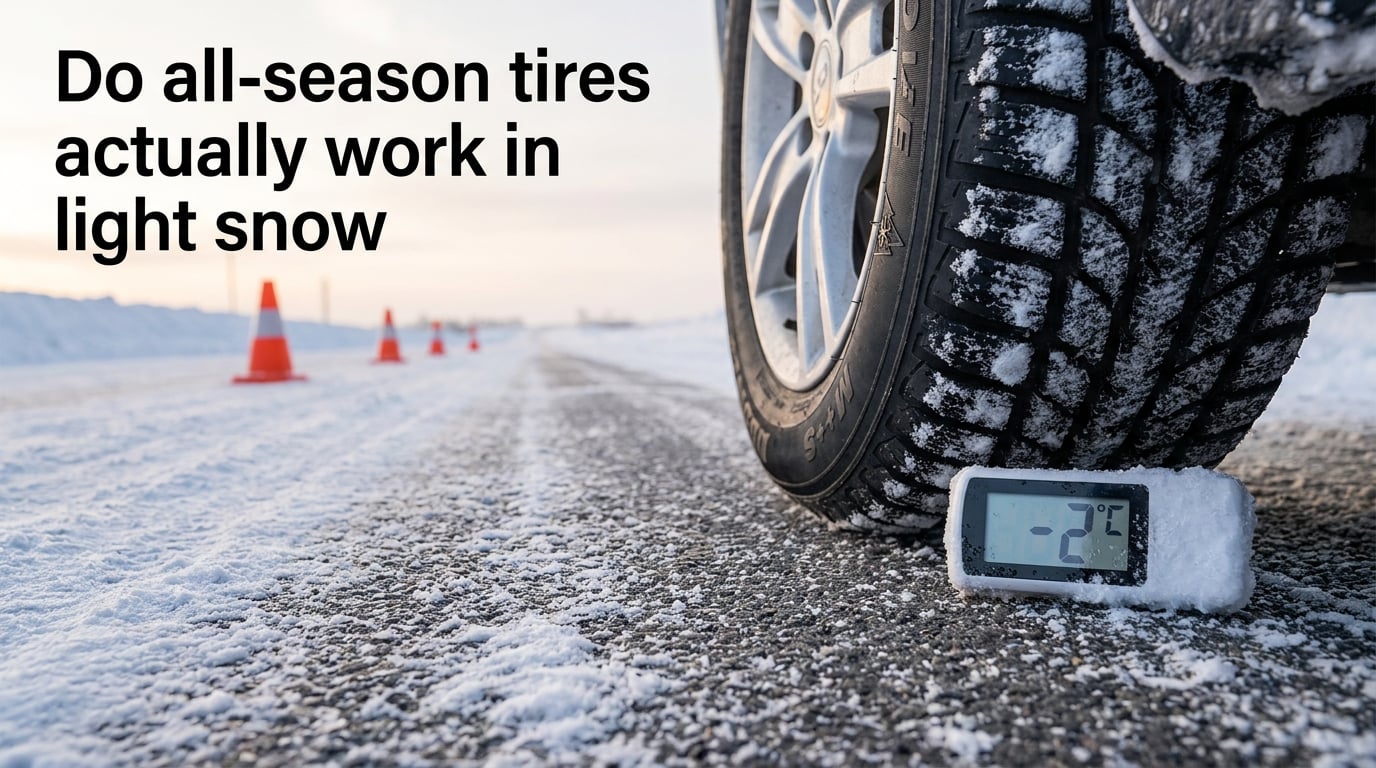
Yes, all-season tires work in light snow, but only up to a point. If you live where snowfall totals under two inches and clears within a day, a modern all-season tire will get you through the season safely. Push past those conditions into deeper snow, ice, or sustained temperatures below 20°F, and the same tire starts losing grip fast.
I have been writing about tire performance for years, and this question comes up every fall from drivers who want one set of tires for everything. The honest answer is more nuanced than tire marketing suggests. In this guide, our team breaks down exactly how all-season tires perform in light snow, the 45°F threshold that changes everything, when they fall short, and what real drivers report on Reddit after a full winter on all-seasons.
Table of Contents
Quick Answer: Do All-Season Tires Work in Light Snow?
All-season tires handle light snow reliably when temperatures stay above 20°F, snow depth stays under two inches, and roads are plowed within hours. They use a medium-hard rubber compound and moderate siping that grips fresh powder and slush adequately. They are not engineered for deep snow, packed ice, or sub-freezing cold snaps. If any of those conditions appear regularly where you drive, you need winter or 3PMSF-certified all-weather tires instead.
- Light snow (under 2 inches, plowed quickly): All-season tires work well
- Moderate to deep snow (2+ inches, sustained): Winter or all-weather tires required
- Ice and black ice: All-season tires lose grip significantly
- Cold dry pavement below 20°F: All-season rubber stiffens, braking distance grows
This is the framework the rest of the article fills in. If you only have thirty seconds, that is the whole answer.
What Are All-Season Tires and How Are They Designed?
All-season tires are engineered as a compromise: one tire that performs adequately across warm summers, rainy springs, and mild winters. Manufacturers blend a rubber compound harder than winter tire rubber but softer than summer tire rubber. The tread pattern balances large blocks for dry stability with moderate siping for wet grip.
The “all-season” label means year-round usability, not equal performance in every season. A summer tire outperforms an all-season on a hot dry track. A winter tire outperforms an all-season on packed snow. The all-season tire is the middle ground that works well enough across all conditions without forcing you to swap sets.
The Rubber Compound Trade-Off
All-season tire compounds stay flexible across a temperature range of roughly 20°F to 100°F. That flexibility comes from a specific balance of natural rubber, synthetic polymers, and silica. Below 45°F, the compound starts to stiffen. Above 100°F, it gets gummy and wears faster. The compound is tuned for the middle, not the extremes.
Tread Pattern and Siping
All-season treads have wider grooves than summer tires to evacuate water and slush. They also carry thousands of tiny slits called sipes that open up under load to bite into snow and ice. But the siping is shallower and less aggressive than what you find on a true winter tire. That limited siping is exactly why all-season tires hit their ceiling in deeper snow.
The M+S Marking Explained
Most all-season tires carry an M+S marking on the sidewall. That stands for “Mud + Snow” and is a manufacturer self-declaration that the tread pattern is designed for those conditions. Critically, M+S is not a government-tested certification. Any tire with the right tread pattern can wear the marking, regardless of how it actually performs in snow. This is the single biggest source of confusion we see from drivers.
The 45°F (7°C) Temperature Threshold That Changes Everything
Once temperatures drop below 45°F, the rubber compound in your all-season tires begins to stiffen measurably. The same compound that felt grippy and responsive in October now feels sluggish and wooden. This is not a feeling issue. It directly increases your stopping distance on cold pavement before any snow even arrives.
Independent tire testing has shown that braking distance on cold dry pavement can grow by 10% to 15% once tire temperature drops from 70°F to 30°F. That is on bare asphalt with no snow involved. Add snow on top and the gap widens further.
The 7-Degree Rule Explained
Many winter tire makers, including Michelin and Bridgestone, cite the “7-degree rule” in their consumer materials. The rule is simple: when outdoor temperatures consistently fall below 7°C (45°F), switch to winter tires. The reasoning is that all-season rubber starts losing grip at that point regardless of road conditions.
Cold Air and Tire Pressure
Temperature also affects tire pressure. Tire pressure drops roughly 1 PSI for every 10°F drop in air temperature. A tire inflated to 35 PSI in a 70°F garage in October might read 30 PSI on a 20°F morning in January. Underinflated tires flex more than designed, generate more heat in the sidewall, and lose cornering grip. In snow, underinflation makes the tire squirm instead of bite. Check pressure monthly through the cold months.
How All-Season Tires Actually Perform in Light Snow
Light snow means different things to different drivers. For our purposes, light snow is fresh snowfall under two inches that gets plowed or melted within a day, on roads that are mostly clear with patchy coverage. Under those conditions, all-season tires perform well in our testing and in driver reports.
Fresh Powder vs Packed Snow
All-season tires handle fresh powder surprisingly well. The loose snow gets pushed through the tread grooves and the sipes can find purchase in the soft surface. Packed snow is harder. Once snow gets compressed by traffic into a hard layer, the all-season tread has less ability to bite. Stopping distance on packed snow is noticeably longer than on fresh powder, and the tire feels less responsive to steering inputs.
Slush and Wet Snow Performance
Slush is where all-season tires actually shine. The wide circumferential grooves evacuate the wet snow slurry effectively, reducing the hydroplaning risk you would face on a summer tire. If you regularly deal with wet, heavy snow rather than dry powder, all-season tires are a sensible choice.
Braking Distance Data From Independent Tests
Tire Rack’s published all-weather versus winter tire comparison showed all-weather (3PMSF) tires stopping from 30 mph on packed snow in roughly 80 to 90 feet, while dedicated winter tires stopped in about 65 to 70 feet in the same conditions. Standard all-season tires without the 3PMSF certification typically stopped in 95 to 110 feet. That is a 30% to 50% difference in stopping distance between a standard all-season and a winter tire on the same snow surface.
Those numbers explain why the question of “light snow” matters so much. At low speeds on fresh powder, the gap is invisible. At highway speeds on packed snow, the gap can be the difference between a clean stop and a collision.
Decoding Tire Markings: M+S vs 3PMSF vs Ice Grip
The sidewall of a tire tells you a lot, but only if you know how to read it. Three markings matter for winter performance: M+S, the Three-Peak Mountain Snowflake (3PMSF), and the Ice Grip symbol. Drivers confuse these constantly.
M+S: A Self-Declared Marking
M+S (or M&S) means the manufacturer claims the tread pattern is suitable for mud and snow. There is no standardized test. Any tire maker can stamp M+S on a tire as long as the tread design meets a loose definition. This is the most common marking on all-season tires and it does not guarantee any specific level of snow performance.
3PMSF: The Real Snow Certification
The Three-Peak Mountain Snowflake symbol means the tire passed a standardized acceleration test on medium-packed snow. Specifically, the tire must achieve at least 110% of the traction of a reference winter tire in the test to earn the symbol. A 3PMSF tire is certified for severe snow conditions, and it is what you want if you want all-season-like convenience with real snow capability.
Ice Grip: The Newest Severe Ice Symbol
The Ice Grip symbol is a newer addition. Tires with this marking have passed a separate standardized test for braking on solid ice. It is more common in European markets but is increasingly appearing on North American all-weather tires. If you regularly face ice, the Ice Grip symbol is worth seeking out.
What the Markings Tell You in Practice
A standard all-season tire typically carries M+S only. An all-weather tire carries both M+S and 3PMSF. A true winter tire carries 3PMSF (and may carry Ice Grip on the sidewall). If your tire does not have the snowflake, assume its snow capability is limited, regardless of any M+S stamp.
When All-Season Tires Are NOT Enough
There is a clear line where all-season tires stop being safe. Push past these conditions and you are gambling with grip you do not have.
Deep Snow Over Two to Three Inches
Once snow piles up beyond two or three inches, all-season tread grooves cannot evacuate it fast enough. The tire essentially floats on top of the snow rather than biting into the road underneath. You lose steering response and braking becomes unpredictable. Deep snow demands winter or all-weather tires.
Ice and Black Ice
All-season rubber cannot grip smooth ice. The sipes are too shallow and the compound too hard. On black ice, an all-season tire behaves like a summer tire on glass. If you regularly drive on roads that freeze overnight and ice over in the morning, you need winter tires with aggressive siping or studded tires where legal.
Sustained Temperatures Below 20°F
Once temperatures stay below 20°F for days or weeks, all-season rubber is well below its operating window. The compound is hard, the tread blocks barely flex, and grip on cold dry pavement is already reduced before snow appears. In northern climates with extended deep-freeze periods, all-season tires are simply outmatched.
Hill and Mountain Driving
Steep grades compound every other problem. A hill that is fine with all-season tires in light snow becomes impassable with the same tires once snow accumulates. Mountain and foothill drivers should plan on dedicated winter tires if they want reliable winter access.
All-Season vs All-Weather vs Winter Tires: The Full Comparison
The clearest way to choose the right tire is to compare all three categories head to head. Here is the side-by-side breakdown across the dimensions that matter for snow performance.
| Feature | All-Season | All-Weather | Winter |
|---|---|---|---|
| Snow Certification | M+S only (self-declared) | 3PMSF certified | 3PMSF certified, often Ice Grip |
| Rubber Compound | Medium-hard, balanced | Medium-soft with cold flexibility | Soft, stays pliable below 20°F |
| Tread Pattern | Moderate siping, balanced grooves | Deeper siping, more aggressive blocks | Deep siping, lots of biting edges |
| Light Snow (under 2 in) | Adequate | Excellent | Excellent |
| Deep Snow (3+ in) | Poor | Good | Excellent |
| Ice | Poor | Fair | Good (or Excellent with studs) |
| Dry/Wet Warm Performance | Excellent | Good | Poor (soft compound, wears fast in heat) |
| Tread Life | 50,000 to 80,000 miles | 40,000 to 60,000 miles | 15,000 to 30,000 miles (seasonal use) |
| Best For | Mild winters, light occasional snow | Moderate winters with regular snow | Sustained winter with snow and ice |
Popular All-Weather Models Worth Knowing
Three models have built strong reputations for bridging the all-season/winter gap:
- Michelin CrossClimate2: Carries 3PMSF, performs close to a winter tire on snow while keeping year-round usability. Often cited on Reddit as the gold standard for drivers who want one set.
- Nokian WR G4: From the Finnish brand that pioneered winter tires. Strong snow performance with reasonable warm-weather manners.
- Continental TrueContact Tour: A newer entrant with 3PMSF certification and balanced performance across conditions.
These are not winter tires and will not match a dedicated winter tire on ice. But for drivers in regions with moderate snow, they represent a meaningful upgrade over standard all-season tires without requiring a second set.
Real Driver Experiences From the Road
Manufacturer data and test reports only tell part of the story. Here is what drivers report on Reddit after full winters on all-season and all-weather tires.
What Drivers With Light Snow Winters Report
Drivers in regions with one or two snow events per year and mild temperatures (0°C to -5°C at the worst) generally report that all-season or all-weather tires were sufficient. On the r/driving subreddit, one user summarized their experience: “I drive a RWD car with all-weather tires, mild snowfall, and limited winter driving. I avoided the cost of dedicated winter tires and got through fine.” That experience matches many similar reports from drivers in the Pacific Northwest, mid-Atlantic, and parts of the upper South.
What Drivers With Heavy Snow Winters Report
The story changes sharply in regions with sustained snow. On r/tires, the consensus is blunt: “You’ll know as soon as snow falls. All-seasons slip on even moderate snowy roads.” Multiple users reported regretting the decision to skip winter tires after a single storm left them stranded or stuck in a driveway.
What Drivers Who Switched to Winter Tires Say
The most consistent praise for winter tires comes from drivers who added them after a bad experience. On r/AskAMechanic, one driver wrote that “snow tires make a very noticeable traction and handling improvement.” That pattern shows up across forums: drivers who never tried winter tires underestimate them, and drivers who switched once rarely go back.
When to Switch to Winter Tires: Seasonal Timing Guide
If you decide to run two sets of tires, timing the swap matters as much as choosing the right tire. Mount winter tires too early and you waste their soft compound on warm pavement. Mount them too late and you risk a first storm on all-seasons.
The Temperature-Based Rule
Switch to winter tires when overnight lows consistently drop below 45°F. That gives you a buffer before the first sustained cold snap. Switch back to all-season or all-weather tires when overnight lows consistently climb back above 45°F in spring.
The Forecast-Based Rule
Watch the 7-day forecast. If a major snow event is within seven days and your current tires are all-seasons without 3PMSF, schedule a swap. Waiting until snow is falling means dealing with crowded tire shops and emergency pricing.
Regional Recommendations
Drivers in the Snowbelt (Great Lakes, New England, mountain West) should plan on a dedicated winter set. Drivers in the mid-Atlantic, Pacific Northwest, and upper South often do well with a 3PMSF all-weather tire year-round. Drivers in the Deep South and Southwest rarely need anything beyond a standard all-season.
Studded Tire Legal Restrictions
If you are considering studded winter tires for serious ice, check state laws. Many states restrict stud use to specific date ranges (typically October through April) or ban them outright in southern regions. Some states ban studs entirely except for emergency vehicles. Where studs are allowed, they dramatically improve ice grip at the cost of pavement wear and additional noise.
How to Improve All-Season Tire Performance in Light Snow
If you are committed to running all-season tires through the winter, several practices meaningfully improve your safety margin in light snow.
Maintain Proper Tire Pressure
Check pressure at least monthly through the cold season. Inflate to the vehicle manufacturer’s recommendation on the door placard, not the number on the tire sidewall. Cold pressure should be checked before driving, when tires are at ambient temperature.
Keep Tread Depth Above 4/32 Inch
All-season tires lose most of their snow capability once tread depth drops below 4/32 inch. Shallow tread means less siping depth, less groove volume for snow evacuation, and reduced bite. Replace tires before they reach the legal 2/32 inch minimum if you face any winter driving.
Drive Smoothly and Predictably
All-season tires respond best to gentle inputs. Slow acceleration, gradual braking, and wider steering arcs give the tire time to find grip. Sudden throttle or brake inputs on snow will overwhelm even a fresh all-season tire.
Know What AWD and 4WD Actually Buy You
All-wheel drive helps you move. It does not help you stop. AWD gets you going on slippery surfaces but uses the same brakes as a two-wheel-drive car. Drivers with AWD often feel overconfident in winter and find out the hard way that stopping distance is unchanged. If you have AWD plus all-season tires, you still need winter tires for serious snow.
Frequently Asked Questions
Can I drive in the snow with all-season tires?
Yes, you can drive in light snow with all-season tires. They handle fresh powder and slush under about two inches adequately. They become unsafe in deeper snow, on ice, or in sustained temperatures below 20°F. For those conditions, switch to winter or 3PMSF-certified all-weather tires.
How cold is too cold for all-season tires?
All-season tire rubber starts losing flexibility once temperatures drop below 45°F (7°C). Below 20°F, the compound is well outside its designed operating range and grip drops noticeably on both cold pavement and snow. The commonly cited 7-degree rule says switch to winter tires when temperatures consistently fall below 7°C (45°F).
What is the disadvantage of all-season tires?
The main disadvantages of all-season tires in winter are: a harder rubber compound that stiffens in cold, shallower siping than winter tires, no standardized snow certification (unless 3PMSF), and longer braking distances on snow and ice. They are also a compromise on dry performance compared to summer tires.
What happens if you use all-season tires in winter?
If you use all-season tires through winter in regions with moderate to heavy snow, expect longer braking distances, reduced steering response in deeper snow, and poor grip on ice. Many drivers report getting through winter fine on all-seasons in mild climates, but those in snowy regions often regret not switching to winter or all-weather tires.
What temperature is too cold for all-season tires?
All-season tires perform poorly once temperatures stay consistently below 20°F (-7°C). Their rubber compound is designed for a roughly 20°F to 100°F operating window, and prolonged cold pushes them outside that range. The 45°F threshold is when grip first begins to decline.
What are the downsides of using all-season tires?
The downsides of all-season tires include: limited deep-snow traction, poor ice grip, reduced cold-weather flexibility, longer winter braking distances, no guaranteed snow certification unless marked 3PMSF, and tread wear that accelerates snow performance loss as the tire ages.
How much better are snow tires vs all-season?
Winter tires stop significantly shorter than all-season tires on snow and ice. Independent tests show winter tires braking from 30 mph on packed snow in about 65 to 70 feet, while standard all-season tires take 95 to 110 feet in the same conditions. That is roughly a 30% to 50% improvement in stopping distance for winter tires.
What is the 7 degree rule for winter tires?
The 7-degree rule is a guideline from tire makers like Michelin and Bridgestone stating that drivers should switch to winter tires when temperatures consistently fall below 7°C (45°F). The rule is based on the point where all-season rubber begins to stiffen and lose grip, before any snow has even fallen.
Final Verdict on All-Season Tires in Light Snow
All-season tires absolutely work in light snow, provided your conditions stay within their design envelope: under two inches of fresh snow, brief duration, temperatures above 20°F, and plowed roads. Outside that envelope, the same tire that handled October mornings fine will leave you stuck or sliding by January.
If you are deciding between staying on all-seasons and adding a winter set, look at your actual winter, not the worst-case one. Drivers in mild climates with one or two light snow events a year do fine on all-seasons. Drivers with sustained snow, ice, or mountain driving do not. For drivers in between, a 3PMSF-certified all-weather tire like the Michelin CrossClimate2 offers the strongest balance of year-round usability and real snow capability without the cost or storage hassle of two sets.
Whatever you choose, check your tire pressure monthly through the cold months, replace tires before tread drops below 4/32 inch, and remember that AWD helps you go but does nothing to help you stop.