
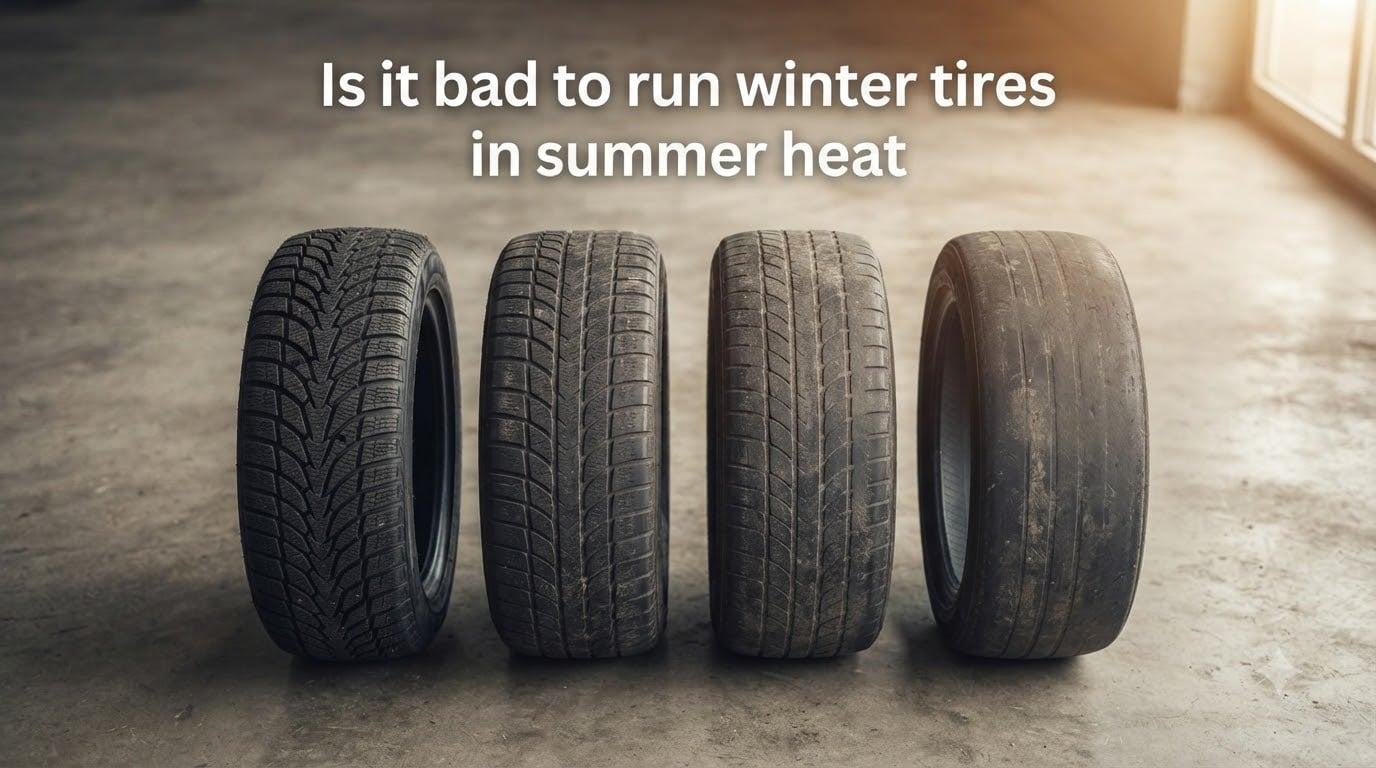
Yes, it is bad to run winter tires in summer heat. The same soft, high-silica rubber compound that gives winter tires their grip below 7°C becomes too soft once temperatures climb, wearing out up to 60% faster, increasing fuel consumption, and lengthening braking distance by as much as 26% on hot wet pavement. Our team pulled together the manufacturer data, CAA-Quebec testing, and forum reports from r/tires and r/askcarguys to give you the full picture and an action plan you can use this week.
Table of Contents
Quick Answer: The Key Facts
- It is bad to run winter tires in summer heat. Heat breaks down the soft rubber compound the tire is built around.
- The 7°C / 45°F rule is the industry switch point. Above that temperature consistently, winter tires no longer perform as designed.
- Lifespan drops by up to 60% when winter tires are driven on warm dry pavement, per Continental Tire research.
- Braking distance increases by up to 26% on hot wet pavement compared to summer tires, per CAA-Quebec testing.
- Fuel consumption rises because of higher rolling resistance, with real-world figures of several percent above a matched summer tire.
- Switch back when overnight lows climb above 7°C (45°F) for a week straight, typically mid-April through May across most of North America.
Why Heat Damages Winter Tires (The Rubber Compound Problem)
A winter tire is engineered around a softer, high-silica rubber compound that stays flexible in freezing temperatures. That flexibility is what lets the tread bite into snow and grip ice, but it is also the exact reason winter tires fall apart in heat.
Once pavement temperatures climb above 7°C (45°F), the compound crosses a threshold where it stops being “pliable” and starts being “soft.” The tread blocks begin to squirm under load, the sipes that give winter tires their biting edges deform, and the tire loses the structural rigidity it needs for stable cornering and braking.
Bridgestone compares it to footwear: winter tires are like insulated snow boots, great on ice and slush, miserable on hot dry pavement. The analogy holds because both products are designed for a specific temperature window.
The technical breakdown looks like this:
- High-silica compound: formulated to stay elastic below freezing, but softens past its design range once ambient air passes 7°C.
- Deeper tread depth and aggressive siping: designed to evacuate snow and slush; on hot dry asphalt, the extra void flexes and accelerates wear.
- More flexible tread blocks: grip snow by conforming to uneven surfaces; on hot pavement they squirm and scrub off rubber.
In short, every feature that makes a winter tire excellent in February works against it in July.
What Happens When You Drive Winter Tires in Summer Heat
Five things happen, in roughly this order of severity:
- Tread wears out up to 60% faster. The soft compound simply gives up rubber against hot asphalt.
- Braking distance grows. On hot wet pavement, stopping from 100 km/h can take up to 26% more distance than on summer tires, per CAA-Quebec testing.
- Fuel economy drops. Higher rolling resistance costs you real money at the pump, with measurable increases over a matched summer tire.
- Handling and cornering grip degrade. The squirming tread blocks let the car wander in evasive maneuvers, and wet-road performance falls off a cliff.
- Road noise rises noticeably. The aggressive tread pattern that works on snow is loud on smooth asphalt, often 3 to 5 dB above a summer tire.
None of these are catastrophic on a single short trip, but they stack up. A driver running winter tires through a full summer will arrive at fall with a tire that has lost a season’s worth of useful life and noticeably worse wet performance than the day it was mounted.
Tread Wear, Fuel Economy and Braking Distance: The Real Costs
Let’s put numbers on each one.
Tread wear. Continental’s testing puts the lifespan loss at up to 60% when winter tires are used year-round in warm climates. CAA-Quebec reports that wear indicators (the small bars molded into the tread grooves) can appear after less than 10,000 km of summer driving on a winter tire, instead of the 50,000+ km you’d expect from the same tire in proper seasonal use.
Fuel economy. The deeper, more aggressive tread pattern creates more rolling resistance than a summer tire. Drivers on forums like r/askcarguys consistently report noticeable drops in fuel economy, and tire manufacturers confirm a measurable percentage-point increase in fuel use when comparing matched winter and summer tires on the same vehicle. Over a full summer that adds up.
Braking distance. CAA-Quebec’s comparison testing is the most cited figure: a vehicle on winter tires needed up to 26% more distance to stop on hot wet pavement than the same vehicle on summer tires. On dry pavement the gap is smaller but still present, and on cold wet roads in shoulder seasons the gap reverses (the winter tire wins).
Noise. Winter tires run noticeably louder than summer tires on smooth pavement. Bridgestone and Continental both list this as a real consumer complaint during summer use.
Comfort and handling feel. Drivers describe winter tires as “squishy” or “vague” in summer corners. The sidewalls flex more, the steering response dulls, and the car feels less precise. None of this is dangerous in normal driving, but it changes how the car feels in an emergency maneuver.
| Tire Type | Summer Performance | Wet Grip | Fuel Economy | Tread Life in Heat |
|---|---|---|---|---|
| Summer tire | Excellent | Good | Best | Normal |
| All-season tire | Good | Acceptable | Good | Normal |
| Winter tire (proper season) | Poor in summer | Poor when warm | Lower | Up to 60% shorter |
| Winter tire in summer heat | Worst | Worst | Worst | Rapid wear |
Hydroplaning and Blowout Risks in Summer Heat
Two safety-specific risks deserve their own section because they are the ones drivers actually worry about.
Hydroplaning. Winter tires are designed to evacuate snow and slush, not large volumes of summer rainwater. The tread pattern channels snow fine, but on a wet road at highway speed the blocks can lose contact with the pavement, and the tire floats on top of the water film. CAA-Quebec flags this as one of the primary summer hazards. Drivers moving from a dry cold day to a sudden summer thunderstorm are at the highest risk, because the tire never had a chance to perform well in the new conditions.
Blowout risk. Manufacturers and clubs warn that prolonged heat cycling weakens the tire structure, particularly the belts and inner liner. The risk is real for underinflated tires and for tires already at the end of their service life. That said, the experienced mechanics on r/askcarguys push back on the scare factor: a properly inflated winter tire in reasonable condition is unlikely to spontaneously blow out from summer driving alone. The honest framing is that heat accelerates any existing weakness rather than creating one out of nothing.
If your winter tires are more than five or six years old, or if you cannot recall the last time you checked the pressure, summer heat is the worst possible time to find out.
When to Switch from Winter Tires (7°C / 45°F Rule)
The industry rule is straightforward: switch back to summer or all-season tires when the average daily temperature climbs above 7°C (45°F) for a sustained period. CAA-Quebec recommends scheduling the change for mid-April in most of Canada. In the US, the calendar guidance varies by region:
- Northern US (New England, Upper Midwest, Mountain West): mid-April to mid-May.
- Mid-Atlantic, Pacific Northwest, lower Midwest: April, or as soon as overnight lows stay above 7°C.
- California, Arizona, Texas, Florida, Southeast: if you ran winter tires at all, they should have come off in March.
- Quebec: studded tires must be removed by May 1 per provincial regulation.
The 7°C threshold works in both directions. Below it, summer tires turn hard and lose grip, and the winter tire’s softer compound regains its advantage. Above it, the winter tire’s softness stops being a feature and becomes a defect.
If you only have one set of tires and live in a mild climate, an all-season tire is a reasonable year-round compromise, though it will not match a dedicated winter tire in heavy snow or a dedicated summer tire in extreme heat.
What to Do If Winter Tires Are Still on Your Car
Step-by-step, here is what to do this week if you realize you are still driving on winter tires.
Step 1: Check the date and the temperature. If overnight lows are consistently above 7°C (45°F), the answer is “yes, change them now.” If you are in a cold snap with another snowstorm in the forecast, you can wait a few weeks.
Step 2: Inspect the tires. Look for tread depth using the coin test (insert a quarter upside down; if you can see George Washington’s head above the tread, the tire is near the wear indicators). Check the sidewalls for cracking, blistering, or bulges. Look at the manufacture date on the sidewall (the four-digit DOT code, week and year). Anything over six years old should be replaced regardless of tread depth.
Step 3: Check tire pressure. Heat raises pressure. A tire inflated to 32 psi in January may read 38 psi in July. Do not let pressure climb above the door-jamb specification; if it does, release air to the recommended cold pressure, then recheck after the tires cool.
Step 4: Book the seasonal change. Most tire shops swap sets in under an hour. If you do this twice a year, consider buying a second set of wheels (steel or alloy) to avoid the mounting and balancing fee each time. Bridgestone recommends this approach for anyone running true seasonal tires.
Step 5: Store the off-season set correctly. Clean the tires, bag them in airtight plastic, store them in a cool dry place away from direct sunlight and ozone sources (no storage next to an electric motor or furnace). If you have a set of mounted wheels, stack them horizontally or hang them on a wall-mounted tire rack, never standing on the tread.
Step 6: Drive gently for the first 50 miles. New (to your car) tires of any type benefit from a break-in period. Avoid hard cornering and emergency braking for the first few days.
How to Tell If Your Winter Tires Are Already Heat-Damaged
Look for these five signs:
- Feathered or uneven tread wear across the tread blocks, indicating the rubber is squirming rather than gripping.
- Visible wear indicator bars in the tread grooves (the small flat bars molded in by the manufacturer).
- Sidewall cracking or checking, especially on tires more than four years old.
- Reduced tread depth below 4/32 inch (about 3 mm), which is the minimum for safe wet performance.
- Noticeably louder ride and softer handling feel compared to the same tire in winter.
If two or more of these show up, the tires are at the end of their useful life regardless of season, and you should replace them rather than store them for next winter.
Frequently Asked Questions
How hot is too hot for winter tires?
Once ambient temperatures stay above 7°C (45°F) for sustained periods, winter tires are operating outside their design window. The soft high-silica compound becomes too pliable, tread wear accelerates, and braking distance grows. Plan your seasonal change for mid-April in northern climates and earlier in warmer regions.
What happens if I run winter tires in summer?
You will see five main consequences: tread wear up to 60% faster, braking distance up to 26% longer on hot wet pavement, higher rolling resistance that lowers fuel economy, reduced cornering grip, and noticeably louder road noise. Hydroplaning risk also rises in summer rainstorms because the tread is designed for snow, not large water volumes.
How long can you drive with snow tires in the summer?
You can drive short distances in summer without immediate damage, but every week of summer use noticeably shortens the tire’s lifespan. Wear indicators can appear after less than 10,000 km of summer driving per CAA-Quebec, versus 50,000+ km of normal winter use. The sooner you swap back to summer or all-season tires, the more life you preserve.
Why are snow tires bad in the summer?
Because the soft high-silica rubber compound that gives winter tires grip on ice and snow turns too soft once temperatures rise above 7°C. The tread blocks squirm under load, sipes deform, and the tire loses the rigidity needed for stable handling and braking. The very features that make winter tires excellent in February work against them in July.
Are winter tires safe to drive in summer heat?
For short trips on dry roads at moderate speeds, winter tires remain drivable in summer heat, but performance is reduced across the board: longer braking, less grip, more noise, faster wear. For highway commuting, wet roads, or emergency maneuvers, dedicated summer or all-season tires are the safer choice once temperatures consistently exceed 7°C.
The Bottom Line
Yes, it is bad to run winter tires in summer heat. The soft rubber compound that makes winter tires work below 7°C becomes a liability above it, costing you up to 60% of tread life, measurable fuel economy, and up to 26% more braking distance on hot wet pavement. Switch back to summer or all-season tires once overnight lows stay above 7°C (45°F) for a week, store the winter set properly, and check pressure and age before mounting them again next fall.