
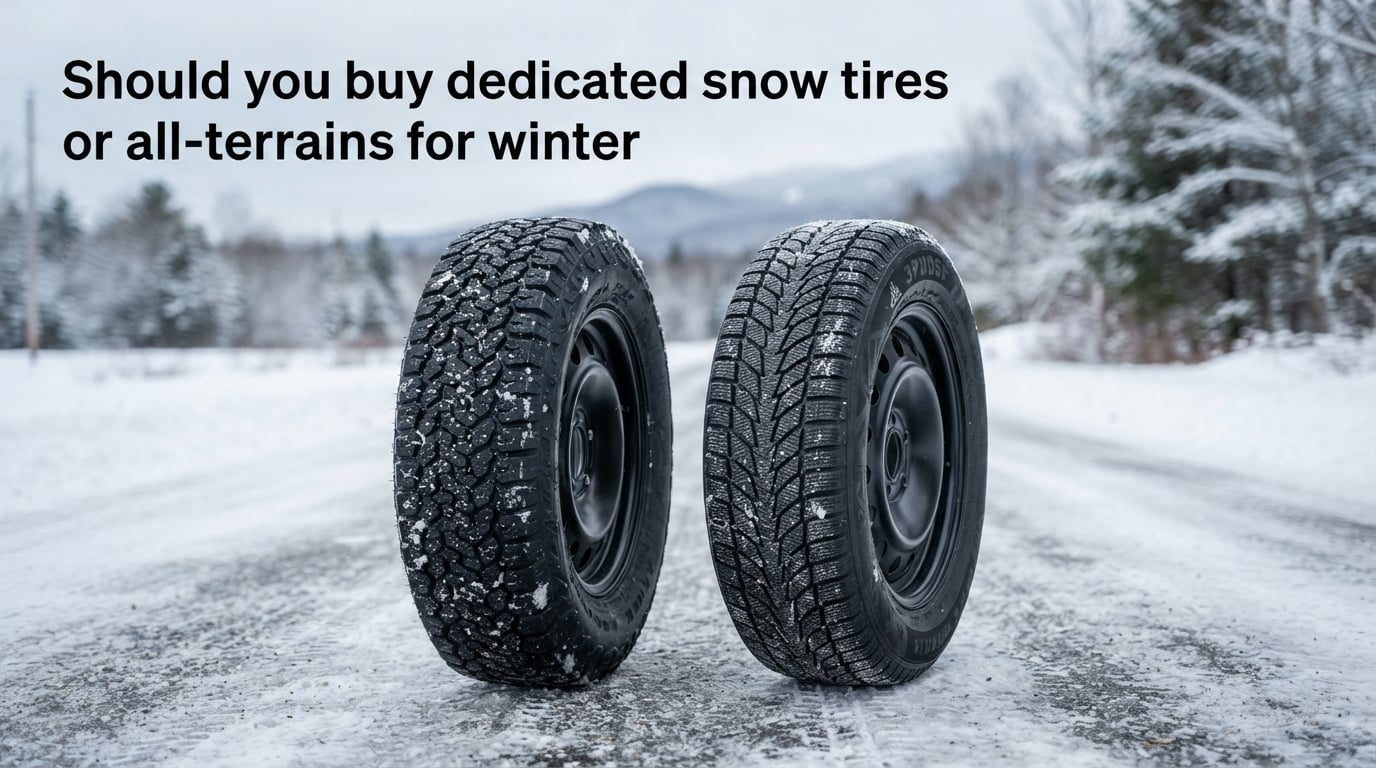
If you have a pickup, SUV, or crossover and dread the twice-a-year tire swap, you are not alone. The real question behind “should you buy dedicated snow tires or all-terrains for winter?” is whether one set of snow-rated all-terrain tires can do the job of two sets. The short answer: if your winters bring regular packed snow, ice, or temperatures that hold below freezing for weeks, dedicated winter tires win on safety. If your winters are mostly mild with a handful of storms and you want to run one set year-round, a snow-rated 3PMSF all-terrain is a defensible compromise.
I have spent enough cold mornings on ice-glazed highways to know the difference is not subtle. A winter tire stops the car sooner and turns into a corner with less drama. An all-terrain tire keeps going long after the plows go home. Let me walk you through how the two tire types are actually built, where each one earns its keep, and how to pick the right set for your climate and vehicle.
Table of Contents
Quick Verdict: Dedicated Snow Tires or All-Terrains?
Buy dedicated snow tires if your winters include regular freezing temperatures, packed snow on plowed roads, or extended mountain commutes. Pick a snow-rated all-terrain (3PMSF marked) if your winters are mild with occasional storms and you want one set year-round.
| If your winter looks like this… | Pick |
|---|---|
| Months of packed snow, ice, or sub-freezing temps on plowed highways | Dedicated winter tires |
| Mild winters with a few storms a year, mostly bare pavement | Snow-rated all-terrain (3PMSF) |
| Deep powder, regular mountain passes, or chain-control roads | Dedicated winter tires, with chains as backup |
The rest of this guide breaks down why that split exists, how to read the sidewall markings, and how to adjust the call for your drivetrain.
What a Dedicated Snow Tire Actually Is
A dedicated winter tire is engineered around one job: grip on cold, snowy, and icy pavement. Three design choices make that possible.
The Compound Stays Pliable Below 45°F
Winter tires use a softer rubber compound loaded with silica and special polymers. That mix keeps the tread flexible when the temperature drops below 45°F (about 7°C), the rough threshold where all-season and all-terrain compounds start to harden and lose bite. A hard rubber cannot conform to the tiny imperfections in ice, so it slides.
Dense Siping Creates Hundreds of Biting Edges
Sipes are the small slits cut into each tread block. Winter tires carry far more sipes than any other category, and each one flexes under load to create a sharp edge that grips snow and ice. All of those little edges working together is what gives a winter tire its characteristic crunch on a cold driveway.
Deeper Tread and Often More Tread Blocks
Winter tires typically have deeper tread depth than all-season or all-terrain products, plus a higher void-to-rubber ratio. Snow needs space to be packed into the tread and then ejected as the tire rotates; tighter-packed treads pack with snow and turn into a slick.
You will also see a mountain-with-snowflake symbol on the sidewall. That is the 3PMSF (Three-Peak Mountain Snowflake) certification, which I will explain in detail below. Studded winter tires add tiny metal pins in the tread for extra ice grip, and studless winter tires rely entirely on compound and siping.
What a Snow-Rated All-Terrain Tire Actually Is
An all-terrain tire is a compromise tire built for highway manners plus off-road ability. A snow-rated all-terrain carries the 3PMSF symbol, meaning the manufacturer proved it meets a snow-traction standard in testing. It is not a winter tire, but it is not a summer tire either.
The Compound Is Harder and More Durable
All-terrain compounds favor cut-and-chip resistance and tread life over cold-weather pliability. They stay reasonable below freezing, but the rubber stiffens earlier than a true winter compound. On a dry 30°F day that difference is small; on glare ice at 10°F it shows up as longer stopping distances and less cornering grip.
Larger Tread Blocks with Open Shoulders
All-terrain patterns have bigger, more aggressive tread blocks than a highway tire. The open shoulders and staggered blocks evacuate mud and snow well in deeper snow, which is why many owners like them on a truck or SUV. Those same big blocks flex less under braking on ice, which is the trade-off.
Reinforced Sidewalls and Often a Higher Load Range
Most all-terrains have stronger sidewalls than a passenger winter tire, so they handle potholes, rocks, and curb edges better. That extra mass also adds rolling resistance, which slightly hurts fuel economy.
Common snow-rated all-terrain examples that forum regulars name are the BFGoodrich KO3, the Falken Wildpeak AT4W, and the Nokian Outpost nAT. They are honest tools for mixed use. None of them is a winter tire.
3PMSF vs M+S: Why the Sidewall Symbol Matters
This is where buyers get burned. Two symbols show up on tire sidewalls and they are not the same.
M+S (Mud and Snow) Is a Self-Declared Mark
The M+S marking is a visual indicator that the tread pattern is designed for mud and snow. It is not a tested certification. Many all-season tires and basic all-terrain tires carry M+S without ever being tested in snow. Treat M+S alone as a marketing hint, not a performance promise.
3PMSF (Three-Peak Mountain Snowflake) Is a Tested Standard
The 3PMSF marking means the tire passed a standardized snow-traction test against a reference tire. To carry the symbol, the tire must demonstrate a measurable improvement in snow acceleration, braking, and traction versus the reference. For all-terrain tires, the 3PMSF marking is the real differentiator. It tells you the tire has been on a snow track and measured up.
If you are shopping for a snow-rated all-terrain, look for the 3PMSF symbol on the sidewall, not just the M+S marking. It is the closest thing to a winter-grade seal of approval for a multi-purpose tire.
Head-to-Head: Dedicated Snow Tires vs Snow-Rated All-Terrains
This table lays out the practical trade-offs. Real numbers vary by specific tire, but the directional differences hold.
| Factor | Dedicated Snow Tire | Snow-Rated All-Terrain (3PMSF) |
|---|---|---|
| Cold-weather compound | Soft, stays pliable well below freezing | Harder, stiffens earlier in cold |
| Siping density | Very high, hundreds of biting edges | Moderate, fewer fine sipes |
| Ice traction | Strong, especially when studded | Adequate on plowed roads, weak on glare ice |
| Deep fresh snow | Good | Good, open blocks evacuate snow well |
| Packed snow | Very strong | Adequate, depends on driver inputs |
| Dry and wet road grip (above 45°F) | Soft compound wears fast, longer braking | Better dry and wet handling |
| Tread life if left on year-round | Poor, usually 3-4 seasons max | Strong, often 50k miles or more |
| Road noise | Quieter than you would expect | Noticeable hum at highway speed |
| Off-road capability | Limited, sidewalls and tread are road-tuned | Strong, designed for gravel and trails |
| Year-round usability | No, swap in fall and spring | Yes, run them 12 months if needed |
| Cost to own | Two sets plus mounting and storage | One set, no swaps |
Climate and Region: Where Each Tire Wins
Tire choice is mostly a climate decision. Map your winter to one of these buckets.
Mild Winters: Mostly Bare Pavement with a Few Storms a Year
Think Pacific Northwest valleys, coastal California, or the Mid-Atlantic during a typical year. Roads are bare more often than not, with a handful of cold snaps. A snow-rated all-terrain is genuinely enough. The 3PMSF certification gives you a margin of safety when storms do hit, and you never deal with the swap.
Moderate Winters: Regular Snow but Heavily Plowed
Upper Midwest cities, southern New England, the lower elevations of Colorado and Utah. Plows run constantly and pavement gets cleared within hours. A snow-rated 3PMSF all-terrain is acceptable for most drivers here, especially with AWD or 4WD. Dedicated winter tires are safer on the days after a storm when ice reforms under packed snow.
Severe Winters: Long Stretches of Packed Snow and Ice
Northern New England, the Dakotas, Minnesota, Wisconsin, upstate New York, the Mountain West above 7,000 feet, most of Canada. This is where dedicated winter tires earn their keep. Stopping distance on packed snow and ice at -10°F is meaningfully shorter on a winter tire, and the difference shows up in accident data, not just marketing brochures.
Deep Powder and Mountain Commutes
If your commute includes an unplowed forest road, a ski resort access road, or a mountain pass that closes intermittently, dedicated winter tires are the safer pick. Deep fresh snow is the one condition where a snow-rated all-terrain can actually match a winter tire, but only until the snow packs down.
Drivetrain Matters: FWD, RWD, AWD, and 4WD
All-wheel drive helps you accelerate. It does almost nothing for braking or cornering. Tires do both. Here is how to apply that to your vehicle.
Front-Wheel Drive Commuter Sedan or Hatchback
The front wheels pull and steer. A dedicated winter tire on all four corners is the biggest single upgrade you can make. Going with a snow-rated all-terrain here usually means accepting more winter drama, because most all-terrain sizes are built for trucks and SUVs, not small commuters.
Rear-Wheel Drive Pickup or Rear-Drive Sport Car
This is the worst-case combination in snow. Empty bed, rear-wheel drive, and a powerful engine feeding the driven wheels. Dedicated winter tires are strongly recommended. If you absolutely refuse to swap, at minimum put 3PMSF all-terrains on the drive axle and be honest about the limits.
AWD or 4WD Crossover, SUV, or Truck
AWD or 4WD buys you get-going confidence. It does not change your stopping distance. A snow-rated 3PMSF all-terrain is enough for many AWD owners in moderate climates, because the system can find traction through most conditions. In severe climates, AWD plus dedicated winter tires is the safest setup you can have.
The recurring forum answer from cold-climate drivers is the same: stop asking whether AWD replaces winter tires. AWD gets you moving. Winter tires get you stopped.
Studded vs Studless Winter Tires (and the 7-7 Rule)
If you decide dedicated winter tires are right for you, you still have one more choice.
Studless Winter Tires
Modern studless winter tires use advanced compounds and dense siping to deliver strong ice and snow grip without metal studs. In most conditions they match or beat studded tires on packed snow and bare cold pavement, and they are legal everywhere. For most drivers, studless is the default.
Studded Winter Tires
Studs are tiny metal pins embedded in the tread that dig into clear ice. They shine on glare ice and hard-packed snow at very low temperatures, but they are noisy, harsher on dry roads, and restricted or banned in many states and provinces. Check your local regulations before buying.
The 7-7 Rule
The 7-7 rule is a timing guideline used in many cold regions: install winter tires when the average daily temperature drops to about 7°C (45°F) for seven consecutive days, and remove them when it climbs back above 7°C for seven days. It is a sensible schedule for protecting the soft winter compound from unnecessary wear during shoulder seasons.
If You Stay on All-Terrains: 5 Winter Driving Tips
If you choose to run a snow-rated all-terrain year-round, drive like the tires are the compromise they are.
- Slow down on plowed highways. Posted limits are calibrated for summer grip.
- Add 5-10 psi over the door-sticker recommendation only if you are running heavy cargo; otherwise inflate to the cold tire pressure on the door jamb.
- Brake earlier and steer gently. Big aggressive inputs overwhelm an all-terrain’s siping.
- Carry chains if you travel mountain passes. Some jurisdictions require them regardless of tire rating.
- Avoid frozen ruts and polished ice patches. An all-terrain can hydroplane on glare ice the same way a summer tire can.
Cost and Convenience: Two Sets vs One Year-Round Set
The ownership math is not as one-sided as people think.
Two Sets: Winter Tires on a Second Set of Wheels
A dedicated winter tire package (four tires plus four steel or alloy wheels, mounting, balancing, and a seasonal swap) is a real line item. The trade-off is that each set lasts longer because it only works half the year. Over ten years you are likely buying one set of winter tires and one set of summer or all-season tires, with swaps twice a year.
One Set: Snow-Rated All-Terrain Year-Round
One set means no swaps, no storage, and no second appointment at the tire shop. The trade-off is a softer dry-road feel, more road noise, slightly worse fuel economy, and reduced winter grip in severe conditions. Over ten years you are likely buying two sets of all-terrains because they wear out faster than two seasonally rotated sets.
Neither path is cheaper in a vacuum. Two-set ownership is better for safety and tire longevity. One-set ownership is better for convenience and storage. Pick the trade-off you can actually live with.
Mountain Pass and Chain-Control Rules
Several jurisdictions legally require 3PMSF (or equivalent M+S with chains) during winter chain controls. Examples include:
- British Columbia: many mountain passes require 3PMSF or chains from October through April.
- Colorado: the Colorado Department of Transportation posts chain requirements on I-70 and other high-country routes.
- California: chain controls on I-80, I-5, and Sierra highways often accept 3PMSF as an alternative to chains.
If your driving regularly crosses a posted chain-control checkpoint, a snow-rated all-terrain can satisfy the requirement in many cases. If conditions exceed 3PMSF, you will still need chains in the vehicle. Always check the local jurisdiction before you drive.
Frequently Asked Questions
Are all-terrain tires better in snow than all-weather tires?
All-terrain tires are designed primarily for off-road and mixed on/off-road use, while all-weather tires are designed to be a true year-round tire with a winter rating. A snow-rated all-terrain with the 3PMSF symbol handles packed snow about as well as a 3PMSF all-weather tire. On glare ice and in extended cold, an all-weather tire with deeper siping typically beats an all-terrain because its compound is tuned for grip rather than cut resistance.
Is it better to get snow tires or all season tires?
If you regularly drive in temperatures below 45°F, on plowed-but-icy roads, or through several snowstorms a season, dedicated snow tires are the safer choice. All-season tires are designed for warm-weather grip with light winter capability, and they stiffen quickly once temperatures stay below freezing. Snow tires use a softer compound and far more siping to grip cold, snowy, and icy pavement.
Do you really need snow tires with AWD?
Yes, if your winters are severe. AWD helps your car accelerate and climb, but it does not change your stopping distance or cornering grip. Those depend on the tire’s contact patch, compound, and siping. Many AWD owners in moderate climates get away with a snow-rated all-terrain, but in heavy snow and on ice, AWD plus dedicated winter tires is the safest combination available.
Are all-terrain tires acceptable for snow?
A snow-rated all-terrain with the 3PMSF symbol is acceptable for light to moderate snow, especially on plowed roads and on AWD or 4WD vehicles. They are not acceptable for severe winters, glare ice, or steep unplowed mountain commutes. In those conditions, dedicated winter tires stop the car sooner and turn into corners with more grip.
Are all-terrain tires good for winter driving?
Snow-rated all-terrain tires with the 3PMSF symbol are good for mild-to-moderate winter driving on plowed highways. They are not a substitute for dedicated winter tires in regions with extended freezing temperatures, packed snow, or ice. The compound stiffens earlier than a winter compound and the siping density is lower, so ice traction is the weak point.
Can you drive on ice with all-terrain tires?
You can drive on ice with all-terrain tires, but expect longer stopping distances and less cornering grip than a dedicated winter tire. The harder compound and fewer biting edges reduce ice traction, especially as temperatures drop well below freezing. If you regularly encounter glare ice, dedicated winter tires (studded or studless) are the safer option.
Conclusion: Match the Tire to Your Winter
The honest answer to “should you buy dedicated snow tires or all-terrains for winter?” depends on how cold your winters get and how far you drive when they do. If you live where the pavement stays below freezing for weeks and plowed roads turn to ice by morning, dedicated winter tires are the right tool. If your winters are mild and you want to run one set year-round, a snow-rated all-terrain with the 3PMSF symbol is a defensible compromise.
Start by mapping your typical winter, then check your drivetrain, then check the sidewall symbol. A 3PMSF all-terrain on an AWD crossover in a moderate climate is a completely reasonable answer. The same tire on a rear-drive pickup in northern Minnesota is a setup for a bad day. Match the tire to your winter, not the other way around.