
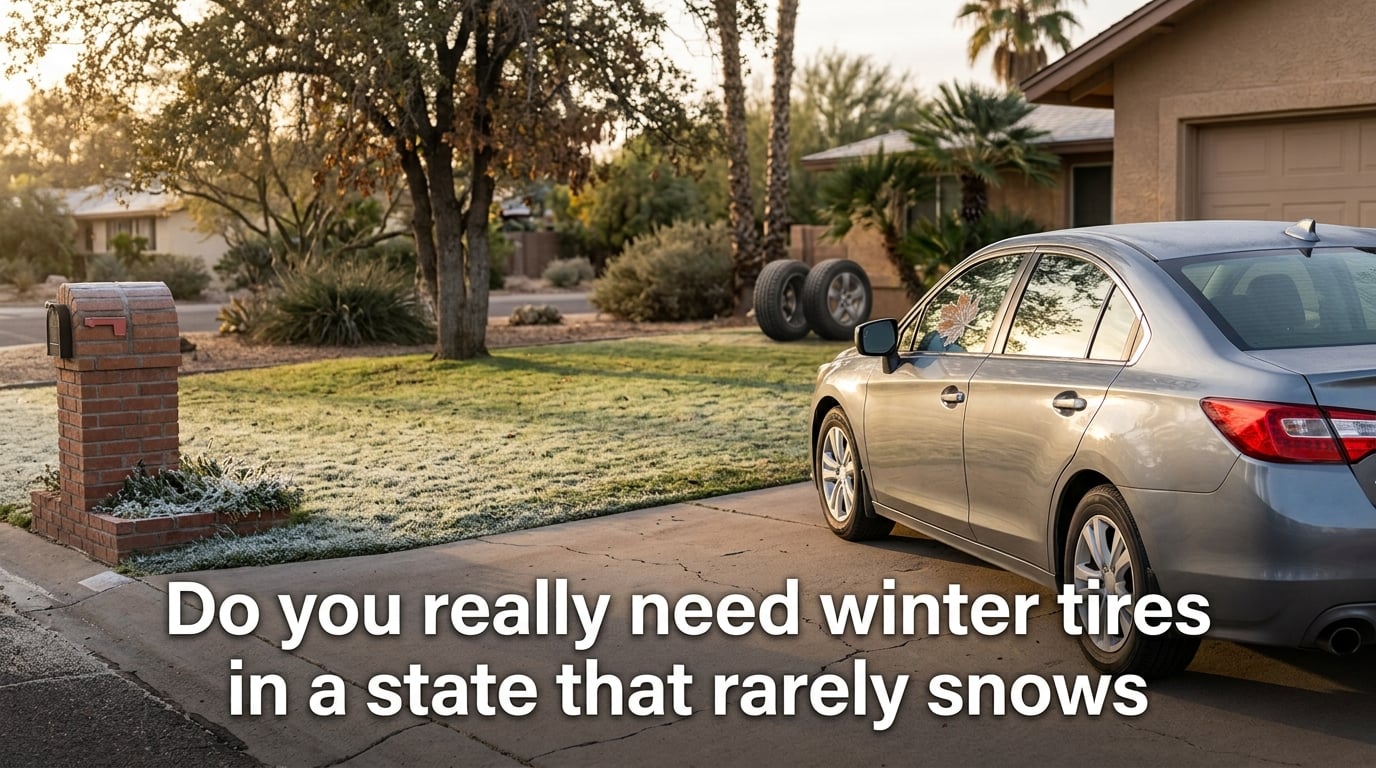
If you live in a state that rarely snows, you probably do not need a dedicated set of winter tires. What you do need is the right tire for the cold you actually get, and in most of the Sun Belt that is a 3PMSF-rated all-weather tire, not a true winter compound. The decision hinges on three things: how often temperatures drop below 45 degrees F, whether you face real ice and freezing rain, and whether you ever drive into mountain snow.
I have been through this decision myself, helping readers across Florida, Texas, Georgia, Arizona, and the California coast sort out what they actually need. Most of them were overbuying winter tires they never used, or under-buying all-weathers they should have had. This guide lays out the honest framework so you can stop guessing.
Table of Contents
Do You Really Need Winter Tires in a State That Rarely Snows?
The short answer: usually no. In a low-snow state, a true winter tire sits in your garage 90 percent of the year, wears out fast on warm pavement, and quietly costs you grip every time the temperature climbs above 45 degrees F. Most drivers in low-snow states are better served by a quality all-weather tire that carries the Three-Peak Mountain Snowflake (3PMSF) symbol.
You do need a dedicated winter tire if any of these apply to you:
- You regularly drive into mountain snow (Colorado, Utah, Vermont, the Sierra).
- Your winters include weeks of sub-freezing temperatures plus ice or freezing rain.
- You live on a rural, hilly, or unplowed road that ices early.
- Your commute crosses shaded bridges, overpasses, or tree-lined backroads that black-ice regularly.
- Your state or insurer offers a discount tied to winter tires (Colorado, Pennsylvania, parts of Canada) and you drive enough to recoup the swap hassle.
If none of those fit, the all-weather middle ground will outperform your all-seasons on the four or five cold snaps you actually see each year, and it will not punish you the rest of the time.
Why Cold Weather Matters More Than Snow Itself
Snow is the visible trigger, but cold is the real story. All-season tires are tuned for a wide temperature band, and their rubber compound hardens once the pavement drops below about 45 degrees F (7 degrees C). When the rubber stiffens, the tread cannot conform to the road surface, your contact patch shrinks, and you lose grip on cold, dry pavement before a single flake has fallen.
Winter tires use a softer, more silica-rich compound engineered to stay flexible in deep cold. They also pack thousands of extra sipes (tiny slits in the tread blocks) and deeper tread depth. Those sipes act like biting edges that grip snow and slush, and they evacuate the thin film of water that coats ice at the contact patch. Three independent test programs have measured winter tires cutting stopping distance by roughly 30 percent versus all-seasons on snow and ice at city speeds.
This is why the 45 degrees F threshold matters more than snowfall totals. Drivers in places like Atlanta, Raleigh, Dallas, or Tucson regularly hit freezing mornings even when no snow is forecast, and shaded bridges can hold ice long after the rest of the road has thawed. A tire that has gone stiff by mid-morning is exactly the wrong tool for that situation.
One quick note on the “7 7 rule” floating around in forums. It is shorthand for 7 degrees C, which is 45 degrees F, which is the cold-grip threshold you just read about. It is not a separate rule. It is the same one, restated.
All-Season vs All-Weather vs Winter Tires: What’s Actually Different
The naming here causes most of the confusion. “All-season” and “all-weather” sound interchangeable, but they are not the same tire.
All-season tires use a moderate rubber compound and tread pattern designed for the broadest mix of conditions. They carry an M+S (Mud and Snow) stamp on the sidewall because they meet a basic federal traction standard, but M+S is a low bar. All-seasons handle dry and wet roads well from spring through fall and stay adequate down into the mid-30s F. Below 45 F their compound stiffens and snow traction falls off fast.
All-weather tires sit between all-season and winter. They use a cold-flexible compound and an aggressive siping pattern, and they are certified with the Three-Peak Mountain Snowflake (3PMSF) symbol, meaning they passed an industry snow-traction test of at least 10 percent better grip than a standard all-season reference tire. A 3PMSF all-weather tire is legal where winter tires are required and can be left on year-round, even in warm southern summers, with acceptable wear.
Winter tires go further. They use an even softer rubber, deeper tread, and the densest siping of the three, optimized specifically for snow, ice, and sustained sub-freezing use. They wear quickly on warm pavement, handle poorly in heavy summer rain because the compound is too soft, and they should be swapped off by the time temperatures regularly climb past 50 F.
| Attribute | All-Season | All-Weather (3PMSF) | Winter |
|---|---|---|---|
| Cold-weather grip below 45 F | Limited | Good | Excellent |
| Snow traction | Minimal | Strong | Best |
| Ice performance | Fair | Good | Best (studless or studded) |
| Wet performance (warm) | Strong | Strong | Weak |
| Tread life in mixed use | Highest | Good | Poor if used year-round |
| Year-round usability | Yes | Yes | No |
| Best home climate | Mild winter, no real ice | Mild-to-moderate winter, occasional snow | Sustained cold and snow |
| Certification symbol | M+S | M+S and 3PMSF | M+S and 3PMSF |
For the rare-snow reader, the comparison essentially comes down to one question: is your “winter” mostly a handful of 28-degree mornings, or is it a real season? The first scenario is what all-weather tires were built for.
State-by-State: How Rare Snow Really Is Where You Live
Snowfall totals only tell part of the story. What matters is how often winter weather actually disrupts driving, including ice events, freezing rain, and extended cold. Here is how the rare-snow states break down in my experience.
Florida, Hawaii, southern California (Los Angeles, San Diego). Snow is essentially a curiosity. Cold mornings and patchy frost are the real winter hazard, especially on bridges and shaded stretches of I-75 or I-10. All-weather tires or quality all-seasons are more than sufficient here.
Texas, Louisiana, Mississippi, Alabama, Georgia (Atlanta area), South Carolina. Snow falls once every few years. The real problem is the surprise ice storm and the freezing-rain morning commute. Drivers in this band benefit enormously from 3PMSF all-weathers because the rubber stays flexible on those 25 F mornings without giving anything up the rest of the year.
Arizona (Phoenix, Tucson), inland southern California, southern Nevada. Almost no snow, almost no ice at lower elevations. Standard all-seasons are typically fine. The exception is anyone driving up to Flagstaff, the Mogollon Rim, or the Sierra, which we cover in the mountain-ski-trip section below.
Central and northern California, coastal Pacific Northwest, mid-Atlantic (Virginia, Maryland). This is the blurry edge. Some winters are mild, others drop a foot and close schools for a week. If your winters look like that, an all-weather tire is honestly the smartest single-set choice, because it covers both the snow year and the no-snow year.
Southern Appalachian mountain counties, the Texas Hill Country, Ozarks. Higher elevation changes the math fast. A “low-snow state” with a mountain county can still deliver genuine winter. If your commute climbs above 1,500 feet, treat your microclimate like a snow state and plan accordingly.
The AWD and 4WD Myth: Why Drivetrain Doesn’t Replace Tires
This is the single most common reason readers skip winter tires, and it is also the most dangerous misconception out there. All-wheel drive and four-wheel drive help your engine turn all four wheels at once. They do almost nothing for the two things that matter most in winter: stopping and steering.
Your antilock brake system (ABS) and electronic stability control (ESC) work with whatever tire is on the car, and an all-season tire below 45 F is already a stiffer, grippier-block tire that cannot bite into snow. AWD lets you accelerate up the icy hill confidently and then sail straight into the intersection because you could not stop. The crash data on AWD vehicles in winter is uncomfortably clear: AWD drivers are statistically more likely to be in winter accidents because they overconfidently enter situations their tires cannot handle.
The Reddit users in cold-climate tire threads echo this. A user who relocated from Central Texas to a snowy state put it plainly: all-seasons are nearly useless in snow because of the hard rubber compound. The drivetrain does not change the compound. If your winters include real cold and snow, you need winter (or at minimum 3PMSF all-weather) tires regardless of how many wheels your engine drives.
What to Do Instead: The Honest Cost Breakdown
Let us talk numbers, because cost is the real reason most readers end up here. A dedicated set of winter tires, mounted on a second set of wheels, will run most drivers somewhere between several hundred and four figures depending on vehicle size, plus 80 to 90 dollars per seasonal swap at a tire shop, plus storage if you do not have a garage. If your state rarely sees snow, that setup is parked and depreciating 90 percent of the year.
Three honest alternatives work better for the rare-snow reader.
Upgrade to a 3PMSF all-weather tire and stop swapping. One set, one swap-free year, decent grip on every cold snap, decent wear in summer heat. For the reader who fits the typical low-snow profile, this is the recommendation I make first.
Keep your all-seasons and buy a set of chains or a quality traction aid. If your “winter driving” is one mountain trip a year, a 100-dollar chain kit in the trunk beats a 1,000-dollar winter set that sits in your garage.
Rent a winter-equipped vehicle at your destination. For ski trips, the airport rental counter often has Subarus and similar crossovers already on winter or all-weather tires. You skip the logistics entirely.
Whatever you do, do not run a true winter tire year-round to avoid the swap. Winter compounds wear two to three times faster on warm pavement, handle poorly in heavy rain, and quietly cost you fuel economy because the soft rubber rolls with more resistance. EV drivers in low-snow states notice this most, because an extra 5 to 10 percent rolling resistance penalty translates directly into lost range every mile.
The Mountain-Ski-Trip Exception
This is the one scenario where the “I live in a low-snow state” answer changes. If your calendar includes an annual or twice-yearly drive to a snowy destination (Breckenridge, Park City, Killington, Whistler, Mammoth), your tires need to handle the trip, not just the driveway.
Three options work here. First, a 3PMSF all-weather tire on the car year-round. It will get you up most ski-trip mountain roads in all but the worst storms, especially with chains in the trunk. Second, an actual winter tire set swapped on for the trip and swapped off afterward, which is more work but more capable. Third, tires entirely: rent a winter-ready car on arrival, take a shuttle, or partner with a friend on snow tires.
Whatever you pick, remember the chain law. Most mountain states require chains or approved traction devices when conditions warrant, regardless of what tires you have. Carry them, and learn to install them before you are standing in a snowstorm at 8,000 feet.
One last honest note on studded tires, since this question comes up constantly. Studded winter tires do outperform studless on bare ice and packed snow, but most low-snow states restrict or ban them outright because they chew up asphalt. Unless you regularly drive on glacial ice, modern studless winter compounds and all-weather 3PMSF tires have closed most of the studded gap.
Quick Decision Checklist: Do You Need Winter Tires?
Run through this list. If you check three or more boxes, a real winter tire set is worth the investment. If you check one or two, an all-weather tire is probably your best year-round answer. If you check none, your current all-seasons are likely fine.
- I regularly drive into mountain snow more than twice a year.
- My winters include weeks of sub-freezing daytime temperatures.
- My commute or daily driving crosses unplowed rural, hilly, or shaded roads.
- My area gets freezing rain or black-ice events more than a few times per year.
- My state or insurer offers a winter-tire discount that meaningfully changes the math.
- I keep my car for 5 or more years and can amortize a second set across that span.
- I have the storage space (or paid storage) for a second wheel-and-tire set.
Frequently Asked Questions
Do I actually need winter tires?
You need winter tires if you regularly drive in sustained sub-freezing temperatures, real snow, or on icy or unplowed roads. If your winters are mostly above 45 degrees F with rare frost, a 3PMSF all-weather tire is the smarter single-set choice for most low-snow drivers.
What is the 45 degrees F rule for winter tires?
Below roughly 45 degrees F (7 degrees C), the rubber compound in standard all-season tires stiffens and loses grip on cold pavement, even when the road is dry. Winter tires and 3PMSF all-weather tires use softer, cold-flexible compounds designed to stay pliable below that threshold.
At what temperature should I install winter tires?
Install winter tires once your area consistently drops below 45 degrees F, usually November in cold regions. Remove them when temperatures regularly climb back above 50 degrees F in spring, because the soft winter compound wears quickly on warm pavement.
Are all-weather tires better than all-season tires in snow?
Yes. All-weather tires carry the Three-Peak Mountain Snowflake (3PMSF) symbol and use a softer, more heavily siped compound than all-seasons. In independent snow-traction testing, a 3PMSF all-weather tire typically delivers closer to winter-tire grip while remaining year-round usable.
Do AWD or 4WD vehicles still need winter tires?
Yes. All-wheel drive and four-wheel drive help you accelerate in snow, but they do not help you stop or steer, which depend entirely on tire grip. AWD on all-season tires stops in roughly the same distance as a two-wheel-drive car on all-seasons, and that distance grows sharply below 45 degrees F.
The Honest Bottom Line
Do you need winter tires in a state that rarely snows? For most readers in the Sun Belt, the answer is no, a true winter set is overkill. What you actually need is a tire whose compound stays flexible below 45 degrees F, which puts a 3PMSF all-weather tire at the top of the list, ahead of dedicated winters you would barely use and ahead of all-seasons that stiffen exactly when conditions turn dangerous.
Spend ten minutes with the decision checklist above. If three or more items apply, look at a real winter set or accept the swap and storage hassle. If one or two apply, an all-weather tire is the single best upgrade you can make this season. If none apply, stay on your current all-seasons, watch for bridge frost on cold mornings, and put the tire money toward an alignment or a brake service instead.
Either way, the question was never really about snow. It was about cold, and now you know which tire handles your cold best.