
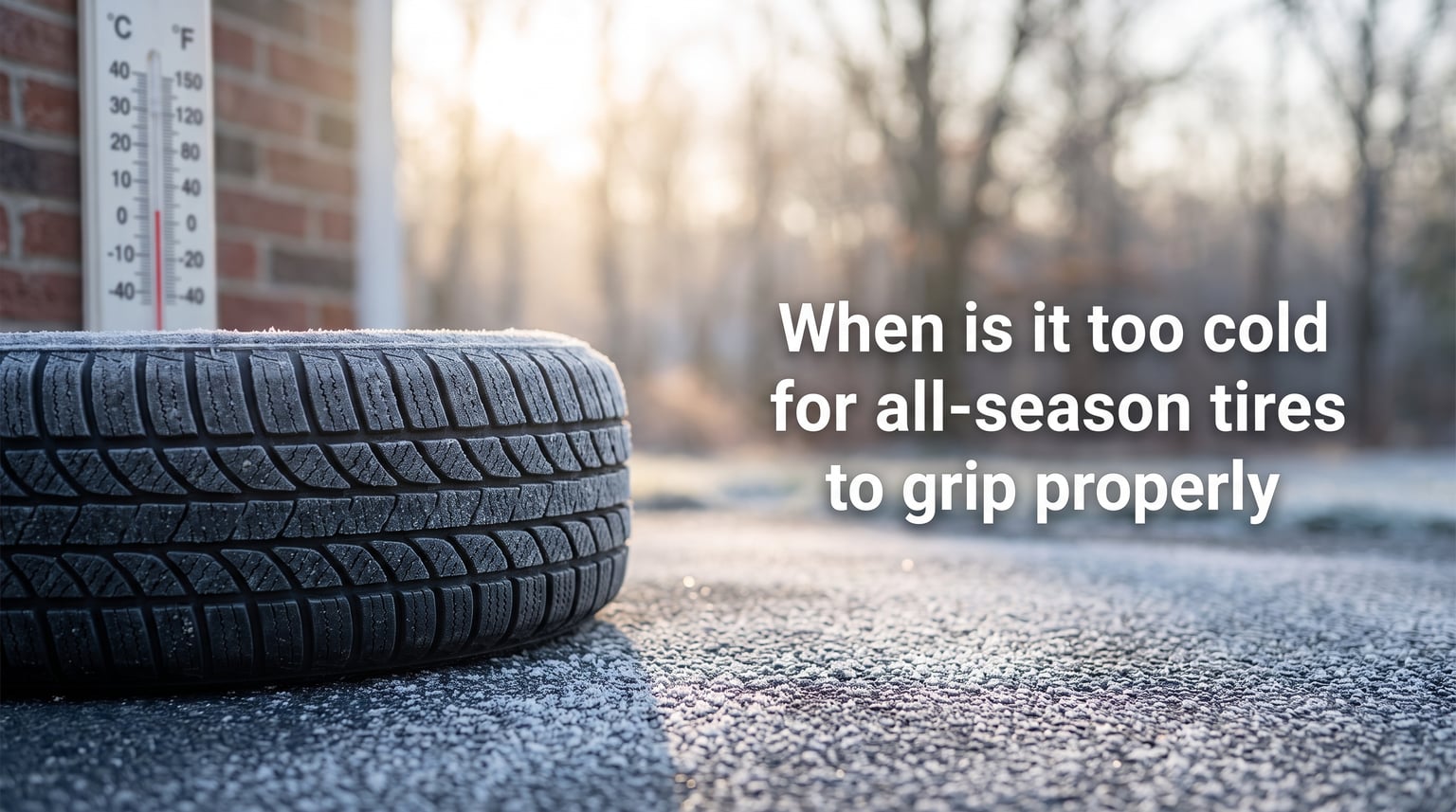
All-season tires begin to lose grip when temperatures drop below 45°F (7°C). Below that threshold, the rubber compound stiffens and stops conforming to road textures, which means longer stopping distances and reduced traction even on dry pavement — before any snow or ice shows up.
I spend a lot of time in the shop talking to drivers who are surprised by this. They bought “all-season” tires expecting year-round performance, then the first cold morning hits and their car feels different. The traction control light flickers on the highway. The steering gets vague. The brakes take longer to slow down.
This guide breaks down exactly what happens to all-season tires in cold weather, the temperatures where grip drops off, and when you should consider switching to winter or all-weather tires. I’ve pulled together tire-industry data, independent testing results, and forum feedback from drivers in cold climates to give you the full picture.
Table of Contents
Why Do All-Season Tires Lose Grip in Cold Weather?
All-season tires lose grip in cold weather because their rubber compound stiffens below 45°F (7°C), reducing the tire’s ability to conform to road surface textures.
Modern tire rubber is a blend of synthetic polymers, silica fillers, and other additives designed to balance grip, wear, and rolling resistance. At warm temperatures, these polymers stay flexible — the tread can bend, wrap around small bumps, and grip microscopic textures in the pavement.
When the temperature drops, the polymer chains slow down and lose flexibility. Tire engineers call this shift the glass transition phase. Below this point, the rubber behaves more like hard plastic than soft, grippy elastomer.
The Polymer Chemistry Behind Cold Grip Loss
Here’s the short version: tire manufacturers tune the rubber compound for a specific temperature window. All-season compounds are optimized for roughly 45°F to 100°F. That covers most of the year in temperate climates — but it leaves a cold-weather gap.
Winter tires use a different polymer blend with more natural rubber and higher silica content. That compound stays flexible well below freezing, sometimes down to -22°F (-30°C) or lower. The trade-off is faster wear in warm weather, which is why you take them off in spring.
How Tread Design Compounds the Problem
Rubber isn’t the only factor. All-season tread patterns prioritize wet roads and light snow over true winter conditions. The sipes (tiny slits in the tread blocks) are shallower than winter-tire sipes, and the channels aren’t as aggressive at evacuating slush.
When the rubber stiffens, those sipes can’t flex open to bite into snow and ice. So you get a double hit: less grippy rubber on top of a tread pattern that can’t deploy its limited winter features.
At What Temperature Do All-Season Tires Stop Gripping Properly?
All-season tires stop gripping properly below 45°F (7°C). The decline is gradual at first, then accelerates as temperatures drop toward and below freezing.
Continental and other major tire manufacturers have tested this extensively. Continental’s research shows all-season tires can lose up to 30% of their traction at 45°F compared to their performance at 70°F — and that’s on dry pavement, with no snow or ice involved.
The decline continues as temperatures fall. At 30°F, grip loss is more pronounced. At 15°F and below, all-season tires are operating well outside their design window.
Stopping Distance by Temperature Band
The table below shows typical stopping-distance increases for all-season tires compared to dedicated winter tires. Numbers are based on independent testing at 30 mph on a consistent surface.
| Temperature | Surface | All-Season Stopping Distance | Winter Tire Stopping Distance | Difference |
|---|---|---|---|---|
| 45°F (7°C) | Dry pavement | Baseline | Baseline + 5-10% | Minimal |
| 30°F (-1°C) | Dry pavement | +10-15% | Baseline | Noticeable |
| 30°F (-1°C) | Wet pavement | +20-25% | Baseline | Significant |
| 15°F (-9°C) | Snow / ice | +30-40% | Baseline | Major |
| Below 15°F | Hard-packed snow | +40% or more | Baseline | Critical |
The practical takeaway: by the time your morning commute hits 30°F, your all-season tires are already working harder to stop the car. Drop another 15 degrees and you’re driving on tires that weren’t designed for these conditions.
How Cold Tire Pressure Compounds Grip Loss
Cold temperatures reduce tire pressure by roughly 1 PSI for every 10°F drop in ambient temperature, and low pressure shrinks the contact patch that grips the road.
This is the often-overlooked second hit. Even if your tires are in great shape and the tread is deep, cold air deflates them. A tire inflated to 35 PSI at 70°F might read 28 PSI on a 20°F morning.
The 4 PSI rule is a quick reminder: check your pressure whenever seasons change, and especially before the first sustained cold snap.
Why Low Pressure Makes Everything Worse
Lower pressure means a smaller contact patch — the literal footprint where rubber meets road. That footprint is what generates grip. A tire at 28 PSI has less rubber on the road than the same tire at 35 PSI.
Combine a smaller contact patch with stiff, cold rubber, and you’ve stacked two grip-reducing factors. Drivers often notice the vague steering or longer braking without realizing pressure is part of the problem.
Check your tire pressure monthly during cold months. Inflate to the pressure listed on your door jamb sticker, not the number on the tire sidewall.
All-Season vs All-Weather vs Winter Tires
All-season tires work above 45°F, all-weather tires handle cold and light snow year-round, and winter tires deliver the best grip below 45°F and on snow or ice.
This is the comparison most drivers need. The names sound similar, but the capabilities are very different.
Quick Comparison Table
| Tire Type | Temperature Range | Tread Design | Rubber Compound | Best For |
|---|---|---|---|---|
| All-Season | 45°F and above | Moderate sipes, balanced pattern | Warm-weather polymer blend | Mild climates, no real winter |
| All-Weather | Below 45°F capable | 3PMSF certified, deeper sipes | Cold-flexible polymer blend | Cold regions with moderate snow |
| Winter | Below 45°F, optimized for sub-freezing | Aggressive sipes, deep channels | High-silica, natural rubber blend | Snow, ice, and sub-freezing temps |
What Makes All-Weather Tires Different
All-weather tires carry the 3PMSF (Three-Peak Mountain Snowflake) symbol. That certification means they’ve passed a standardized snow-traction test. All-season tires typically carry only the M+S (Mud and Snow) marking, which is a self-declared designation with no minimum performance standard.
If you live somewhere with real winter but don’t want the hassle of seasonal swaps, all-weather tires are a legitimate middle ground. They’re not as good as winter tires in deep snow, but they’re a major upgrade over all-seasons in cold conditions — and you can leave them on year-round.
When Should You Switch to Winter or All-Weather Tires?
Switch to winter or all-weather tires when temperatures consistently drop below 45°F (7°C), typically from late October through early April in northern climates.
This is the 7/7 rule: when it’s 7°C (45°F) or colder, winter or all-weather tires are safer. The timing varies by region, but the principle is the same.
Regional Switching Calendar
| Region | Typical Switch Window | Recommended Tire Type |
|---|---|---|
| Pacific Northwest | November to March | All-weather or winter |
| Mountain West | October to April | Winter (with severe snow rating) |
| Upper Midwest / Northeast | November to April | Winter |
| Southeast | Rarely needed | All-season (year-round) |
| Canada (most provinces) | October to April | Winter (legally required in Quebec) |
Does AWD or 4WD Change the Equation?
No. All-wheel drive helps you accelerate in snow, but it doesn’t help you stop or steer. Braking and cornering depend on tire grip, not drivetrain layout.
Drivers with AWD and 4WD vehicles sometimes skip winter tires because they feel confident in their traction. Then they slide through an intersection because their all-season tires couldn’t grip the icy patch under the stop sign. AWD is not a substitute for winter tires.
Warning Signs Your All-Season Tires Are Struggling
Your all-season tires are struggling when you notice longer braking distances, vague steering response, or traction control activation on cold dry roads.
Cold-weather grip loss doesn’t happen all at once. It builds gradually, and the signs are easy to miss if you’re not paying attention.
Common Warning Signs
You brake earlier than usual but still feel like you’re going to slide. Your traction control light flickers on clear, cold mornings. The steering feels loose or numb, especially on highway curves.
Frost on the windshield is another reliable indicator. If you’re scraping frost, your tires are operating below their design temperature.
Worn tread makes everything worse. All-season tires with 4/32″ of tread or less perform even more poorly in cold weather. The remaining rubber can’t channel water or flex into snow. If your tires are approaching the wear bars, consider replacing them before winter — or switching to a dedicated winter or all-weather set.
Frequently Asked Questions
At what temperature do tires lose grip?
Tires begin to lose grip when ambient temperatures drop below 45°F (7°C). All-season tire rubber stiffens at this threshold, reducing the tire’s ability to conform to road textures and increasing stopping distances by 10-15% on dry pavement and up to 30-40% on snow and ice.
What is the 4 PSI rule on tires?
The 4 PSI rule is a guideline reminding drivers that tire pressure drops roughly 1 PSI for every 10°F decrease in ambient temperature. A tire inflated to 35 PSI at 70°F may read 28-31 PSI on a 20°F morning. Check pressure monthly during cold months and inflate to the door-jamb recommendation, not the sidewall maximum.
What is the 7 7 rule for winter tires?
The 7/7 rule states that when temperatures drop to 7°C (45°F) or below, winter or all-weather tires provide better grip than all-season tires. This is the temperature at which all-season rubber begins to stiffen. Switch to winter or all-weather tires in the fall once overnight lows consistently hit 7°C.
Is 40 degrees too cold for summer tires?
Yes. Summer tires are designed for warm-weather performance and use a compound that stiffens dramatically below 45°F. At 40°F, summer tires lose significant grip on cold pavement. Summer tires should not be used when temperatures regularly fall below 45°F, regardless of whether snow is present.
Is it safe to mix winter tires with all-season tires?
Mixing winter tires with all-season tires on the same vehicle is not recommended. Mismatched tires create unpredictable handling, especially during braking and cornering on slippery surfaces. If you must run two different types, mount them in pairs on the same axle — winter on the rear for rear-wheel-drive cars, winter on all four for front-wheel-drive cars.
At what temperature should winter tires be replaced?
Winter tires should be replaced when tread depth reaches 4/32 inch (about 3mm) or when the rubber shows signs of hardening and cracking, typically after 4-6 seasons of use. Winter tires also wear out faster in warm weather, so remove them when temperatures consistently stay above 45°F (7°C).
How hot is too hot for all-season tires?
All-season tires perform best between 45°F and 100°F. Above 100°F, the rubber can become overly soft, accelerating wear and reducing steering precision. Extreme heat (above 120°F on the road surface) can damage the compound, but all-season tires handle summer heat far better than winter tires do.
Why do my tires keep losing traction?
Tires lose traction for several reasons: cold weather below 45°F stiffens the rubber compound, low tire pressure reduces the contact patch, worn tread limits grip, and contaminated or wet roads reduce friction. If traction loss happens only in cold weather, the most likely cause is all-season tires operating outside their temperature range — switching to winter or all-weather tires usually solves the problem.
The Bottom Line on All-Season Tires and Cold Weather
All-season tires grip properly down to 45°F (7°C). Below that threshold, the rubber compound stiffens, stopping distances grow, and your safety margin shrinks — even on dry pavement with no snow in sight.
The fix is straightforward: monitor your tire pressure during cold months, watch for warning signs like vague steering or traction-control activation, and switch to winter or all-weather tires before temperatures consistently drop below 45°F.
Drivers in northern climates who deal with real winter conditions benefit most from a dedicated winter-tire set. Drivers in moderate climates with occasional cold snaps can get by with 3PMSF-certified all-weather tires that stay on year-round.