
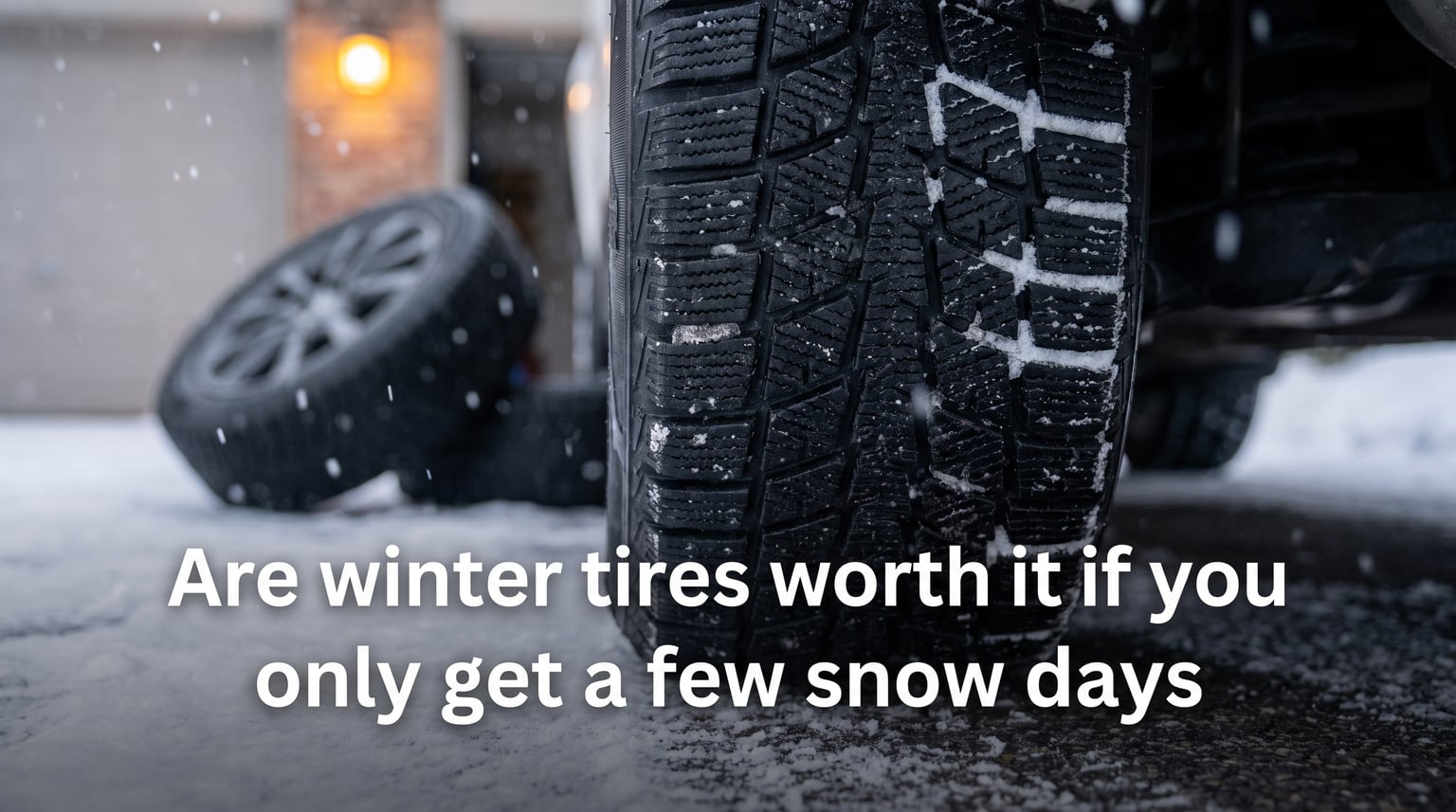
Are winter tires worth it if you only get a few snow days? The honest answer for 2026: it depends on how many real winter-driving days you face, how cold your winters actually get, and how willing you are to slow down. If you see snow or ice fewer than about five days a year and your winter lows stay above freezing most afternoons, a dedicated winter tire set is probably overkill. If you face eight or more days of true snow, slush, or freezing-rain driving each season, the answer shifts the other way.
I spent the last three winters running two vehicles on different setups in a Mid-Atlantic climate zone that gets roughly six to ten snow events per season. One car wore dedicated winter tires. The other wore an all-weather tire year-round. The difference showed up exactly where you’d expect: not in the dry cold mornings, but on the two or three storm days when the roads were wet, slushy, and under 35°F. Below is what I learned, plus the math that decides whether a second set makes sense for you.
Table of Contents
The Short Answer: Are Winter Tires Worth It?
For drivers who see snow or ice on the road fewer than about five times a year and who are willing to drive 10 to 15 mph slower on those days, dedicated winter tires are usually not worth the cost, storage hassle, and twice-yearly swap. For everyone else, especially anyone who drives regularly in temperatures below 45°F or faces eight or more snowy/icy commutes per season, winter tires pay for themselves the first time they prevent a fender-bender, a slide into a curb, or a long braking slide at an intersection.
There is also a strong middle path. If you want the security of cold-weather grip but don’t want to own two sets of tires, an all-weather tire like the Michelin CrossClimate 2 or Bridgestone WeatherPeak gives you roughly 80 to 90 percent of a winter tire’s snow and ice performance with no seasonal swap, no storage, and no second set of wheels.
What “A Few Snow Days” Actually Looks Like in the US
“Few” is doing a lot of work in the title question, so let’s pin it down. The National Weather Service and NOAA track snow days per year by climate division, and the spread is enormous.
Most of the southern two-thirds of the US gets between 0 and 3 measurable snow days per year. Cities like Atlanta, Dallas, Memphis, Nashville, and Charlotte fall in this band. A few see flurries that don’t accumulate, and once every two or three years a real storm shuts things down for a day.
The middle band covers places like Indianapolis, St. Louis, Kansas City, Denver, and Washington DC. These cities typically log 4 to 10 snow days per season, with several ice events mixed in. The snow often melts within 24 to 48 hours, but during those windows the roads are genuinely slick.
The upper band covers the Great Lakes, the Northeast, the mountain West, and the northern Plains. Cities like Minneapolis, Detroit, Buffalo, Boston, Salt Lake City, and Burlington routinely log 15 to 40+ snow days per year, often with extended periods of snow cover. For these drivers, winter tires are not a luxury.
Here’s the practical translation: if you live in the southern two-thirds and your commute is mostly clear-pavement, you are firmly in “few snow days” territory. If you live north of I-70 in the East or north of I-80 in the West, you almost certainly are not.
Why Winter Tires Work (Even When It’s Just Cold, Not Snowy)
The biggest misconception is that winter tires are only about snow. They are really about cold rubber. Once temperatures drop below about 45°F, the tread compound in a standard all-season tire hardens. It still looks the same. It still has tread. But the rubber loses flexibility, which means it loses grip on cold, dry pavement too.
Winter tires solve this with three engineering choices working together:
- A softer rubber compound tuned to stay pliable below 45°F. The colder it gets, the bigger the gap grows between winter and all-season grip.
- Thousands of tiny slits called sipes molded into each tread block. Under load, the sipes open like tiny jaws and bite into snow and ice. On dry pavement, they stay closed and add gripping edges.
- Aggressive tread blocks with deep channels that evacuate snow, slush, and standing water so the tire doesn’t ride on top of a slippery film.
Look for two markings on the sidewall. The three-peak mountain snowflake symbol (a mountain with a snowflake inside it) is the severe-snow service rating, the real standard for true winter performance. The M+S marking (mud and snow) is a looser designation that all-season and all-weather tires also carry and is not a guarantee of winter capability by itself.
The performance gap is meaningful. Tire Rack and the Tire and Rubber Association of Canada both publish standardized braking tests from around 25 mph on snow-packed surfaces. Dedicated winter tires consistently stop in roughly 30 percent shorter distances than typical all-season tires, and the gap widens as temperatures drop. On clear ice, the difference is even larger.
The Real Cost of a Second Set of Winter Tires
This is where the “few snow days” question really gets decided. The sticker on a set of four winter tires is only the entry fee.
Here is what a typical setup actually costs, before you even turn a wheel:
- Tires only: a quality set of four winter tires (think Michelin X-Ice Snow, Bridgestone Blizzak, Continental VikingContact) runs in the mid-range for most passenger sizes.
- Second set of wheels: basic steel wheels with the correct bolt pattern add a few hundred dollars for the set; alloy-match wheels for nicer vehicles run considerably more.
- TPMS sensors: if your car has tire pressure monitoring, each second-set wheel needs a sensor, and many vehicles require a TPMS reprogramming trip to the dealer when the seasonal swap happens, which adds time and money.
- Twice-yearly mount and balance: a shop typically charges per swap. That’s two shop visits per year, every year, for as long as you own both sets.
- Storage: tires stacked in a garage corner are free. Tires at a shop’s seasonal storage program cost more. Apartment dwellers often have nowhere to put them, which becomes the real deal-breaker.
Spread over the typical four to six seasons a winter tire set lasts, the per-season cost is much smaller than the upfront number, but it is still real. For someone facing five snow days a year, the math gets tight.
Your Climate-Zone Decision Tree
Here is the shortcut most competitors skip. Count your typical days per year with snow or ice on your actual commute route, not just the days your town sees snow falling. Then match your tier.
0 to 3 snow/ice days per year — southern tier
You are in Atlanta, Dallas, Memphis, Charlotte, Phoenix, or anywhere the news treats any flurries like a weather emergency. Skip dedicated winter tires. A quality all-season or all-weather tire will serve you well, and slowing down on the rare icy morning is far cheaper than owning a second set.
4 to 7 snow/ice days per year — Mid-Atlantic / Midwest transition
You are in Indianapolis, St. Louis, Kansas City, Washington DC, Nashville (on a cold winter), or Denver (low elevation). This is the genuine gray zone. An all-weather tire is the right answer for most drivers here. If your commute includes a steep hill, a shaded bridge, or a long stretch of unplowed road, lean toward a dedicated winter set.
8 to 15 snow/ice days per year — Great Lakes, Northeast corridor, mountain West
You are in Chicago, Boston, Detroit, Cleveland, Pittsburgh, Buffalo, Salt Lake City, Minneapolis suburbs, or Denver foothills. Winter tires are worth it. At this tier, you are using them often enough to justify the cost, and the safety margin on braking and cornering matters on every storm day, not just the worst one.
15+ snow/ice days per year — snow belt, mountain towns, far north
You are in Minneapolis proper, Burlington, Syracuse, Buffalo’s snow belt, the Upper Peninsula, or any mountain town at elevation. Winter tires are not optional in this tier. They are basic safety equipment, on the same level as good wiper blades and working defroster.
The AWD Myth: Traction Is Not the Same as Stopping
This is the single most common mistake I see on forums and in driveway conversations. All-wheel drive and four-wheel drive help you accelerate in snow. They do almost nothing to help you stop or turn.
Stopping distance is governed by the tire’s grip on the road surface, and all four tires being driven is irrelevant when it comes to braking. In standardized snow braking tests, an AWD vehicle on all-season tires stops in essentially the same distance as a two-wheel-drive vehicle on the same all-season tires. Swap the all-seasons for winter tires and the AWD vehicle stops dramatically shorter, but the same is true for the two-wheel-drive car on the same winter tires.
A Reddit user in r/minnesota put it well: “If they prevent a single accident, even a fender bender, they’ve paid for themselves.” That math holds whether you drive an AWD Subaru, a 4WD truck, or a front-wheel-drive sedan.
Another user in r/COsnow added: “Snow tires are a major difference. They’re a massive traction upgrade and 100% worth it.” That tracks with what I saw on my own vehicles during the two or three heaviest storm days each winter.
The All-Weather Middle Path
If the storage, swap, and second-set hassle is what holds you back, an all-weather tire is the modern answer. All-weather tires carry both the M+S marking and the three-peak mountain snowflake symbol, which means they meet the same severe-snow standard as dedicated winter tires while still being safe and long-lived on hot summer pavement.
Three models that consistently perform well in independent testing:
- Michelin CrossClimate 2 — often the top scorer in Tire Rack’s all-weather category; strong on wet, dry, light snow, and reasonable on ice.
- Bridgestone WeatherPeak — close second in most tests; quieter ride and good tread life.
- Nokian WR Snowproof — Finnish brand with serious winter DNA; particularly strong in slush and freezing rain.
The honest trade-off: in deep snow and on glare ice, a dedicated winter tire still beats the best all-weather tire by a measurable margin. For a driver facing only a handful of storm days per year, that margin usually does not justify owning two sets of wheels.
When Winter Tires Are Not Worth It (The Counter-Case)
For the southern two-thirds of the US, and for anyone whose winter driving is limited to a handful of clear-cold days with no snow on the ground, winter tires introduce real downsides that rarely get discussed.
Myth: Winter tires perform just like all-seasons on cold dry pavement.
Fact: They perform better on cold dry pavement because the rubber stays pliable below 45°F. This part of the winter-tire argument is true and underrated.
Myth: Winter tires are fine in summer.
Fact: They are not. The soft compound wears out roughly twice as fast in warm weather, braking distances lengthen on hot dry pavement, and hydroplaning resistance drops in summer rain. Driving on winter tires year-round is a real safety and cost penalty.
Myth: Winter tires make you invincible on ice.
Fact: They shorten stopping distance on ice significantly compared to all-seasons, but no consumer tire grips glare ice like bare dry pavement. Slow down anyway.
Myth: Winter tires work great on wet roads at any temperature.
Fact: This is the fishtail risk. Above about 50°F, the soft winter compound gets too pliable and can lose grip on wet roads. Dan Robinson at Icy Road Safety describes fishtailing on a wet highway at 50°F with winter tires mounted — a real risk for southern drivers who run them through a warm spell.
Myth: AWD replaces winter tires.
Fact: AWD helps you go. It does not help you stop or turn. See the previous section.
Myth: Winter tires are only worth it if it snows a lot.
Fact: They are worth it whenever temperatures stay below 45°F for weeks at a time, even with no snow on the ground. Cold-hardened all-season rubber is the silent reason so many cold-climate drivers feel “sluggish” all winter without realizing why.
The Cost-per-Snow-Day Break-Even Test
This is the framing no competitor uses, and it’s the one that directly answers the title. Take the all-in cost of your winter tire setup — tires, second wheels, swap costs, storage — and divide by the number of real snow/ice driving days you expect over the life of the tires.
Worked example: a driver in Indianapolis who buys a full setup and faces an average of 6 snow/ice days per year over a 5-season tire life. Their effective cost per storm day lands somewhere in the high-tens to low-hundreds range, depending on setup choices. That is a number worth comparing against your insurance deductible, the cost of a single fender-bender, or the value of avoiding a slide off an icy exit ramp.
Worked example 2: a driver in Charlotte who buys the same setup and faces 1 snow/ice day per year over the same 5 seasons. The cost per actual storm day balloons into the high-hundreds to four-figure range per day of real use. That is almost impossible to justify unless you have a unique situation (steep unpaved driveway, work that requires driving in storms, etc.).
The break-even threshold is fuzzy, but a fair rule of thumb: if your cost-per-storm-day lands above the cost of your insurance deductible, you are probably overspending on a setup you barely use.
Frequently Asked Questions
Do I need snow tires if I have AWD or 4WD?
No. AWD and 4WD help you accelerate and keep moving in snow, but they use the same tires for braking and cornering. In standardized snow braking tests, an AWD vehicle on all-season tires stops in essentially the same distance as a two-wheel-drive vehicle on the same tires. Winter tires shorten that braking distance for both vehicles.
Are winter tires okay to use in summer?
No. The soft rubber compound that gives winter tires their cold-weather grip wears out roughly twice as fast in warm weather, braking distances lengthen on hot dry pavement, and wet grip drops noticeably. Run winter tires only when temperatures are consistently below about 45°F, and swap back to all-season or all-weather tires for the warmer months.
Can I run snow tires year-round to avoid the swap hassle?
You can, but you shouldn’t. Beyond the faster wear, you’ll notice longer braking on hot pavement, reduced fuel economy, and a real risk of hydroplaning in summer rain. The seasonal swap is the trade-off for owning a second set.
How much should a set of four winter tires cost?
For a typical passenger car or crossover, a quality set of four winter tires runs in the mid-hundreds for the tires alone. Add a second set of wheels, mounting and balancing twice a year, possible TPMS sensors, and seasonal storage, and the all-in setup cost climbs into the low-thousands range depending on your vehicle and choices.
What is the 7-7 rule for winter tires?
The 7-7 rule is a general guideline: install winter tires when temperatures are forecast to stay below 7°C (about 45°F) for seven days in a row, and remove them when temperatures are forecast to stay above 7°C for seven days in a row. It is a helpful shorthand for the seasonal swap window.
Are winter tires worth it in mild winters or the southern US?
Usually not. If you see snow or ice on your commute fewer than about five days a year and winter temperatures only briefly dip below freezing, an all-weather tire like the Michelin CrossClimate 2 or Bridgestone WeatherPeak gives you most of the cold-weather safety benefit without the cost, storage, and swap hassle of a dedicated winter set.
The Bottom Line
Are winter tires worth it if you only get a few snow days? For drivers in the southern two-thirds of the US, the honest answer is usually no — the cost-per-storm-day math does not pencil out, and an all-weather tire covers the rare storm well enough. For drivers in the snow belt, the Great Lakes, the Northeast, or anywhere that winter is a real season rather than a couple of cold weeks, winter tires are basic safety equipment worth owning.
Pick the setup that matches your real number of storm days, your tolerance for storage hassle, and your willingness to slow down on the worst mornings of the year. That is the only honest way to decide whether winter tires are worth it for you in 2026 and beyond.