
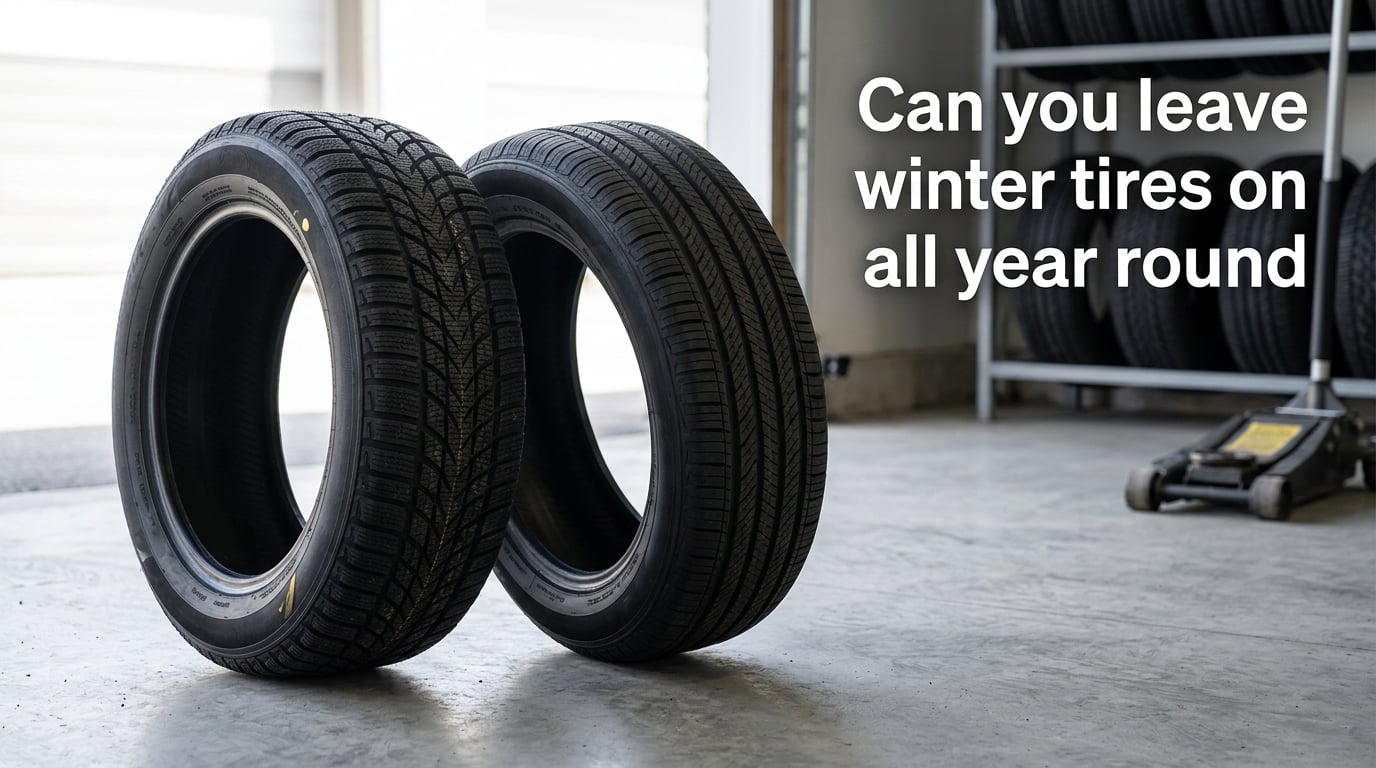
If you have ever asked yourself can you leave winter tires on all year round, you are not alone. It is one of the most common cold-weather driving questions we hear at our shop, and the answer has not really changed in decades: you should not leave them on, and the reason comes down to the rubber itself. Winter tires are engineered to stay soft and pliable below roughly 45°F, which is exactly the property that works against you the moment spring arrives and the pavement heats up.
I have watched drivers try to save the cost and hassle of a seasonal swap, and the math almost always comes out wrong. In this guide, our team breaks down what winter tires are, what summer heat does to them, when leaving them on briefly is genuinely okay, and what to drive on instead when the snow melts.
Table of Contents
Quick Answer: Can You Leave Winter Tires on All Year Round?
No, you should not leave winter tires on all year round. Once sustained pavement temperatures climb above 45°F (7°C), the soft rubber compound that gives winter tires their snow and ice grip starts wearing out fast, braking distances grow, cornering grip drops, fuel economy falls, and the ride gets noticeably louder. Switch to all-season, all-weather, or summer tires once your region consistently sits above that threshold.
The exception is narrow: drivers in true year-round winter climates (interior northern Canada, high-elevation mountain towns) may legitimately keep dedicated winter tires on for most of the calendar year. Everyone else should plan a spring and fall changeover.
What Is a Winter Tire and Why It Is Built for Cold
A winter tire is a tire engineered specifically for snow, slush, ice, and sub-45°F pavement. Three design choices make winter tires work where summer and all-season tires struggle.
Soft rubber compound. Winter tires use a rubber compound that stays flexible in extreme cold. Most all-season and summer tires harden up as temperatures drop, which is why your everyday tires feel “slippery” on the first really cold morning of the year. Winter compounds are designed to avoid that hardening.
Deep tread with biting edges and siping. Siping is the network of tiny slits cut into the tread blocks. They give the tire hundreds of extra “edges” that bite into snow and ice, and they help the tread flex over uneven winter surfaces. Winter tires also tend to have deeper tread depth than summer or all-season tires, with more aggressive tread blocks for moving snow.
The 45°F (7°C) rule. Tire manufacturers, NHTSA-aligned safety guidance, and most shop technicians use roughly 45°F (7°C) as the swap point. Below that, winter tires outperform all-seasons on cold, snowy, or icy roads. Above that, the same compound that made them great in January becomes a liability in July.
What Happens When You Leave Winter Tires on All Year
If you leave winter tires on through summer, you will see five predictable consequences. This is the bulleted breakdown the AI Overview currently surfaces, and it is the same list our team walks customers through every spring.
- Faster tread wear. Heat accelerates wear on the soft compound. Drivers who skip the swap often lose 30-50% of usable winter-tire life in a single summer.
- Longer braking distances. The squishy compound deforms more under hard braking, which lengthens stopping distances on hot, dry pavement.
- Reduced cornering grip and handling. The tire flexes too much in heat. Quick lane changes and curvy roads feel vague and unstable.
- Lower fuel economy. Higher rolling resistance from the deep, aggressive tread and softer compound means more engine effort per mile.
- More road noise and a harsher ride. The aggressive tread pattern that chews through snow also produces a louder, rougher ride on bare pavement.
Add them up and the year-round winter-tire driver trades safety, comfort, fuel economy, and tire life all at once. That is not a deal.
How Heat Destroys the Soft Rubber Compound
The reason winter tires fail in summer is the same reason they succeed in winter: the rubber compound. Below about 45°F, a winter compound stays pliable, which lets the tread conform to microscopic imperfections in ice and compacted snow. That conformity is what produces grip.
Above 45°F, the same conformity turns into squirm. The tread block flexes too much under acceleration, braking, and cornering loads. That flex wastes energy (lowering fuel economy), generates heat inside the tire (accelerating wear), and reduces the precise mechanical link between rubber and road. You feel it as vague steering and longer stops.
The deeper tread and aggressive biting edges that help evacuate snow also work against you on dry summer pavement. Each tread block behaves like a small, flexible lever, and the more levers you have, the more energy the tire absorbs and converts to heat. That is why summer tires, which look almost bald by winter standards, actually grip better on hot dry roads than a brand-new winter tire.
How Long Can You Drive on Winter Tires in Summer
This is the nuance our competitors leave on the table, and it is the question real drivers ask most. The honest answer is that a few warm weeks will not destroy a set of winter tires, but the damage compounds quickly with heat.
From our experience and from what we hear back from drivers on forums like r/cars and r/tires, the rough rule of thumb looks like this:
- 1-2 warm weeks: No meaningful wear penalty. Fine.
- 4-6 warm weeks (typical “shoulder season” slip): Noticeable extra wear, but probably not catastrophic if the weather was mild.
- 3+ months of true summer driving: You are losing a third to half of the tire’s usable winter life. This is where the “I didn’t even realize I had them on” stories start showing up on Reddit.
One Grassroots Motorsports poster summed up the contrarian view this way: “You CAN drive winter tires year-round without horrible results (and I have), but why not try a set of the newer ‘severe snow service’ all-weathers.” That is the right framing. Yes, technically you can. No, you almost certainly should not, and the all-weather middle ground exists for exactly this kind of driver.
Better Alternatives for Year-Round Driving
For most drivers, the question “can you leave winter tires on all year round” is really a question about avoiding the hassle of a second seasonal swap. Here is what to actually drive on instead.
All-season tires. The default for most passenger vehicles in mild climates. Decent in light snow, good in rain, fine on dry and wet summer roads. Not great in heavy snow or on ice, but adequate for short, plowed commutes.
All-weather tires (severe snow service rated). This is the modern middle ground and the option our team now recommends most often to customers who do not want two sets. All-weather tires carry the Three-Peak Mountain Snowflake (3PMSF) symbol, meaning they are tested and certified for severe snow service. They use a tread compound and pattern closer to a winter tire but engineered to last year-round. Drivers in regions with real but not extreme winters (Pacific Northwest, Mid-Atlantic, mountain towns at moderate elevation, the Great Lakes snow belt) often find all-weathers are all they ever need.
Summer tires. The grip-and-handling champions for warm, dry, and wet conditions above 45°F. Sticky compound, minimal tread squirm, short braking distances. The catch is that summer tires harden and lose grip below about 40-45°F and are genuinely unsafe in snow or on ice. Use only if you have a separate winter set.
Winter vs All-Season vs All-Weather vs Summer at a Glance
The table below summarizes how the four categories compare on the attributes that matter for year-round use.
- Compound: Winter = very soft, stays flexible in cold. All-season = medium, balances warm and cool. All-weather = medium-soft, engineered for a wide range. Summer = soft and sticky in heat, hard in cold.
- Tread design: Winter = deep, aggressive, heavily siped. All-season = moderate, light siping. All-weather = winter-inspired with 3PMSF rating. Summer = shallow, minimal siping, large contact patches.
- Best temperature range: Winter below 45°F. All-season 30-90°F roughly. All-weather 0-90°F roughly. Summer above 45°F.
- Best climate: Winter for sustained snow and ice. All-season for mild winters. All-weather for real winters with year-round use. Summer for performance in warm climates with a second set.
- Year-round safe? Winter no. All-season usually yes. All-weather yes (the middle ground). Summer no, requires a winter set.
US Regional Guide: When to Switch by Climate Zone
One of the biggest gaps in the existing guides online is regional guidance. The right answer for Minneapolis is not the right answer for Atlanta. Here is a general calendar based on climate zone.
- Snow Belt and far north (Minnesota, Wisconsin, Michigan Upstate NY, Maine, mountain Colorado): Winter tires typically run November through early to mid April, sometimes into May in the snowiest pockets.
- Mountain West and high elevation (most of Colorado, Utah, Wyoming, parts of New Mexico): October or November through April or May, depending on elevation. Mountain weather is its own beast.
- Mid-Atlantic and Great Lakes shoulder (Pennsylvania, Ohio, upstate New York, lower Michigan, northern Illinois, Massachusetts): Mid to late November through March or early April. This zone is where “shoulder season slip” hurts most.
- Pacific Northwest, mountain South, and Mid-South (Seattle, Portland, Denver suburbs, Atlanta, Raleigh, Nashville): December through February, sometimes into March. Many drivers in this zone are better off on all-weather tires year-round instead of swapping.
- Deep South and desert Southwest (Houston, Phoenix, Miami, Los Angeles basin): Winter tires are usually unnecessary. All-season or summer tires handle the rare cold snap fine.
The single best test is your average daily temperature for a two-week stretch. Once daytime highs stay consistently above 50°F and overnight lows stop dipping below 40°F, it is time.
Second Set of Wheels vs Seasonal Unmounting
For drivers who own winter tires and want them to last, the real question is not whether to swap but how to make swapping painless. Two practical options exist.
Option 1: Buy a second set of wheels. Mount the winter tires on a dedicated set of steel or alloy wheels, store them, and swap the entire wheel-and-tire assembly at each changeover. Most shops can do the swap in 30-45 minutes once your TPMS sensors are paired. The break-even math works out for anyone who plans to keep the vehicle more than two to three winters: two mount-and-balance cycles per year cost about as much as a basic set of steel wheels.
Option 2: Seasonal unmount and remount. The shop unmounts the winter tires from your existing wheels and remounts the all-season set, twice a year. Cheaper up front, but adds mount-and-balance fees each swap and shortens the life of the wheels’ finish.
Storage tips for off-season winter tires. Store them cool, dry, dark, and either upright (mounted) or stacked flat (unmounted). Avoid concrete floors in damp basements; a piece of plywood or a plastic mat underneath helps. Many shops, including ours, offer off-site tire storage for a small annual fee, which also protects them from UV, ozone, and temperature swings.
TPMS reminder. When you swap wheels, your Tire Pressure Monitoring System sensors move with the wheels. On most cars, the system relearns automatically within a few miles of driving. On some vehicles, a manual relearn step is required; check your owner’s manual or ask the shop to walk you through it.
Frequently Asked Questions
Is it okay to drive with winter tires all year long?
No. The soft rubber compound that gives winter tires their grip in cold weather wears down quickly, brakes worse, and hurts fuel economy once pavement temperatures stay above roughly 45°F. Switch to all-season, all-weather, or summer tires for the warmer months.
Can I put winter tires on the front only?
We do not recommend it. Putting winter tires on only the front axle of a rear-wheel-drive car gives you great steering grip but leaves the rear to break loose easily. On a front-wheel-drive car, the front grips and the back slides. The safest setup is winter tires on all four positions, ideally matched across the axle.
Do you burn more gas with winter tires?
Yes. The deep tread blocks and softer compound create more rolling resistance, which costs a few miles per gallon in warm weather. Drivers who run winter tires year-round typically see a noticeable drop in fuel economy during summer months.
How long should winter tires stay on?
Generally from when your area first sees sustained temperatures below 45°F in the fall until they first stay above 45°F in the spring. In much of the Snow Belt that is November through March or April. In milder climates it may be December through February. The 45°F threshold is the simplest rule of thumb.
What temperature should you remove winter tires?
Plan the swap once daily highs are consistently above 50°F and overnight lows stay above 40°F. That usually lines up with pavement temperatures above the 45°F (7°C) threshold most manufacturers use. Waiting a couple of weeks past that point costs meaningful tread life.
Is it illegal to have winter tires in summer?
In most US states, no. It is not illegal to run winter tires in warm weather. The exception is studded winter tires, which many states restrict to a defined winter window (commonly October or November through April or May). Check your state’s studded-tire dates before mounting studs for the season.
The Bottom Line on Leaving Winter Tires on Year-Round
So, can you leave winter tires on all year round? Technically yes, and a handful of drivers in extreme climates do. For everyone else, the smarter move is a seasonal swap tied to the 45°F rule, paired with either all-season tires for mild climates or all-weather tires for regions with real winter weather. Your winter tires will last longer, your braking and fuel economy will improve the moment you swap, and the changeover only takes about an hour at the shop if you invest in a second set of wheels.
When you are ready, schedule a seasonal changeover with our team and we will mount, balance, store, and swap your tires so the only thing you have to think about is the drive.