
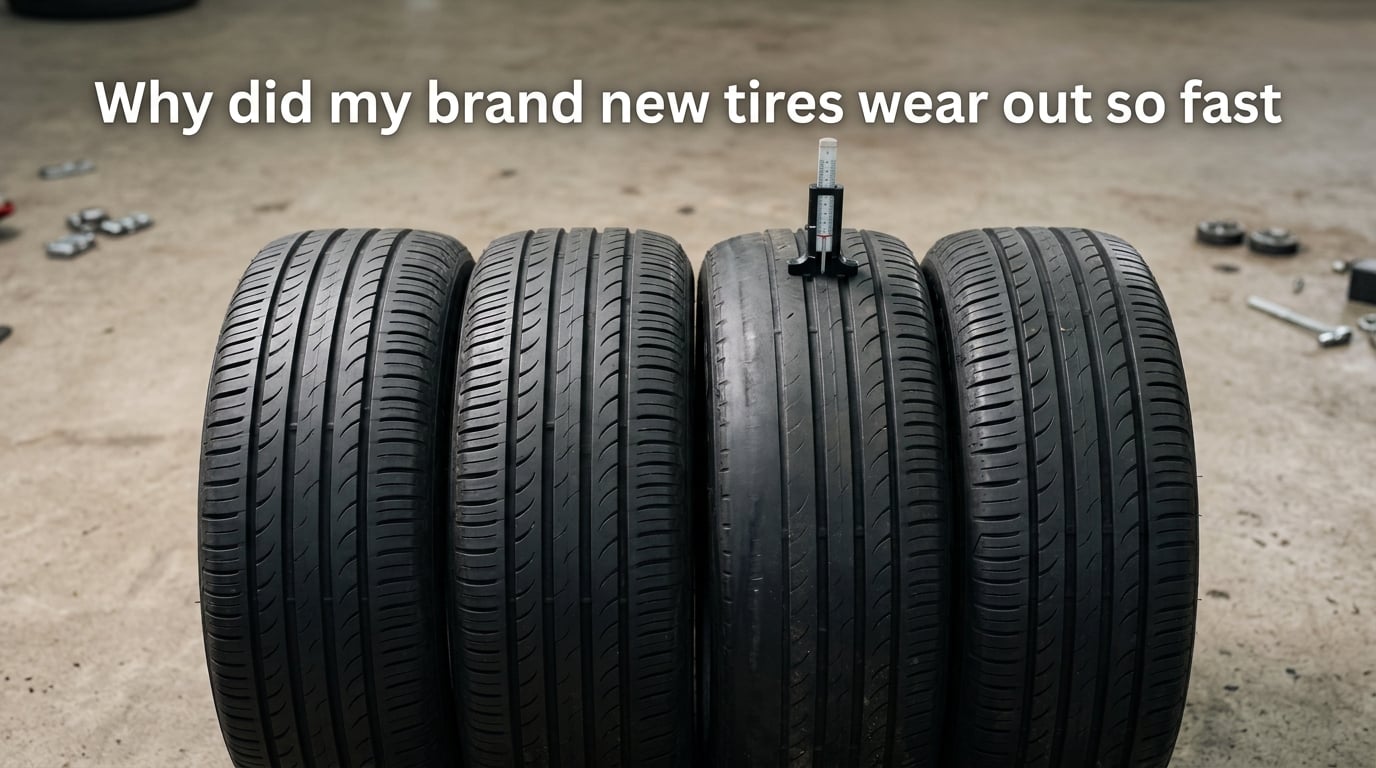
If you are asking “why did my brand new tires wear out so fast?” you are not alone. Our team hears this question every week from drivers who expected 50,000+ miles and got 20,000 instead. The good news: fast tire wear is almost always traceable to a specific cause, and most of those causes are fixable for far less than a new set of tires.
This guide breaks down the eight most common reasons new tires wear out too quickly, how to read your own tire wear pattern to diagnose the issue, and the prevention habits that keep a fresh set of rubber on the road for its full lifespan.
Table of Contents
Key Takeaways
- Most new tires should last 40,000 to 70,000 miles – faster wear almost always signals a mechanical or driving issue.
- Underinflated tires wear on the shoulders; overinflated tires wear in the center.
- Wheel alignment (toe, camber, caster) is the number one hidden cause of premature wear after install.
- Skipped rotations and aggressive driving habits cut tire life by 30 percent or more.
- OEM tires on new cars use softer rubber compounds for ride comfort – that trade-off is not a defect.
- Worn suspension components (shocks, struts, ball joints) let tires bounce and wear unevenly.
- Sticking brake calipers can drag one tire into early replacement.
- Check pressure monthly, rotate every 5,000 to 7,500 miles, and check alignment once a year.
How Long Should Brand New Tires Last?
Most passenger tires are engineered to last between 40,000 and 70,000 miles. Premium touring and all-season tires typically land in the 60,000 to 80,000 mile range, while high-performance summer compounds often fall between 25,000 and 45,000 miles.
OEM tires that come installed on a brand new car usually wear out closer to the 30,000 to 50,000 mile mark. That is not because automakers are giving you bad tires. Modern OEM compounds are tuned for ride comfort, low noise, and short stopping distances – properties that come at the cost of tread life. Once they wear out, owners typically replace them with longer-lasting aftermarket options.
If your tires are worn out at 20,000 miles or less, the wear is genuinely premature and almost always points to a mechanical or driving-related cause. Anything in the 25,000 to 40,000 mile range on OEM rubber can be normal but worth investigating. Past 50,000 miles on quality aftermarket tires is solid value.
Top Causes of Premature Tire Wear
Our team pulled the eight most common reasons we see tires wear out fast. If you match your symptoms to one of these, you will know exactly where to start looking.
1. Incorrect Tire Pressure
Tire pressure is the single most controllable variable in tire life. Underinflated tires bulge outward at the contact patch, so the tread scrubs the road on the shoulders instead of the center. Overinflated tires do the opposite – the center tread carries the load and wears down first while the shoulders sit nearly unused.
Check the pressure on every tire (including the spare) at least once a month and before any long trip. Use the vehicle manufacturer’s recommended PSI listed on the driver’s door jamb sticker – not the number molded into the tire itself, which is the maximum safe pressure, not the target. A digital gauge is more accurate than the stick-style gauge at most gas stations.
Temperature swings of 10 degrees can change tire pressure by 1 to 2 PSI. A cold morning in winter can leave tires significantly underinflated, which is one reason tire wear accelerates in cold seasons.
2. Wheel Alignment Problems
Alignment drift is the leading hidden cause of fast tire wear. Hitting a curb, a pothole, or simply normal suspension settling can knock your toe, camber, or caster settings out of spec without any obvious symptom at the steering wheel.
Toe alignment is the most common culprit. Even a small toe misalignment (just a fraction of a degree) makes the tire scrub sideways with every rotation. That constant sideways drag can shave tens of thousands of miles off tire life and can ruin brand new tires in as little as a few thousand miles if the misalignment is severe.
Camber misalignment causes one-sided wear – either the inner or outer shoulder of the tire wears down dramatically while the opposite edge stays full. Caster issues mostly affect steering feel and stability rather than wear, but they can amplify other alignment problems.
If you are installing new tires, pay for an alignment in the same visit. An alignment costs a fraction of a replacement set of tires, and it is the single best insurance policy against your new rubber wearing out fast.
3. Skipped Tire Rotations
Front tires and rear tires do different jobs. On front-wheel-drive and most rear-wheel-drive vehicles, driven axles wear faster. On AWD vehicles, all four tires share the work but wear in slightly different patterns based on the cornering forces each position handles.
Rotating tires every 5,000 to 7,500 miles moves each tire to a different position so they wear evenly across the set. Skipping rotations means two tires on one axle wear down to the wear bars while the other two still have plenty of tread left – and on AWD vehicles, mismatched tread depths can actually damage the drivetrain.
If you have an AWD vehicle, follow the manufacturer’s rotation pattern exactly. Some AWD systems require a specific cross-rotation or even a more frequent interval. Skipping rotations on AWD is also more expensive because you usually have to replace all four tires at once instead of just two.
4. Aggressive Driving Habits
Hard acceleration, late braking, and high-speed cornering all push extra friction into specific zones of the tire. Spirited driving can easily cut tire life by 30 to 50 percent compared with smooth driving.
The biggest offenders are rapid launches (especially from a stop), cornering at speed, and braking hard at the last second instead of easing off the throttle earlier. If your front tires are wearing out faster than your rears, hard braking and aggressive turns are likely contributors.
Our team has talked with Subaru Ascent owners who replaced all four tires at 23,000 miles after one year – and the community consensus pointed to a combination of OEM soft compound and stop-and-go aggressive driving. Smooth inputs cost you almost nothing in time but pay you back many times in tire life.
5. Worn Suspension Components
Shocks, struts, springs, ball joints, and bushings all work together to keep the tire planted on the road. When any of these components wear out, the tire bounces or wanders slightly with every bump. That motion translates directly into uneven tread wear.
The classic symptom of worn suspension is cupping – scalloped, wavy wear patches around the circumference of the tire. You will often feel it as a rhythmic thumping at certain speeds. Cupping almost always means a shock or strut is on its way out, and it can destroy a new set of tires in 10,000 miles or less.
Replacing shocks and struts typically runs into the hundreds per corner, but it is far cheaper than replacing tires every 20,000 miles. If you feel any bounce, sway, or thumping on rough roads, get the suspension checked before your next tire purchase.
6. Sticking Brake Calipers
A brake caliper that does not fully release keeps the brake pad lightly dragging on the rotor. That constant friction transfers heat and load to one tire, which then wears faster than the other three even when everything else is dialed in.
Sticking calipers are most common in wet climates where corrosion builds up in the slide pins. You may notice the affected wheel running warmer than the others, or pulling slightly to one side under braking. Left alone, the dragging tire can wear out in half the mileage of its siblings.
If one tire is mysteriously worn and the alignment is good, have a technician check for a sticking caliper before assuming the tire was defective.
7. OEM Soft Rubber Compound
This is one of the most common frustrations on owner forums. A Subaru Ascent or Toyota Highlander owner replaces all four factory tires at 35,000 miles, expects the aftermarket set to last much longer, and is surprised when the new set also wears faster than expected.
Modern OEM tires are engineered with softer rubber compounds that grip better in wet conditions, ride quieter, and shorten braking distances. The trade-off is shorter tread life. This is a design choice, not a defect, and it is consistent across nearly every new car on the market.
Aftermarket tires from premium brands often last 50 percent longer because they can prioritize longevity over the OEM tuning for ride quality. If you commute long distances and want maximum tread life, a tire with a harder compound and higher mileage warranty is usually worth the upgrade.
8. Wrong Tire Size or Type
Installing a tire with a different diameter, width, or load rating than the manufacturer specified can change how the tire carries weight and flexes under load. Even a slightly taller sidewall can throw off speedometer calibration and put extra stress on the differential, especially on AWD vehicles.
Mixing tire types (for example, pairing all-season tires with summer performance tires) is also a recipe for uneven tread wear because the compounds and tread patterns grip differently. Always replace tires in sets of four, or at minimum in matched pairs on the same axle.
Stick with the size, load index, and speed rating listed on the door jamb sticker. If you want to go larger or smaller for cosmetic or performance reasons, have a professional confirm the change does not void your warranty or interfere with the drivetrain.
How to Read Your Tire Wear Pattern
The location of the wear on your tire tells you almost exactly what caused it. Our team built this diagnostic chart so you can match what you see to the most likely cause and the fix.
Center wear only: Almost always overinflation. The tire bulges in the middle and rides on the center ribs. Drop the PSI to the door-jamb recommendation and check again at the next fill-up.
Both shoulders (edges) worn, center tread full: Underinflation. The tire flattens out at the contact patch and scrubs the road on both shoulders. Add air and inspect for slow leaks.
Inner or outer shoulder worn on one side only: Camber misalignment. This is most common on vehicles that have been lowered or that have worn suspension components. Get an alignment check and replace any bent control arms or struts.
Feathering (smooth on one side, sharp on the other): Toe misalignment. Run your hand across the tread; if it feels like a saw blade in one direction, your toe is off. An alignment will correct it.
Cupping or scalloping (diagonal dips around the tire): Worn shocks, struts, or other suspension components. Replace the worn parts and then re-balance or replace the tires depending on severity.
Patchy or random wear spots: Out-of-balance tire, sticking caliper, or damaged wheel. Have the wheel balanced and check for a dragging caliper.
A simple tread depth check takes 60 seconds. Stick a penny into the tread with Lincoln’s head pointing down. If you can see the top of his head, the tread is below 2/32 inch and the tire is due for replacement. A dedicated tread depth gauge gives you a more precise reading.
How to Prevent Fast Tire Wear
Most premature wear comes down to a handful of habits. Our team recommends the following routine to protect any new set of tires.
First, check tire pressure once a month and before long trips. Use a quality digital gauge and stick to the PSI on the door jamb, not the maximum on the tire sidewall.
Second, rotate every 5,000 to 7,500 miles. Pair the rotation with your oil change so it never slips your mind. On AWD vehicles, follow the manufacturer’s exact rotation pattern.
Third, get an alignment check once a year, and immediately after any hard impact with a curb, pothole, or debris. Many tire shops offer free alignment checks as part of a rotation service.
Fourth, smooth out your driving. Easing off the throttle earlier, braking gently, and cornering at reasonable speeds will extend tire life significantly without adding time to your commute.
Finally, address any suspension noise, vibration, or pulling as soon as you notice it. A small repair now prevents a four-tire replacement later.
When to File a Tire Warranty Claim
Most tire manufacturers offer a mileage warranty that promises a certain number of miles. If your tires wear out before that mileage and you have rotated them on schedule, kept them properly inflated, and have no alignment or suspension issues, you may have a legitimate warranty claim.
Warranty claims typically require proof of regular maintenance (rotation records, receipts) and an independent inspection. Most manufacturers prorate the replacement cost based on the remaining mileage, so you will usually get a partial credit toward a new set rather than a full refund.
If you have documented all maintenance and the tire wore out significantly under the warranted mileage with no mechanical cause, contact the tire manufacturer directly. The shop that installed the tires can often assist with the claim paperwork.
If the wear is clearly caused by alignment, suspension, or driving habits, the warranty will not apply – but you have still solved the real problem and can prevent it from happening again.
Frequently Asked Questions
How long should 4 new tires last?
Most new tires are engineered to last 40,000 to 70,000 miles. Premium all-season touring tires can reach 60,000 to 80,000 miles, while high-performance summer tires typically last 25,000 to 45,000 miles. OEM tires on new cars usually fall in the 30,000 to 50,000 mile range because of softer rubber compounds tuned for ride quality.
Do I really need alignment after new tires?
Yes. Installing an alignment at the same time as new tires is the single best way to protect your investment. Even a small toe misalignment can scrub thousands of miles off tire life in a short time. If your vehicle was aligned within the past year and you have not hit any curbs or potholes, you may be fine – though a quick check is still worth it.
How fast can a bad alignment ruin tires?
A severe toe misalignment can destroy a brand new set of tires in as little as a few thousand miles. Even a small out-of-spec toe can cut tire life by tens of thousands of miles over the life of the tire. Camber misalignment can wear out one shoulder in under 10,000 miles if the angle is significantly off.
Why are my two front tires wearing out so fast?
Front tires carry most of the braking and steering load, so they almost always wear faster than the rear. If the front tires are wearing noticeably faster than normal, the most common causes are missed rotations, aggressive braking or cornering habits, low tire pressure on the front axle, or camber misalignment. A rotation and an alignment check will usually identify the cause.
The Bottom Line
If you are asking “why did my brand new tires wear out so fast,” the answer is almost always one of the eight causes above. Start with a free alignment check and a pressure inspection – those two steps catch the majority of premature wear cases. From there, build the simple maintenance habits that keep your next set of tires on the road for its full lifespan.