
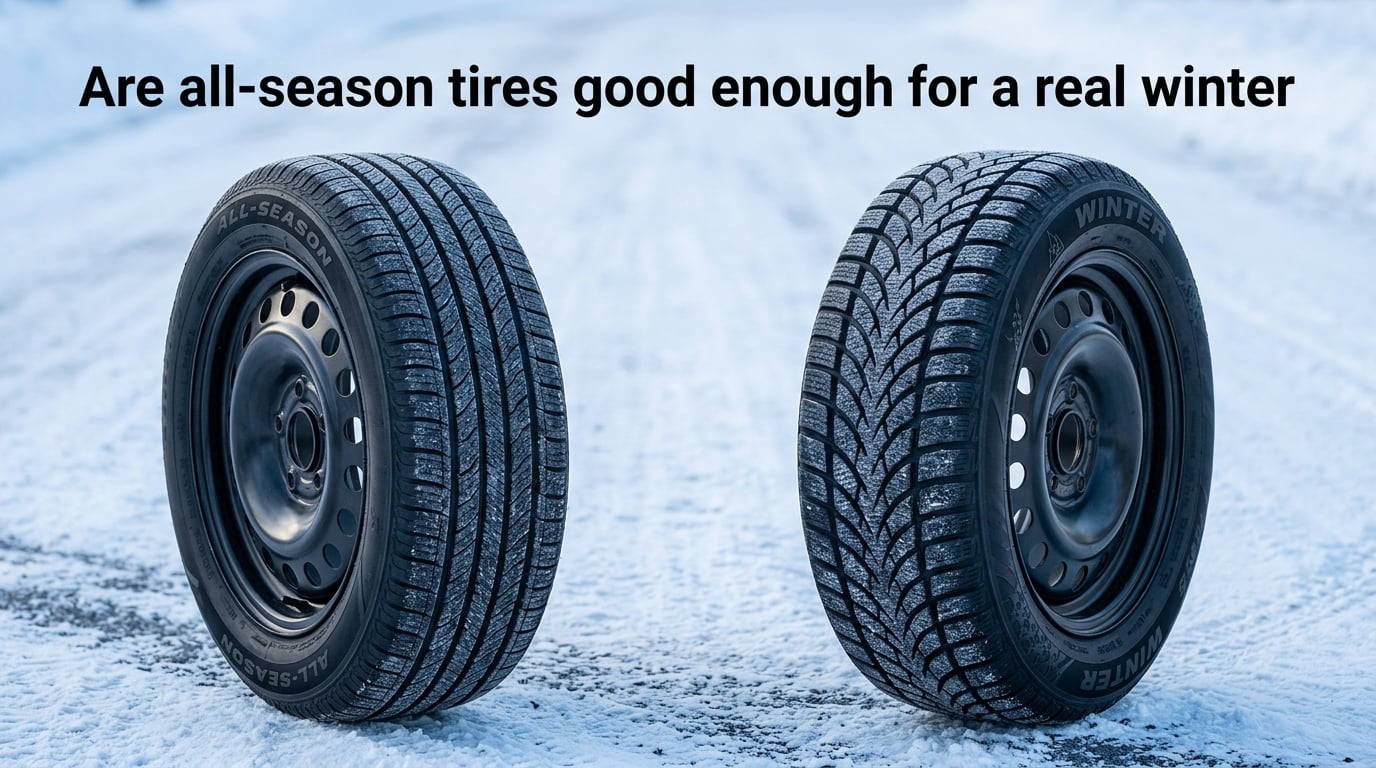
No, all-season tires are not designed for a real winter. Their rubber compound stiffens below roughly 45°F (7°C), so the colder it gets, the less grip you have. They will handle dry roads, wet roads, and the occasional dusting of snow. They will not reliably handle sustained sub-freezing temperatures, deep snow, packed snow, or ice. For a true winter, dedicated winter tires (or at minimum 3PMSF-rated all-weather tires) are the safer choice.
Yes, all-seasons are fine when:
- Your area sees fewer than 5-10 snow days per winter
- Temperatures usually stay above 20°F (-7°C)
- You park in a garage and drive short, plowed urban routes
No, switch to winter tires when:
- You drive where temperatures regularly fall below freezing for weeks
- You face regular snow, packed snow, or black ice
- You tackle hills, unplowed roads, or a mountain commute
Below, I’ll walk you through the rubber compound physics, the stopping-distance data that changed my mind years ago, when all-seasons genuinely work, and how to read the 3PMSF symbol on your sidewall so you can stop guessing.
Table of Contents
What Are All-Season Tires Actually Designed For?
An all-season tire is engineered as a compromise. It has to deliver acceptable grip in dry summer heat, in cold rain, and in a light dusting of snow, all on a single tread.
The compromise shows up in two places: the rubber compound and the tread pattern.
The compound trade-off. All-season compounds are harder and more heat-tolerant than winter compounds. That helps them resist wear during summer and gives them a long tread life (typically 50,000-70,000 miles). The cost is that they go rigid below about 45°F, which is precisely the temperature where you need the most grip.
The tread trade-off. All-season tread is shallower (about 8-10/32 inch) with smaller, more numerous blocks designed to evacuate water and grip dry pavement. It works in a few inches of fresh snow, but it does not pack the deep, jagged tread and aggressive biting edges that winter tires use to claw into packed snow and ice.
Bridgestone’s team uses a useful analogy: all-season tires are like a year-round sneaker. They handle light trails and rain. They are not ski boots. Wearing them to a ski slope is technically possible, but you will slip. Winter tires are the ski boots.
What Counts as a “Real Winter” for Tires?
For tires, “real winter” is not a date on the calendar. It is a temperature and a road state.
The 45°F threshold. Tire industry research consistently points to roughly 45°F (7°C) as the temperature where all-season rubber starts losing meaningful grip. Below that mark, the compound hardens and traction drops – usually without the driver noticing until the first hard brake or sharp turn.
Sustained cold plus a frozen surface. When air temperatures sit below freezing for weeks at a time, the road itself stays cold. Any moisture becomes black ice, packed snow, or frozen ruts. That is the operating environment winter tires are engineered for.
Snow day count. A rough rule of thumb: if your area sees more than about 10-15 days of measurable snow per winter, or if snow lingers on the ground for more than a few days at a time, you are in winter-tire territory. Below that, all-seasons may be enough.
Black ice and freezing rain. These are the silent killers. Black ice forms on roads that look completely dry, often at temperatures between 28°F and 32°F. Freezing rain coats the road in a thin layer of ice. Neither gives any visual warning, and neither gives all-season tires a chance to bite.
Why All-Season Tires Struggle in the Cold
Three things change when an all-season tire hits cold weather, and all three work against you.
1. The rubber stiffens. Below 45°F, the all-season compound behaves more like hard plastic than rubber. It cannot conform to the microscopic texture of the road, so the contact patch – the actual tire-to-road area, which is only about the size of your hand per tire – loses grip. Reddit’s r/tires community calls this the “hockey puck” effect: one morning the tires felt fine, and by afternoon, with no warning, they stopped gripping.
2. The tread is shallower. All-season tread typically runs 8-10/32 inch when new. Winter tires run 11-13/32 inch with deeper, more open channels. The extra depth is what lets winter tires evacuate snow and slush instead of packing it into a slick layer between tire and road.
3. Siping and biting edges are less aggressive. Siping is the network of tiny slits in the tread blocks. As the tire rolls, the sipes open and close, creating tiny biting edges that grip snow and ice. Winter tires have thousands more sipes per tire, and the blocks themselves have sharper, more jagged edges. All-season tires have siping for wet grip, but it is far less dense and less aggressive.
The combined effect is that all-seasons work well down to about freezing, get marginal in the 20s, and become genuinely hazardous below about 15°F on any snow or ice.
Stopping Distance: All-Season vs Winter Tires on Ice
This is the data point that converted me years ago, and it is the single most-quoted trust signal in tire forums.
MotorTrend and Tire Rack ran an instrumented test: the same car, the same driver, the same ice surface, the only variable being the tires.
The result: from 12 mph on glare ice, winter tires stopped in about 34 feet. All-season tires needed about 57 feet. That is a 23-foot difference at parking-lot speed.
Scale that up to highway speed and the gap widens dramatically. A car doing 60 mph on packed snow has roughly twice the stopping distance on all-seasons as on winter tires. That can be the difference between stopping in time and sliding into an intersection.
ABS and all-wheel drive do not fix this. ABS prevents the wheels from locking up so you can steer; it does not give the tire more grip. AWD helps the car accelerate in snow; it does not help it brake or turn. I cover that myth in detail below.
All-Weather Tires: A Middle Ground?
If you do not want to swap tires twice a year, there is a third option worth considering: all-weather tires.
All-weather tires look like all-seasons on the outside but use a colder-flexible compound and carry the Three-Peak Mountain Snowflake (3PMSF) symbol. That symbol is awarded only after a tire passes an industry-standard severe-snow traction test, so it is a real performance claim, not a marketing line.
Where all-weather tires work well:
- Moderate climates with a few heavy snow events per winter
- Suburban drivers who do not want a second set of wheels
- Drivers in regions where studded tires or chains are impractical
Where all-weather tires fall short:
- They are not as grippy as dedicated winter tires in extreme cold or on true ice
- They wear faster in summer than pure all-seasons, so expect a shorter tread life
- They are louder and slightly less fuel-efficient than the best all-seasons
Common all-weather picks include the Michelin CrossClimate 2 and the Vredestein Quatrac Pro. Both are widely available in sizes that fit most passenger cars, crossovers, and SUVs.
How to Read Tire Sidewall Symbols: 3PMSF vs M+S
If you already have tires on your car, you can check what they are rated for in about ten seconds. Look at the sidewall for two symbols.
M+S (Mud and Snow). This is a self-declared marking. Any manufacturer can stamp it on a tire without independent testing. M+S means the tread pattern is designed to handle some mud and snow. It does not mean the tire has been tested or certified for severe winter conditions.
3PMSF (Three-Peak Mountain Snowflake). This symbol – a snowflake inside a three-peak mountain – means the tire passed an ASTM standardized severe-snow traction test. It is the only sidewall symbol backed by an industry-accepted performance standard.
You may also see an “ice grip” symbol (a mountain with an icy peak) on some European tires, but in North America the 3PMSF is the gold standard.
Quick reference:
If your tire has only M+S: All-season tire. Suitable for light winter conditions only.
If your tire has 3PMSF (with or without M+S): Certified for severe snow. Either a winter tire or an all-weather tire.
The AWD + Winter Tires Myth
This is the most common winter-tire misconception I see on Reddit’s r/cars and r/AskAMechanic. The myth goes like this: “I have all-wheel drive, so I do not need winter tires.”
AWD and winter tires do completely different jobs.
AWD sends engine power to all four wheels. It helps you go in snow. That is it.
Winter tires give the car more grip on the road. They help you start, stop, steer, and stay stopped on snow and ice.
Every modern AWD system still relies on the same contact patch – hand-sized, four of them total – to brake and corner. AWD cannot create grip the tire does not have. In Tire Rack’s instrumented testing on ice, a Subaru Outback on winter tires stopped roughly 30% shorter than the same Outback on all-seasons, despite identical AWD hardware.
If you have AWD, the rule is the same as for any other car: match the tires to the climate, not to the drivetrain.
When All-Season Tires Are Fine (and When They Aren’t)
Not everyone needs winter tires. Here is a quick framework based on climate and use case.
All-seasons are fine if:
- Your winters are mild (rarely below 25°F / -4°C)
- Snow accumulation rarely exceeds an inch or two and melts within 24 hours
- You park in a garage and drive short, plowed urban routes
- You have a backup plan (work from home) for the rare heavy-snow day
All-seasons are not enough if:
- You see regular temperatures below 20°F (-7°C) for weeks at a time
- Snow lingers on the ground for multiple days or builds up over weeks
- You drive hills, mountain passes, or unplowed side streets
- You regularly encounter black ice, freezing rain, or shaded road sections that stay slick all day
- You commute before plows have run or after sunset in winter
By region:
Southern US, Pacific Coast, desert Southwest. All-seasons are usually fine.
Mid-Atlantic, Ohio Valley, Pacific Northwest lowlands. All-weathers are a smart compromise; winter tires only needed if you drive hills or unplowed roads.
Upper Midwest, Mountain West, New England, Quebec, Ontario, Alberta. Winter tires are strongly recommended for at least 4-5 months per year.
EV drivers: Winter tires also help preserve EV range in cold weather because the rolling resistance of a winter compound at low temperatures is closer to the rolling resistance of an all-season at warm temperatures. You will still see range drop in winter, but less of it.
The Real Cost of a Second Set of Winter Tires
The “winter tires are too expensive” argument comes up constantly. The real numbers are more reasonable than most drivers expect.
Option 1: Buy a second set of wheels. This is the most popular route. Mount the winter tires on a separate set of steel or alloy wheels and swap the whole set twice a year. Many tire shops will swap and balance four wheels for about $80-120 total, or do it for free if you bought the tires from them.
Option 2: Use the same wheels. Have the shop unmount and remount tires on the same wheels each season. This costs about $100-160 per swap, twice a year, so roughly $200-320 annually. That adds up over time, which is why most drivers eventually buy the second wheel set.
Storage. A stacked set of four wheels with tires takes about as much space as a large suitcase. Most garages, basements, and even some closets handle it. Many tire shops also offer seasonal storage for around $50-100 per season.
Insurance discount (Canada). In several Canadian provinces, including Quebec and Ontario, drivers with a dedicated set of winter tires can claim a small insurance discount, typically around 5%. It does not cover the cost of the tires, but it softens it. Check with your insurer to confirm eligibility.
Tread life. Because you only run winter tires for 4-5 months, a quality set typically lasts 4-6 winters. Spread across the seasons, the annual cost is comparable to a daily coffee habit – and far cheaper than a single fender-bender.
Frequently Asked Questions
Are all-season tires good for winter?
Not for a real winter. All-season tires are designed for moderate climates and lose meaningful grip below about 45°F. In sustained cold, snow, or ice, winter tires (or 3PMSF-rated all-weather tires) are the safer choice.
What happens if you use all-season tires in winter?
As temperatures drop below 45°F, the rubber compound hardens and the tire loses grip. Stopping distance on ice and packed snow grows significantly, handling becomes unpredictable, and you may slide during routine braking or turns. Drivers often describe the loss of grip as sudden and without warning.
Are all-season tires just as good as winter tires?
No. Tire Rack instrumented testing shows winter tires stop about 23 feet shorter than all-season tires at just 12 mph on ice. The gap grows at highway speed. Winter tires also use a softer cold-flexible compound that grips below freezing, where all-season rubber goes stiff.
Can I drive with all-season tires in snow?
Yes, in light snow that melts within a day or two. All-season tires can handle a dusting, fresh powder up to an inch or two, and well-plowed wet roads. They become unreliable in packed snow, deeper accumulation, or any ice.
What are the downsides of all-season tires?
The trade-offs are: shorter grip below 45°F, shallower tread that packs with snow, fewer siping and biting edges for ice traction, longer stopping distances on slick surfaces, and less confidence on hills or unplowed roads. They also cannot match the severe-snow performance of 3PMSF-certified tires.
When should I switch from all-season to winter tires?
Mount winter tires once temperatures start consistently dropping below about 45°F, typically late October to early December in most northern regions. Swap back to all-seasons in spring once temperatures stay reliably above 45°F day and night. Many drivers schedule the swap around the first sustained cold snap or the first real snow forecast.
Are all-season tires good enough for winter in Alberta or Ontario?
Generally no. Alberta and Ontario see long stretches of sustained sub-freezing temperatures, regular snow accumulation, and frequent black ice. Most drivers in these regions run winter tires for at least five months of the year, and several insurers offer a small premium discount for doing so.
The Bottom Line on All-Season Tires in a Real Winter
All-season tires are an outstanding compromise for moderate climates and the shoulder seasons. They are not a real-winter tire.
If your winters are mild and short, you will likely never notice the difference. If your winters are real – sustained cold, regular snow, and the occasional icy commute – the 45°F compound threshold, the 23-foot stopping-distance gap, and the “hockey puck” grip loss are not abstract numbers. They are the moment you slide into a curb, or stop just in time, or wish you had swapped the tires back in November.
Match your tires to your climate. For most drivers north of the 45°F line, that means a real set of winter tires (or 3PMSF all-weather tires) from late fall through early spring.