
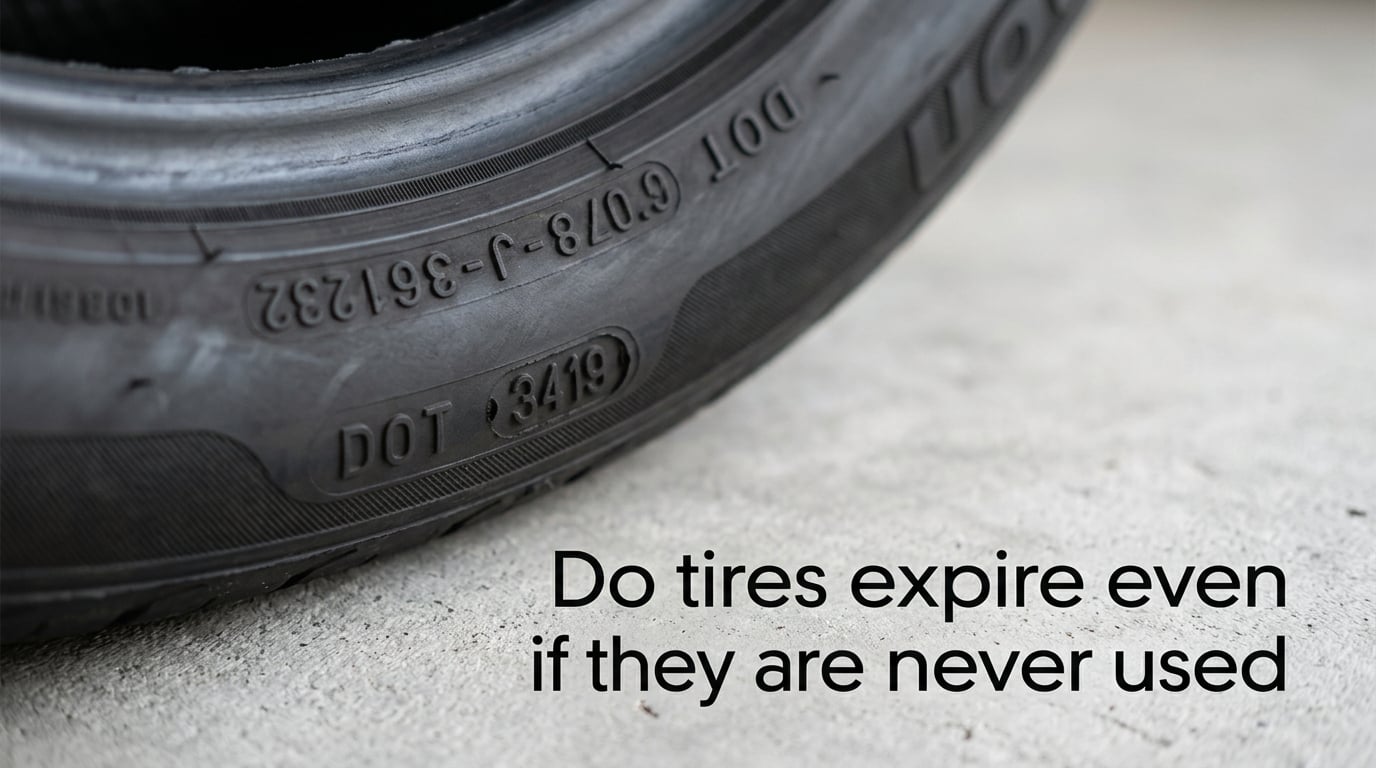
Yes, tires expire even if they are never used. Most tire manufacturers and the NHTSA recommend replacing tires after 6 years, with an absolute maximum of 10 years from the manufacture date, regardless of tread wear or use. Rubber degrades from oxygen, UV, ozone, and heat exposure over time, so a brand-new-looking tire that has been sitting in a warehouse or garage for a decade can still be unsafe to mount.
I get this question a lot from readers who just pulled a spare out of a trunk, bought a set from a dealer with dusty shelves, or own a classic car that barely moves. In this guide, I will walk you through what “tire expiration” actually means, how to read the manufacture date on any tire, what makes unused tires age, and how to store them so they last as long as possible. By the end, you will know exactly when to replace a tire and how to spot trouble before it strands you on the highway.
Table of Contents
What Does It Mean for a Tire to Expire?
“Expiration” in tires is not about a printed date like milk. It is the point at which the rubber compound has chemically degraded enough that the tire is no longer safe to use, regardless of how much tread is left.
Tire aging is a separate concept from tire wear. Wear is mechanical — the tread rubber physically rubs off as you drive. Aging is chemical — the polymers in the rubber react with oxygen, sunlight, ozone, and heat over time. Even a tire that has never touched pavement is subject to aging.
This is why mechanics consistently treat the manufacture date, not the purchase date or install date, as the true age of a tire. A “new” tire that has been sitting on a shelf for three years is three years into its chemical life the moment you mount it.
How Long Do Unused Tires Last Before They Expire?
There are two numbers to remember: 6 years and 10 years.
The tire industry — through the Tire Manufacturers Association and most major brands — recommends replacement at 6 years from the manufacture date. After that, the rubber compounds have typically lost enough flexibility that the risk of failure starts climbing, even if the tread looks fine.
The NHTSA’s position is more permissive: 10 years is the absolute maximum a tire should remain in service, regardless of use, condition, or apparent tread depth. After 10 years, the tire is considered expired.
So the practical answer is this: a tire that has never been driven can last up to 6 years with reasonable confidence and up to 10 years at the outer edge, as long as it has been stored away from heat, sunlight, and ozone. Tread depth tells you nothing about age — a 9-year-old tire with 9/32 inch of tread is still unsafe if the sidewalls have hardened.
Why Tires Age Even When They Are Never Used
Rubber is not a stable material. From the moment a tire is cured, four environmental forces start working on it. Even a tire that never carries a load is exposed to all four.
Oxygen (oxidation): Atmospheric oxygen slowly reacts with the long-chain polymer molecules in rubber, breaking them into shorter fragments. The tire loses elasticity and becomes brittle. This is the slow background process that ages every tire on Earth.
UV light (photodegradation): Sunlight breaks the chemical bonds in rubber at the surface. Carbon black is added to tire compounds partly to absorb UV and slow this damage, but it does not stop it. A tire stored outdoors in direct sunlight can show visible surface cracking in just a few years.
Ozone: Atmospheric ozone is far more reactive than regular oxygen. It attacks the double bonds in rubber molecules and causes the characteristic “ozone cracking” pattern — fine, branching cracks on the sidewall. Ozone is generated by electric motors, welding equipment, and even some household appliances, which is why tires stored near a garage compressor or workshop age faster.
Heat (thermo-oxidative degradation): Heat accelerates every other aging process. A tire stored in a hot attic or a Phoenix garage at 110 degrees Fahrenheit is aging 2-3 times faster than the same tire in a climate-controlled basement at 65 degrees. This is why climate matters so much in real-world tire life.
Humidity: Moisture trapped inside a tire can corrode the steel belts and bead wire from the inside. Tires stored with moisture inside (for example, sealed in a wet bag) age faster mechanically than chemically.
How to Read the DOT Date Code on Your Tire
Every tire sold in the United States carries a DOT (Department of Transportation) code on its sidewall. The last four digits of that code tell you when the tire was made. Here is how to decode it.
Step 1 — Find the DOT stamp. Look on the sidewall, near the rim. You will see a string that starts with “DOT” followed by letters and numbers. For example: DOT U2LL 8YXR 0424.
Step 2 — Locate the last four digits. They are at the very end of the DOT code, separated from the rest. In the example above, the last four digits are 0424.
Step 3 — Read the first two digits as the week of manufacture. “04” means the 4th week of the year — roughly late January. The week runs from 01 to 52 or 53.
Step 4 — Read the last two digits as the year. “24” means 2024. So this tire was manufactured in late January 2024.
Pre-2000 tires used a 3-digit code. If the DOT code on an older tire ends in only three digits (for example, “248”), the first two digits are the week and the last digit is the year of the decade. So 248 = week 24 of a year ending in 8 — either 1988 or 1998. Without other context you cannot tell which decade, which is one reason these tires are no longer considered roadworthy.
This is one of the most useful pieces of information a tire buyer can have. Check the DOT code before you mount any tire, especially if the tire is being sold at a discount or has been sitting on a dealer rack for a while.
Signs Your Unused or Stored Tires Have Gone Bad
Even if a tire is within the 6-year window, chemical aging can still push it past safe limits. Here are the four warning signs to check before mounting or driving on any stored tire.
1. Sidewall cracking (dry rot). Look for fine cracks running along the sidewall, often in a branching or spider-web pattern. These are ozone cracks or photodegradation cracks. Once visible, the tire is past its safe life and must be replaced, even if the tread is perfect.
2. Discoloration and fading. A tire that has turned gray, chalky, or bluish has lost protective oils from the rubber compound. It is aging fast and will crack soon.
3. Bumps, bulges, or deformities. Any localized bulge means the internal structure has separated or the belts have shifted. This is a tire that can fail at highway speed and must be replaced immediately.
4. Loss of flexibility. Press your thumb into the tread or sidewall. If the rubber feels hard and does not give, it has lost the plasticity needed to grip the road and absorb impacts. This is the silent killer of aged tires — they look fine until they fail under load.
If you see any of these signs, do not mount the tire. A new set of four tires is cheaper than a single accident or roadside tow.
How to Store Tires So They Last Longer
If you have seasonal tires, a spare set, or a project car that sits for months at a time, how you store them matters as much as when you bought them. Here is what actually extends tire life in storage.
Clean the tires first. Wash off brake dust, road grime, and any oil or solvent residue. Contaminants left on the surface accelerate chemical aging.
Bag them in airtight plastic. Use large garbage bags or specialty tire storage bags. Sucking out excess air with a vacuum cleaner reduces oxygen exposure dramatically. This single step can add years of storage life.
Store them in a climate-controlled space. Ideal storage is between 50 and 70 degrees Fahrenheit with low humidity. A basement, climate-controlled garage, or insulated shed is good. An uninsulated attic, a metal shed in the desert, or a trunk in summer sun is not.
Store vertically if unmounted, or stacked if mounted on wheels. Unmounted tires should stand upright, rotated monthly so they do not develop a flat spot. Mounted tire-and-wheel assemblies stack neatly on their sides.
Keep them away from ozone sources. Electric motors, welders, central vacuum systems, and fluorescent lights with ballasts all generate ozone. A corner of the garage next to the compressor is the worst possible spot.
Avoid direct sunlight and fluorescent UV. UV light ages rubber fast. Store tires in opaque bags or in a dark corner.
Write the DOT date on the bag. When you pull them out in two years, you will not have to hunt for the date code under a film of dust.
A tire stored this way can comfortably reach the 6-year mark and often push toward 8-10 years if conditions are ideal. A tire stored outdoors in the sun in Phoenix or Houston will be unsafe in 3-4 years.
Special Cases: Spare Tires, RV Tires, and Low-Mileage Vehicles
The 6/10-year rule applies to all pneumatic tires, but a few categories deserve special attention because they fail in surprising ways.
Donut spares (compact temporary spares). These are designed for short distances at low speeds, but they are still rubber and they still age. A donut that has been sitting in your trunk since the car was new is now as old as the car. Check its DOT code. If it is past 6 years, replace it before you need it.
Full-size spares mounted under or behind a vehicle. Same chemistry, same rule. Spare tires are the most commonly forgotten tire on a vehicle, which is why they often fail first.
RV and trailer tires. These age out before they wear out. RVs sit for long stretches, often outdoors, and trailer tires are frequently underinflated. The RV community widely treats 5-7 years as the practical replacement window for trailer tires, even if the tread looks fine.
Low-mileage and classic cars. This is the single most common confusion I see in forums. A car that has only driven 18,500 miles in 8 years still has 8-year-old tires. Tread depth is irrelevant. The rubber has aged the same as if the car had been driven 100,000 miles. Mechanics StackExchange and Reddit threads are full of owners surprised to learn this — and the answer is always to replace the tires by age, not by miles.
Climate-specific considerations. Owners in hot, sunny climates (Arizona, Texas, Florida, Southern California) should treat the 6-year window as a hard ceiling. Owners in cooler, less sunny climates (Minnesota, Maine, the Pacific Northwest) can usually push closer to the 8-9 year mark safely.
Is It Okay to Buy Tires That Are 1-2 Years Old?
Most tires on a dealer shelf are 6-18 months old. A tire that is 1-2 years old is still considered “new” by the industry — it has not lost meaningful chemical performance, and most manufacturers warranty their tires from the date of sale, not the date of manufacture.
Beyond 2 years, however, the value equation shifts. A tire that has been sitting on a rack for 3-4 years may be discounted, but you are starting its service life with 3-4 years already gone. By the time you add it to your rotation, you may be looking at replacement in 2-3 more years.
Avoid buying tires older than 5 years, no matter the discount. At that point the warranty has likely expired, the rubber has begun measurable aging, and you are paying near-full price for a tire with half its expected life.
Always check the DOT code on each individual tire before purchase. Dealers should rotate stock, but tires sometimes sit on the same shelf for years.
Stored vs In-Use Tire Aging: What Changes
The chemistry is the same in both cases, but the dominant aging factor shifts depending on whether the tire is in storage or mounted on a vehicle.
Stored tires age primarily from environmental exposure — oxygen, ozone, UV, and heat. Mechanical wear is zero. The good news is that proper storage dramatically slows these factors. The bad news is that improper storage can make a stored tire fail faster than one in light service.
In-use tires still age from the same chemistry, but they also experience mechanical wear, flex fatigue from rolling under load, and heat buildup from driving. The 6/10-year rule still applies, but tread depth becomes a parallel indicator — once the tread wears down to 2/32 inch, the tire is unsafe regardless of age.
Mounted-but-parked tires (a car that sits in a driveway for months) are an interesting middle case. They are exposed to the same environmental aging as stored tires, but they are also holding air pressure against the rim and may develop flat spots, dry rot on the contact patch, and bead corrosion. If you park a car for more than a month, lift it off the ground or rotate the tires monthly.
Frequently Asked Questions
How long can tires sit unused?
A tire can sit unused for up to 6 years and remain safe under ideal storage conditions, and up to 10 years as an absolute maximum per NHTSA guidelines. Beyond 6 years the rubber compounds begin to harden and crack, even if the tread looks untouched. Climate-controlled, bagged storage away from sunlight and ozone will get you closest to the full window.
Can 20 year old tires still be good?
No. A 20-year-old tire is past the 10-year NHTSA maximum by a factor of two and should not be used on a vehicle under any circumstances. The rubber will have hardened, the antioxidant compounds will be depleted, and the steel belts are very likely corroded. Replace them regardless of tread depth or appearance.
Are 10 year old tires still ok?
A 10-year-old tire is at the absolute outer limit of safe service life and should be replaced as soon as possible. The rubber has lost significant flexibility, and sidewall or tread cracking is likely. If the tires are mounted on a daily driver, replace them now. If they have been stored perfectly and still have full tread depth, some owners stretch to 11-12 years, but this is outside manufacturer guidance.
How do I read a DOT tire date code?
Find the DOT stamp on the tire sidewall. The last four digits are the manufacture date: the first two digits are the week of the year (01-52) and the last two digits are the year. For example, 0424 means week 4 of 2024. Tires made before 2000 use a three-digit format — the first two digits are the week and the last digit is the year of the decade.
Is it okay to buy 2 year old new tires?
Yes, a 2-year-old tire is still considered new by the industry. Manufacturers typically warranty tires from the purchase date, and 2 years is well within the safe chemical aging window. Always check the DOT code on each tire before you buy — dealers should rotate stock, but older tires sometimes linger on the shelf.
Is it okay to use 7 year old tires?
A 7-year-old tire is past the 6-year industry recommendation but inside the 10-year NHTSA maximum. Inspect the sidewalls carefully for cracks, check for hardening, and verify the DOT code. If they look clean, are properly stored, and have good tread, they can usually be run for another 1-2 years with annual inspection. Many owners choose to replace them now for safety margin.
How many years do tires last before dry rot?
Dry rot (ozone cracking on the sidewall) typically becomes visible between 6 and 10 years from the manufacture date, depending on storage conditions. Tires stored outdoors in direct sunlight or near ozone sources can show dry rot in as little as 3-4 years. Tires stored in climate-controlled, dark conditions can go a decade or longer without visible cracking.
Does heat age tires faster?
Yes. Heat is one of the fastest accelerators of tire aging. A tire stored at 95 degrees Fahrenheit ages roughly twice as fast as the same tire stored at 65 degrees. This is why hot-climate garages (Arizona, Texas, Florida) often see sidewall cracking within 4-5 years, while cool-climate garages (Minnesota, Maine) can keep tires safe for 8-10 years.
Key Takeaways on Tire Expiration
Tires do expire even if they are never used. The rubber ages from oxygen, UV, ozone, and heat regardless of whether the tire ever sees pavement. Aim to replace tires by 6 years from the manufacture date, never push past 10 years, and always check the DOT code before mounting a tire that has been sitting around.
The single best thing you can do today is walk to your vehicle, find the DOT stamp on each tire, and read the last four digits. That 10-second check tells you whether you are driving on tires that are safe — or on tires that look fine but are quietly aging out.