
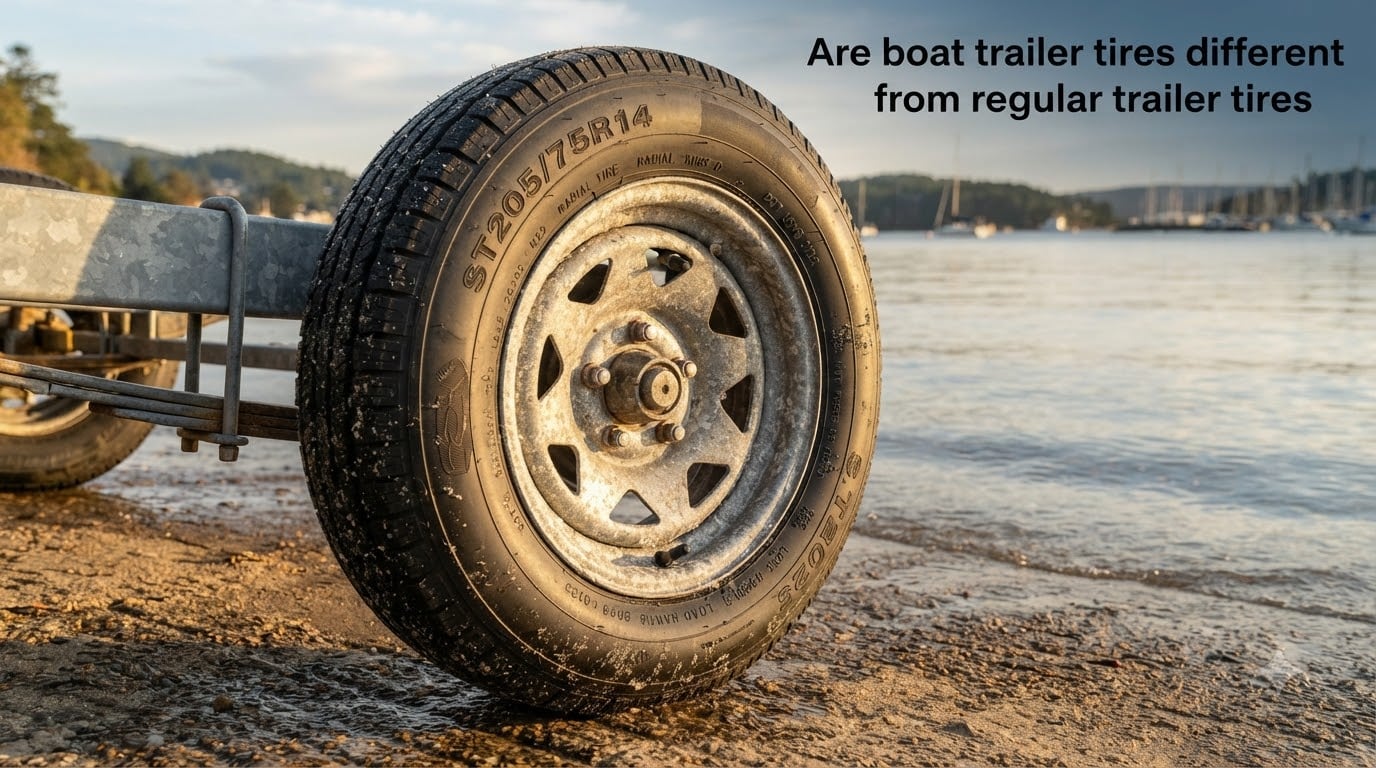
Yes, boat trailer tires are different from regular trailer tires. Boat trailer tires carry the ST (Special Trailer) designation, have stiffer sidewalls, higher load capacity at higher cold inflation PSI, and a default speed rating of 65 mph. They are built specifically for non-driven, load-bearing use over highway distances, with reinforced construction to handle the static weight of a boat and trailer.
I spent a weekend digging through Tire Rack’s tire guides, scrolling Reddit threads on r/boating and r/towing, and comparing four competitor articles to put together this answer. What I found surprised me – most guides explain the ST designation but skip the boat-specific failure modes that actually strand people on the shoulder of I-95. This article covers both the textbook differences and the real-world reasons boat trailer tires blow out when regular trailer tires wouldn’t.
Table of Contents
What ST (Special Trailer) Means on a Boat Trailer Tire
ST stands for Special Trailer, and it is a tire service designation created specifically for non-driven trailer applications. The Tire and Rim Association (TRA) defines ST as a tire engineered for use on travel trailers, boat trailers, fifth wheels, and pop-up campers – any trailer where the tires carry load but do not transmit power, steering, or braking torque to the road.
The ST designation matters because passenger (P-metric) and light-truck (LT) tires are designed with different priorities. P-metric tires are built to balance traction, steering response, ride comfort, and tread life on a driven axle. LT tires are built to handle the braking and cornering loads of a driven light truck. ST tires are built for one job only: carrying a heavy, non-rotating load safely at highway speeds. That singular focus is why the sidewalls are stiffer, the ply is reinforced, and the cold inflation pressure is higher than what you would see on a passenger tire of the same size.
Boat Trailer Tires vs. Regular Trailer Tires: Key Differences
Boat trailer tires and regular trailer tires share the ST designation – both fall under the Special Trailer category. The differences show up in how each tire handles the specific stressors of its use case. A boat trailer tire, in particular, needs to deal with launch ramp dunking, saltwater exposure, and long periods of stationary storage. Here are the core differences that matter when you are comparing the two:
- ST designation: Both use it, but boat trailer tires are sized for the boat’s tongue weight and GVWR.
- Sidewall strength: Stiffer than passenger tires to prevent sway when the boat shifts.
- Cold inflation PSI: Higher (often 50-65 PSI) to support the static boat load.
- Speed rating: Default 65 mph; some premium boat trailer tires rate up to 75 mph.
- Load range: Sized to match the trailer’s GVWR per axle (commonly C, D, or E).
- Construction: Twin steel belts and nylon reinforcement for load-bearing stability.
- Tread design: Symmetric pattern with a solid center rib for straight-line tracking.
If you tow a boat, the ST tire is not optional – it is the only tire engineered for the static tongue weight and side-loading forces your trailer generates. A regular passenger tire flexes too much under those loads and overheats quickly, which is why blowouts happen.
ST vs. LT vs. P-metric: Side-by-Side Comparison
The table below shows how ST boat trailer tires differ from LT (Light Truck) and P-metric (Passenger) tires across the four specifications that matter most for towing safety.
| Specification | ST (Special Trailer) | LT (Light Truck) | P-metric (Passenger) |
|---|---|---|---|
| Typical use | Boat, travel, cargo trailers (non-driven) | Pickup trucks, SUVs (driven axle) | Cars, crossovers, minivans |
| Sidewall stiffness | Stiffest, reinforced | Stiff, but flexible for ride comfort | Softest, designed for comfort |
| Default cold inflation PSI | 50-65 PSI | 35-50 PSI | 30-35 PSI |
| Speed rating | 65 mph (L) standard | Up to 75-99 mph depending on type | Up to 118-149 mph |
| Load range options | B, C, D, E, F | C, D, E | Standard load or XL |
| Ply rating | Up to 12 PR equivalent | 6-10 PR | 4 PR equivalent |
| Belt package | Twin steel belts + nylon overlay | Steel belts, sometimes nylon cap | Steel belts, lighter construction |
The takeaway: ST tires win on load-bearing capacity and sidewall strength in their size class, but lose on speed and ride comfort because they are not designed for either. LT tires offer higher speed ratings but are built for driven axles, not non-driven service. P-metric tires are the worst choice for any trailer over 1,000 lbs – they overheat and fail fast under static load.
Internal Construction: Why ST Tires Are Built Differently
An ST boat trailer tire’s internal architecture is what separates it from a passenger tire of the same rim diameter. According to Tire Rack’s trailer tire guide, ST tires use twin steel belts running diagonally under the tread for stability, plus a nylon overlay strip at the belt edges to resist distortion at high speeds. That construction is heavier than what you find in a typical passenger tire.
The sidewalls are also thicker. The extra rubber and stronger cord plies resist the “sway” that happens when a boat shifts position mid-turn – a dynamic load that passenger tires cannot absorb without flexing excessively. When a sidewall flexes too much under load, two things happen: the tire builds up internal heat, and the tread footprint shrinks, which reduces traction and accelerates wear on the shoulders.
Finally, the tread pattern is symmetric with a solid center rib. This is intentional – boat trailer tires track straight down the highway, so they do not need the directional or asymmetric patterns you see on high-performance passenger tires. The solid rib improves straight-line stability, while the symmetric shoulder blocks extend evenly across both sides of the tire to balance wear on tandem axles.
Load Range and PSI: Carrying the Boat’s Weight
Load range tells you how much weight a single tire can carry at a specific cold inflation pressure. ST tires use letter designations – B, C, D, E, and F – where higher letters mean higher load capacity and higher required PSI. A Load Range C ST205/75R15, for example, is rated for around 1,820 lbs at 50 PSI, while a Load Range D version of the same size carries about 2,150 lbs at 65 PSI.
Matching load range to your trailer’s Gross Vehicle Weight Rating (GVWR) is the single most important step. Take the GVWR, divide by the number of tires on the ground (two for single-axle, four for tandem-axle), and that gives you the minimum per-tire load capacity you need. Always add a safety margin of 10-15% above that number – overloading is the leading cause of trailer tire blowouts.
Cold inflation pressure is measured before you drive, when the tire is at ambient temperature. Tire Rack’s testing showed that for every 10°F change in ambient temperature, tire pressure changes by roughly 2 PSI. That means a tire inflated to 50 PSI on a 70°F morning can climb to 60+ PSI on a 100°F summer highway – which is normal. The danger is the opposite: cold pressure dropping below spec in winter, which lets the sidewall flex and overheat under load.
Why Boat Trailer Tires Are Rated for 65 mph
The default ST speed rating is 65 mph, marked with an “L” on the sidewall. This is not arbitrary – it reflects the heat-dissipation limit of ST construction under load. When an ST tire runs above its rated speed for extended periods, the internal temperature climbs, the nylon overlay softens, and the tire is at risk of catastrophic failure. Some premium boat trailer tires (like the Goodyear Endurance) carry a 75 mph rating for owners who tow at highway speeds for long distances.
For most boat owners, the practical answer is simple: do not exceed 65 mph with ST tires unless the sidewall specifically says you can. Trailer tire blowouts at highway speed are almost always tied to either under-inflation, overloading, or speed above the tire’s rating – and sometimes all three. A slow, steady tow speed is your cheapest insurance policy.
How to Read a Boat Trailer Tire Size Code
The size code on a boat trailer tire sidewall looks intimidating, but it decodes cleanly once you know the order. Take a common size, ST205/75R15 Load Range C:
- ST – Special Trailer service designation
- 205 – Section width in millimeters (the tread face measured sidewall to sidewall)
- 75 – Aspect ratio (sidewall height is 75% of the 205 mm width)
- R – Radial construction (D would mean diagonal/bias-ply)
- 15 – Wheel diameter in inches
- Load Range C – 6-ply equivalent, rated at 50 PSI cold
So that ST205/75R15 tire fits a 15-inch wheel, is 205 mm wide, has a sidewall about 154 mm tall, and is built with radial plies. The Load Range C tells you its max load and required inflation. If you see “D” instead of “R,” the tire is bias-ply – older construction that runs hotter and wears faster, but is still legal and common on smaller boat trailers.
Boat-Specific Stressors Most Guides Miss
Generic trailer tire guides treat boat trailers like cargo trailers, but the marine use case adds stressors that deserve their own discussion. These are the issues that bite boat owners in particular:
- Saltwater submersion at the ramp. Every launch and retrieval dunks the wheels. Salt accelerates corrosion of steel wheels and standard rubber valve stems. Marine-grade valve stems and galvanized or aluminum wheels are worth the upgrade if you boat in saltwater.
- Launch ramp debris. Broken glass, oyster shells, and sharp rocks on ramps can puncture or cut the sidewall. A visual inspection after every ramp dunk catches damage before it becomes a blowout at 60 mph.
- Bearing heat feedback. If your wheel bearings are failing, that heat transfers directly into the tire and can cause a blowout even when inflation and load are correct. Bearing buddies and a fresh grease packing every season protect both bearings and tires.
- Long stationary storage. Boat trailers often sit for weeks or months between trips. Tires develop flat spots from sitting under load. Inflating to the maximum rated PSI (not exceeding it) during storage reduces flat spotting.
- Tongue weight distribution. Boats loaded too far back on the trailer lighten the tongue, which shifts weight to the rear axle and can cause uneven wear or sway. Reposition the boat so roughly 5-10% of total weight sits on the tongue.
These stressors are why a boat trailer tire that “looks fine” can still fail. Saltwater corrosion hides inside the wheel, dry rot develops on the sidewall from UV exposure, and flat spots from storage become high-speed vibration once you hit the road.
Common Problems and Failure Modes
Boat trailer tires fail in predictable patterns. If you understand the failure mode, you can often prevent it. The most common issues reported by owners on Reddit (r/boating, r/tires, r/bassfishing) and on BobIsTheOilGuy forums include:
- Blowouts from under-inflation. The leading cause of trailer tire failures. Cold pressure below spec lets the sidewall flex, builds heat, and the tire disintegrates. One Reddit user on r/boating reported three blowouts in two years on a used boat – all traced back to tires that had been sitting underinflated before he bought it.
- Dry rot and spiderweb cracking. UV exposure degrades the rubber compound even when the tire has plenty of tread. Cracks appear on the sidewall and within the grooves. This is why age matters more than miles – a 6-year-old trailer tire with 1,000 miles can be more dangerous than a 3-year-old tire with 10,000 miles.
- Flat spots from long storage. A tire that sits for months under load develops a flat section. At highway speed, that flat spot causes vibration and uneven wear. Inflating to max cold PSI during storage and rotating the trailer 180° periodically helps.
- Uneven inner-edge wear. Common on single-axle trailers and usually a sign of misalignment, improper tongue weight, or chronic under-inflation. The inner edge carries more load when the tire is low on air.
- Premature wear from mixing bias and radial. Mounting one bias-ply and three radials (or vice versa) on a tandem trailer creates uneven handling and uneven wear. Always match construction type across all positions on the same axle.
If you have to replace one tire on a tandem-axle trailer, replace both tires on that axle at minimum. Mismatched tires on the same axle handle and brake differently, which is a real safety issue at highway speed.
Replacement Interval and the DOT Date Code
The consensus across forum reports and industry sources (NHTSA, Tire Industry Association, Tire Rack) is to replace boat trailer tires every 3 to 5 years regardless of tread depth. Age matters more than miles because the rubber compound degrades from UV, heat cycles, and time – even on a tire that has barely been driven.
To find the age, look at the DOT date code on the sidewall. The last four digits are the week and year of manufacture – “0824” means the 8th week of 2024. Tires made before 2000 used a three-digit code (the last three digits were week and year, with the decade implied), but any tire that old should already be off the road.
For context, one user on r/boating kept trailer tires on a low-mileage boat for 13 years before a 1,200-mile trip – and replaced them anyway before departure because of dry rot concerns. That is the safe mindset. Tires are cheaper than a tow bill or a boat damaged in a roadside blowout.
Boat Trailer Tire Sizes by Trailer Type
Boat trailer tire sizes scale roughly with boat length and trailer GVWR. The chart below maps common configurations. Always cross-check against your trailer placard for the exact tire size and load range it requires.
| Boat / Trailer Type | Typical Tire Size | Typical Load Range | Rim Diameter |
|---|---|---|---|
| Small jon boat / kayak launch (single axle) | ST175/80R13 or 4.80-12 | B or C | 12-13 inch |
| Aluminum bass boat (single axle, 16-18 ft) | ST205/75R14 or ST205/75R15 | C | 14-15 inch |
| Fiberglass bass boat (tandem axle, 18-21 ft) | ST215/75R14 or ST225/75R15 | C or D | 14-15 inch |
| Inboard / wake boat (tandem, 21-26 ft) | ST225/75R15 or ST235/80R16 | D or E | 15-16 inch |
| Large saltwater bay boat / center console (tandem, 26+ ft) | ST235/85R16 or ST235/80R17.5 | E or F | 16-17.5 inch |
Two caveats. First, do not upgrade size without checking wheel clearance and axle rating – a larger tire may not fit or may exceed the axle’s load capacity. Second, if you are upgrading load range within the same size (C to D), confirm the wheel is rated for the higher PSI. Standard 15-inch trailer wheels are usually fine to 65 PSI, but it is worth a quick check.
Boat Trailer Tire Maintenance Checklist
A 15-minute routine before each trip and a deeper inspection twice a year prevents most trailer tire failures. Here is what I run through on our test trailer:
- Cold inflation check before every trip. Use a dedicated truck/trailer pressure gauge. Add air when tires are cold (driven less than a mile or sat for 3+ hours).
- Visual inspection of sidewalls and tread. Look for cracks, blisters, foreign objects, and uneven wear. The penny test works on trailer tires – if you can see Lincoln’s head above the tread, the tire is at the end of its life.
- Tread depth measurement. Replace at 2/32 inch – the legal minimum – but most trailer owners replace at 4/32 inch because the tire’s load capacity drops as tread wears down.
- Check the DOT date code annually. If the tire is past 5 years, plan to replace it before the next season regardless of how it looks.
- Wheel bearing service each spring. Repack bearings with fresh marine-grade grease. Bearing heat is a direct tire killer.
- Cover tires during long storage. UV covers or a tarp over the wheels dramatically slows dry rot. Inflate to max cold PSI before storage and move the trailer a few inches every 30 days to prevent flat spots.
- Use marine-grade valve stems in saltwater. Standard rubber valve stems crack and leak after repeated saltwater exposure. Stainless or brass valve stems are a straightforward upgrade that lasts years longer.
Frequently Asked Questions
Can you put regular tires on a boat trailer?
You can mount P-metric or LT tires that physically fit the wheels, but it is not recommended. Passenger tires overheat and fail under the static tongue weight of a boat, and light-truck tires are built for driven axles rather than non-driven load-bearing service. An ST (Special Trailer) tire is engineered for exactly this use case and is the safer choice for any trailer over 1,000 lbs.
What are the common problems with boat trailer tires?
The most common boat trailer tire problems are blowouts from under-inflation, dry rot and spiderweb cracking from UV exposure, flat spots from long storage, uneven inner-edge wear from misalignment or chronic low pressure, and premature wear from mixing bias-ply and radial tires on the same trailer. Age also degrades the rubber compound even when tread depth looks fine.
What type of tire is best for a boat trailer?
The best tire for a boat trailer is a radial ST tire with Load Range C, D, or E matched to the trailer’s GVWR. Premium options like the Goodyear Endurance, Maxxis M8008, and Carlisle Radial Trail HD are well-regarded for marine use because they combine reinforced sidewalls, twin steel belts, and higher speed ratings than entry-level ST tires.
What does ST mean on a trailer tire?
ST stands for Special Trailer, a tire service designation defined by the Tire and Rim Association for non-driven trailer applications like boat trailers, travel trailers, fifth wheels, and pop-up campers. ST tires have stiffer sidewalls, higher load capacity at higher cold inflation PSI, and a default speed rating of 65 mph compared to passenger or light-truck tires.
What is the main difference between ST and LT trailer tires?
The main difference is that ST (Special Trailer) tires are built for non-driven, load-bearing service, while LT (Light Truck) tires are built for driven axles on pickups and SUVs. ST tires have stiffer sidewalls, higher cold inflation PSI, twin steel belts with nylon overlay, and a default 65 mph speed rating. LT tires offer softer sidewalls for ride comfort, lower PSI, and higher speed ratings.
What size tires are typically used on a boat trailer?
Common boat trailer tire sizes range from ST175/80R13 on small jon boats to ST235/85R16 on larger tandem-axle saltwater rigs. Most aluminum bass boats use ST205/75R14 or ST205/75R15 Load Range C. Inboard and wake boats on tandem axles usually need ST225/75R15 or ST235/80R16 in Load Range D or E.
How long do boat trailer tires last?
Boat trailer tires typically last 3 to 5 years regardless of mileage, because the rubber compound degrades from UV, heat, and age even when tread depth looks acceptable. Owners on boating forums commonly replace trailer tires every 4-5 years as a safety practice. Always check the DOT date code on the sidewall – the last four digits show the week and year of manufacture.
Why do trailer tires fail so often?
Trailer tires fail more often than vehicle tires because they sit under load for long periods, run at higher cold inflation PSI, and are often neglected between trips. Under-inflation, overloading, exceeding the 65 mph speed rating, and age-related dry rot are the most common causes. Marine use adds saltwater corrosion, launch ramp debris, and bearing heat as additional failure triggers.
The Bottom Line on Boat Trailer Tires
Boat trailer tires are different from regular trailer tires in degree rather than kind – both fall under the ST (Special Trailer) designation, but boat trailer tires are sized and constructed for the specific demands of marine use. The reinforced sidewalls, twin steel belts, higher cold inflation PSI, and 65 mph speed rating are not marketing flourishes; they are engineering responses to the static load and side-loading forces a boat creates. Match the load range to your trailer’s GVWR, check cold pressure before every trip, replace tires every 3 to 5 years regardless of tread, and your boat will stay on the trailer where it belongs.