
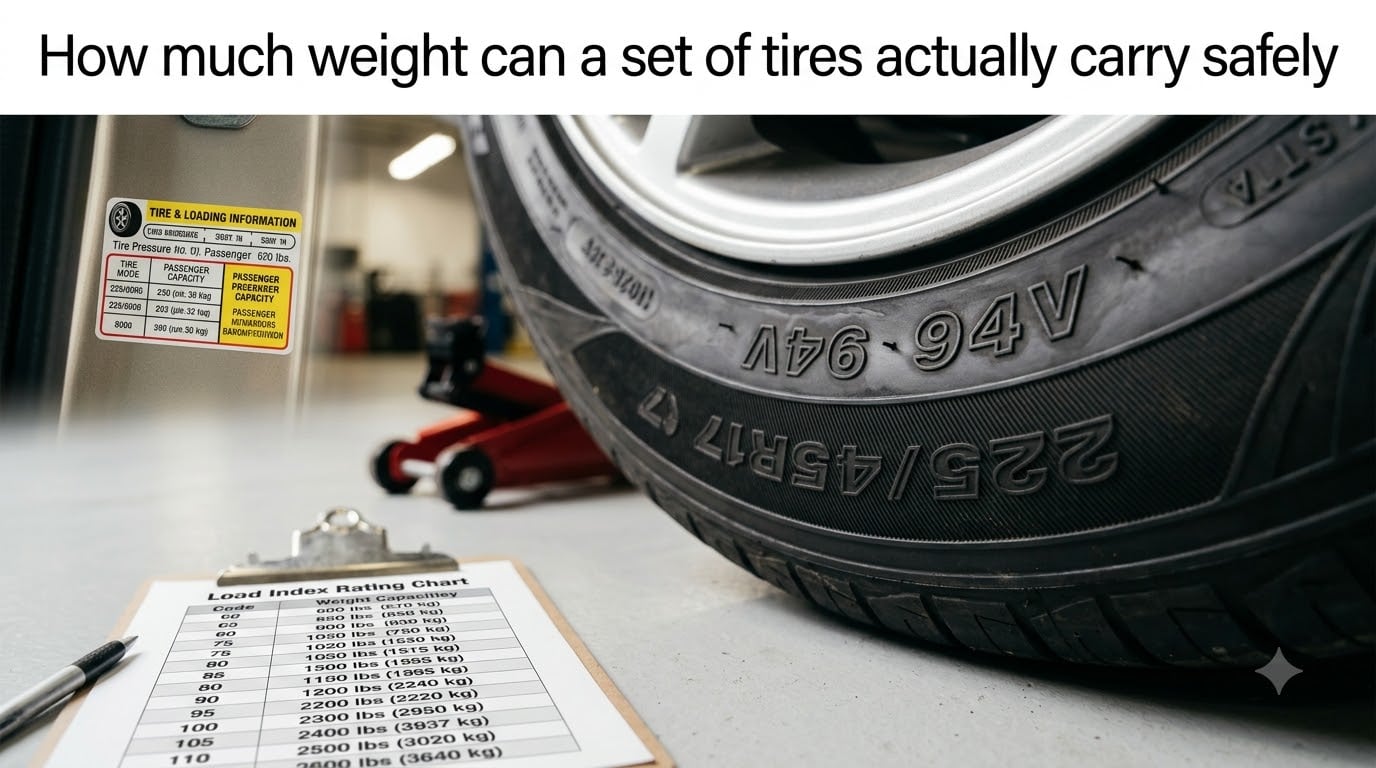
A typical set of four passenger-car tires can safely carry between 4,000 and 6,500 lbs, and a light-truck set can carry 8,000 to 13,000 lbs. The exact number is set by the load index, a two- or three-digit number stamped on each tire’s sidewall. Multiply that per-tire number by the number of tires on your vehicle, compare the total to your Gross Vehicle Weight Rating (GVWR) on the door-jamb placard, and you have the safe working capacity of your tires.
I dug into the load curves, the sidewall markings, and the NHTSA tire-placard rules to put this guide together for 2026. Whether you tow a camper, haul pallets, carry five passengers, or just want to know if your factory tires are up to the job, the answer is on the sidewall and in your owner’s manual.
Table of Contents
What Is Tire Load Index?
Tire load index is a standardized code (set by the Tire & Rim Association and used worldwide) that tells you the maximum weight a single tire can carry at its maximum inflation pressure. The number itself does not equal pounds; you have to look it up on a load index chart.
For example, a tire with load index 92 can carry 1,389 lbs at the pressure printed on the sidewall. A tire with load index 110 can carry 2,339 lbs. Higher numbers mean more load-carrying capability, and the scale runs from 0 (about 99 lbs) all the way past 150 (about 8,500 lbs per tire) for the biggest commercial tires.
The index is standardized across every brand, so a Michelin and a Goodyear with the same load index carry the same maximum weight. That standardization is what makes the system trustworthy, and it is why your owner’s manual and door-jamb placard are the canonical sources, not the tire shop’s opinion.
How to Read the Load Index on a Tire Sidewall
Every passenger and light-truck tire has a full size, type, and service description molded into the sidewall. The load index sits right next to the speed rating inside that string of letters and numbers.
Step 1: Find the size code on the sidewall. It looks like P225/65R17 or LT265/70R17. The first letter tells you whether it is a P-metric (passenger) or LT (light truck) tire.
Step 2: Move past the size to the service description. It will read something like 91H, 108T, or 121/118S. The first number is the load index, and the last letter is the speed rating.
Step 3: Look up that load index on a chart. LI 91 = 1,356 lbs, LI 108 = 2,205 lbs, LI 121 = 3,197 lbs. Those numbers are per tire at the tire’s maximum cold inflation pressure.
Step 4: Check the max load and max pressure stamped near the bead of the tire, usually in small English-and-metric text. The numbers there should match what the load index chart gives you.
Quick Reference: Common Load Index Values
Here are the values you will see most often on passenger cars, SUVs, and light trucks:
- Load Index 85 = 1,135 lbs per tire (small sedan)
- Load Index 91 = 1,356 lbs per tire (typical midsize sedan)
- Load Index 95 = 1,521 lbs per tire (large sedan / minivan)
- Load Index 100 = 1,764 lbs per tire (compact SUV)
- Load Index 108 = 2,205 lbs per tire (mid-size SUV)
- Load Index 114 = 2,601 lbs per tire (3/4-ton truck)
- Load Index 116 = 2,756 lbs per tire (F-150 / Silverado 1500)
- Load Index 121 = 3,197 lbs per tire (HD truck, E-rated)
- Load Index 126 = 3,748 lbs per tire (heavy commercial)
Multiply any of those numbers by 4 for a standard four-tire vehicle and you have the total tire load capacity.
How to Calculate Your Vehicle’s Total Tire Load Capacity
Total tire load capacity follows one simple formula:
Per-tire load capacity x number of tires = total capacity
For a dually truck with six wheels, use six. For a semi with 18 wheels, use 18. For the rest of us with cars, SUVs, and pickups, four is the right multiplier.
Step 1: Find the load index on each tire (front and rear are usually the same on a passenger vehicle).
Step 2: Look up the per-tire pounds on the chart.
Step 3: Multiply by the number of tires on the ground.
Step 4: Compare that total to your vehicle’s Gross Vehicle Weight Rating.
Example: A Toyota Camry with LI 91 tires: 1,356 lbs x 4 = 5,424 lbs total tire capacity. The Camry’s GVWR is 4,630 lbs, so the tires are rated well above what the vehicle can ever weigh, with a comfortable margin built in.
What Is GVWR and Where Do You Find It?
GVWR stands for Gross Vehicle Weight Rating. It is the maximum allowable total weight of your vehicle plus everything in it or on it: passengers, cargo, fuel, and a trailer tongue weight if you are towing.
You will find the GVWR on the tire placard, a yellow-and-black sticker on the driver’s-side door jamb, or on the edge of the door itself. The same sticker lists your cold tire pressure recommendation and the original equipment tire size. Your owner’s manual will repeat the GVWR and break it down further into GAWR (front and rear axle weight ratings).
When you compare your four-tire total capacity to the GVWR, you want the tires to carry at least the GVWR, and ideally 25% more than that. That buffer is your real-world safety margin, and it covers braking events, sharp turns, potholes, and uneven weight distribution that no placard number can capture perfectly.
Worked Examples: How Much Can Each Vehicle Type Carry?
Here is how the numbers land for the vehicles most people actually drive, using factory load index ratings:
Honda Civic (LI 91): 1,356 lbs x 4 = 5,424 lbs total capacity. GVWR is usually around 3,800 to 4,100 lbs. The tires are dramatically over-rated for normal use.
Mid-size SUV like a Toyota Highlander (LI 108): 2,205 lbs x 4 = 8,820 lbs total capacity. GVWR is around 6,000 lbs. Again, plenty of headroom for passengers and luggage.
Ford F-150 with 20-inch factory wheels (LI 116): 2,756 lbs x 4 = 11,024 lbs total capacity. GVWR on a crew-cab 4×4 is around 7,600 lbs, and max payload is around 2,000 lbs. The tires handle the truck and a healthy load.
Ram 2500 with E-rated LT tires (LI 121): 3,197 lbs x 4 = 12,788 lbs total capacity. The truck’s GVWR pushes 10,000 lbs, and that is before you hitch a 20,000-lb gooseneck trailer. The factory tires are sized for the truck’s curb weight, and the trailer gets its own set of tires with their own ratings.
Semi-truck drive position (LI 149): About 7,160 lbs per tire, with eight drive tires and eight trailer tires per side. Drive and trailer positions carry 34,000 lbs each on a Class 8 tractor-trailer. Total tire capacity is enormous, but so is the load.
Load Range, Ply Rating, and Inflation Pressure
Load range is the old-school letter system (A through N) that lines up with how many plies of fabric the tire was built with. Today’s radials have fewer actual plies than the letter suggests, but the letter still tells you how stiff the tire is and how much pressure it can hold.
Load Range C = 6-ply equivalent, max 50 PSI, common on half-ton trucks for a softer ride. Load Range D = 8-ply equivalent, max 65 PSI, the old workhorse for 3/4-ton trucks. Load Range E = 10-ply equivalent, max 80 PSI, standard on heavy-duty pickups and many trailers. Load Range F = 12-ply equivalent, max 95 PSI, common on commercial and trailer tires.
PSI ties directly to capacity. A tire’s published maximum load only applies when it is inflated to its maximum cold pressure. Drop the pressure and the load capacity drops with it; manufacturer load curves show that a 10 PSI drop can cost you 15 to 20% of the rated load. This is why chronic underinflation combined with heavy loads is the leading cause of heat-related tire failures on pickups and trailers.
P-Metric vs LT Tires and the 25% Safety Margin
The first letter on a tire size tells you a lot. P means P-metric, engineered for passenger cars, crossovers, and light-duty use. LT means light-truck, engineered for heavier trucks and SUVs that tow or haul. They use different test standards, different ply materials, and different pressure targets.
If your truck or SUV came with LT tires from the factory, replacing them with P-metric tires of the same size drops your safe load capacity. If you switch to larger aftermarket wheels and lower-profile tires, the load index usually drops too, because the sidewall is shorter and the air volume is smaller. That is why f150forum users keep asking if their 22-inch aftermarket setup is safe for towing: usually the answer is no, or only with a significant load reduction.
The industry-standard safety margin is 25% above GVWR. If your tires can carry 25% more than your vehicle’s published maximum weight, you have the buffer to absorb hard cornering, emergency braking, and uneven loading. If your tires barely meet GVWR, you are riding the limit every time you load up.
Two other factors quietly shrink your real-world capacity: tire age and operating temperature. Tires older than about six years lose structural integrity even if the tread looks fine. UV exposure and time harden the belts and reduce load-carrying ability, which is why the DOT date code matters for used tires. Sustained high-speed driving also reduces capacity on some speed ratings; T-rated tires carry less at sustained highway speeds than H-rated ones of the same load index.
Frequently Asked Questions
How much weight can a tire carry?
A typical passenger-car tire with load index 91 carries about 1,356 lbs at its maximum cold inflation pressure. A set of four such tires can carry about 5,424 lbs. Light-truck tires with load index 116 carry about 2,756 lbs each, so a full set can carry around 11,000 lbs. The exact number depends on the load index stamped on your tire sidewall, your cold inflation pressure, and your tire’s age and condition.
What is the 3 tire rule?
The 3 tire rule is a safety concept used by RV and trailer owners: you should assume that one of your tires could fail at any time, so each remaining tire must be able to carry the full load by itself plus a safety buffer. In practice this means oversizing trailer tires so the remaining three (or remaining five on a dually) can handle the gross trailer weight if one goes flat on the highway.
What is the 7 7 rule for tires?
The 7 7 rule is a quick visual tire-age check: a tire should be replaced once it is 7 years old regardless of tread depth, and any tire older than 7 years should not be sold as new. Tires degrade from heat, UV, and time even when unused, so a 7-year-old spare or 7-year-old trailer tire can no longer be trusted at its original load rating.
Can a car hold 500 pounds?
Yes, easily. A typical sedan with load index 91 tires has a total tire capacity of about 5,424 lbs, which is well above its curb weight plus 500 lbs of cargo or passengers. Even a compact car with load index 85 tires can carry 4,540 lbs total, far more than 500 lbs. The real question is the vehicle’s cargo capacity rating, not the tires.
What is the 3% rule for tires?
The 3% rule refers to the allowable variation in tire pressure between tires on the same axle. Tire manufacturers and safety regulators recommend keeping the pressure difference between left and right tires under 3% to prevent the vehicle from pulling to one side under load. Larger pressure mismatches create uneven loading and accelerate tire wear.
What is a good load index for a truck tire?
For a half-ton truck like a Ford F-150 or Chevy Silverado 1500, look for load index 116 or higher, which gives each tire about 2,756 lbs of capacity. For a heavy-duty 3/4-ton or 1-ton truck, look for load index 121 to 126, which puts each tire in the 3,200 to 3,750 lbs range. Match or exceed the load index that came on the truck from the factory, and check the door-jamb tire placard before towing.
What ply is a 115s tire load index?
Load index 115 typically corresponds to Load Range E in light-truck sizing, which is the modern 10-ply equivalent. These tires are built for heavy-duty pickups and large trailers, with a maximum cold inflation pressure of 80 PSI and a per-tire load capacity of about 2,679 lbs.
What load range is a 10 ply truck tire?
A 10-ply truck tire is Load Range E. Load Range E tires have a maximum cold inflation pressure of 80 PSI and are designed for heavy-duty trucks, large trailers, and commercial applications. Common load index values for Load Range E tires run from about 117 to 126, with per-tire capacities from roughly 2,833 lbs to 3,748 lbs.
How to calculate tire load capacity?
Calculate tire load capacity in four steps: (1) Find the load index on each tire’s sidewall, usually part of the service description like 116T. (2) Look up the load index on a chart to get the per-tire pounds (LI 116 = 2,756 lbs). (3) Multiply the per-tire load by the number of tires on the vehicle (2,756 x 4 = 11,024 lbs for a standard pickup). (4) Compare the total to your vehicle’s GVWR on the door-jamb placard, aiming for at least 25% more capacity than GVWR.
Conclusion
The weight a set of tires can safely carry comes down to the load index on the sidewall, multiplied by the number of tires, and compared to the GVWR on your door-jamb tire placard. Always check the owner’s manual, keep your cold inflation pressure at or above the placard number when loaded, and replace any tire older than seven years regardless of tread depth.