
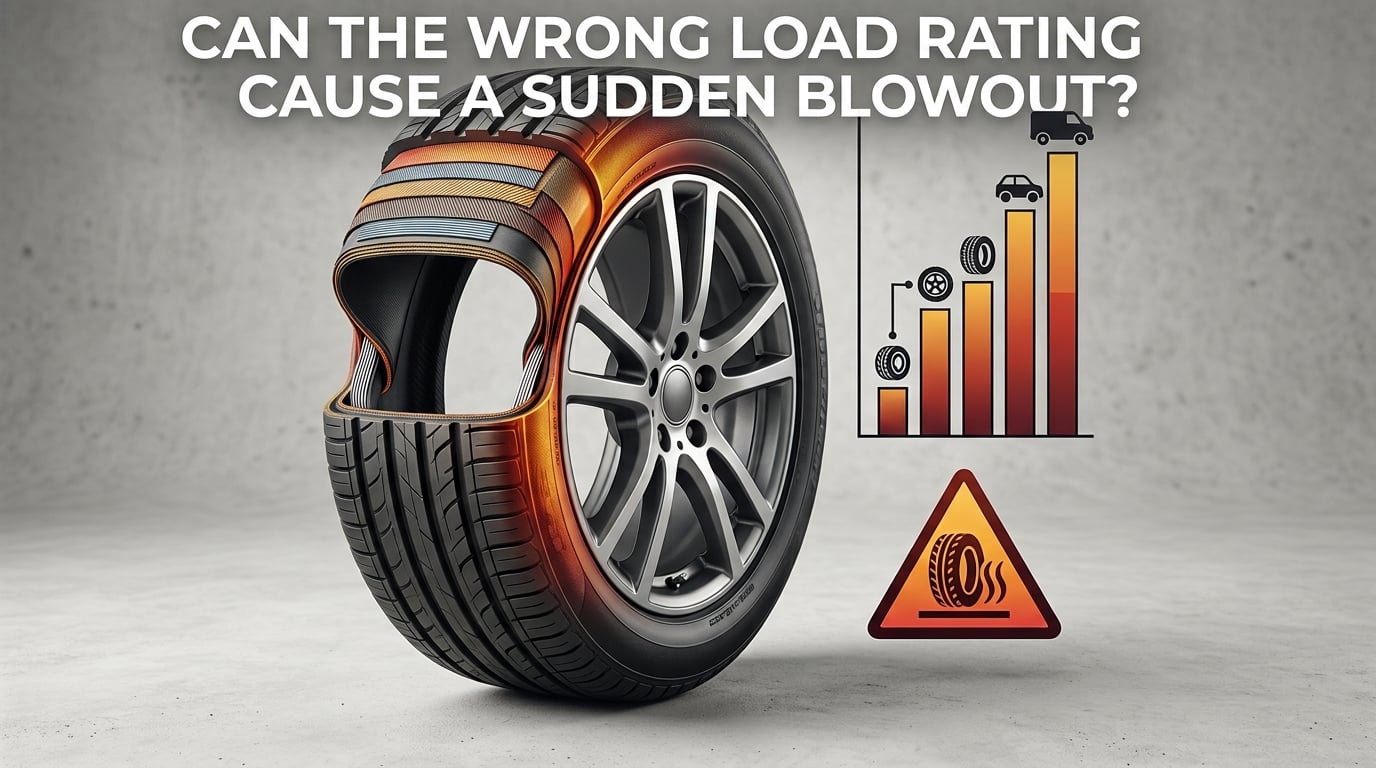
Yes – the wrong load rating absolutely can cause a sudden blowout. When a tire’s load rating is below the weight the vehicle demands, the sidewall flexes excessively with every revolution, generates heat that the tire cannot dissipate, and the internal structure eventually fails. That failure is the sudden blowout most drivers describe as terrifying – and it is one of the most preventable causes of tire-related accidents on the highway.
I have spent enough weekends around tow trucks and tire shops to see this play out more than I would like. A trucker pulls in with a shredded steer tire that “had plenty of tread.” A family SUV limps in on a spare after a sidewall rupture on the interstate. Almost every time, the load rating was undersized for the work the tire was doing, or the tire was older than the owner realized.
In this guide, I will walk you through exactly how the wrong load rating causes a blowout, how to decode the number on your sidewall, what warning signs to watch for, and the prevention steps our team uses with every customer at american-tire.com. You will leave with a clear, scannable plan for keeping your tires inside their safe operating range.
Table of Contents
What Is a Tire Load Rating (and What Does It Mean on the Sidewall)?
A tire load rating is the maximum weight a single tire is engineered to safely carry when inflated to its recommended pressure. On the sidewall of every modern passenger and light-truck tire you will find a load index number – a two- or three-digit code such as 95, 105, or 121 – that maps to a specific pound-capacity in a standardized industry table. Right next to it you will usually see a load range letter (SL, XL, C, D, E, or F), which is the older “ply rating” system still used on light-truck and trailer tires.
Three terms commonly appear together, and they describe different things:
- Load index – the number that translates to a maximum load in pounds (e.g., 110 = 2,337 lbs per tire).
- Load range – a letter that groups tires by ply rating and maximum inflation pressure (SL, XL, C, D, E, F).
- Ply rating – how many layers of reinforced fabric the tire contains, which determines its structural strength.
For passenger cars you will most often see Standard Load (SL) or Extra Load (XL). For SUVs, pickups, and trailers you will see lettered load ranges like C (6-ply), D (8-ply), E (10-ply), or F (12-ply). Higher letters generally mean stronger tires built to carry more weight at higher pressures – not “tougher everyday tires,” as some shoppers assume.
The single most important takeaway: a tire can only carry what its load index allows, regardless of how new or expensive it is. Putting a low load-index tire on a heavy vehicle is the mechanical equivalent of asking a compact car’s axle to do a truck’s job.
How the Wrong Load Rating Causes a Sudden Blowout (The Step-by-Step Cascade)
This is the part most short articles gloss over, and it is also the part that actually explains why blowouts feel so sudden. A wrong load rating does not just “stress” the tire – it triggers a four-step cascade that ends in a violent release of air. Understanding each step makes prevention obvious.
Step 1: Excessive Sidewall Flex
Every tire flexes slightly under load – that flex is part of how it absorbs bumps. But an under-rated tire flexes too much, because the sidewall rubber and the belts inside it were designed for a lighter weight. The sidewall bows outward beyond its engineered shape, over and over, on every revolution.
Step 2: Heat Buildup From Repeated Flexing
Flexing is friction in disguise. The polymer sidewall heats up with every revolution, and the tire’s cooling airflow cannot keep up. A 2024 NHTSA-style study commonly cited by tire engineers found that running a load range E tire at a load range D’s capacity can raise internal tire temperature by 20 to 40 degrees Fahrenheit over a sustained highway drive. At 60 to 70 mph, that is hundreds of flex cycles per minute piling heat into a structure never built for it.
Step 3: Structural Weakening of the Belts and Beads
Sustained heat degrades the adhesive that bonds the steel belts to the polyester casing and the rubber that anchors the bead to the wheel. The tire’s internal integrity quietly weakens. You will not see this from the outside. There is no warning light, no vibration – just a tire that is slowly losing the molecular cohesion it needs to hold together under load.
Step 4: Sudden Rupture
At some point – often at highway speed, in summer heat, while towing, or hitting a small bump – the weakened structure gives way. Air that was held at 35 to 80 psi escapes in a fraction of a second. The tire deflates explosively. The vehicle drops onto its rim. Steering pulls violently to one side. That is the sudden blowout.
The reason it feels “sudden” is not bad luck – it is the natural endpoint of weeks or months of invisible overheating, finally crossing a structural threshold. Mechanics and forum contributors (including long-time members of reddit.com/r/Truckers) consistently name underinflation and overloading as the two root heat generators that start this cascade, with tire age as a compounding factor.
Load Index Chart: What the Numbers Actually Mean in Pounds
Below is a quick-reference table for the most common passenger and light-truck load indices. Use it to convert the number on your sidewall into a real weight limit per tire, then multiply by four (or six, for dual-rear-wheel trucks) to estimate your vehicle’s tire-supported load capacity.
| Load Index | Max Load (lbs) | Typical Use |
|---|---|---|
| 91 | 1,356 | Compact and midsize sedans |
| 95 | 1,521 | Mid-size sedans, small crossovers |
| 100 | 1,764 | Full-size sedans, minivans |
| 105 | 2,039 | Small SUVs, light crossovers |
| 110 | 2,337 | Mid-size SUVs, half-ton pickups (unloaded) |
| 115 | 2,679 | Half-ton pickups (lightly loaded) |
| 120 | 3,086 | Three-quarter-ton trucks, heavy SUVs |
| 121 | 3,195 | Three-quarter-ton trucks with tow packages |
| 126 | 3,748 | One-ton trucks, commercial vans |
| 129 | 4,079 | Dually trucks, heavy trailers |
Two things to remember when reading this chart. First, the rating assumes the tire is inflated to the pressure printed on the vehicle placard, not the “max PSI” on the sidewall. Second, you never want to operate at the absolute limit – tire makers recommend keeping a safety margin of 10 to 15 percent for handling reserve, heat dissipation, and uneven road surfaces.
P-Metric vs Light Truck vs Special Trailer Tires
The single most common under-rating mistake I see is putting P-metric tires on a half-ton or three-quarter-ton truck that should be running LT (Light Truck) tires. The “P” stands for “passenger,” and the tire was engineered around the ride comfort and lower load needs of cars and crossovers.
| Tire Type | Typical Load Range | Best For | Common Mistake |
|---|---|---|---|
| P-metric (passenger) | SL or XL | Sedans, minivans, crossovers | Using on heavy trucks or for towing |
| LT (Light Truck) | C, D, E, F | Pickups, SUVs that tow or haul | Under-inflating “for a softer ride” |
| ST (Special Trailer) | C, D, E, F | Travel trailers, boat trailers, car haulers | Using P-metric in ST application |
| Commercial (C suffix) | Various | Delivery vans, work trucks, fleet use | Mixing on the same axle |
ST (Special Trailer) tires deserve their own warning. They have thicker sidewalls designed to handle the sustained vertical load of a trailer, but they are not engineered for the steering and cornering forces of a driven axle. Putting an ST tire on a tow vehicle’s drive wheels is a real-world mistake our team sees far more often than people admit.
How Speed Rating Interacts With Load Rating
Tires carry a speed rating letter (S, T, H, V, W, Y) on the sidewall alongside the load index. They look like independent specs, but they share the same structural budget. A tire carrying maximum load at maximum speed has almost no safety margin for heat. Drive 5 mph over the speed rating on an under-rated tire, and you are accelerating the heat cascade from Step 2 above.
Warning Signs Your Tires Are Under-Rated Before They Fail
Blowouts feel sudden in the final moment, but the wrong load rating almost always gives clues first – if you know where to look. Our shop technicians watch for these patterns during every inspection:
- Excessive heat radiating from the wheel – a wheel that is too hot to hold your hand on after a normal drive, while the others are merely warm.
- Visible sidewall bulge or blister – a soft bubble in the sidewall rubber signals internal belt separation, an immediate failure risk.
- Unexplained vibration above 50 mph – especially if it disappears when you back off the throttle, this often points to a tire working past its design envelope.
- Faster-than-expected shoulder wear – the edges of the tread block wearing while the center stays full indicates the tire is rolling over onto its shoulder under excess load.
- Pressure drop after driving – a tire that loses more than 1 to 2 psi after a few hours of driving, then needs topping off again, may have structural movement inside.
- The “soft” or “squishy” feel – subjective but real: drivers often describe an overloaded tire as feeling like it has too little air, even at the placard-recommended PSI.
These signs compound. A tire showing one of them is a tire to watch closely. A tire showing two or more is a tire that should come off the vehicle before your next long drive.
How to Find the Correct Load Rating for Your Vehicle
The load rating you need is set by the vehicle manufacturer, not by the tire manufacturer. It accounts for the gross axle weight, the suspension design, the braking system, and the engineering margin the maker chose. You find that spec in three places, and I recommend all three for cross-checking.
Step 1: Read the Door Jamb Placard
The single most reliable source. Open the driver’s door and look on the B-pillar (the post the door latches onto). You will find a sticker that lists the original-equipment tire size, the recommended cold inflation pressure, and – in fine print – the maximum vehicle load. Match the load index on the sticker to the load index on your sidewall.
Step 2: Cross-Check the Owner’s Manual
The manual often lists acceptable tire sizes and load ranges, including upgrade options. If you have added heavier accessories – a winch, a snowplow mount, a heavier bumper – the manual will sometimes call for a higher load range than the original sticker shows.
Step 3: Verify the Sidewall Markings
Look for the service description on your current tires. It is a three-digit load index plus a letter speed rating, like “110T” or “121S.” Compare it to what the placard and manual say. If your sidewall number is lower than the placard’s recommendation, you have an under-rated tire on your hands.
The “fast and dirty” rule: if your vehicle is a pickup, SUV, or van and your sidewall says “P” at the front of the size designation, you are running a passenger tire on what may need a Light Truck tire. Confirm with the door jamb sticker before assuming your setup is correct.
How to Prevent a Blowout From a Wrong Load Rating
Prevention is faster, cheaper, and far less scary than replacement after a blowout. These are the seven checks we walk every customer through at american-tire.com:
- Verify the load index and load range match the door jamb placard on every tire, including the spare.
- Inflate to the placard pressure, not the “max PSI” on the sidewall. Max PSI is a structural limit, not an operating recommendation.
- Check pressure cold, monthly, and before any trip over 100 miles. Heat from driving raises pressure artificially, so “drive-in” readings mislead.
- Rotate every 6,000 to 8,000 miles to keep wear even across all four positions; under-rated tires often wear unevenly first.
- Inspect sidewalls monthly for bulges, blisters, cracks, or cords showing through.
- Replace any tire older than 6 years, regardless of tread depth. DOT date code on the sidewall tells the manufacture week and year. Old rubber compounds the heat cascade regardless of how good the tread looks.
- Upgrade to LT tires when you regularly haul or tow, even if your truck came with P-metric originals from the factory.
TPMS (Tire Pressure Monitoring System) warnings are also useful here. A TPMS light that comes on after long drives or in hot weather – and seems to “fix itself” after the tires cool – is often a tip-off that one tire is consistently running hot, usually because it is under-rated or under-inflated for the load.
Members of reddit.com/r/RVLiving and irv2.com have shared that upgrading from D-rated to E-rated (10-ply) tires on heavy travel trailers eliminated a year of repeated highway blowouts. The tire choice itself was the cure – not better inflation, not better driving, not luck.
What To Do During a Sudden Tire Blowout
Even with perfect prevention, road debris and age can still trigger a blowout. Knowing exactly what to do is what separates a fender-bender from a rollover. Five steps, in order:
- Hold the steering wheel firmly with both hands. A front blowout will yank the wheel hard toward the failed side. Do not slam on the brakes.
- Keep the vehicle pointed straight. Resist the urge to counter-steer aggressively. Small corrections only.
- Let off the accelerator and gently ease off the gas. Let the vehicle slow naturally. Do not brake hard unless you need to avoid a collision.
- Once the vehicle has slowed below 30 mph and is stable, gently apply the brakes and pull well off the road onto a flat, solid surface.
- Turn on hazard lights, set the parking brake, exit safely from the passenger side if you are on a highway shoulder, and place flares or triangles if you have them.
One thing our team tells every customer after a blowout: do not drive on the ruined tire, even for a block. The belts have already separated, and even low-speed driving on a flatted tire can chew up a wheel that costs far more to replace than a tire.
Frequently Asked Questions
At what PSI will a tire blowout?
There is no single PSI at which every tire blows out – the answer depends on the tire’s load rating, heat state, speed, and sidewall integrity. A tire inflated well above its rated maximum can rupture the sidewall or bead directly, but most highway blowouts happen at pressures inside the normal operating range because heat and overload have already weakened the structure. If a tire is consistently reading 5 PSI or more below spec, treat it as a failure risk.
What is the 3% rule for tires?
The 3% rule is a quick pre-trip check: inflate your tires while they are cold, then drive a short distance and re-measure. If any tire has gained more than about 3% in pressure from that initial cold reading, the starting pressure was likely too low for the load. Under-inflation forces the sidewall to flex more and generates heat, which is the same root cause as a wrong load rating failure.
Will insurance cover damage from a tire blowout?
Standard auto insurance covers a blowout-related collision under your collision or liability coverage (depending on who was at fault), but it typically does not cover the failed tire itself or mechanical damage caused only by the tire failure. If the blowout resulted from manufacturer defect, the tire maker’s warranty may apply. Many policies also exclude damage from known issues like severely under-inflated or under-rated tires, so a tire-shop inspection report after a blowout is worth keeping.
What are the odds of a tire blowout?
The odds depend heavily on the vehicle type, age of tires, and whether the driver carries heavy loads. NHTSA data in past years has shown roughly 11,000 tire-related crashes per year in the U.S., with under-inflation and overload consistently among the top contributing factors. Drivers who maintain correct pressure, match their load rating to their vehicle placard, and replace tires on a 6-year cycle meaningfully reduce their personal odds.
Do overinflated tires cause blowouts?
Yes, over-inflation can cause blowouts, but it usually does so in a different way than an under-rated tire. Over-inflation stiffens the sidewall and reduces the contact patch, which can lead to impact damage, faster center wear, and a higher chance of road-hazard rupture. The blowout cascade from over-inflation is more sudden and mechanical; the cascade from a wrong load rating is thermal and structural. Both end in a sudden pressure loss, but the prevention steps are different.
What happens if you experience a tire blowout?
Hold the steering wheel with both hands, keep the vehicle pointed straight, ease off the accelerator, avoid hard braking until the vehicle has slowed, and then pull safely off the road with hazard lights on. A front blowout pulls the car toward the failed side; a rear blowout often feels like the back end sliding. Remaining calm and resisting the urge to over-steer is what keeps the vehicle controllable until you can stop.
How common are tire blowouts?
Tire blowouts are less common than slow leaks, but they still represent thousands of crashes annually in the U.S. They are far more common on vehicles that tow or haul heavy loads, on older tires, and during summer heat waves when pavement and ambient temperatures combine to push tire internal temperatures higher. Drivers who match their load rating, maintain pressure, and replace tires on schedule experience blowouts at a fraction of the national rate.
Conclusion
Yes – the wrong load rating can absolutely cause a sudden blowout, and the failure cascade is mechanical, predictable, and almost entirely preventable. The four steps (excess sidewall flex, heat buildup, structural weakening, sudden rupture) all trace back to a tire carrying more weight than its design allows.
The fix is straightforward: match your sidewall load index to the door jamb placard, inflate to the recommended cold pressure, retire any tire older than six years, and upgrade to LT or higher load-range tires the moment you start hauling or towing regularly. If you are not sure where your current tires sit on the scale, bring them in to american-tire.com and we will read the sidewall with you, check the placard against your use case, and recommend a safe upgrade path before your next long drive.