
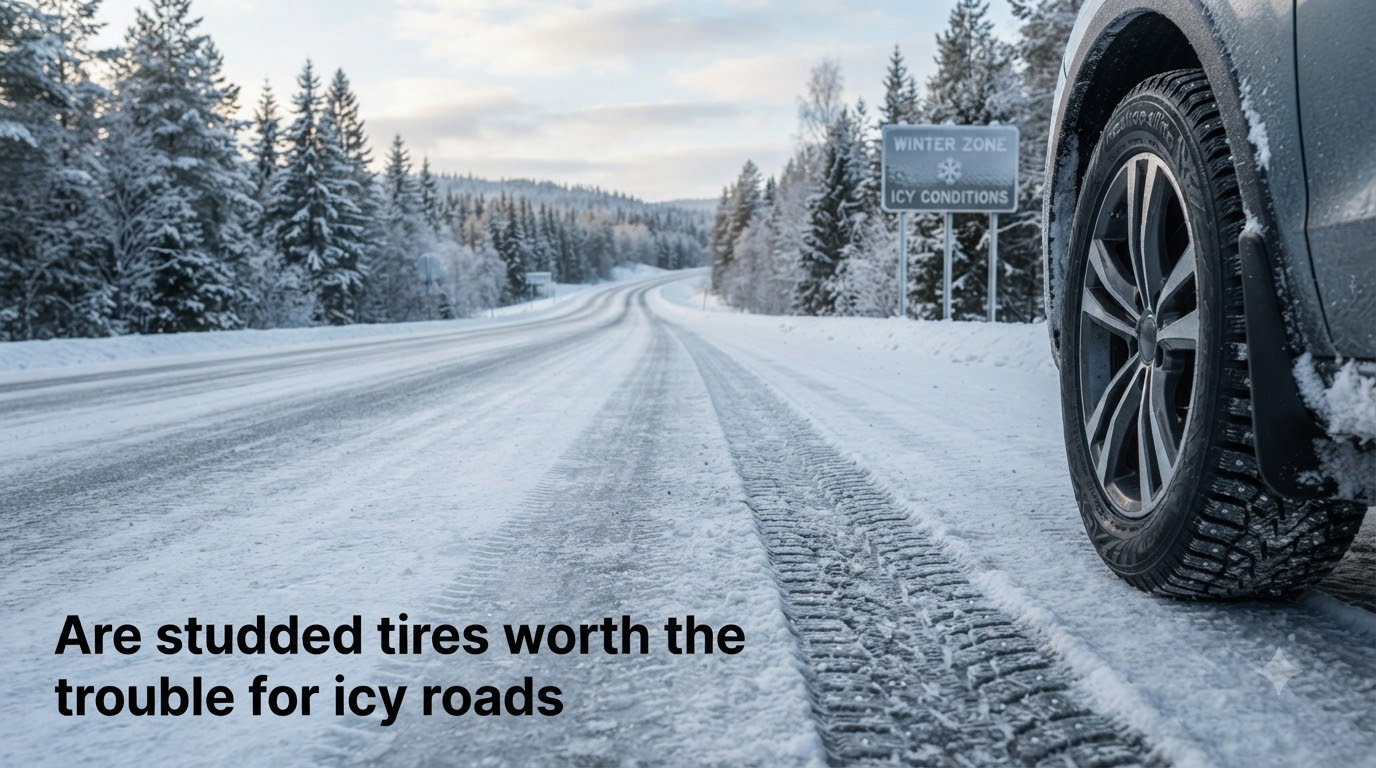
Studded tires are winter tires fitted with tiny metal studs (usually tungsten carbide) embedded in the tread, and yes, they can be worth the trouble on icy roads in one specific scenario: when you regularly drive on untreated, packed-ice roads near the freezing point, like rural routes, mountain passes, or long consistent winter commutes. In that narrow sweet spot, studded tires can deliver 15-20% shorter braking distances than even premium studless winter tires. Outside that window (on plowed city streets, mild winters, light fluffy snow, or cold dry ice below -10°C), the trade-offs (road noise, pavement wear, stud loss, dry-road grip loss, and seasonal swap hassle) outweigh the upside. This guide walks through exactly when studded tires earn their keep and when a modern studless winter tire is the smarter call.
By the end of this article you’ll understand the physical mechanism that makes studs work, the temperature window where they actually outperform alternatives, the honest pros and cons from real owners, the legal landscape across U.S. states, and a simple decision checklist you can use before you commit to a set.
Table of Contents
How Studded Tires Actually Work on Ice
Studded tires work by using hundreds of small metal pins (most commonly tungsten carbide, a material nearly as hard as diamond) anchored into the tread blocks. Under the weight of your vehicle, each stud presses down and bites into the surface of smooth ice, creating dozens of tiny friction points per tire that the rubber alone cannot achieve.
Rubber on smooth ice is unusually slippery because ice has a thin, quasi-liquid surface layer at typical winter temperatures. Studs bypass that problem mechanically. Think of each pin as a miniature ice axe gripping the frozen surface as the tire rotates.
There’s a sweet spot where studs shine, and it isn’t “any ice.” Independent tire testing and owner reports agree on the range: studs perform best on glare ice and wet ice between roughly -2°C and 0°C (28-32°F). That’s the temperature range where ice is at its slipperiest and where rubber compounds struggle the most.
Below about -10°C (14°F), ice becomes drier and harder. Rubber compounds actually grip better on cold dry ice, and the stud’s mechanical advantage shrinks. If your region stays deep-cold all winter (think Interior Alaska, northern Manitoba), the gap between studded and premium studless narrows significantly.
Modern studded tires still rely on a winter-specific rubber compound underneath the studs. The studs do the ice work; the rubber compound handles braking on snow, slush, and cold dry pavement. A studded tire with a mediocre compound will still disappoint you in snow, so the tread design matters just as much as the studs.
The “temperature window” most competitors skip
Most articles treat “ice” as one category, but ice performance changes dramatically with temperature. Nokian, Continental, and Michelin all publish internal test data showing studded tires pulling ahead on smooth ice most clearly between 0°C and -5°C. Above 0°C the ice melts into wet slush (where studless tires with deep grooves are often better), and below -10°C the rubber compound gains enough grip on its own that the studs offer diminishing returns. If your local ice tends to form during shoulder-of-winter thaws, studs will feel like magic. If your local ice forms in deep January cold, the difference will feel smaller than the marketing implies.
When Studded Tires Are Worth It
Studded tires earn their keep in a specific cluster of conditions. If your driving matches three or more of the scenarios below, studs will probably pay for themselves.
You commute on rural or mountain roads that aren’t well-treated with salt. Back-road commutes through forest service roads, ranch land, or unincorporated county roads rarely get the same brine and salt treatment that city arterials do. Packed ice forms and stays for weeks. Studs make a measurable difference on these surfaces.
You drive through long consistent winters with persistent ice cover. Northern Plains states, the Mountain West, upstate New York, Vermont, New Hampshire, and most of Canada see ice that lingers from November through March. Studs help most when ice is the dominant surface, not an occasional event.
You park on icy lots or drive steep, untreated driveways. Ski resort parking lots, rural driveways, boat ramps, and shaded cul-de-sacs hold ice long after the main roads are clear. r/Bend (Oregon) owners consistently praise studs specifically for the ski-lot scenario, even when they admit studs are overkill for their daily city commute.
You drive mountain passes and elevation changes regularly. Temperature swings on mountain routes mean melt-and-refreeze cycles that produce polished ice. Studs handle glare ice better than any other technology currently sold to consumers.
You prioritize the safety margin in genuine emergencies. Test data and r/vermont owner reports both describe studded tires as a “night and day difference” on back roads that aren’t treated. The 15-20% shorter braking distance near 0°C translates to roughly 1-2 car lengths at highway speed. That’s not hype, it’s measurable.
You can legally run them where you live. Several states restrict or ban studded tires entirely (covered in detail below). If studs aren’t legal where you drive, the rest of this list doesn’t matter.
When Studded Tires Are NOT Worth It
Studded tires are a poor investment for a different cluster of drivers. If your situation matches the list below, modern studless winter tires will probably serve you better.
You mostly drive plowed and salted city streets. Plowed arterials get black pavement within hours of a storm in most urban areas. Studs have nothing to bite into. You’ll pay for the noise, road wear, and reduced dry grip with zero upside on your actual commute.
Your winters are mild with only a handful of snow days. If you see four or five snowfalls a winter and ice is rare, premium all-season tires with the 3PMSF (mountain snowflake) symbol will get you through 95% of conditions without the swap-and-storage headache.
Your snow is light, dry, and fluffy. Studs are an ice technology, not a snow technology. In light fluffy snow (think mountain powder or prairie fluff), modern studless winter tires with aggressive siping actually outperform studded tires because the rubber compound can flex and grip the snow crystals.
You live in a state that bans or heavily restricts studs. Some states prohibit studded tires entirely, and others limit them to specific months. Driving on studs where they’re illegal can mean a ticket, so the equipment choice gets made for you.
You drive long highway stretches on bare pavement. Studs chew up tread on dry asphalt and wear out faster than studless tires in mixed conditions. If 80% of your winter miles are highway on bare pavement, you’ll wear a set of studded tires out in two seasons or less.
You can’t tolerate road noise. Studs produce an audible hum on bare pavement starting around 30 mph. r/Calgary commuters describe it as an “annoying hum” that’s tolerable but noticeable. If you have a quiet cabin and a long highway commute, the noise will wear on you.
Studded vs Studless vs All-Season vs Chains: A Real Comparison
Most studded-vs-studless articles compare only two options, which leaves drivers in the wrong region or with the wrong use case without a useful answer. Here’s how the four main options stack up against each other.
| Factor | Studded Winter | Studless Winter | All-Season (3PMSF) | Tire Chains |
|---|---|---|---|---|
| Ice traction (near 0°C) | Best | Very Good | Fair | Best (extreme) |
| Ice traction (below -10°C) | Good | Good | Fair | Excellent |
| Snow traction | Good | Best | Fair | Best |
| Dry road grip | Reduced | Fair | Best | Poor (must remove) |
| Road noise | Noticeable hum | Quiet | Quiet | Loud (temporary) |
| Pavement wear | Moderate damage | Minimal | None | Moderate damage |
| Legal (most of U.S.) | Restricted | Yes | Yes | Yes (emergency use) |
| Annual effort | Two swaps + storage | Two swaps + storage | None | On/off each storm |
| Best for | Persistent ice, rural | Snow + occasional ice | Mild winters | Occasional emergencies |
Notice that modern studless winter tires have closed the gap considerably. r/tires technicians report that premium studless options like the Nokian Hakkapeliitta R5, Continental VikingContact 7, Michelin X-Ice Snow, and Bridgestone Blizzak test within 5-10% of studded performance on most real-world ice. The stud advantage is real but smaller than it was a generation ago.
Tire chains are a different category entirely. They’re the absolute best grip you can buy, but you have to install and remove them every time you encounter ice. For most daily drivers that’s not realistic. Chains make sense for a truck that occasionally crosses a mountain pass, not for a commuter in a sedan.
The Downsides of Studded Tires
Here’s where the studded-tire story gets honest. There are real costs to running studs, and pretending otherwise wastes your money.
Road noise. Studs produce an audible hum on bare pavement above roughly 30 mph. r/Calgary owners describe it as a constant companion that doesn’t go away. Quieter cabin? You’ll notice it more, not less.
Pavement damage. Tungsten carbide studs physically abrade asphalt, and the wear accumulates. State DOTs in non-mountain regions cite road damage as a primary reason for restricting or banning studs. Studies commissioned by Pacific Northwest states estimate stud damage adds meaningfully to annual repaving budgets.
Stud loss and vibration. This is the one competitors skip entirely and Reddit owners complain about constantly. Studded tires lose studs. A typical owner report on r/Calgary or r/tires describes losing 10-30 studs per tire over the life of the set. Once enough studs are missing, the tire develops a vibration that won’t balance out. Premium studded tires hold studs better than cheap ones, but no studded tire is immune.
Shorter tread life on dry roads. Studs chew up rubber on bare pavement. A studded tire that lasts four winters in pure ice conditions might last two winters in mixed highway driving. You’re paying for a wear item that disappears faster the more you drive on cleared roads.
Environmental particulate matter. Stud wear adds fine metal and rubber particles to road runoff. Tires-Easy is one of the few outlets that quantifies this; the cumulative particulate load from studded tires in a metro area is small compared to general vehicle emissions but measurable, and it’s the reason several states have tightened stud rules over the past decade.
Two seasonal swaps per year. Most studded-tire owners run studs only in winter and switch back to all-season tires the rest of the year. That’s two mount-and-balance appointments per year, plus storage if you don’t have space. Mounting and balancing twice a year is a recurring cost and a recurring inconvenience.
Storage hassle. Four tires and wheels take up real space. If you’re an apartment dweller, you’re paying for off-site tire storage or juggling them in a corner of the garage.
Studded Tire Laws and Where They’re Legal
Studded tire legality is state-dependent and can change year to year, so always confirm with your state DOT before you buy. Here’s the broad landscape as of 2026.
States that generally ban studded tires for passenger vehicles. Several states restrict or prohibit studded tires on standard passenger vehicles, including (but not limited to) some southern and mid-Atlantic states. Check your specific state.
States that allow studs with seasonal restrictions. Many northern and mountain states allow studs only during a defined winter window, typically October through April or November through April. Driving on studs outside that window can mean a fine.
States that allow studs year-round on passenger vehicles. A small number of states (mostly in the Mountain West and far North) allow studs year-round.
The U.S. Tire Manufacturers Association reference. The USTMA publishes an annual summary of state-by-state stud laws. If you’re unsure about your state, that summary is the most reliable single source and links from most state DOT pages.
Canadian provinces vary too. Quebec allows studs with a seasonal window. Alberta and British Columbia allow them. Ontario restricts them. If you live in Canada, check your provincial rules before mounting.
The legal landscape shifts, sometimes in the direction of fewer restrictions (Mountain West adding winter travel) and sometimes in the direction of more restrictions (some Northeast states tightening dates as pavement-wear concerns grow). What’s true in 2026 may be different in 2026+2, so re-check before each winter season.
Cost and Lifespan: How Many Winters Will Studded Tires Last?
Studded tires typically last 2-4 winters, depending heavily on how you drive them. Pure ice and packed snow is gentle on the tread (studs do most of the work, and the rubber doesn’t flex much). Dry pavement miles eat the tread quickly.
The tire itself is only part of the total cost. Add two seasonal mount-and-balance appointments per year, plus storage if you need it, plus the cost of a second set of wheels (you can mount studded tires on a separate wheel set so swaps take minutes instead of an hour). When you total it, the real question isn’t “what do studded tires cost” but “what does running studded tires cost over five winters,” and the answer climbs faster than most people expect.
Stud loss shortens the effective life further. r/Calgary and r/tires owners commonly replace studded tires a year earlier than they’d planned because enough studs fell out to make the tires vibrate.
Studdable tires are an alternative worth considering. These come from the factory with pre-drilled stud holes (currently only a few dedicated winter patterns offer this), and you can have them studded or re-studded by a tire dealer. If a set of studs wears out before the tread does, the tire can be re-studded, which extends the useful life.
Who Should and Shouldn’t Buy Studded Tires: A Quick Decision Checklist
Answer these questions honestly. The more “yes” answers you give in the first list, the more likely studs are worth it for you.
Studs probably pay off if you can answer yes to several of these:
- Do you regularly drive on untreated rural roads, mountain passes, or shaded back routes?
- Does your region see persistent ice cover for 8+ weeks per winter?
- Are most of your winter trips at near-freezing temperatures (not deep cold)?
- Do you park or drive on steep, icy lots (ski resorts, rural driveways)?
- Is your daily round-trip under 30 miles, so stud wear stays manageable?
- Are studded tires legal where you drive?
- Can you tolerate an audible hum on bare pavement?
Modern studless winter tires are the better call if:
- You mostly drive plowed, well-salted urban streets.
- Your winters are short or mild with limited ice.
- Most of your winter precipitation is light, fluffy snow.
- Studs are illegal in your state or province.
- You have a long highway commute on bare pavement.
- You want a quiet cabin and minimal hassle.
The 7/7 rule for winter tires. The widely cited “7/7 rule” says you should have winter tires (studded or studless) on your car once temperatures consistently drop below 7°C (about 45°F), and you can switch back to all-season tires once they’re consistently above 7°C. Summer compounds in all-season tires start losing grip below that threshold even on dry roads, so the 7/7 rule is more about winter tire timing than about studded tires specifically.
The simplest decision framework. If ice is your primary winter problem and you can legally run studs, get them. If snow is your primary winter problem, modern studless is usually the better answer. If your roads are mostly plowed and salted within hours of a storm, skip both and run a 3PMSF all-season.
Frequently Asked Questions
Do studded tires work well on ice?
Yes, studded tires work well on ice, especially smooth and glare ice near the freezing point (around 0°C / 32°F). In that temperature window, studs can deliver 15-20% shorter braking distances than even premium studless winter tires. Below about -10°C the advantage shrinks because cold dry ice gives rubber compounds more grip on their own.
What are the downsides of studded tires?
The main downsides of studded tires are road noise (an audible hum on bare pavement above 30 mph), pavement wear, stud loss over time, shorter tread life on dry roads, environmental particulate matter from stud wear, two seasonal swaps per year, and storage cost. Several U.S. states also restrict or ban studded tires during part of the year.
How many winters will studded tires last?
Studded tires typically last 2-4 winters depending on driving conditions. Pure ice and packed snow are gentle on the tread, while dry pavement miles wear them out faster. Stud loss can shorten the effective life further; many owners on r/Calgary and r/tires report replacing studded tires earlier than planned because missing studs cause vibration.
What states have banned studded tires?
Several U.S. states restrict or ban studded tires for passenger vehicles, especially in the South and mid-Atlantic. Many northern and mountain states allow studs only during a defined seasonal window (typically October through April). A smaller group of states in the Mountain West and far North allow studs year-round. Always check your state DOT or the U.S. Tire Manufacturers Association summary for current rules.
How much better are studded tires on ice?
On smooth ice near 0°C, studded tires typically deliver about 15-20% shorter braking distances than premium studless winter tires. That works out to roughly 1-2 car lengths at highway speed. The advantage is largest near freezing and shrinks as temperatures drop below -10°C or when the surface is textured rather than glassy.
What is the 7/7 rule for winter tires?
The 7/7 rule says you should switch to winter tires once temperatures consistently fall below 7°C (about 45°F) and switch back to all-season tires once they’re consistently above 7°C. The rule is about winter tire timing in general, not specifically about studded tires; below that threshold, summer compounds in all-season tires lose grip even on dry roads.
Final Verdict: Are Studded Tires Worth the Trouble on Icy Roads?
Studded tires are worth the trouble on icy roads, but only for a specific kind of driver. If you regularly commute on untreated rural roads or mountain passes, deal with persistent ice near the freezing point, and can legally run studs in your state, the 15-20% braking-distance advantage on glare ice is real and meaningful, and no current technology beats it. If your winters are mostly plowed city streets, mild temperatures, or light fluffy snow, modern studless winter tires will serve you better with less hassle, less noise, and no road-damage guilt.
The honest answer is that studs are a specialty tool, not a default upgrade. For the right driver, they’re indispensable. For everyone else, premium studless winter tires have closed the gap far enough that the trade-offs rarely make sense.
Before you buy, check your state DOT for current stud laws, measure how many of your winter miles are actually on ice, and be honest about whether you’ll tolerate the hum. That decision tree will get you to the right answer faster than any marketing claim.